Struggling Patrick Peterson and Cardinals Secondary Face Toughest Test Yet
The Arizona Cardinals have lost only one game this season. They’re undefeated at home, and they’ve won their only division game.
Remarkably, three of their five wins (including that divisional win over the San Francisco 49ers) have come with backup quarterback Drew Stanton starting, and third-stringer Logan Thomas has even made an appearance.
All is well in the desert, except when an opposing offense calls a forward pass of any kind.
TOP NEWS
.jpg?w=2560 "NFL Paris Football")
NFL House in Paris Closes for Protests
.jpg?w=2560 "Seahawks Chiefs Football")
Trevon Diggs Cut by Seahawks
.jpg?w=2560)
B/R's Expert Week 7 NFL Picks 🔮
The Cardinals defense is ranked 31st against the pass, giving up an average of 284.8 yards per game and 7.8 per attempt. That’s a steep tumble from a year ago when it was allowing 233.0 passing yards per game and a meager 6.5 per attempt.
So hey there, head coach Bruce Arians, what's up with that?
A lack of pass-rushing pressure isn’t helping matters in the defensive backfield. The Cardinals have been absolutely gutted by injuries to a front seven that recorded 47 sacks in 2013 (tied for sixth).
Most notably, John Abraham (11.5 sacks last year to lead the team) suffered a concussion and was then forced to retire, Darnell Dockett (4.5 sacks in 2013) tore his ACL and Calais Campbell (9.5 sacks) has missed two games with a knee injury.
But for Arians, explaining the quick statistical slide of his secondary is even simpler than pointing to the vanishing sacks since last season. During a press conference earlier this week (via ESPN.com) Arians was asked how his team has managed to be nearly dead last defensively against the pass but first against the run.
He needed seven words for his answer.
"They can't run. They're going to throw.”
Offense is Arians' default mindset because it’s so ingrained in his mental muscle memory after being a coordinator on that side of the ball for many years. Here his thoughts returned to fundamental football. He processed the original question by essentially asking himself another one: If I was the other guy, how would I beat us?
Passing and then more passing is the answer, because running certainly isn’t. The Cardinals are indeed ranked first against the run while allowing only 72.5 yards on the ground per game and a mere 3.2 per carry.
| Yds/game | Yds/carry | Touchdowns | |
| 2013 | 84.4 (1st) | 3.7 (2nd) | 4 (T3rd) |
| 2014 | 72.5 (1st) | 3.2 (T1st) | 4 (T10th) |
Those are some glistening numbers over the Cardinals’ past 22 regular-season games.
But surface digits don’t show that two significant pieces of last year’s run stuffing are gone through a free-agency departure and a suspension. When the Cardinals lost middle linebackers Karlos Dansby and Daryl Washington a regression against the run was assumed. Instead impressive depth has been showcased, with second-year linebacker Kevin Minter sliding in just fine alongside veteran Larry Foote.
So yes, Arians is correct, and the man may know his football. Why would an opposing offense repeatedly attempt to find running lanes where none exist? That strategy is doomed, so quickly it turns to the air.
But let’s look at another comparison between this season and 2013. Here’s how opposing offenses have approached the Cardinals during back-to-back seasons when gaining anything of significance on the ground rarely happened.
| Rush attempts | Pass attempts | |
| 2013 | 370 (second fewest) | 625 (third highest) |
| 2014 | 138 (second fewest) | 225 |
That's a chasm between the run and pass attempts faced in both seasons, and the final 2014 numbers look similar when projected over 16 games (368 rush attempts and 600 pass attempts).
But while a higher volume of opposing pass attempts clearly puts more stress on a secondary, a defensive regression this glaring can’t be shrugged away quite so easily. Is the secondary struggling due to the lethal combination of nearly zero pressure (only seven sacks) and having to defend many sailing footballs?
Pressure and a lack of it is the dollar-store umbrella hanging over all of this. It's the sort of purchase made during a time of dire need, and soon after it’s discovered the umbrella smells like urine for some reason and has nine holes.
The best secondaries in the league during any season (think Seattle Seahawks last year and their menacing pass rush that’s also disappeared now) lean heavily on pressure up front. When defensive backs know a quarterback doesn’t have much time they can cheat in coverage. That leads to interceptions and great field position.
But let’s look deeper, ending the excuse-making and shrugging. The small mountain of pass attempts the Cardinals have faced is a concern. But that was also a reality last year, and they allowed 51 fewer passing yards per game.
The problem right now is a core one with a core player.
Patrick Peterson was just given a contract worth $70 million, $47.4 million of which is guaranteed. Being the highest-paid cornerback in the league comes with certain expectations. Like, say, actually being the best at his position.
So far in 2014 something odd has happened with Peterson: He’s looked painfully normal.
In coverage Peterson has allowed an opposing passer rating of 124.9 when targeted, according to Pro Football Focus (subscription required). That ranks 62nd among the 68 cornerbacks who have appeared on the field for at least 50 percent of their team’s defensive snaps.
"Patrick Peterson needs to give some of that money back...
— Cian O'Fathaigh (@Cianaf) October 22, 2014"
Brace for some ugliness because it gets worse.
After six games Peterson has already allowed four touchdowns, and he’s been called for eight penalties, again per PFF. That's only one behind a group of cornerbacks who have given up five touchdowns. Usually Peterson isn’t remotely close to anyone named Antoine Cason, Buster Skrine or Robert Alford in any category that matters, but here we are.
Peterson has been burned at his own game: speed. He needed only 4.34 seconds to run 40 yards at the 2011 scouting combine. Toss in usually textbook footwork and terrific anticipation, and you’re left with a cornerback who has 43 passes defensed over 54 career games.
But this season Peterson’s typically pristine technique has been lacking, which was particularly evident on the 64-yard touchdown he allowed to Washington Redskins wide receiver DeSean Jackson in Week 6.
On the first play of the second quarter Kirk Cousins was sacked, with Cardinals linebacker Alex Okafor bringing down the quarterback for a loss of 10 yards. That set up a passing situation on second down, and the Redskins spread the field from a shotgun formation with three receivers to Cousins’ right and one to his left.
Jackson was in the far slot with Peterson playing him tight.
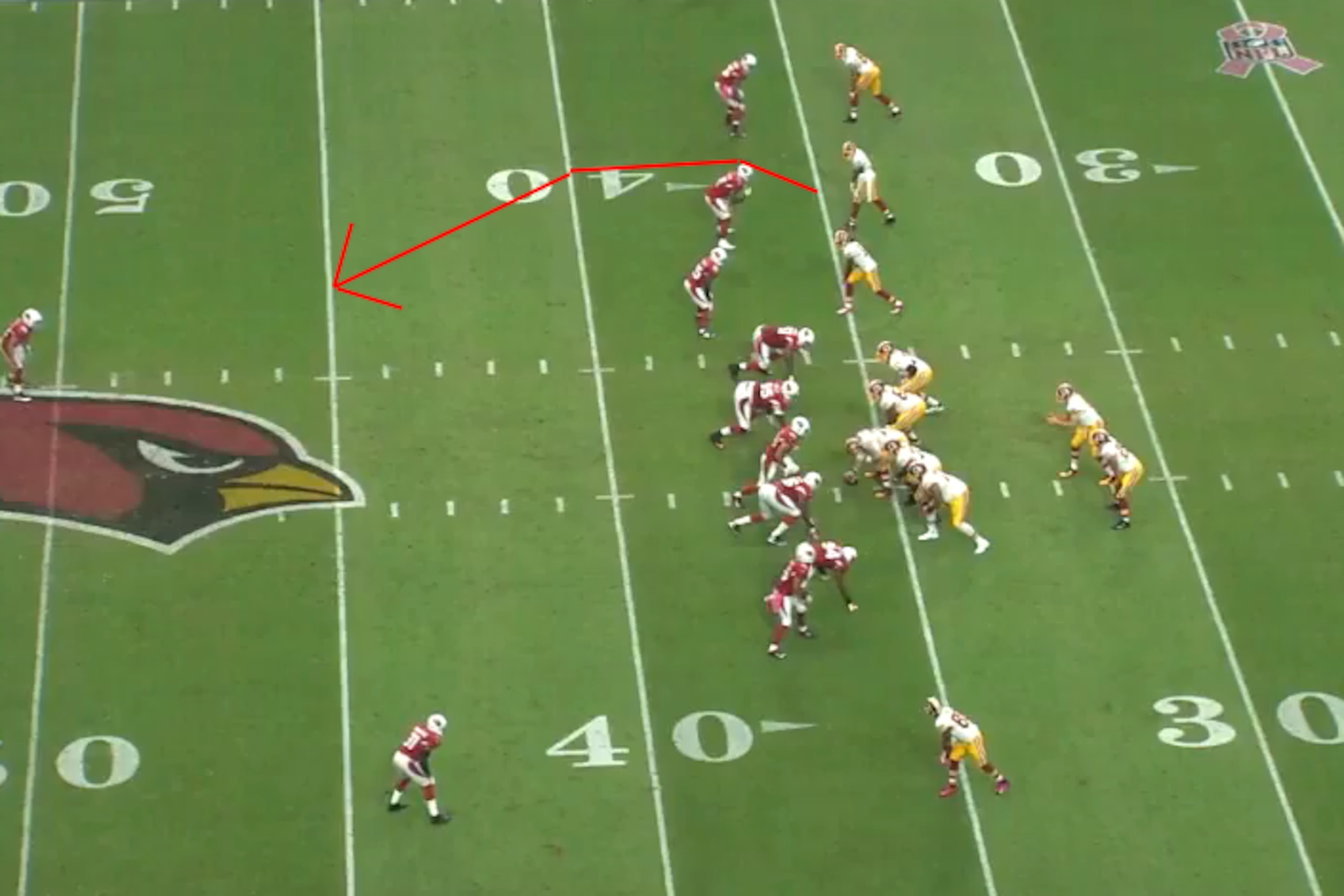
Jackson looked to get the ball in full stride up the middle after running a slant. Short of taking one deep, the ideal outcome in this situation was Jackson gaining a decent chunk and getting close to the original line of scrimmage. That would have left the Redskins with a more manageable third-down situation.
Peterson’s assignment was to prevent that exact outcome. He couldn’t get beat on the inside. Later, while speaking to The Arizona Republic's Kent Somers, Arians was critical of his top cornerback on this play because, well, he was beat on the inside. Badly.
"He got beat on an inside route where he was supposed to have inside technique,” Arians said. “Can't happen. It was not his best game."
The coverage was designed to give Petersen help with Jackson on the outside. That’s where the Cardinals were challenging Cousins, saying, “Hey kid, if you can put a ball in this space between the league’s best cornerback with a safety closing in, we’ll giving you a cookie.”
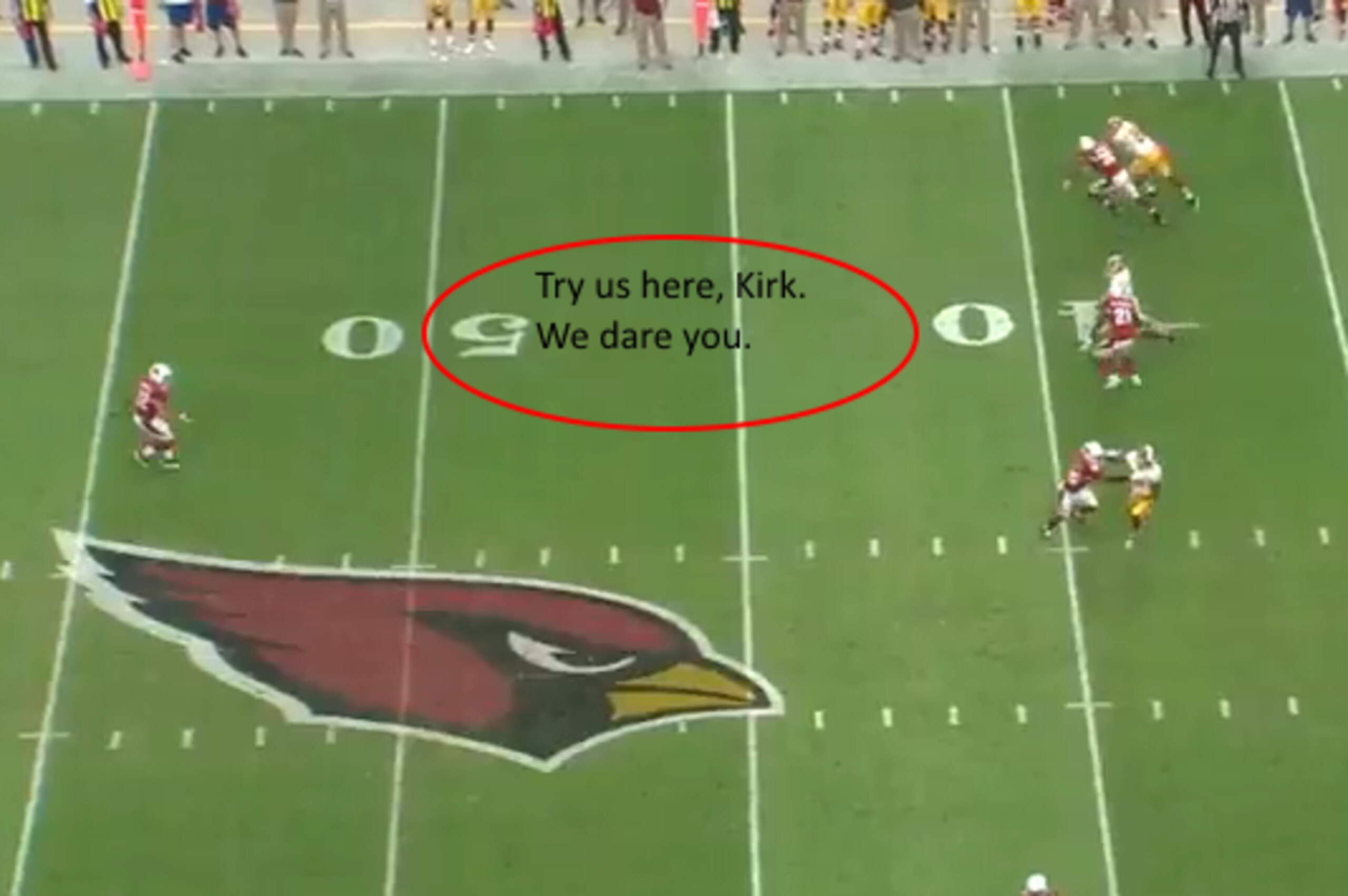
Safety Tyrann Mathieu has plenty of speed too but not nearly enough to turn and make a play on Jackson after he was dropping back in the other direction.
A completion to the middle of the field was game over. And yet there was Peterson, letting Jackson gain a half step on him and access to the inside. The rest was just a matter of running.
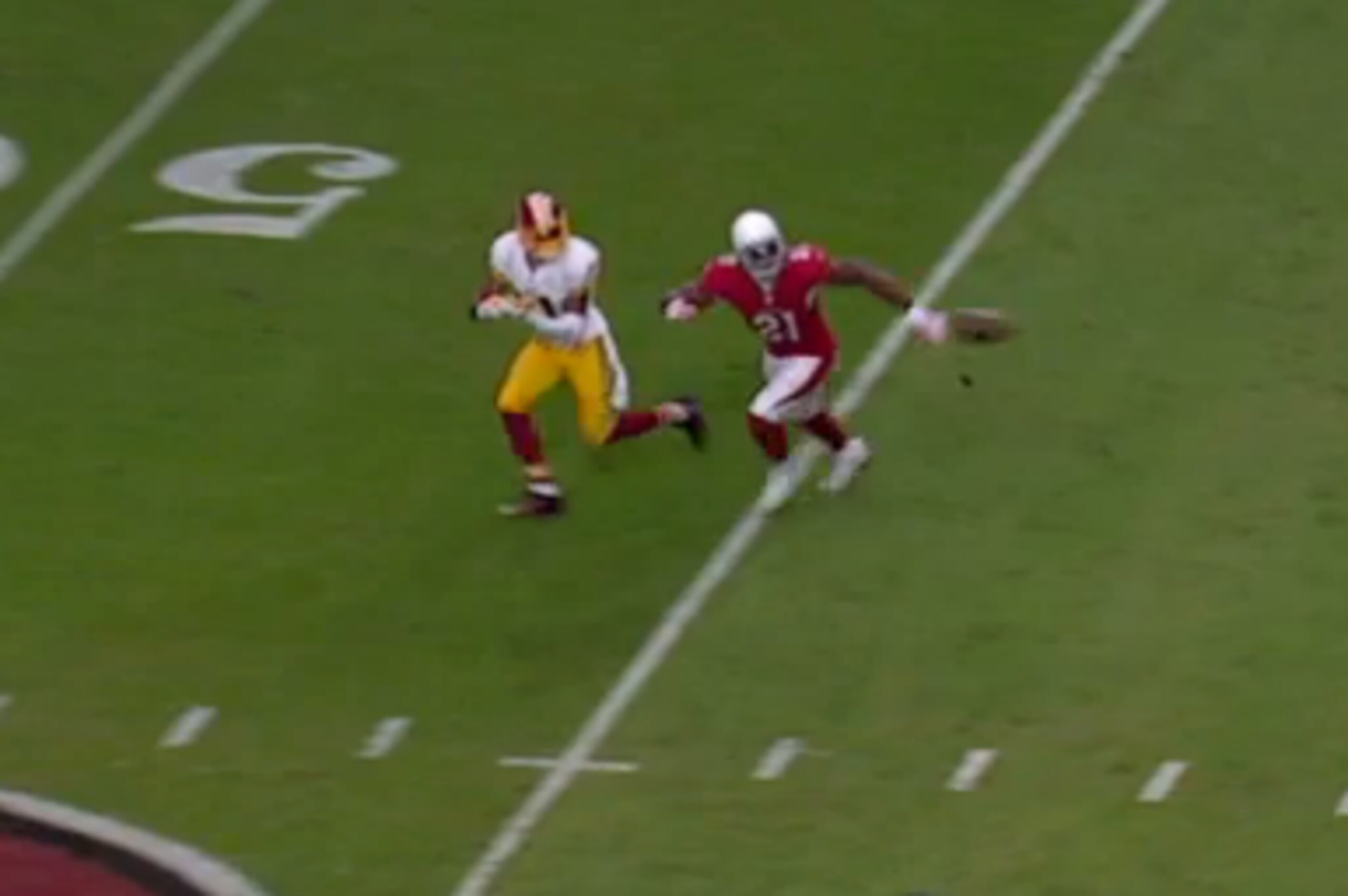
A half step has always been all a blazing receiver like Jackson needs. And usually Peterson gives up few steps, half or otherwise.
With his established history it’s easier to have faith in a quick Peterson turnaround despite struggles against the likes of Jackson and Denver Broncos wide receiver Emmanuel Sanders (seven receptions for 101 yards in Week 5). However, given a different kind of history—the recent kind—it’s difficult to trust cornerback Antonio Cromartie on the other side.
Cromartie’s struggles aren’t nearly on the same level as Peterson’s, but there’s still reason for concern. He was absolutely torched by Broncos wide receiver Demaryius Thomas in Week 5, giving up a whopping 221 yards in coverage, according to PFF.
Against another premier wide receiver a Cardinals cornerback was burned, with Broncos quarterback Peyton Manning quickly seeing where he could inflict the most pain.
"Antonio Cromartie was thrown at 15 times vs Denver. That's 5 more than he had been in three games heading into that encounter.
— Pro Football Focus (@PFF) October 7, 2014"
If we exclude that game Cromartie has largely been the shutdown presence lacking from Peterson. In four of the Cardinals’ six games he’s allowed less than 15 receiving yards, and over the first three weeks he coughed up a grand total of only 30 yards (all from PFF).
But if the Cardinals want to remain atop the NFC West their secondary is faced with an awful reality. It can’t get bombarded by the league’s best passing offenses.
It simply can’t happen, even with the high volume of passes from opponents and the lack of support up front in the form of pressure (which should improve if Calais Campbell returns for Week 8).
At 5-1 the Cardinals are among the league’s four one-loss teams, and the true test for their secondary is coming now. This Sunday Arizona hosts the Philadelphia Eagles and then in Week 9 a trip to Dallas awaits, two teams also with only a single blemish. The Eagles are currently averaging 262.3 passing yards per game (seventh), while the Cowboys are averaging 8.4 yards per pass attempt (tied for third).
Over the next two weeks we’ll find out just how far the Cardinals secondary can fall or if a quick rebound is coming.
.jpg?w=2560 "Titans Colts Football")