How the New York Giants Offensive Line Went from Liability to Asset in Two Weeks
Quarterback Eli Manning has become more comfortable, more accurate, more poised. The running game has taken off in a major way. Even the much-maligned, depleted defense has tightened up with only 31 points allowed in Weeks 3 and 4.
But the primary explanation for how the New York Giants' season has taken a 180-degree turn the last two weeks has to be the offensive line.
With veteran interior linemen Kevin Boothe, Chris Snee and David Baas gone, the Giants have been sending out somewhat of a patchwork line on a weekly basis, putting extra pressure on tackles Will Beatty (who has been eased back after offseason leg surgery) and Justin Pugh (who just 17 months ago was a student at Syracuse).

.jpg?w=2560 "Commanders Eagles Football")

With castoffs John Jerry and J.D. Walton forced into starting roles at right guard and center, and with rookie second-round pick Weston Richburg basically starting by default at left guard, this was expected to be another disastrous season for the line, and by extension the rest of the offense.
Two weeks in, it appeared as though that would absolutely be the case. But offensive line coach Pat Flaherty must have found some magic football dust, because everything changed in Week 3.
| Weeks 1 and 2 | 18 |
| Weeks 3 and 4 | 8 |
Just like that, Pro Football Focus (subscription required) has the Giants line ranked fourth in football in terms of pass-blocking efficiency. They've given up just 26 pressures in total, which is the seventh-lowest mark in the NFL.
Beatty is PFF's highest-rated left tackle, Pugh is their third-ranked right tackle. Jerry also has a positive grade at guard. Even Walton and Richburg—clearly the weakest links—have completely turned it around the last two weeks.
| LT Will Beatty | 2.7 | 7.4 |
| LG Weston Richburg | -6.1 | 4.7 |
| C J.D. Walton | -3.8 | 1.5 |
| RG John Jerry | -1.7 | 3.2 |
| RT Justin Pugh | 2.2 | 2.9 |
| Overall | -6.7 | 19.7 |
Bear in mind they've faced four solid defensive fronts. It's not as though the early schedule was tough and then they had soft defensive opponents in Weeks 3 and 4. Their first two foes—Detroit and Arizona—have very stout front sevens, but their most recent two opponents—Houston and Washington—are probably better.
The Lions still ranked 28th in the NFL with only 33 sacks last year and their only star up front is Ndamukong Suh. The Cardinals lost Karlos Dansby in the offseason and are without Pro Bowl defenders Darnell Dockett (injury) and Daryl Washington (suspension).
Meanwhile, the Texans have without a doubt the league's best defensive lineman in J.J. Watt, and Washington's stacked front seven—led by Pro Bowlers Brian Orakpo, Ryan Kerrigan and Jason Hatcher—has given up just 3.3 yards per rushing attempt this season.
So how have things changed so dramatically? It helps, of course, that Manning and his receivers finally appear to be on the same page as they grasp new offensive coordinator Ben McAdoo's West Coast-oriented offense.
| Weeks 1 and 2 | 2.35 seconds |
| Weeks 3 and 4 | 2.03 seconds |
Manning is getting the ball out considerably faster, and the success they've had in the passing game has certainly helped open things up for running back Rashad Jennings, who had a career-high 176 yards against the Texans and now ranks third in the league in rushing.
Look, Manning has the experience and intuition to be able to detect pressure and navigate the pocket in order to buy time. The problem during the first couple weeks is that there were so many moments in which the pass protection collapsed in multiple spots at the same time.
One such example: Detroit brings an extra rusher on a blitz to the strong side.

Normally, Manning would roll to his right and go through his reads on that side of the field. But Pugh was beat so badly by Lions defensive end George Johnson that Manning stood no chance.
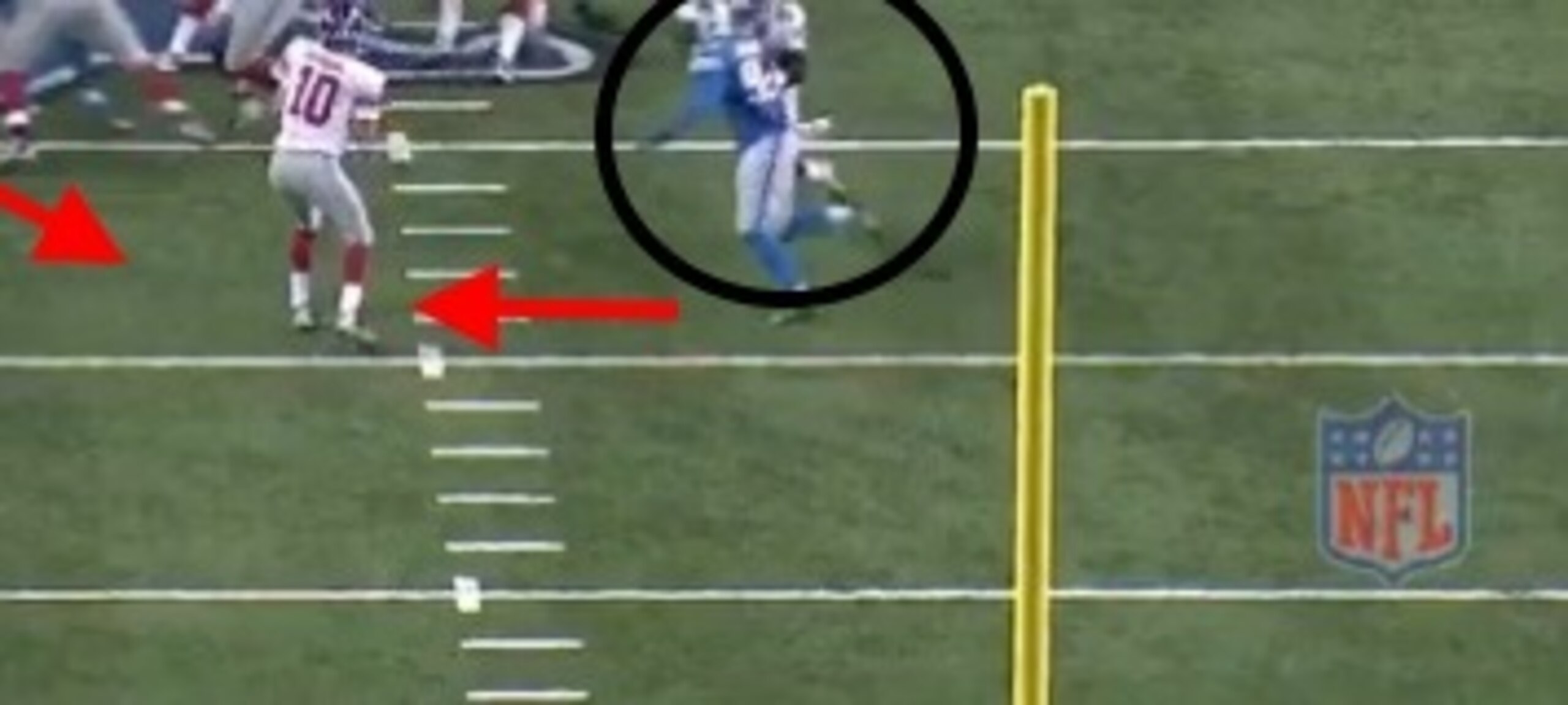
Let's keep in mind that this five-man line came together late. The original plan was for free-agent pickup Geoff Schwartz to play a major role, but he's on the short-term injured reserve with an ankle injury. This edition of the line didn't start together until the final game of the preseason.
We always hear about how important continuity and chemistry are when it comes to line play. They have to work together as a unit, not as five individual cogs. And early on this season, it was often apparent they hadn't developed that cohesion just yet. They didn't have a feel for how quickly they could break off of blocks in order to shift to nearby rushers.
An example from the same quarter against Detroit: Beatty is ready to give help to the rookie Richburg in the case that Lions linebacker DeAndre Levy blitzes.

Since tight end Larry Donnell is running a route as a receiver, a blitz from Levy would have alerted Manning that Johnson would have a clear path to him as a rusher on the blind side. As a result, Manning would have been able to find his hot read.
But instead, Beatty spends an inordinate amount of time assisting Richburg with a lone rusher and is late getting over to pick up Johnson, who forces Manning to scramble right and throw an inaccurate pass toward wide receiver Victor Cruz.

Nobody had a feel for one another. The entire offense wasn't on the same page, especially the blockers. And when you don't have your pass protection in line, defenses begin to cheat. The Lions were able to press against the run, leaving disorganized messes in front of Jennings and his rookie backup, Andre Williams.
An example of that from the fourth quarter against Detroit: Richburg pulls right to lead the way for Williams on a run that it appears is supposed to hit the six hole between the right tackle (Pugh) and the tight end (Donnell).
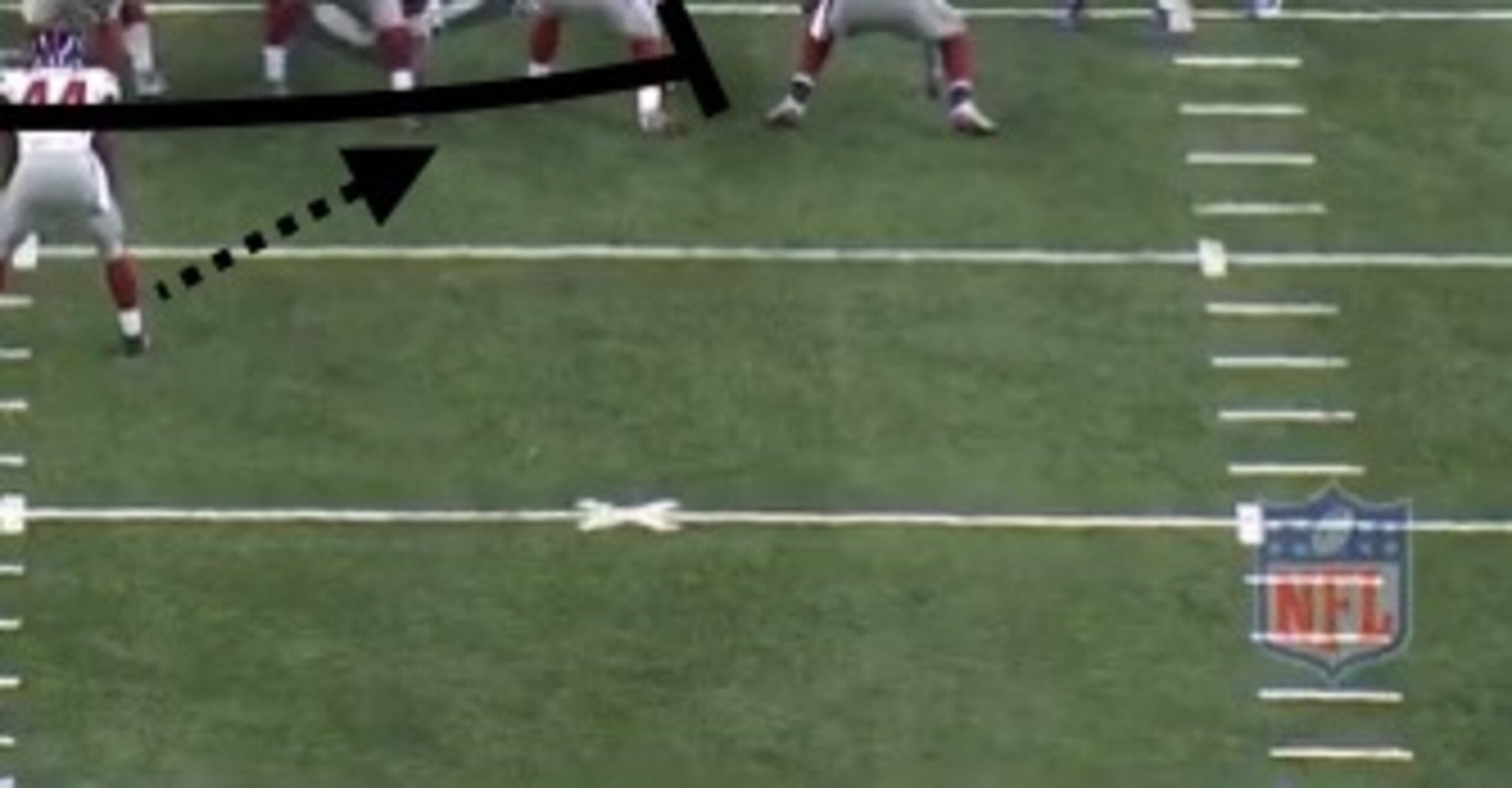
But the Lions crash the backfield without hesitation and Richburg and Pugh quite literally trip each other up, giving Williams nowhere to go at the outset of the run. He'd merely get back to the line of scrimmage.

But fast forward three weeks and it seems everything has finally clicked. You can see the cohesion.
Here's Washington sending a fifth rusher, just as Detroit did in the example above. And once again, Donnell is running a pass route beyond the edge-rusher on the strong side, Brian Orakpo.

But this time, after quickly monitoring the interior protection from Richburg and Co., Beatty is way quicker adjusting in order to pick up Orakpo on the edge.

Manning hasn't seen pockets this clean in years.


And you can see real holes for the running backs.

They're locating their blocks faster in space, pulling without tripping over one another and trusting each other both in protection and while run blocking.
What's scary is there's little reason to believe this line won't continue to improve. They've still only been together one month, and Manning should keep making things easier on them, especially when he gets rookie first-round pick Odell Beckham into the fray at receiver.
On top of all that, they've already been challenged by some of the best defensive fronts in football. They'll get some breaks in the coming weeks against the likes of Atlanta, Philadelphia, Dallas and Indianapolis, none of whom pose the same threat the Texans or Redskins did. So now they have a chance to build that confidence up high.
If they can stay on this path, there's little reason to believe this offense can't keep scoring at its current pace. And if that happens, the Giants have a real chance to defy the preseason odds by winning the NFC East.
Brad Gagnon has covered the NFC East for Bleacher Report since 2012.
.jpg?w=2560 "Chiefs Dolphins Football")
.jpg?w=2560 "Cardinals Giants Football")