
New York Jets 2014 Virtual Program: Depth Chart Analysis, X-Factors and More
The season of waiting and overanalysis is finally over. Real, live professional football is finally among us.
After a long, winding offseason that took many predictable and even more unforeseen twists and turns, the New York Jets are about to find out whether or not general manager John Idzik was able to piece together a winning team for 2014.
An influx of draft picks and newfound cap room allowed for Idzik to make some much-needed improvements, but his relatively cheap, high-volume approach to rounding out his roster have left many unconvinced as to whether or not the Jets are set up to contend just yet.
All eyes will be on quarterback Geno Smith as he tries to secure his position as the Jets' franchise player.
On the defensive side, the secondary is garnering even more headlines as of late—but for all the wrong reasons. A deficit of talent and a surplus of off-field incidents leave the Jets with one of the worst secondaries in the game—poor enough to possibly leave them out of a playoff spot if their young talent cannot make rapid improvements in their play.
Here is a full program for the 2014 Jets season, breaking down every position from head to toe after roster cuts were made. This will also take a look at some X-factors, important games, season award winners and more.
Quarterback
1 of 13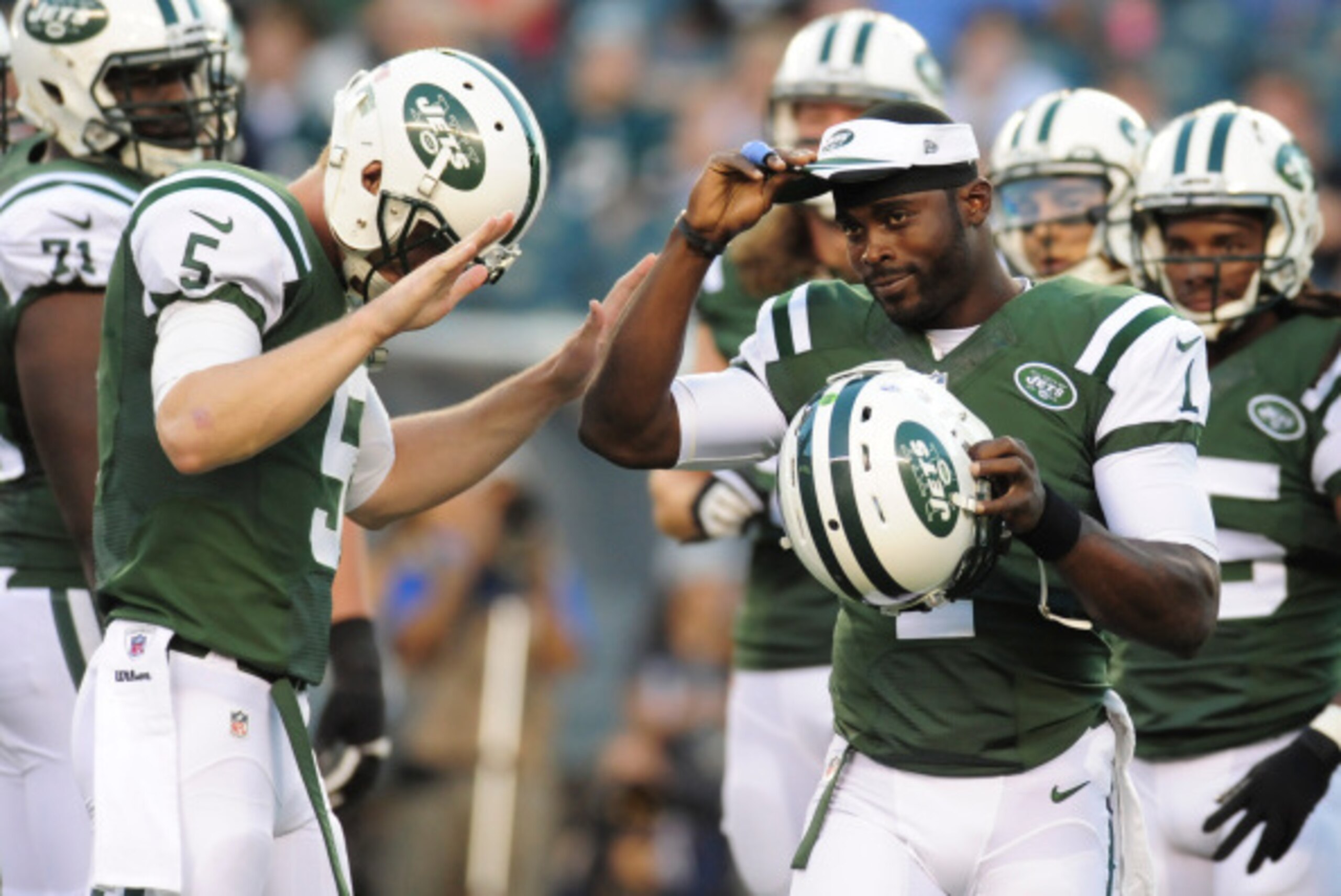
Depth Chart
- Geno Smith
- Michael Vick
Time will tell whether or not the Jets are a better team than their 2013 counterparts, but there is no doubting the fact that they will be much improved at the most important position in American sports.
If the Jets can be confident from one development this preseason, it will be the slow-by-steady improvement of sophomore quarterback Geno Smith. While he was hardly in a serious competition with Michael Vick, the improvement he has made from last season has become more evident as the preseason wore on.
After tossing 21 interceptions in 2013, Smith has only made one obvious misfire in the preseason, throwing an interception in Week 2 against the Cincinnati Bengals. He was flawless the following week against the New York Giants, earning a 120.2 quarterback rating in a half of play.
As he becomes more acclimated with his new offensive weapons, including Eric Decker, Jace Amaro and Chris Johnson, there is no reason to suggest that Smith's improvement will stagnate over the coming weeks.
The Jets are not just better at the starting position—their depth at quarterback has improved throughout. Michael Vick is essentially a $5 million premium insurance policy the team hopes it never has to tap into. Time is no longer on Vick's side as it pertains to his football career, but he is still more than a capable player who is better than several NFL starters.
For the first time in the Rex Ryan era, the Jets will enter the season with just two quarterbacks on the roster. While this does open up a roster spot for a more needy position, the Jets are rolling the dice by leaving Vick as the lone backup.
If the Jets find themselves having to rely on Vick to carry them through a game, there is no telling how long he will last under center before he ends up on the trainer's table. After all, Vick has played just one 16-game season in his career. Not having Matt Simms ready on the sidelines leaves the Jets vulnerable to a situation where they may not have a quarterback to field during a game.
Still, as long as health does not become a major issue, this new combination of Vick and Smith is a massive improvement over last year's group.
Running Back
2 of 13
Depth Chart
- Chris Ivory
- Chris Johnson
- Bilal Powell
- Tommy Bohanon
Under John Idzik's management, this position has gone from being a weak point on the roster to being one of the few strengths of the offense.
When healthy, Chris Ivory is one of the top inside runners in the league, particularly after contact. Now removed from his role as the feature back for the Tennessee Titans, Chris Johnson is a near-perfect complement to Ivory both as a change-of-pace runner and as a receiver.
Meanwhile, Bilal Powell will serve as a Swiss Army knife of the offense, filling in all of the leftover duties. Given Johnson's career workload and Ivory's spotty injury history, some extra depth is hardly a bad thing.
While the Jets have a nice blend of speed, power and everything in between, figuring out a balance of carries for their top three runners is not going to be an easy task for offensive coordinator Marty Mornhinweg. For now, Ivory figures to get the bulk of the early-down carries, but the Jets will ride the hot hand as the season wears on.
Until now, the Jets have carried five running backs (including a fullback) throughout Rex Ryan's tenure in New York. Despite having at least solid showings all preseason, both Daryl Richardson and Alex Green have been cut in an effort to preserve roster spots.
Meanwhile, there were no guarantees that Tommy Bohanon would have a second tour with the Jets as the primary fullback, but the 2013 draft pick was able to hold off rookie Chad Young to keep his job for one more season.
Despite the shrink in numbers, this unit is going to be the core component of the Jets offense.
Wide Receiver
3 of 13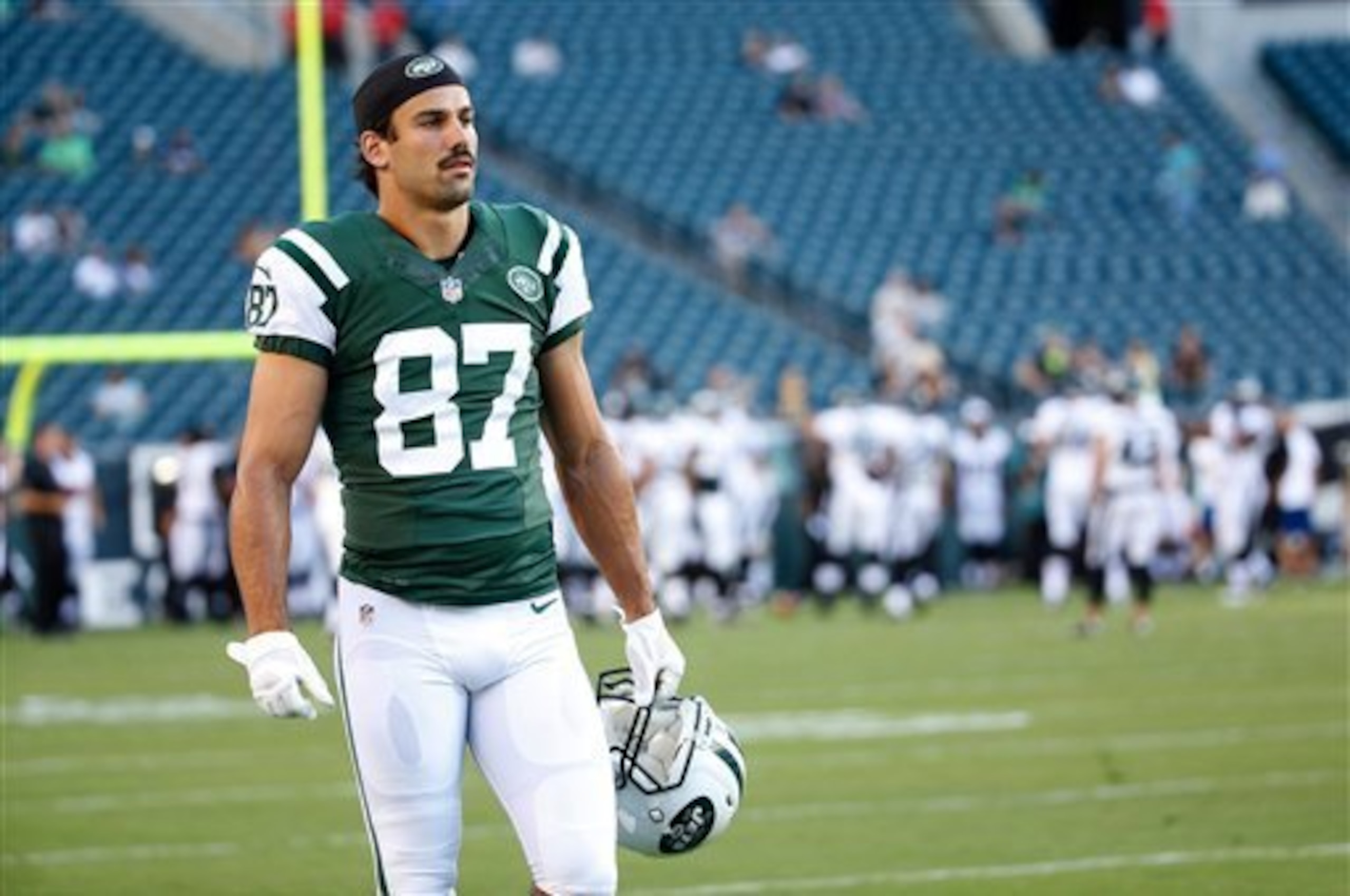
Depth Chart
- Eric Decker
- Jeremy Kerley
- David Nelson
- Greg Salas
- Jalen Saunders
- Saalim Hakim
- Walter Powell
The Jets' receiver depth chart can be divided into two parts: the established starters—Eric Decker and Jeremy Kerley—and everyone else.
One of the few "splurges" general manager John Idzik made in free agency, Decker immediately becomes the thickest blend of reliability and skill of the skill position players. He may not match his 1,288-yard production from a year ago with Peyton Manning, but he is nonetheless a talented, big-play receiver who brings a level of professionalism and standards to a receiving corps that has been anything but professional in recent years.
Jeremy Kerley will resume his role as the primary slot receiver, leaving a gaping hole at the No. 2 position on the perimeter.
As of now, David Nelson appears to be the primary No. 2 target, but Greg Salas may begin to steal some snaps away if he continues his preseason surge. The best is still to come from rookie Jalen Saunders, who sat out a good chunk of the preseason after suffering a seizure while driving to the facility.
The biggest news from final cut day was Idzik's decision to leave disappointing 2011 second-round pick Stephen Hill off the roster. On the field, Hill's "role" will be replaced by big-bodied rookie Quincy Enunwa, who, unlike Hill, showed he could be effective on special teams.
Saalim Hakim will not see much (if any) action on the regular offense, but the Jets are keeping a seventh receiver on the roster because of his ability as a kick returner.
While it has come a long way from a year ago, this unit is still a work in progress. Idzik is still at least another offseason away from completing this rebuilding project once and for all.

.jpg?w=2560 "Commanders Eagles Football")
.jpg?w=2560 "Texans-Mixon Released Football")
Tight End
4 of 13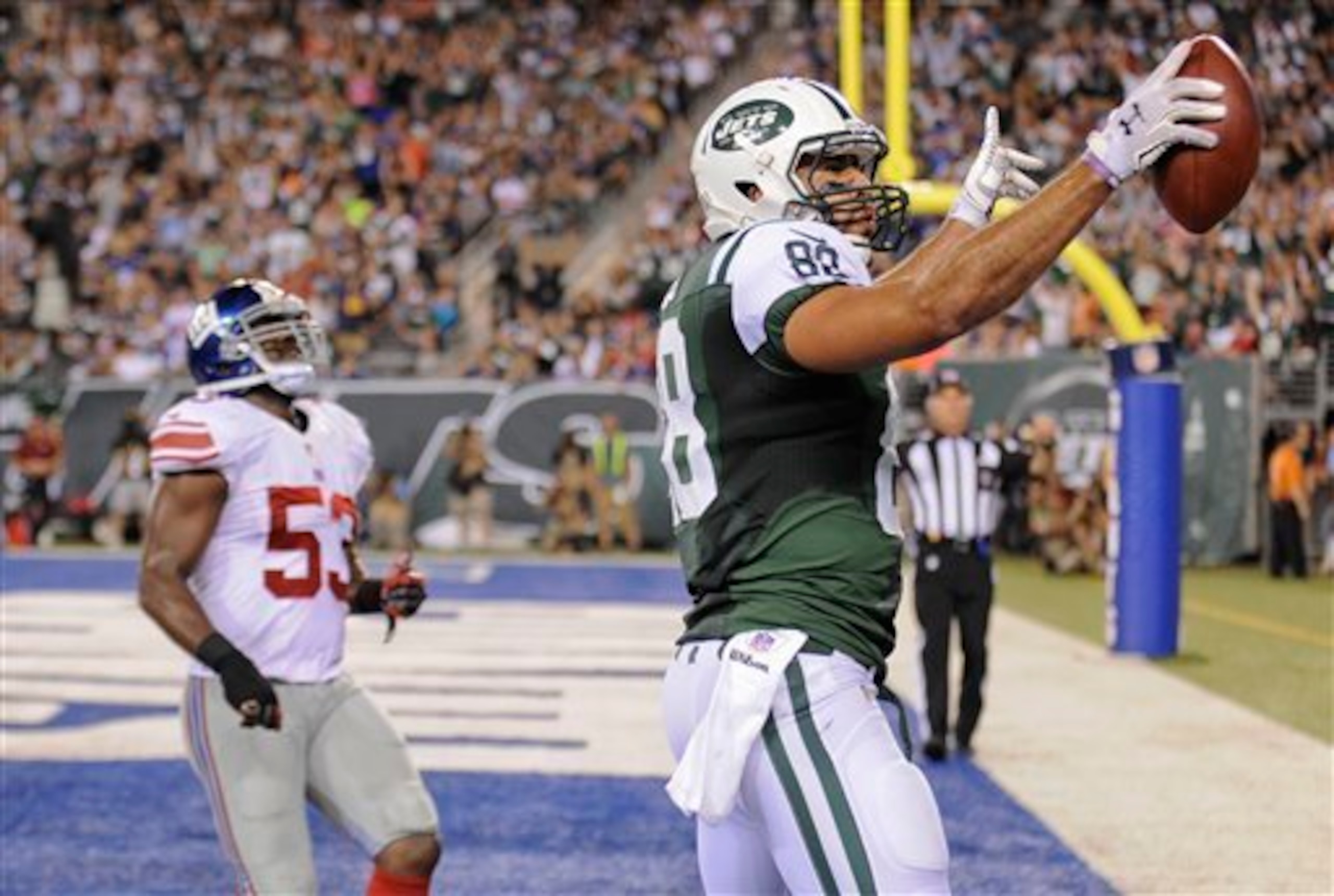
Depth Chart
- Jeff Cumberland
- Jace Amaro
- Zach Sudfeld
The outcome of the tight end depth chart is hardly a surprise, but how this position will play out over the course of the season will be a storyline to watch.
Prior to the draft, the Jets were going to rely on Jeff Cumberland, but the unexpected availability of Jace Amaro in the second around has thrown a welcome wrench into their plans.
While Cumberland spend a good chunk of the preseason nursing an Achilles injury, Amaro started to get over his rookie struggles and get the hang of the NFL game. He led the Jets in receiving in the third preseason game against the Giants, catching four passes that included a touchdown.
Cumberland will enter the season as a starter, but the tight end pecking order can change in a hurry if Amaro continues to develop at such a rapid rate.
Meanwhile, it comes to little surprise that Zach Sudfeld wins the final No. 3 job over Chris Pantale. Sudfeld (6'7", 260 pounds) has a much thinner frame compared to Amaro (6'5", 265 pounds) and Cumberland (6'4", 260 pounds) but is capable of backing up for a short duration if need be.
Offensive Line
5 of 13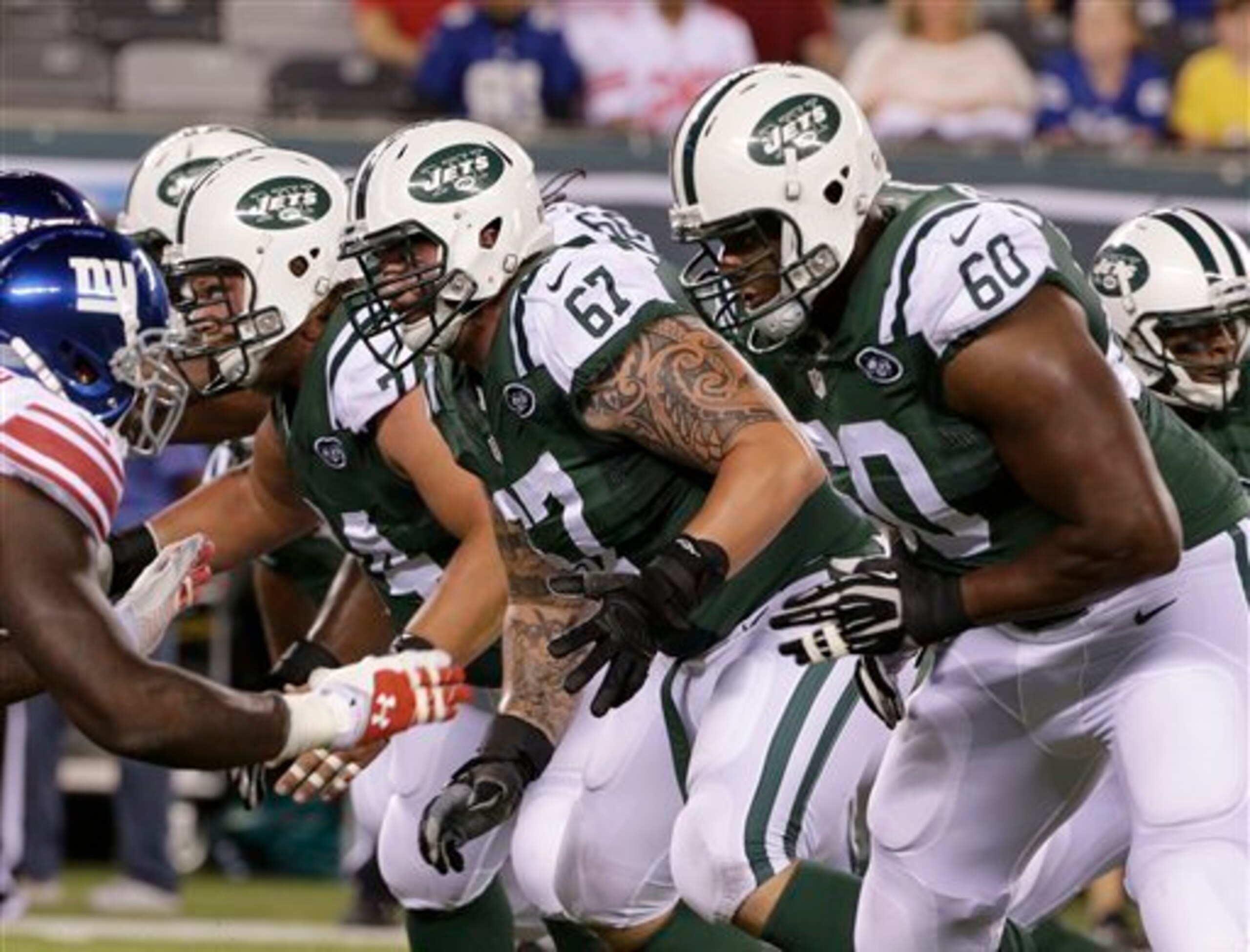
Depth Chart
LT: D'Brickashaw Ferguson, Ben Ijalana
LG: Brian Winters, Oday Aboushi
C: Nick Mangold, Dalton Freeman
RG: Willie Colon, Dakota Dozier
RT: Breno Giacomini
Since the start of free agency, the Jets have come a long way in answering a lot of the uncertainties surrounding the offensive line. Faced with the possibility of replacing two veteran starters and possibly benching a second-year player, the Jets offensive line has molded nicely this preseason.
One of the most underrated moves from Idzik this offseason was how swiftly and efficiently he was able to replace right tackle Austin Howard with Seattle Seahawks alum Breno Giacomini. Giacomini is nearly two years older than Howard (29 in September) but is at least Howard's equal as a player on the field.
With Nick Mangold and D'Brickashaw Ferguson assuming their posts at center and left tackle, the two guard spots are the positions to watch this year.
Willie Colon is back in the lineup after some injury scares, but the Jets will never be convinced that his health issues are a thing of the past, evidenced by their selection of Dakota Dozier in the fourth round of the draft. Brian Winters has held off converted tackle Oday Aboushi for the starting job for the time being, but a return to his rookie form will force him to the bench before the season is over.
Aboushi actually started the second preseason game in place of Winters, which sent a message to Winters that this competition will be ongoing until Winters stops giving the Jets a reason to question his adequacy.
A fifth-round pick from 2013, Aboushi is a particularly valuable backup because of his versatility. He will serve as a swing tackle, backup guard and reserve tackle with experience in both spots. If he does not get on the field this year, he could force Colon out of his starting role in 2015.
There has also been a swap at the backup center position, as Dalton Freeman has replaced Caleb Schlauderaff as Nick Mangold's backup. Freeman may have won this job a year earlier had an ankle injury not forced his release after training camp.
Based on this group's performance in Week 3 of the preseason in which they did not allow Geno Smith to be sacked, the arrow is pointing up on the offensive line.
Defensive Line
6 of 13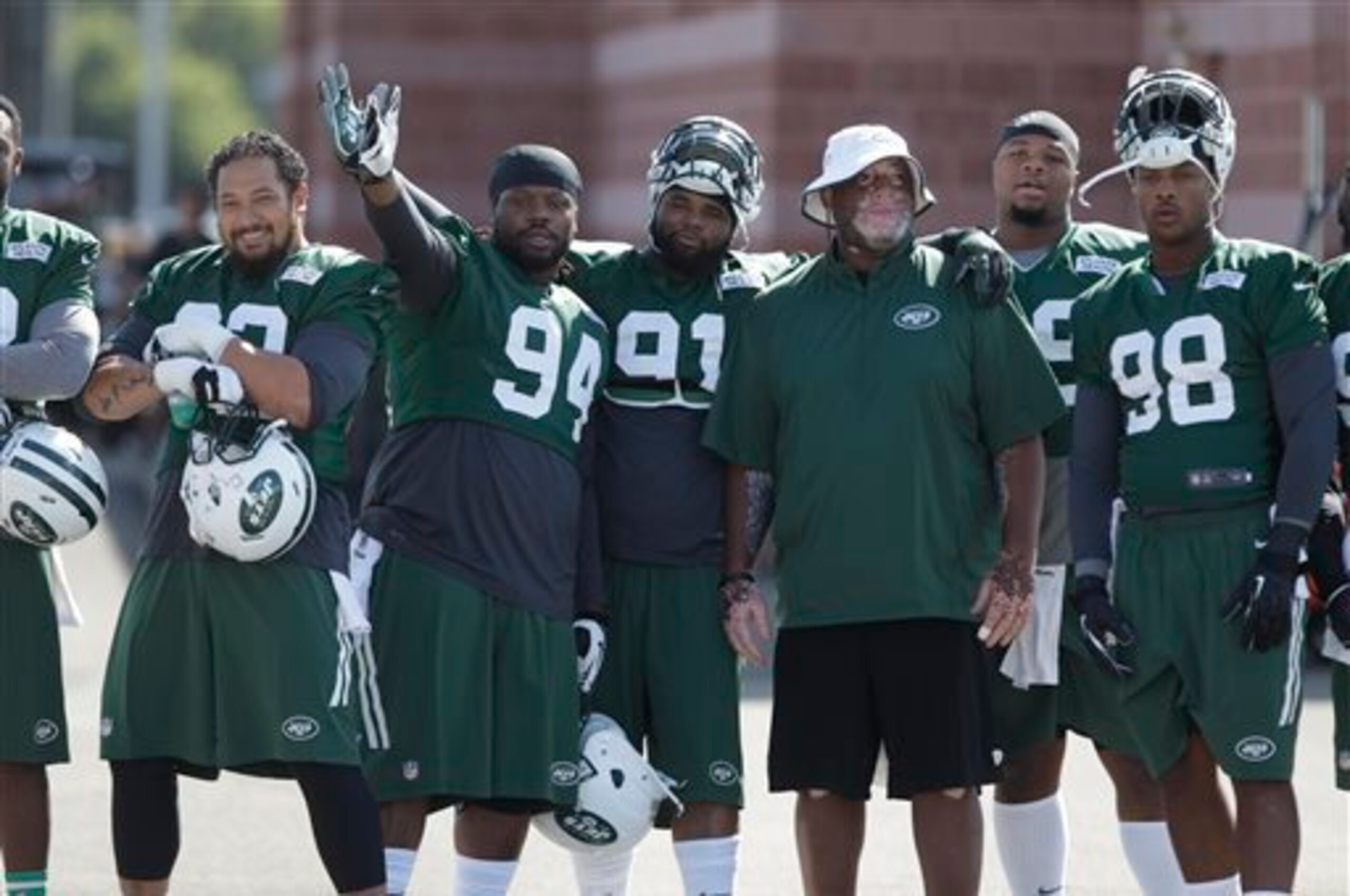
Depth Chart
DE: Muhammad Wilkerson, Sheldon Richardson, Leger Douzable
DT: Damon Harrison, Kenrick Ellis, T.J. Barnes
When Rex Ryan took over as head coach in 2009, the defensive line was incredibly weak when considering how the Jets finished first in the league in total defense.
Now, the defensive line is not just a strength of the defense—it is the core of the team.
In a contract year, the best is still yet to come from Muhammad Wilkerson. Since his selection in the first round of the 2011 draft, Wilkerson has developed into more than just a force on the field (he led the team with 10.5 sacks last year)—he is regarded as one of the leaders on the team.
Even more growth can be expected from 2013 first-round pick Sheldon Richardson. The reigning Defensive Rookie of the Year was dominant against the run last season but could stand to improve a bit in the pass-rushing department coming off a 3.5-sack season.
If the ultra-athletic Richardson can play anywhere near his peak potential this season, the defensive line has a chance to be truly special.
One of the best storylines of 2013, Damon Harrison's emergence as one of the best run-stuffing nose tackles in the game was certainly welcome but not entirely necessary. According to Pro Football Focus (subscription required), the top-performing defensive lineman on the Jets this preseason has been Kenrick Ellis, but Harrison's emergence has overshadowed his near-equal production.
This dominant unit will get a slight boost in depth this year with the addition of T.J. Barnes to the bottom of the depth chart. Barnes will have a tough time getting on the field this year with Harrison and Ellis in front of him, but he was too impressive in the preseason to let another team have a chance to pick him up.
Linebackers
7 of 13
Depth Chart
ILB: David Harris, Demario Davis, Nick Bellore, A.J. Edds
OLB: Quinton Coples, Calvin Pace, Jason Babin, Ik Enemkpali, Trevor Reilly
David Harris has enjoyed a long, productive tenure as the quiet leader of the Jets linebacking corps, but 2014 will be the start of an inevitable passing of the torch to Demario Davis.
Now 30 years old and entering the final year of his contract, Harris is no longer the future of the Jets defense, although he can still be a key part of the present unit. Davis, however, has not only been at least equal to Harris on the field as of late—earning a superior grade than Harris in Pro Football Focus' ratings this preseason—he has emerged as a much more natural, outspoken leader with a personality opposite to that of the more reserved Harris.
Davis is not the only player who is primed for a breakout season this year. Fellow 2011 draftee Quinton Coples has much more pressure on him to produce like a first-round pick is expected to. Held back by position changes, injuries and veteran talent in front of him, there are no more excuses for the former Tar Heel to become a top-tier outside linebacker in his second year at his new position.
The Jets need a healthy Coples to upgrade their lagging edge pass rush, but he will not be the only source of pressure off the edge. New addition Jason Babin should thrive as a situational pass-rusher given the amount of talent he will be surrounded with.
Just three seasons removed from his remarkable 18.5-sack season, Babin still has some gas in the tank when it comes to getting after the quarterback. Asking him to play extensively as a three-down player, however, is asking for trouble.
As long as Calvin Pace and Coples can stay healthy, Babin can get into a comfort zone in his situational role.
What is most surprising about the Jets linebacker corps is the sheer size of the group. To the surprise of many, fifth-, and sixth--round rookies Ik Enemkpali and Trevor Reilly were able to latch on to the bottom of the roster.
Journeyman linebacker A.J. Edds was able to impressively beat the odds to stick on the final roster (after some initial shuffling—Edds was actually released at the deadline to ensure that George would be able to pass through waivers unclaimed three days later).
From the surface, having two of his outside linebacker rookies make the roster puts John Idzik in a favorable light, but it is worth questioning how much bias factored into the decision that Idzik made in making room for these two players. Enemkpali flashed enough as a pass-rusher to warrant a spot, but there is no way a 26-year-old Reilly is a better player than Garrett McIntyre, a 29-year-old veteran the Jets cut to make room for Reilly.
According to Pro Football Focus, McIntyre had five combined pressures, hurries and sacks in just 44 snaps. Reilly had just three in roughly three times as many snaps, with no sacks to show for it.
Either way, this position has a nice blend of youth, upside and veteran leadership. The key for this group to take the next step will be in the pass-rushing department, which the Jets desperately need to improve to make up for their deficiencies in the secondary.
Cornerbacks
8 of 13
Depth Chart
- Dee Milliner
- Darrin Walls
- Kyle Wilson
- Phillip Adams
- Leon McFadden
The Jets' cornerbacks have stolen all of the preseason headlines in New York—for all the wrong reasons.
Both on and off the field, this position has gone from being a huge question mark to an outright disaster in a matter of weeks.
Dexter McDougle's ACL injury and Dimitri Patterson's mysterious absence from the Week 3 preseason game (that tied to his release) have left the Jets with a minimal amount of depth with little starting-caliber talent to work with. Dee Milliner's expected absence from opening day only complicates matters:
"Jets will host Raiders one week from today in season opener. Feeling right now is that Dee Milliner (high ankle sprain) won't be ready #nyj
— Manish Mehta (@MMehtaNYDN) August 31, 2014"
The Jets need their former ninth overall selection to not just improve upon his tumultuous rookie season, but they need him to become a shutdown cornerback overnight. Sitting out the first game with an injury is no way to develop as a young player.
As bad as things look right now, the Jets have two solutions in their back pocket—Darrin Walls and Antonio Allen.
Since arriving on the Jets at the end of the 2012 season, Walls has outplayed his status as a former undrafted free agent—Pro Football Focus has rated him as the top-performing cornerback on the Jets this preseason. While unproven in the long term, Walls has a lot of untapped potential that the Jets will be forced to utilize.
Converted safety Antonio Allen also possesses a lot of upside as a man-cover specialist. He held his own against A.J. Green in Week 2 of the preseason, suggesting that he may be able to survive as an outside cornerback after all—at least until Milliner returns from injury.
Entering his contract year, Kyle Wilson will assume his duties as the primary slot cornerback. Wilson is coming off the best season of his career but has been an easy target this preseason after allowing nine of 10 targets to be caught.
Cleveland Browns castoff Leon McFadden offers a lot of upside as a former third-round pick. While he disappointed in Cleveland, McFadden is similar to the released Patterson as a slot corner but offers more in terms of youth (and perfect attendance in preseason games).
Even if the Jets' luck begins to turn with Walls and Allen excelling in their new, expanded roles, this is easily the weakest position on the team that will need a lot of work next offseason, regardless of how 2014 plays out.
Safety
9 of 13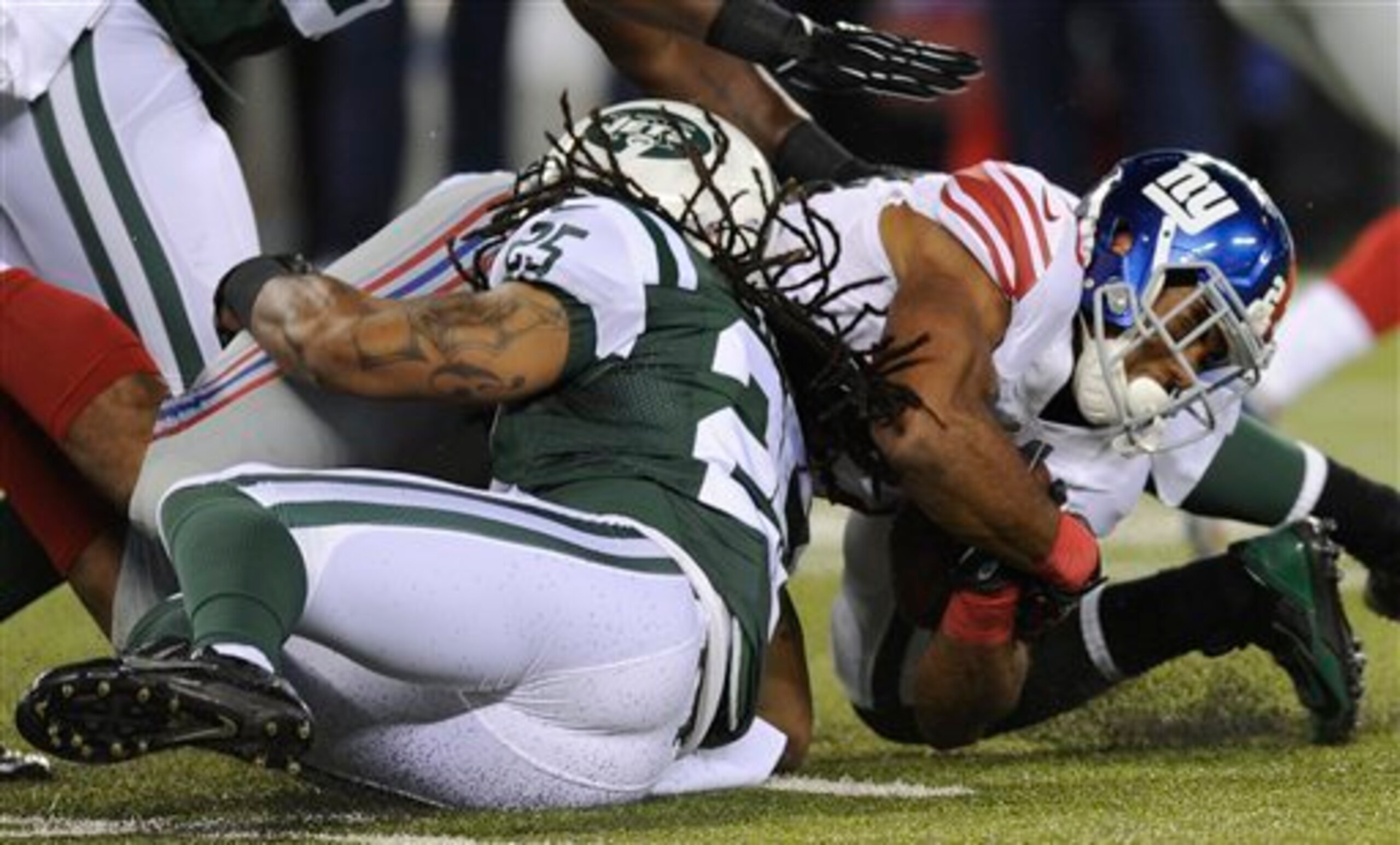
Depth Chart
- Antonio Allen
- Dawan Landry
- Calvin Pryor
- Jaiquawn Jarrett
- Josh Bush
On paper, the Jets are set to roll with five safeties on the roster this year, but that number will fluctuate depending on how Antonio Allen is deployed (as either a safety or a cornerback).
Nonetheless, the obvious player to keep a close eye on is rookie first-round pick Calvin Pryor. The highest-rated defensive player of the preseason in Pro Football Focus' ratings, the Jets will need Pryor to do what he does best—force turnovers and make big hits—to make up for where they lack elsewhere in the secondary.
If Allen does stay at safety, how Rex Ryan will choose to deploy his three starting-caliber safeties will be just as important to watch. Will Ryan elect to go with the younger, more talented duo of Allen and Pryor or lean on the veteran savvy of Dawan Landry?
In either case, all three safeties will see similar doses of playing time, whether it be through the use of "big nickel" looks or deploying them based on specific game situations. Allen's cloudy position designation allows the team to blur the lines when it comes to deploying specific personnel sets.
While he was able to find a way onto the bottom of the depth chart, this is very much a make-or-break season for Josh Bush. A sixth-round pick in 2012, Bush has yet to play a meaningful role on the regular defense. If he does not make an impact in his third season, chances are he never will.
Special Teams
10 of 13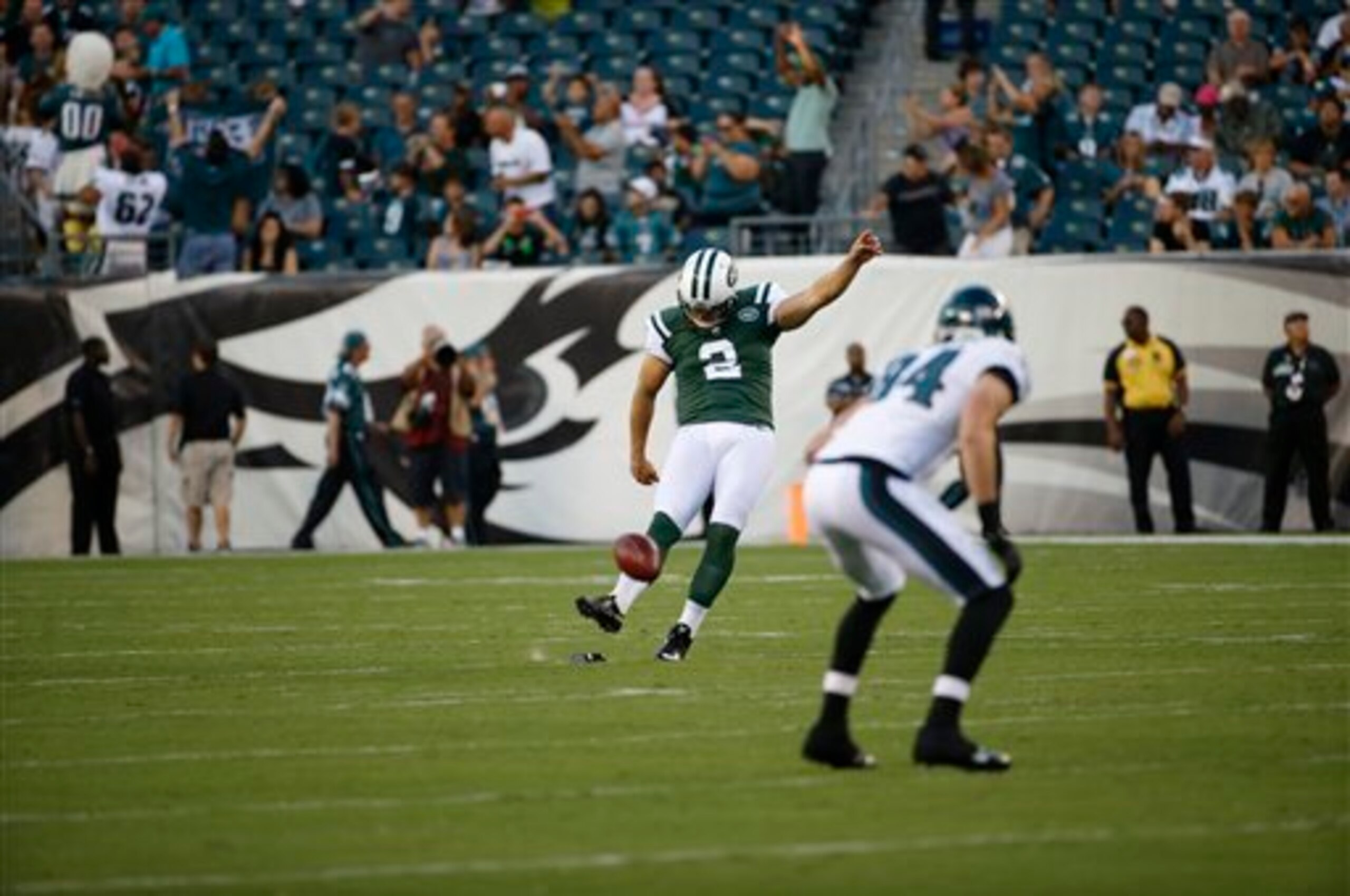
Depth Chart
Nick Folk (K)
Ryan Quigley (P)
Tanner Purdum (LS)
After finally earning a much-deserved extension in the offseason, Nick Folk was finally able to enjoy a stress-free training camp in which his job was never in jeopardy. Long snapper Tanner Purdum also never gave the Jets a reason to start looking elsewhere for serious competition.
The position that will be in constant flux this year is the punter spot—a job Ryan Quigley has been unable to seize without losing the strength of his grip every few weeks.
Once referred to as "our guy" by special teams coach Thomas McGaughey, per ESPN New York's Rich Cimini, Quigley's dreadful performances in Weeks 3 and 4 have once again put his job in jeopardy. In Week 3 against the New York Giants, he averaged just 38.4 yards per punt, which included two awful 29-yard punts.
Quigley is the assumed Week 1 starter, but a slow start to a regular season could prompt the Jets to make a change with a more deserving player who was unable to make the cut on another team with a steadier punting situation.
X-Factors
11 of 13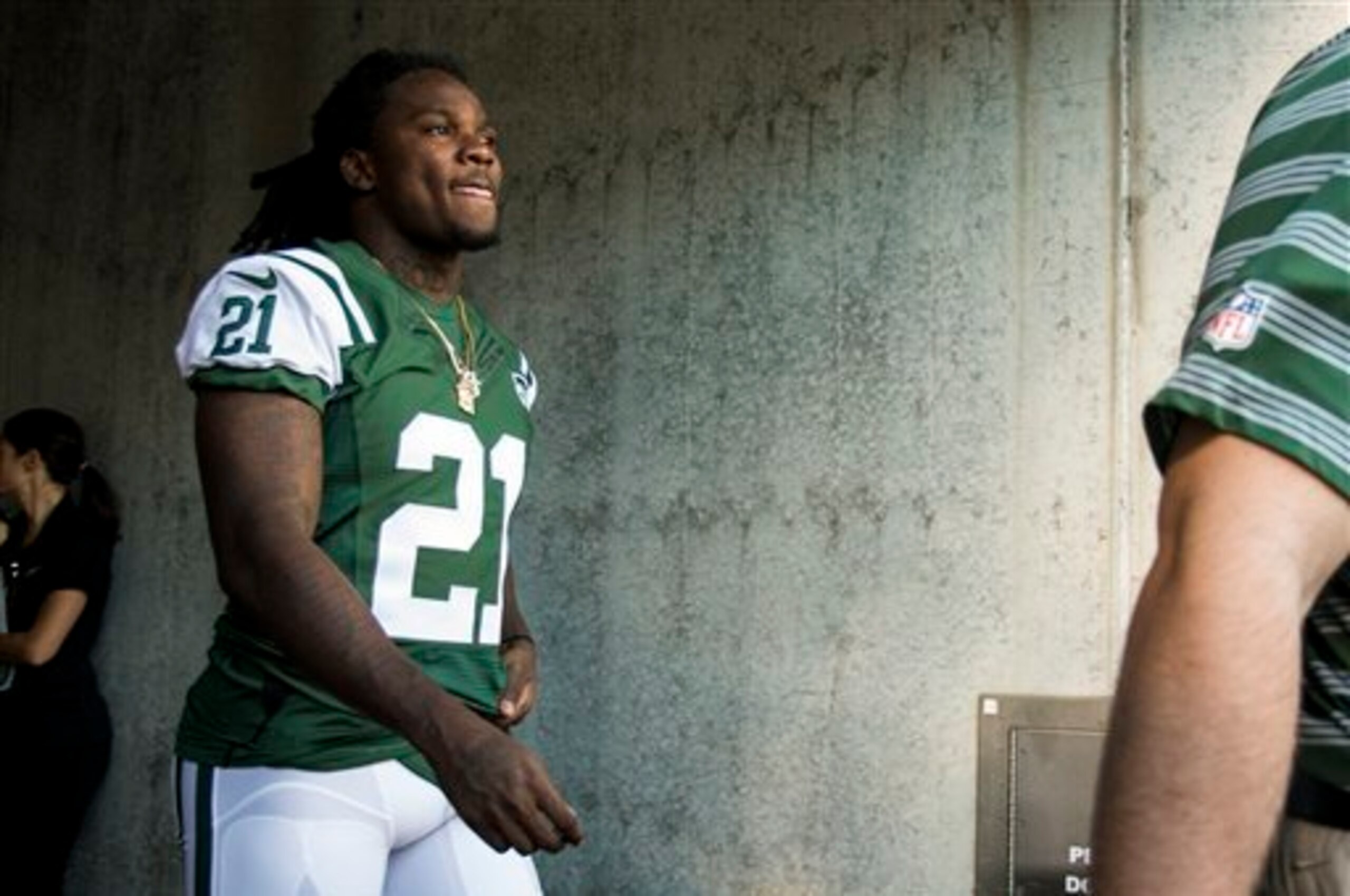
Chris Johnson
The quintessential X-factor, Chris Johnson was brought in to be something between a starter and a playmaking superstar for the Jets. No longer capable of carrying an entire offense on his back, Johnson can still be a highly effective player if used in the proper doses.
He is very much an "all-or-nothing" player: If there is space for Johnson to make plays, he will make them—but the space may not always be there.
Jason Babin
As improved as the Jets' pass rush is with Wilkerson and Richardson on the defensive line, the edge portion of the pass rush was still underwhelming last season, particularly after Antwan Barnes was lost for the season.
With Barnes' health still in question, Jason Babin can easily fill in his shoes as a situational pass-rusher. Babin is a few years older than Barnes but is coming off a seven-sack season on a bad Jacksonville Jaguars team that rarely played with a lead.
Babin's attitude makes him a much bigger risk off the field than on the field. If he can mesh with the Jets' locker room without issue, Babin can provide great value as a stopgap, situational pass-rusher to make up for their secondary woes.
Dee Milliner
No matter how responsibly a general manager balances a budget or wins in the trade market, missing on early draft picks is a quick way to deteriorate a roster.
The first selection of the Idzik era last spring, the Jets need Dee Milliner to not just make great improvements in his second season—he needs to be a shutdown cornerback now. However, it seems as if his spotty injury history will continue to slow his development with his availability for the season opener up in the air, according to the New York Daily News' Manish Mehta.
No defensive player's performance will have such a noticeable impact as Milliner. If he can play up to his draft status and be a shutdown cornerback, the Jets defense has a chance to be elite. Otherwise, throwing on the Jets will be easy as any team in the league, as they have one of the thinnest secondaries in the game.
Biggest Games
12 of 13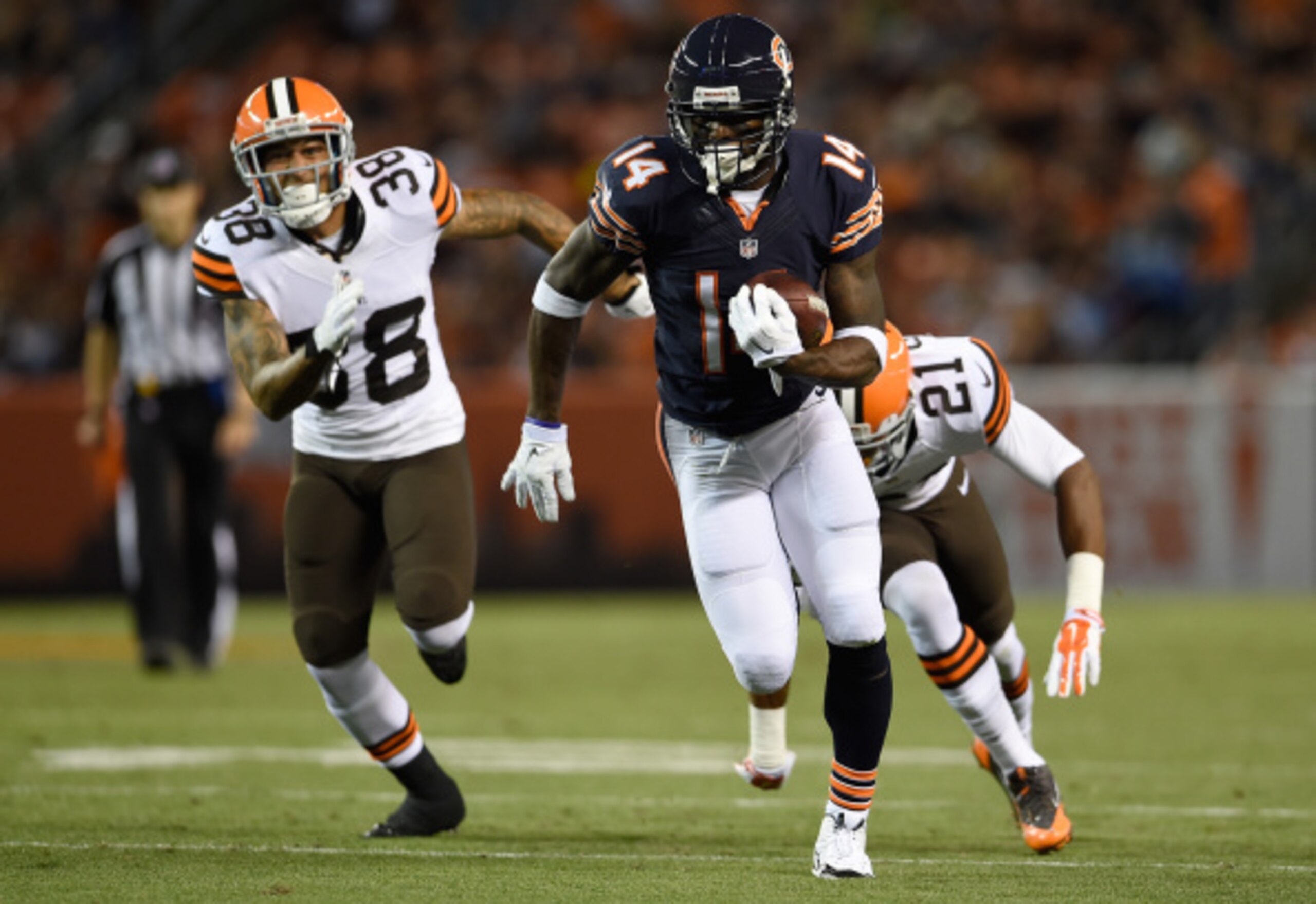
Week 16 vs. New England Patriots
Every game against the perennial division-winning Patriots is huge for the Jets, but this late-season matchup has particular importance. By this point, the Jets may be within a win or two of the playoffs. This in-division game would count not just in the win total but their in-division and in-conference records as well.
If the Patriots don't have the division wrapped up by this point, this game could effectively be an AFC East championship game.
Week 10 vs. Pittsburgh Steelers
Every team loves to enter the bye week off a win. With the Jets having a late bye this year (Week 11), having a playoff-worthy 10-game record has even more importance.
This game is not just important from a playoff standpoint but as an in-conference game: The Steelers provide a good measuring stick as to where the Jets are as a team. While the Steelers have had two "down" years recently, Rex Ryan recognizes how difficult it is to beat Ben Roethlisberger as a former division opponent. Plus, getting some revenge from last year's beating would be icing on the cake.
Week 3 vs. Chicago Bears
Eight days after trying to stop Aaron Rodgers and the Green Bay Packers, the Jets will be forced with the task of stopping the dynamic Chicago Bears' passing game. By this point, Jay Cutler will likely still have a clean sheet of health and a beleaguered Jets secondary to pick apart.
Adding to this dynamic is the return of Santonio Holmes, who was picked up mid-preseason by the Bears. Letting a former controversial wide receiver run all over a messy secondary on national television is not an ideal look for a coach who is trying to keep his job next year.
Week 13 vs. Miami Dolphins
Playing the Miami Dolphins late in the season seems to have become an annual tradition. Assuming the Patriots continue their divisional dominance, second place in the AFC East will likely come down to the Jets or Dolphins.
This matchup and the Week 17 one will have equal impact on standings, but this game in New York will set the tone for the home stretch in the playoff race.
Season-End Awards
13 of 13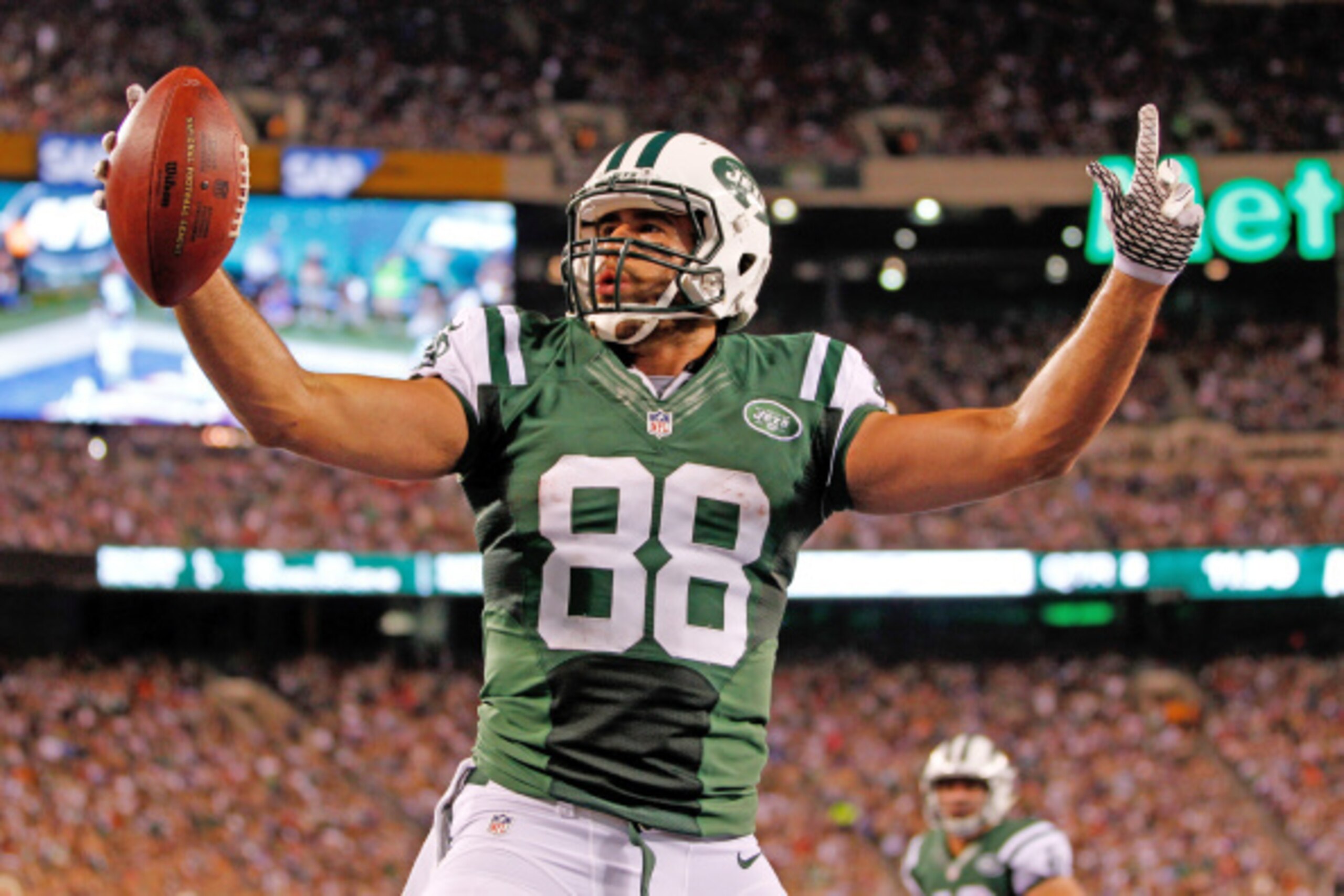
Team MVP: Muhammad Wilkerson
The primary leader on the team, Wilkerson is still on the upward swing in his on-field development. The emergence of Richardson and Harrison will only give Wilkerson more chances to rack up sacks—and his salary totals in his next contract.
Most Improved: Geno Smith
Smith has yet to cause jaws to drop with explosive "wow" plays, but his development has been steady and stable. He looks like a different player than the rookie who threw 21 interceptions a year ago.
With a new stable of offensive weapons and another year in Marty Mornhinweg's system, no one has more potential for success than the Jets' quarterback.
Rookie of the Year: Jace Amaro
Amaro was not the first player selected in this year's draft by the Jets, but he stands a bigger chance to make an impact on the results of the Jets' season than any other rookie.
Playing in place of the injured Jeff Cumberland in Weeks 2 and 3 of the preseason, Amaro emerged as one of Geno Smith's favorite targets. He combined for six catches in those two games, including a touchdown. He even showed his adequacy as a blocker—an area of the game Cumberland still struggles in.
If Amaro continues his upward trend at this rapid rate, it is only a matter of time before he supplants Cumberland as the No. 1 tight end on the team.
Comeback Player of the Year: Chris Johnson
Chris Johnson may not be recovering from any type of major injury, but he is undergoing a mid-career crisis as he moves to the bright lights of New York. His numbers will not be as flashy as they were in Tennessee when he was the lead runner, but his new role will allow for him to be more explosive and efficient with every carry he gets.
Advanced statistics provided by ProFootballFocus.com (subscription required).

.jpg?w=2560 "Chiefs Dolphins Football")