Predicting NBA Stat Leaders for Every Major Category This Season
We're still going to play out the 2018-19 NBA season. Don't worry.
But thanks to our handy-dandy crystal ball, we already know who's going to emerge victoriously in each of the major statistical categories. The scoring champion? We have that covered. The assists leader? Ditto. We're even breaking down the expected leaders in field-goal percentage and three-pointers made—a category that matters more and more as we shift further toward triple-dominated offenses.
Stars reign supreme here, and it's important to remember this isn't intended to function as a series of hot takes. We're not trying to be bold, so much as accurate, though those two concepts aren't always mutually exclusive.
Reading the crystal ball is difficult, but it tends to point toward the most legitimate of candidates.
Let's dive into the haze.
Field-Goal Percentage
1 of 7
Leader: DeAndre Jordan, C, Dallas Mavericks
DeAndre Jordan might not have the most diverse skill set on the offensive end, but he's darn good at filling his specialized role.
During his final go-round with the Los Angeles Clippers, he scored 1.25 points per possession as a roll man—a play type that comprised 18.2 percent of his usage within the offensive schemes. That's the primary reason he was able to shoot 64.5 percent from the field, leaving him behind only Clint Capela (65.2 percent) among all qualified players.
Jordan simply doesn't take bad shots. He rarely pushes the boundaries established by his own limitations, instead accepting and thriving within his role. That's why he was one of just three players to appear in at least 40 games and take his average shot no further than two feet from the basket, per NBA Miner:
- Tyson Chandler: 1.0 feet
- DeAndre Jordan: 1.34 feet
- Clint Capela: 1.83 feet
And now, though he's transitioning to a new scheme with the Mavericks, he's about to be receiving feeds from even better passers. That might be different if Milos Teodosic had played more minutes alongside the big man in Los Angeles, but that wizardrous distributor only accounted for 12.0 percent of the passes Jordan received—behind Lou Williams (18.6) and Austin Rivers (24.3).
Now, he gets to be on the receiving end of Luka Doncic's feeds, and while the incoming rookie has no NBA experience, he's already proved himself as one of the best passers at the sport's second-highest level. He and Dennis Smith Jr. should ensure that Jordan keeps getting easy looks at the tin, and it's not like the Mavericks will suddenly ask him to expand his range.
Runner-Up: Clint Capela, C, Houston Rockets
This isn't about Clint Capela declining after he led the league in field-goal percentage last year. He could replicate those efforts, again converting well over 60 percent of his attempts for the Rockets. Instead, it's about Jordan somehow improving to the levels he reached when he played alongside Chris Paul, which included three consecutive seasons above 70 percent.
Why should we expect any slippage from Capela, which would be necessary for Steven Adams, Enes Kanter, Montrezl Harrell, Tyson Chandler, John Collins or some new contender to challenge him? We shouldn't, especially if Paul stays healthy enough to suit up in more than 58 contests and gives the Rockets two top-notch pick-and-roll ball-handlers to make life easier for the big man.
Capela and Jordan, both because of their own skill and the quality of the distributors teaming up with them, exist in a class of their own.
3-Pointers Made
2 of 7
Leader: Stephen Curry, PG, Golden State Warriors
The purpose of this article isn't to make bold predictions but instead to accurately forecast what will come to pass in 2018-19. Though that sometimes involves climbing out on a shaky limb, this isn't one of those times. The three-point crown went to James Harden in 2017-18, and it's about to travel back into the hands of the best shooter this sport has ever witnessed.
Yes, Curry made "only" 212 triples last year, leaving him behind Eric Gordon (218), Wayne Ellington (227), Damian Lillard (227), Klay Thompson (229), Kemba Walker (231), Kyle Lowry (238), Paul George (244) and Harden (265). But that's massively misleading during a season in which Curry fought through injuries to make a meager 51 appearances and still registered within the top 10 of a volume-based category.
Let's instead take a glance at the per-game hierarchy:
- Stephen Curry: 4.2 threes per game
- James Harden: 3.7
- Eric Gordon: 3.2
- Paul George: 3.1
- Damian Lillard: 3.1
- Kyle Lowry: 3.1
- Klay Thompson: 3.1
- Wayne Ellington: 2.9
- Kemba Walker: 2.9
- Kyrie Irving: 2.8
Do you really want to bet against Curry, who's entering the 2018-19 proceedings with a clean bill of health and a featured role within the deadly Golden State Warriors offense?
I didn't think so.
Runner-Up: James Harden, SG, Houston Rockets
Look back up at those per-game standings.
Harden may have trailed Curry by a substantial amount, but he also separated himself from the rest of the pack. That 0.5 threes-per-contest gap between himself and teammate Eric Gordon is rather significant, enough to create a 41-triple differentiation if both men take the court for all 82 outings in the regular season. It's also not something we should expect to go away anytime soon.
Harden's three-point prowess might drop off if he struggled to splash as many treys when sharing the floor with Paul. But that's not the case. He shouldn't be expected to grapple with either volume or efficiency if his All-NBA point guard spends more time healthy in 2018-19.
During the 2017-18 campaign, a period in which the two were presumably still establishing a rapport, Harden shot 40 percent from downtown and made 3.9 three-pointers per 36 minutes when playing alongside Paul. When operating as the solo star, the bearded 2-guard hit 34.9 percent of his downtown attempts and connected on 3.7 three-balls per 36 minutes.
If anything, he might trend upward when this dream backcourt pairing is used more frequently.
Blocks Per Game
3 of 7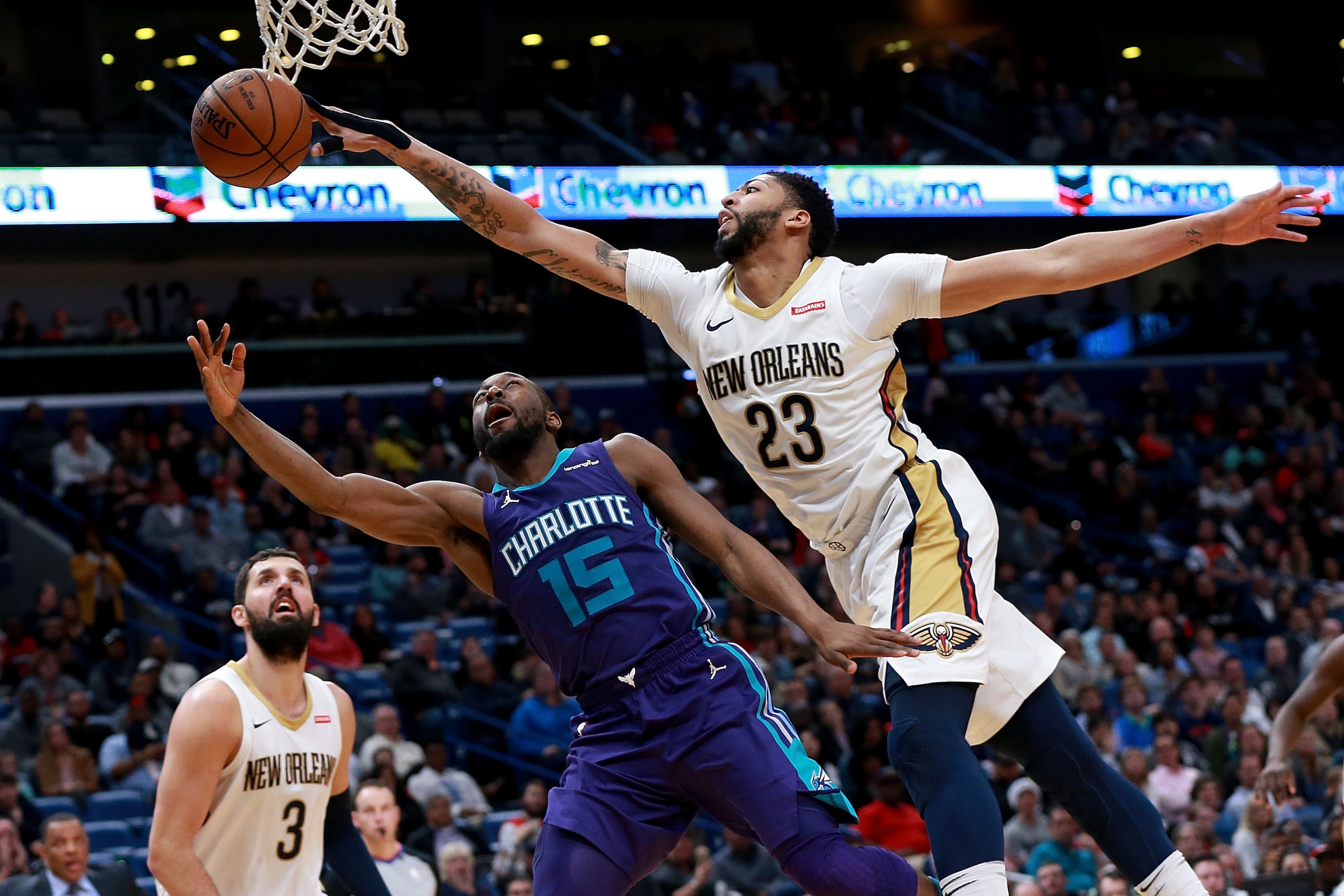
Leader: Anthony Davis, PF/C, New Orleans Pelicans
Anthony Davis is an anomaly.
An all-around superstar on the preventing end who finished No. 3 in the Defensive Player of the Year voting for 2017-18, trailing only Rudy Gobert and Joel Embiid, he possesses an unfair combination of length, agility, instincts and athleticism. He can stifle out post-up attempts from bigger players, rotate from the weak side to play help defense and switch onto far smaller adversaries for possessions at a time. He's a machine engineered to wreak havoc, and wreak havoc he has.
No one was within 0.7 swats per game of his league-leading tally last year, and the gap between him (2.6) and No. 2 Clint Capela (1.9) was as large as the chasm between Capela and No. 17 Ekpe Udoh (1.2). Talk about running away with a category.
But this advantage also holds if we look at block percentage, an advanced statistic that analyzes rejections on a per-possession basis. He doesn't quite dominate the category, but he's the only member of the top 10 who played at least 30 minutes per game.
This won't change going forward. Maybe the gap between Davis and the rest of the league will shrink, but his ability to obstruct jumpers with his pterodactyl arms allows him to continue compiling blocks in a league shifting further and further toward perimeter-oriented play. Plus, the 25-year-old may only be getting better as he seeks the fourth rejection title of his young career.
Runner-Up: Jarrett Allen, C, Brooklyn Nets
Speaking of players getting better...
Allen wasn't quite on the radar in the blocks competition last year. He racked up 1.2 rejections per game during his rookie season with the Brooklyn Nets, which left him trailing 16 qualified players. But that number is about to shrink.
A 6'11" center with a 7'5 ½" wingspan (and he may still be growing), Allen now has an unencumbered path to more minutes as a sophomore. He didn't take over the starting job until late January, but that's now his role to lose. And with only Ed Davis and Kenneth Faried challenging him on the Brooklyn depth chart, he's unlikely to cede much ground.
During his 31 starts, Allen played an average of 23.8 minutes and still blocked 1.7 shots per game. Already, that would put him at No. 6 on the full-season leaderboard, trailing only Davis (2.6), Capela (1.9), Kevin Durant (1.8), Embiid (1.8) and Myles Turner (1.8), many of whom are legitimate candidates for this runner-up positioning.
But what if he plays 28 minutes per game? What if he pushes north of 30 during his second professional go-round? Prorating his numbers as a starter, he'd be up over two swats per contest in those situations, and that's before factoring in any development a raw prospect might undergo before and during his age-20 venture.


Steals Per Game
4 of 7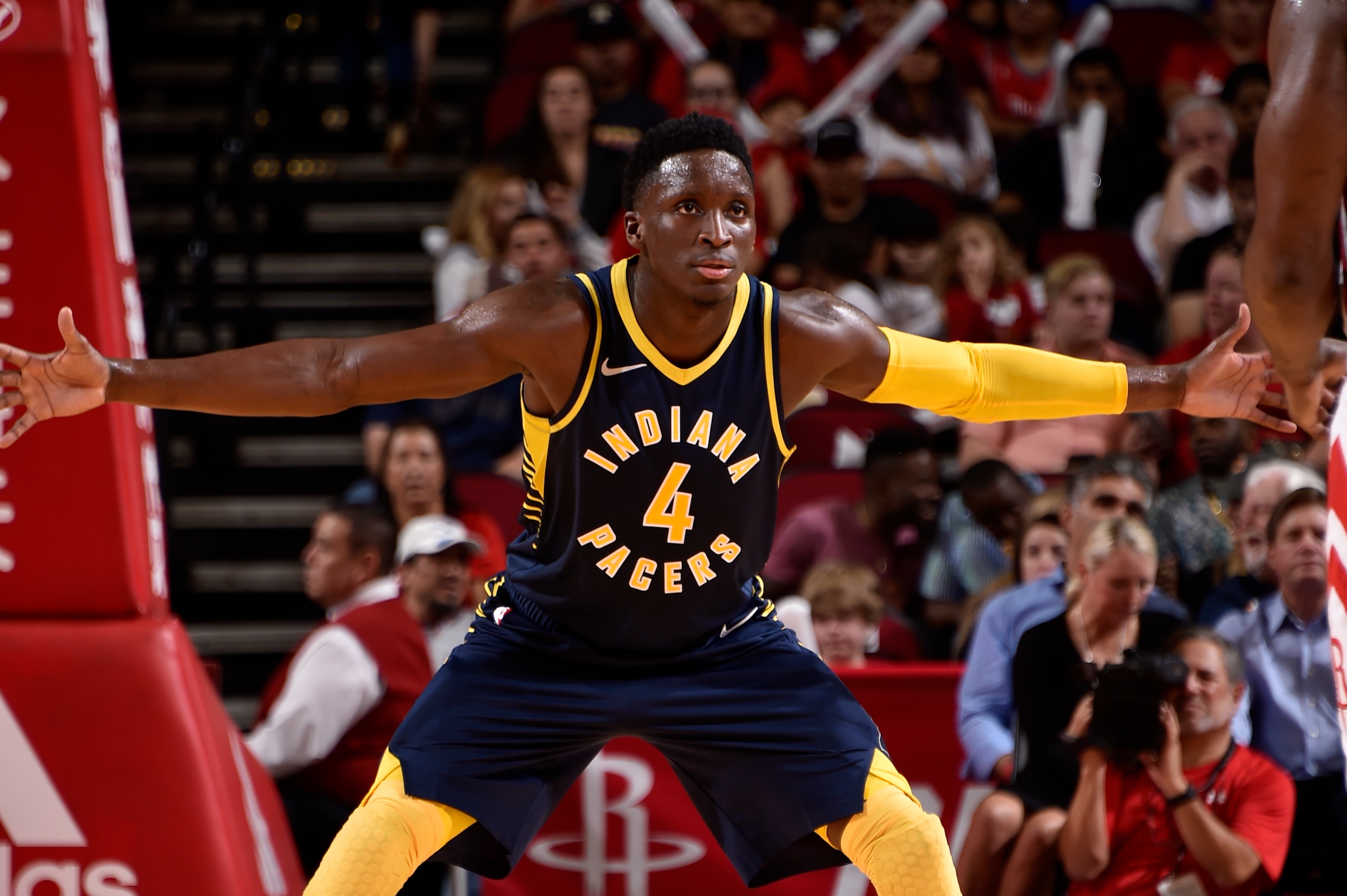
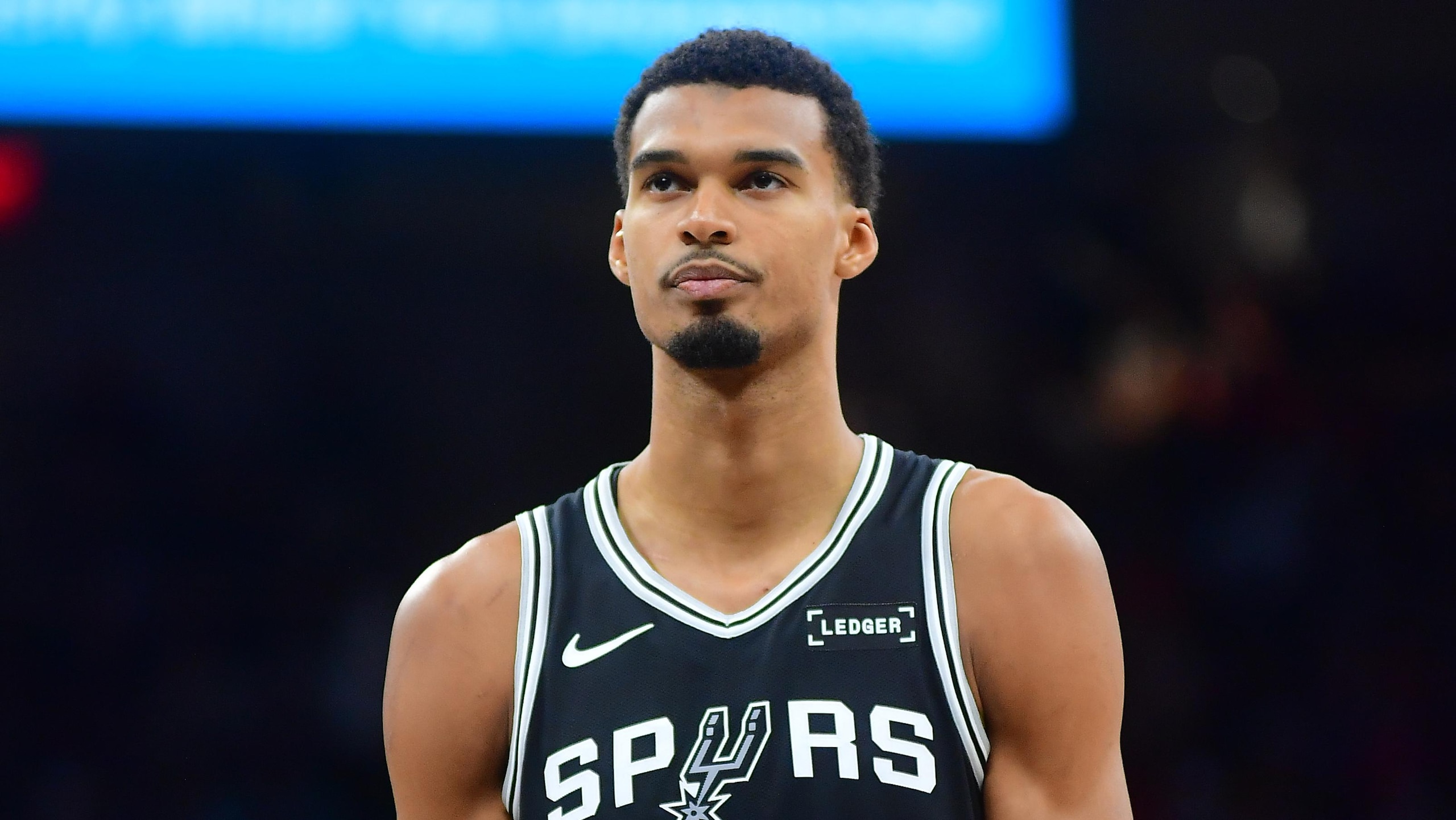
Leader: Victor Oladipo, SG, Indiana Pacers
Had Dejounte Murray (my original pick to take this title) remained healthy rather than losing his 2018-19 campaign to a torn ACL, we would have had to painfully relegate Oladipo to runner-up status.
There would've been no shame in finishing as the second-best basketball thief in the world. After all, just as was the case with other jumps to prominence, the finish would've been more about belief in Murray than disbelief in the Indiana Pacers star replicating his 2017-18 efforts.
Of course, dethroning him will prove to be a difficult endeavor if he does replicate them.
No qualified player earned more steals per 36 minutes last year, and only a select few pickpockets came within sniffing distance. Oladipo finished 0.4 swipes per game clear of the pack, and the gap between him (2.4) and No. 2 Eric Bledsoe (2.0) was as large as the one between Bledsoe and No. 12 Ricky Rubio (1.6). He even led the Association in steal percentage, which isn't easy to do while shouldering such immense offensive responsibilities and logging hefty minutes.
On the flip side, the increased depth of the Indiana rotation might make it easier to rest him a bit more. He might not need to play 34 minutes per game for the second consecutive season, and the increased defensive efficacy of Turner and others on the interior will make gambling for thefts a bit less of a priority.
Slippage isn't guaranteed, but it's not unfathomable. Don't consider this one a lock, even if Oladipo looks like by far the safest bet.
Runner-Up: Chris Paul, PG, Houston Rockets
If anyone has a chance, it's going to be Paul.
The point guard endured a down year as a steals artist in 2017-18 while adjusting to his new spot alongside James Harden and the rest of the Rockets, but he still picked up 1.7 swipes per contest. Astoundingly, that's only the third time in his career he failed to crest the two-steal threshold.
Paul is getting older, sure. He'll be playing out his age-33 campaign under the supervision of head coach Mike D'Antoni, and floor generals don't always age in graceful fashion. But his history is immaculate in this category, as he's already racked up six thievery crowns during his sure-to-be Hall of Fame career.
Year 2 of the Houston tenure should feature a bounce back in spite of Father Time and potentially declining minutes in a deep Rockets rotation. Comfort dictates as much, since Paul will be far more willing to make advantageous gambles after a year of acquired chemistry that allows him to trust Capela and the rim-protecting stalwarts covering for him on the interior of the stopping schemes.
Sure, this spot could go to a number of young up-and-comers such as Ben Simmons and Donovan Mitchell. But this veteran has the track record necessary to inspire everlasting belief.
Rebounds Per Game
5 of 7
Leader: Andre Drummond, C, Detroit Pistons
Recording 16 boards per game is unreal in today's NBA. In fact, these are the top qualified rebounding seasons during the current millennium:
- 2017-18 Andre Drummond: 16.0
- 2002-03 Ben Wallace: 15.4
- 2017-18 DeAndre Jordan: 15.2
- 2010-11 Kevin Love: 15.2
- 2014-15 DeAndre Jordan: 15.0
Though Drummond is navigating uncharted territory right now, that might be—please sit down so you don't hurt yourself—the baseline for what we should expect moving forward.
His free-throw improvements (and overall offensive strides) have allowed him to remain on the floor in late-game situations, clearing the path to more playing time. He's still just 25 years old and has plenty of time left in his athletic prime. And he's in the perfect situation to keep functioning as a rebounding vacuum.
Newsflash: Blake Griffin isn't exactly a devastating glass-cleaner, and his perimeter proclivities often drag him away from opportunities, clearing the path for his center to compile more boards. There's a reason DeAndre Jordan registered two of the top-five modern-day efforts while playing alongside the power forward.
After a midseason trade, Griffin played his first game for the Detroit Pistons on Feb. 1. From that point through the end of the regular season, Drummond averaged a can't-be-real 17.1 rebounds per contest.
Enough said.
Runner-Up: DeAndre Jordan, C, Dallas Mavericks
Jordan may no longer have the luxury of lining up alongside Griffin, but his journey to the Mavericks will pair him with another lackluster rebounder in Dirk Nowitzki. We shouldn't expect much of a decline here, even as the uber-athletic pivot moves into his 30s.
He might not be on the same level as this fully realized version of Drummond, but he's still part of a two-man tier.
Apologies to Karl-Anthony Towns, Dwight Howard, Anthony Davis, Joel Embiid and all the other talented rebounders trotting along the Association's hardwood. They're just not going to pass muster when compared to a man who averaged 15.2 rebounds per game in 2017-18. In fact, his lowest mark in the last five years (a league-leading 13.6 boards per game in 2013-14) would still have finished second with room to spare last year.
Once more, enough said.
Assists Per Game
6 of 7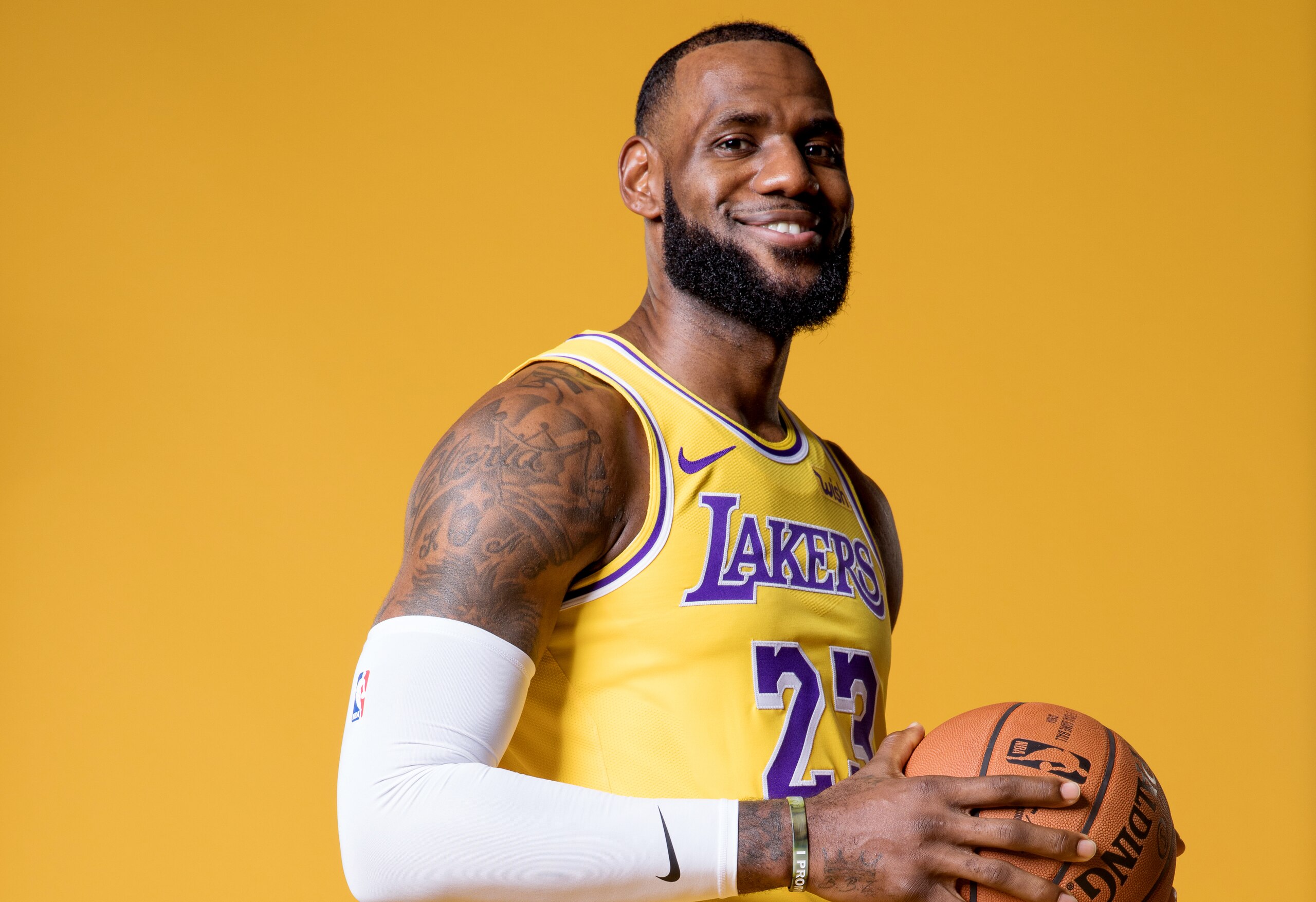
Leader: LeBron James, SF/PF, Los Angeles Lakers
Let's get funky.
During his final season with the Cleveland Cavaliers, LeBron James averaged 9.1 assists per game, which left him behind only Russell Westbrook's 10.2. Despite the plethora of accolades he's compiled throughout his illustrious career—one that leaves him as an unabashed lock to make the Hall of Fame on the first ballot—he's never produced more dimes per game.
In fact, he's set a new career high during each of the last two seasons.
Expect that trend to continue, even as he transitions to the Los Angeles Lakers and feels out a new set of teammates. James has always fancied himself a pass-first player, and he's leaned more and more on that skill to counteract any ill effects levied by Father Time in this extended prime. Now, wearing a Purple and Gold uniform alongside Brandon Ingram, Kyle Kuzma and other up-and-comers, he might focus his talents on improving them and allowing others to shoulder an increased portion of the scoring burden.
"Scoring has never been on my list of goals," he said in 2016, per ESPN.com's Brian Windhorst. "Facilitating, getting my guys involved and rebounding, defending, getting blocked shots and things of that nature always ranked above that."
That might be truer than ever during a semi-rebuilding season in which the Lakers are trying to tease out potential from the youngsters while preserving cap space for star pursuits in 2019. If James proves just how much of a team player he can be at this stage of his career, the Hollywood appeal will only grow.
Expect a third consecutive lifetime high in assists per game. This time, it'll be enough to get one of the greatest distributors in NBA history the first passing title of his career.
Runner-Up: Ben Simmons, PG, Philadelphia 76ers
Perhaps because his inaugural campaign was delayed a year by injury, Ben Simmons didn't run into the rookie wall during the 2017-18 season. Instead, he came out of the All-Star break better than ever, pushing the Philadelphia 76ers toward the top tier of the Eastern Conference by averaging 14.5 points, 8.9 rebounds and 9.8 assists per game.
Still, he averaged "only" 8.2 dimes during the entirety of his rookie season. Now, here's the full list of players throughout NBA history who have averaged at least 8.3 assists in their initial go-rounds:
- 1987-88 Mark Jackson: 10.6
- 1960-61 Oscar Robertson: 9.7
- 1995-96 Damon Stoudamire: 9.3
- 1989-90 Tim Hardaway: 8.7
- 1978-79 Phil Ford: 8.6
- 2010-11 John Wall: 8.3
- 1983-84 Ennis Whatley: 8.3
That's it. Throughout the entirety of the NBA archives, that's all we have.
Simmons is a special passer on a Sixers team that's only getting better, and he has the keys to the offense under the supervision of head coach Brett Brown. Watch him play for just a few minutes, and that'll be enough to witness the preternatural vision and pinpoint accuracy.
Toppling Westbrook is a tough task, but it's a manageable one for a top-five distributor coming off a stellar rookie campaign that still left so much room to grow.
Points Per Game
7 of 7
Leader: Anthony Davis, PF/C, New Orleans Pelicans
The time has come.
Davis trailed only Harden in the scoring race last year, and that was the product of years filled with ceaseless improvement. He's upped his points-per-game tally each and every season of his professional career, with a decline from 24.4 to 24.3 in 2015-16 functioning as the lone exception.
Slowly but surely, his game has expanded to include pick-and-roll prowess, a convincing arsenal of back-to-the-basket moves, incredible instincts in off-ball situations and a three-point stroke that let him connect on his 2.2 attempts per game at a 34 percent clip.
But what Davis did during the second half of 2017-18 is the greatest selling point yet.
He proved he could assume an even larger scoring burden without DeMarcus Cousins, who was lost for the season with an Achilles rupture. Once the center went down toward the tail end of a Jan. 26 contest against the Rockets, this particular Kentucky product averaged an eye-popping 30.2 points while shooting 51.4 percent from the field and 83.5 percent from the stripe.
That wasn't it.
He then used nine postseason games against the Portland Trail Blazers and Golden State Warriors to put up another 30.1 points per contest, this time while slashing 52.0/27.3/82.8. Even with the pressure cooker turned up and defenses entirely focused on slowing him down, he refused to succumb.
"In my eyes, I'm the best player in the game," the unibrowed big man recently said, per NOLA.com's Andrew Lopez. "I really feel that way. Nobody can tell me different."
The proving process began last year. It'll only continue moving forward.
Runner-Up: James Harden, SG, Houston Rockets
Remember how we covered that Harden's three-point shooting prevailed whether Paul was joining him on the court or watching from the bench? Well, that didn't quite extend to his overall scoring game.
In 970 minutes with the starting backcourt working in harmony, Harden was incredibly efficient but put up just 28.4 points per 36 minutes—impressive for almost anyone, even if that's a bit below his typical standard. In 1,581 minutes sans Paul, the bearded shooting guard logged 32.5 points per 36 minutes.
Maybe Harden will once again crest the 30-points-per-game threshold in 2018-19. Perhaps he'll fall just below. Either way, he'll be among the primary contenders for the scoring crown, seeking to become the first repeat victor since Kevin Durant in 2009-10, 2010-11 and 2011-12.
But if Paul plays in more than 58 games (something he's done every season since 2009-10), the construction of the Rockets offense will shift enough that he loses ground. That tiny opening is all Davis needs while building upon his second-half exploits.
Adam Fromal covers the NBA for Bleacher Report. Follow him on Twitter: @fromal09.
Unless otherwise indicated, all stats courtesy of Basketball Reference, NBA.com, PBPStats.com, NBA Math or ESPN.com.
.jpg?w=2560 "NBA Gambling Charges")

.jpg?w=2560 "Jonathan Taylor Landing Spots")

.jpg?w=2560 "NFL House in Paris Closes for Protests (AP)")