

Paul George Would Solve Cavaliers' Biggest Problems vs. Warriors, NBA at Large
Sent home licking their wounds from a brutal NBA Finals rematch, the Cleveland Cavaliers face immense pressure to reset the roster and get it more Golden State Warriors-ready for 2017-18.
Unlike the Warriors of last summer, who had enough cap space to sign Kevin Durant, the Cavs are projected to be $29 million over the cap with only 10 players under contract.
Their only hope to vastly improve will come via the trade market. According to recent reports, their top target is Indiana Pacers forward Paul George.
TOP NEWS
Buzz: Kings Declined Trae Trade
Buzz: Why Kawhi Trade Is Delayed ✋

Top NBA Free Agents Available 🙋
The 27-year-old All-Star won't come cheap. Cleveland will almost certainly have to part with Kevin Love and find a third team with young talent and draft picks to facilitate the deal. The Pacers, Cavs and Denver Nuggets discussed a three-team trade prior to Thursday's NBA draft, according to Marc Stein and Chris Haynes of ESPN, but they "could not agree to a final trade construction" at the time.
Losing Love would hurt, especially since he showed an inspired effort in the Finals this season. But Golden State leaves Cleveland no choice.
When attempting to match the firepower of Durant's Warriors, George would give the Cavaliers their absolute best chance.
What Cavs Lineup Looks Like With Paul George
Given George's versatility, there are two different roads Cleveland can go down.
At 6'9", George has spent the majority of his time at small forward, but he can also play shooting guard and power forward at times. Don't ask George to play the 4 full-time, however. He so despised the idea of regularly guarding power forwards that 6'6" Pacers teammate CJ Miles agreed to switch positions with him to keep George happy.
That shouldn't be an issue for Cleveland. The Cavs can either move LeBron James to the 4 or move JR Smith to the bench and let George play shooting guard.
Smith has been a starter for 157 of his 164 games with the Cavaliers. He previously told Bleacher Report he preferred to start with this group after spending the majority of his career as a sixth man.
Putting George at shooting guard is tempting. He's a good enough shooter and defender to handle the position, he'd have a mismatch against nearly every other shooting guard in the league, and would allow James to stay at small forward.
Indiana likes to run George off multiple pin downs to open up shots from all areas of the court, much like a Kyle Korver or J.J. Redick. While not possessing a typical shooting guard's frame, the Cavs could take advantage of his perimeter skill set in bigger lineups.
Doing so could risk upsetting Smith and would leave a huge hole at power forward. Cleveland's likely replacement would be Channing Frye, who at 34 is best suited for a reserve role.
The Cavs would have to add another glass cleaner to help replace Love's 11.1 nightly boards, the eighth-best mark in the NBA. One option would be Kenneth Faried, who Stein and Haynes mentioned could be shipped to Cleveland from Denver in a George trade.
If James is willing, moving him to power forward full time would be the ideal situation.
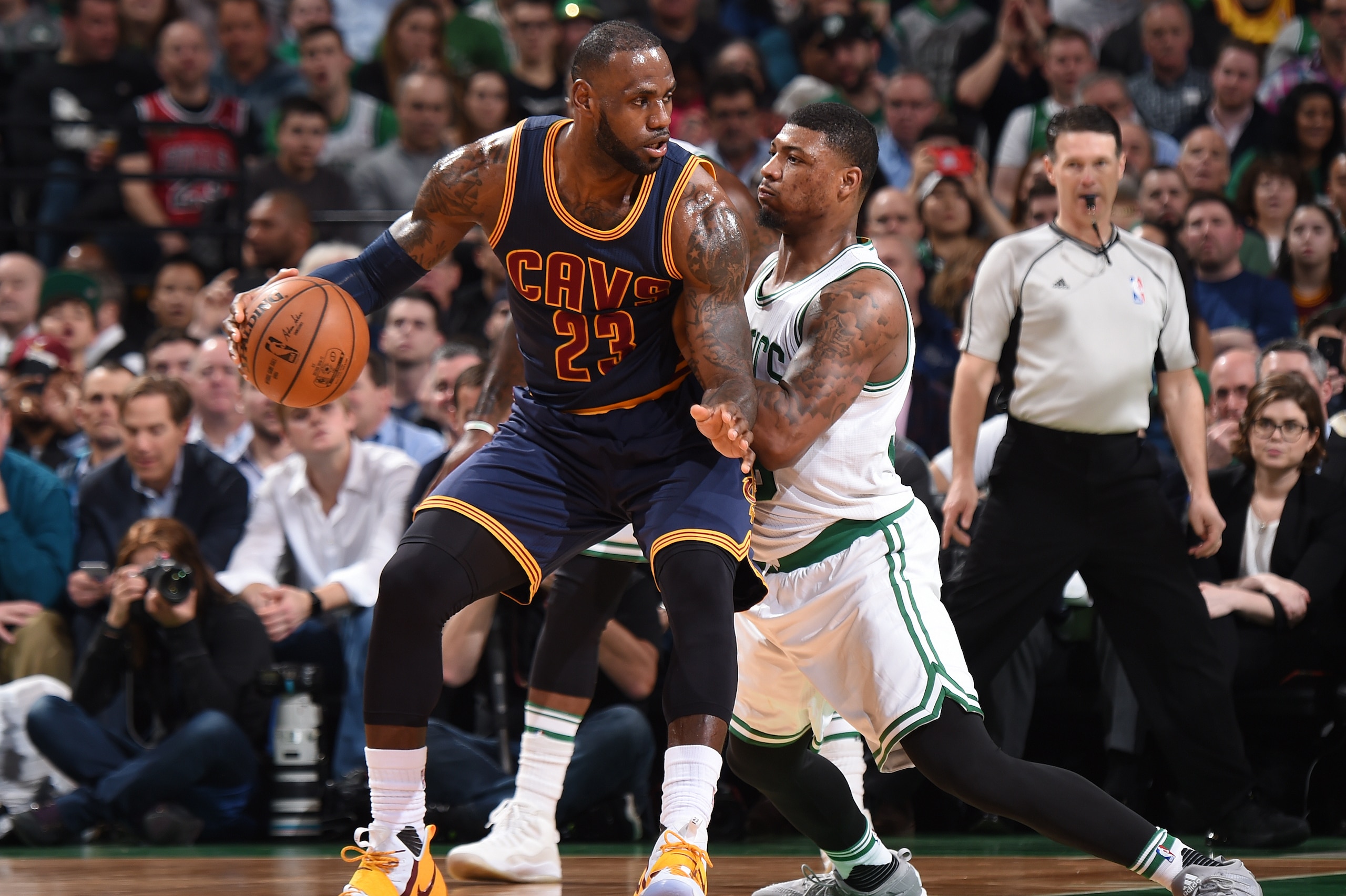
Cleveland could keep its starting backcourt of Kyrie Irving and Smith intact while putting George at his most comfortable position at the 3. James has been hesitant to move to the 4 in the past, but that was largely during his time with the Miami Heat. In the past five years, the NBA has gotten smaller, faster and less position-defined. Remember, James was willing to switch positions in 2016 if Joe Johnson would have signed with the Cavs, according to Haynes. He'd presumably do the same for George.
In the postseason, James already plays plenty of power forward. Over his past three playoff runs, James spent 45.3 percent of his court time playing either the 4 or 5. Head coach Tyronn Lue loves to go with smaller lineups that use James as a point guard on offense and center on defense.
In the Finals, the Cavs' top 10 five-man lineups all had James playing power forward or center, per NBA.com. These 10 lineups were a combined plus-63 in the series, one in which the Cavs lost by a combined 34 points over five games.
Trading Love to get George is almost a must when matching up against the Warriors. Here's how a starting lineup with James and George at the forward spots would look:
| Kyrie Irving | J.R. Smith | Paul George | LeBron James | Tristan Thompson |
| 6'3" | 6'6" | 6'9" | 6'8" | 6'9" |
How Cavs with George Would Match Up Against Golden State
Love's solid 2017 Finals production (16.0 points, 11.2 rebounds) didn't tell the whole story. Love is a fantastic talent, a great locker room guy and is productive against 28 NBA teams, but the Warriors are his kryptonite.
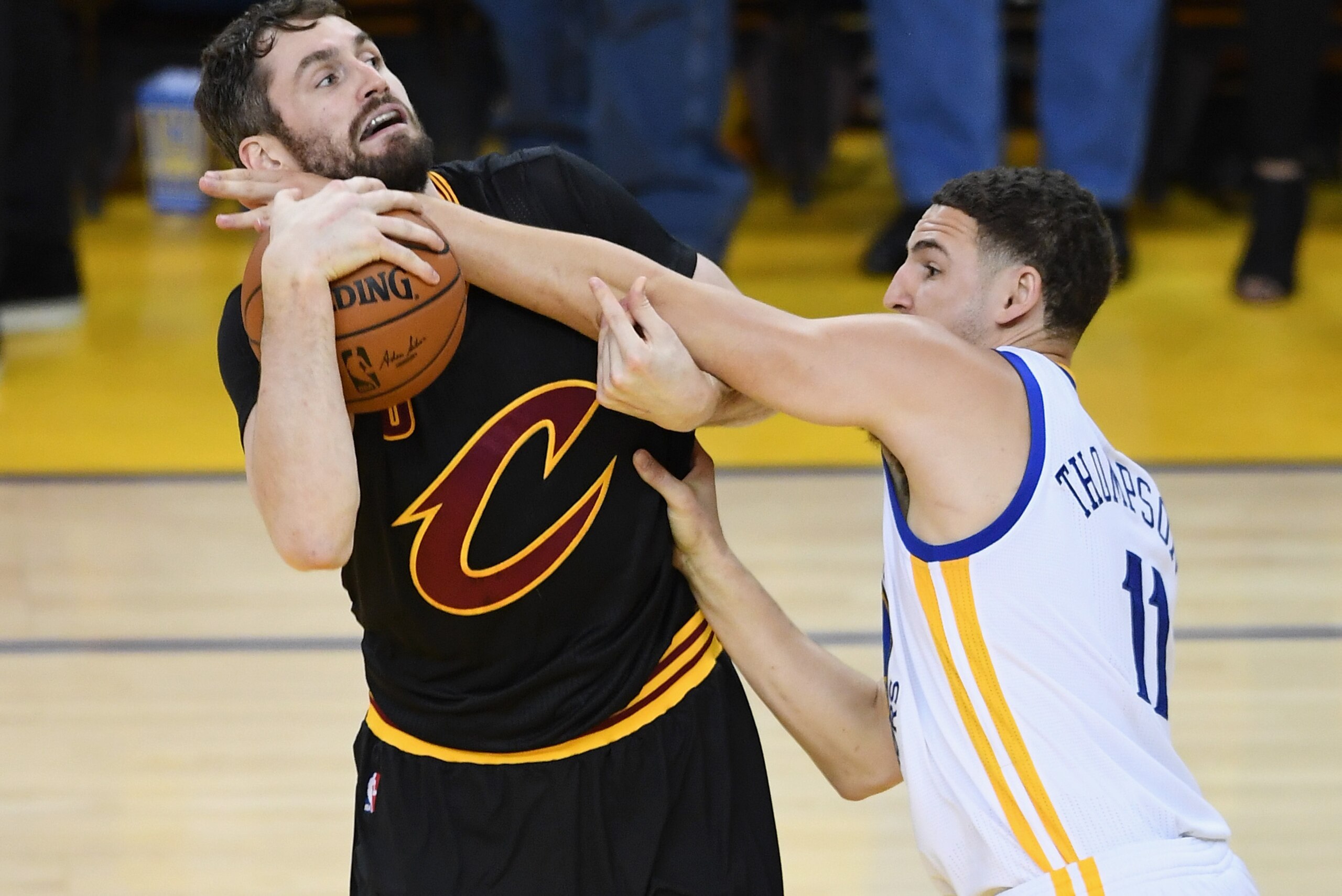
Love scored 18.9 points on 43.3 percent shooting against all non-Golden State teams this past year, regular and postseason combined. Against the Warriors, this production fell to 14.7 points on just 37.2 percent.
Defensively, Love was sound throughout the Eastern Conference playoffs, holding Pacers, Toronto Raptors and Boston Celtics players to 50.9, 48.1 and 46.2 percent shooting from the field, respectively, per B/R Insights. The Warriors were too much, however, scoring on Love at a 52.6 percent clip.
Given the Warriors' tendency to go small with Draymond Green at the 5 and Kevin Durant at the 4, the Cavs were forced to choose between using either Love or Thompson, their third and fourth-best players.
Adding George would revolutionize Cleveland's matchups against Golden State.
Instead of going small, benching one of their best players and forcing the offensively inept Iman Shumpert or aging Richard Jefferson to fill a big role, the Cavs could use their regular starting lineup for lengthy stretches.
The biggest advantage? James would no longer have to serve as the team's leading scorer and facilitator while also covering perhaps the world's best offensive player in Durant. George is a three-time member of the All-Defense team, and at 6'9" and 220 pounds, he matches up well with Durant's listed 6'9" and 240-pound frame.
"He's my favorite player in the league. I've been saying that for a while,” Durant said before playing the Pacers in December, per Monte Poole of CSN Bay Area. "He's just so smooth, man, and can do it all: can pass, can rebound, can defend, can shoot the J, can post up, handle the ball. He's my favorite player.
"Just getting to know him over the last few years, it makes the competition even better when we play against each other. I‘ve got nothing but respect for Paul. It's a mutual respect. We always have battles when we play against each other."
George held opponents to just 34.7 percent shooting from outside of 15 feet this past season, 2.6 percentage points below their season average, per NBA.com. His length and ability to play on the perimeter regularly frustrates opponents and forces them into adjusted shot releases.
While no one can stop Durant, George has been able to somewhat contain him. In their three meetings over the past two years, Durant shot 14-of-27 in the 19 minutes and 55 seconds George guarded him, per B/R Insights. Durant made just three of his 12 three-point attempts during this time.
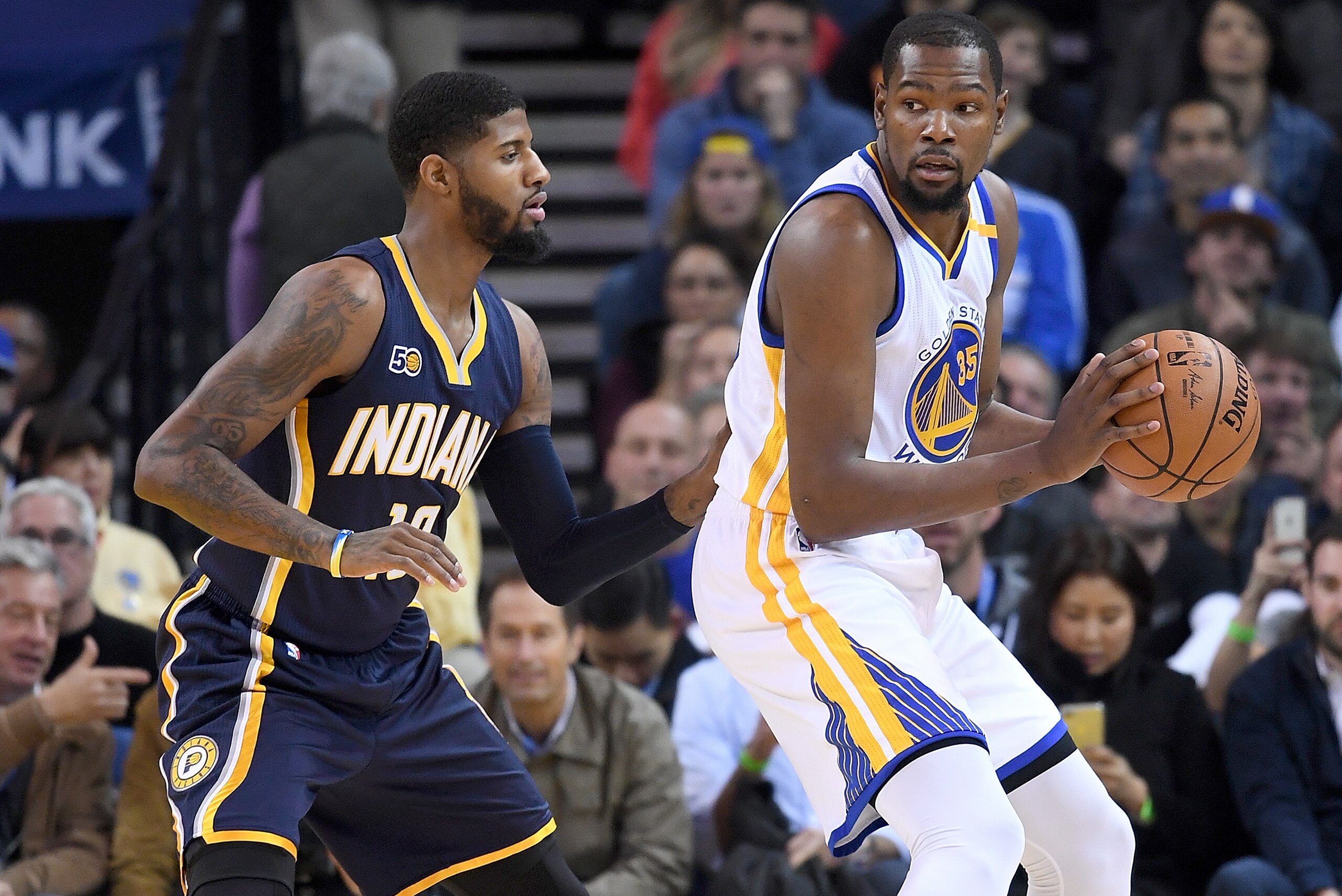
Against Cleveland in the Finals, Durant was the Warriors' best outside shooter at 47.4 percent (18-of-38). If Durant missed a few more attempts in Games 3 or 5, the series could have gone to Game 7.
Some of the Cavs' best moments came when 36-year-old Jefferson guarded Durant for stretches so James could get a breather and focus on running the offense. With George on Durant and James switching to guard Green, the four-time MVP could have increased his 33.6-point, 12.0-rebound and 10.0-assist performance. Scary to think about.
Having George on offense would help tremendously. His 23.7 points per game were 15th in the NBA, and he could carry Cleveland for stretches while James and Irving need a break. The Cavs without James have typically been a crumbling mess. With George, they might be able stretch a lead at times rather than watch one disappear.
Adding George to the Cavs would make life more difficult for the Warriors defensively as well. Durant would have to pick his poison between defending James and George, while Green would see more time on James and less on Thompson.
George playing off the ball with James as a playmaker would bring a different dimension to his game, too. He made 41.8 percent of his catch-and-shoot threes and 40.0 percent of all "open" looks this past season, which he'd see far more of playing next to James and Irving rather than Jeff Teague and Thaddeus Young.
Trading for George would be risky for Cleveland, as he could walk as an unrestricted free agent in 2018. But considering all he would bring to Cleveland, especially against the Warriors, the Cavs should take that chance.
Greg Swartz is the Cleveland Cavaliers' lead writer for Bleacher Report. Stats provided by NBA.com and Basketball-Reference.com unless otherwise noted.
.jpg?w=2560 "NFL head coaching legend has a Minecraft hobby just as impressive")
.jpg?w=2560 "Baker, Bucs Agree to Deal 💰")

.jpg?w=2560 "Week 1 Waiver Wire Targets")
.jpg?w=2560 "Week 1 Start 'Em, Sit 'Em Plays")