

Why Ezekiel Elliott Should Be the Leading 2016 NFL MVP Candidate
There's a resistance to handing the NFL Most Valuable Player award to anyone who doesn't play quarterback.
That stubbornness is understandable given how physically demanding and mentally terrifying the position is every week. But rigid thinking might be useless in 2016, a year with plenty of quality quarterback candidates but also lacking one who has seized the crown.
The Patriots' Tom Brady is having a, well, Brady-like year. But he missed a quarter of the 2016 season due to suspension.
.jpg?w=2560 "Colts Football")
.jpg?w=2560)
.jpg?w=2560 "Commanders 49ers Football")
There's a solid case to be made for the Detroit Lions' Matthew Stafford. It's based around his high efficiency—but at a specific time and game situation. The Oakland Raiders' Derek Carr has fallen off a touch in recent weeks. And the Atlanta Falcons' Matt Ryan is having a tremendous season, but not with the same dominance as 2015 MVP Cam Newton.
It's time to open your mind and look beyond the annual routine of defaulting to the best quarterback. This year, the leading candidate with two weeks remaining plays a different position, and he has a chance to do something historic.
Ezekiel Elliott has redefined how we look at the modern rookie running back.
Sitting at 1,551 rushing yards heading into Week 16, the Dallas Cowboys back has a legitimate opportunity to break Eric Dickerson's rookie rushing record of 1,808 yards. Dickerson established that lofty perch way back in 1983, and since then only one rookie has even kind of, sort of (but not really) approached the same rushing area code. That was Alfred Morris when he ran for 1,613 yards with the Washington Redskins in 2012.
In fact, Morris is the only rookie running back over the past 33 years to break the 1,600-yard mark, a plateau Elliott will cruise past in Week 15 with one more game remaining.
It's important to let history sink in and realize how high Dickerson's benchmark is for a rookie running back—and how impressive it will be if Elliott even threatens his record.
So consider all the Hall of Fame running backs who have come and gone since Dickerson set his record more than three decades ago.
There are six running backs in the Pro Football Hall of Fame who played their rookie seasons after 1983. Collectively they earned 41 Pro Bowl bids, and they recorded a combined 11 seasons with 1,500-plus rushing yards.
Oh, and one of the names on the list below is the NFL's all-time leading rusher. Yet despite the bright shine coming from each Hall of Famer, they all fell well short of Dickerson's record.
| Thurman Thomas | 1988 | 881 |
| Barry Sanders | 1989 | 1,470 |
| Emmitt Smith | 1990 | 937 |
| Jerome Bettis | 1993 | 1,429 |
| Marshall Faulk | 1994 | 1,282 |
| Curtis Martin | 1995 | 1,487 |
Heck, Elliott's chase is still impressive when we expand the historical scope further.
Let's assume he puts a scare into Dickerson but falls short. In that scenario, he'd get to 1,700-plus yards, which would require a cake walk by Elliott's standards (149 rushing yards over two games). In post-merger league history, there have been only 30 seasons in which a running back has chugged for 1,700-plus yards. And here's the real hammer: Not one was a rookie, save for Dickerson.
So it's clear Elliott is doing something historically significant. And when we return to modern times, he's also compiling all of his yards at a higher rate than anyone.
Through 14 games, Elliott has gained 327 more yards than the Titans' DeMarco Murray, the league's second-best rusher (1,224 yards). He's averaging 110.8 rushing yards per contest, which is 6.6 yards clear of the Steelers' Le'Veon Bell, whose per-game rushing average is boosted by missed games and 69 fewer carries.
Beyond Bell, Elliott is in another dimension compared to the rest of his peers.
| Ezekiel Elliott | 310 | 110.8 |
| Le'Veon Bell | 241 | 104.2 |
| DeMarco Murray | 268 | 87.4 |
| LeSean McCoy | 205 | 86.8 |
| Jordan Howard | 211 | 81.5 |
Elliott has logged far more carries than anyone on that list, which means he's also had many more opportunities to stumble and hurt his rushing average. But he just keeps going.
As he plows forward, though, Elliott will run into an MVP wall far stronger than any defensive line he's muscled through in his young NFL career. That is when a different sort of history comes into play.
The NFL has named an MVP every year since 1957. Of those 59 years the award has been handed out, it's gone to a quarterback at the end of 40 seasons.
I'm not mentioning that to show some wrong in need of fixing. Quarterbacks are deemed the most valuable players more often for a simple but important reason: They play arguably the most mentally complex position in sports, and the physical demands—to be athletic, to be a precise thrower and to manipulate the pocket with keen instincts—are high, too.
Which is why, historically, in a season when the MVP isn't a quarterback, another player at a different position did something exceptional.
That happened in 2012 when Minnesota Vikings running back Adrian Peterson came nine yards short of breaking Dickerson's all-time single-season rushing record. It happened in 2005 when Seattle Seahawks running back Shaun Alexander broke the single-season total touchdowns record. And it happened in 2006 when the Chargers' LaDainian Tomlinson, who scored 31 times for a record that still stands, dethroned Alexander.
Elliott has to scale a steep mountain. The question is: Has he already done that? Or is he almost there but in danger of falling just short?
Another slice of history from NFL Research gives us a better idea of exactly how high that mountain is. Entering the hallowed MVP grounds as a running back has often meant holding one of two keys, and he likely won't get either of them:
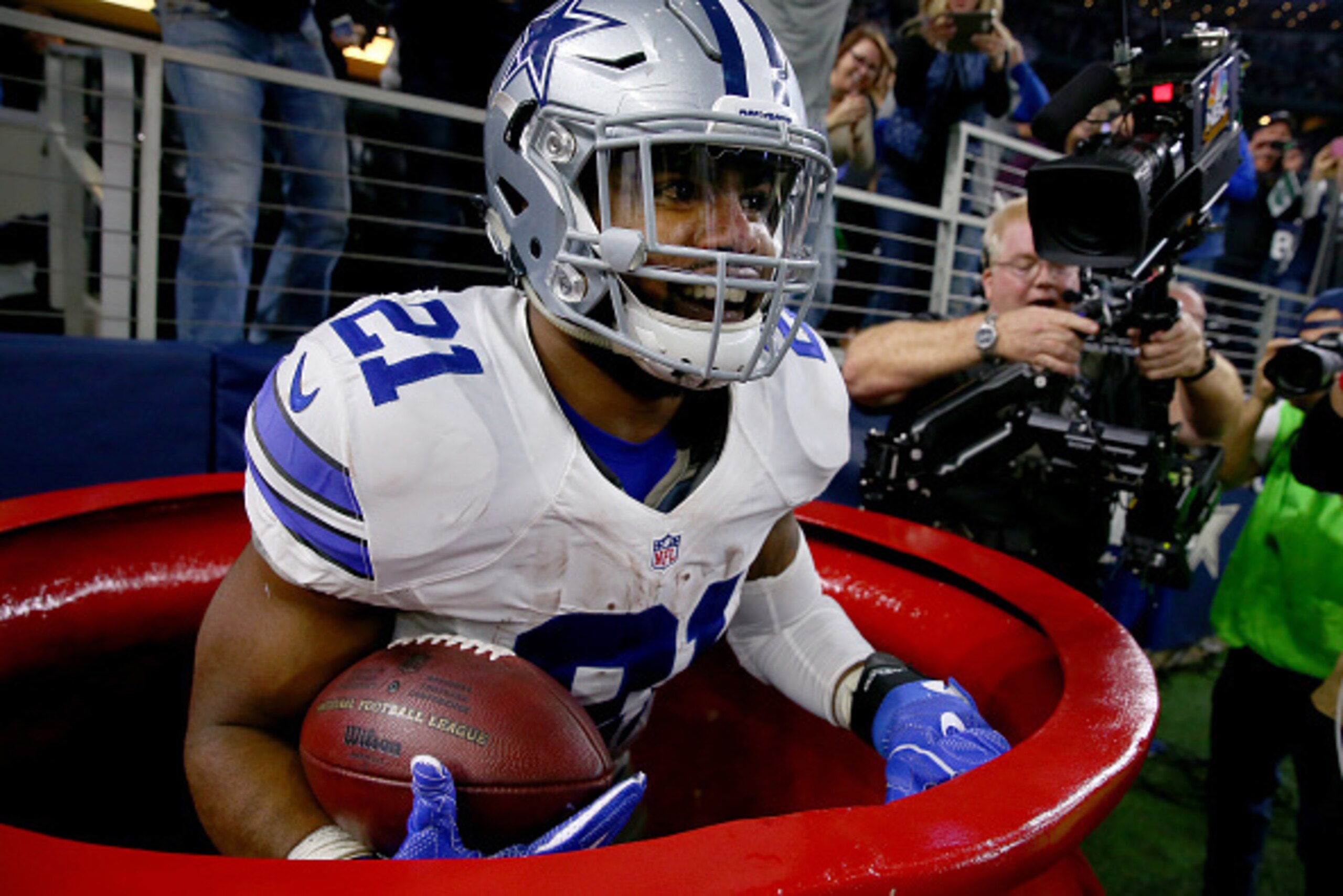
Those projections came prior to Week 15, when Elliott exploded against the Tampa Bay Buccaneers for his highest single-game rushing total (159 yards). He also scored his 14th touchdown and then disappeared into a giant red kettle.
That game bumped Elliott's 2016 rushing pace up to 1,773 yards, which shows how much Dickerson's rookie record is within reach with one more outburst. It wouldn't even need to be a real kaboom either. He needs to average 128.5 rushing yards over the final two weeks to tie it, which sounds like a mighty tough ask until you remember he marched through four straight games with 130-plus rushing yards from Weeks 3 to 6.
But yes, he'll still fall well below both the 2,000-yard rushing mark and 20 touchdowns. Should the barrier for MVP entry still be that high at the running back position, though?
The NFL has been a pass-oriented league for about a half-decade now, and that's not changing anytime soon. Dan Marino's single-season passing yards record of 5,084 yards stood for 27 years. Then over a three-year stretch starting in 2011 his record was passed five times. Marino now has one of eight seasons in which a quarterback passed for 5,000-plus yards, and for well over two decades he stood on that pedestal alone.
So while an MVP running back needs to do something remarkable, the goal posts should still be adjusted accordingly as rushing production gets suppressed.
Where they should sit is the tricky question, and it's one MVP voters will wrestle with. But siding with a first-year player who's dominated in every facet of the game, as ESPN Stats & Information notes, is never a bad idea:
The earth-moving offensive line Elliott runs behind has been showered with praise each week. But the credit those five men are rightfully receiving shouldn't subtract from Elliott's brilliance. After all, he's generated lots of extra yardage on his own by running like a moose in the Canadian wilderness who's late for something.
Elliott's violent running style has led to 913 yards after contact, according to Pro Football Focus. That leads the league by a wide margin (the Dolphins' Jay Ajayi is second with 707 yards). He's done that while setting a new Cowboys rookie record for single-season rushing yards in only 10 games. Then in Week 15, he established a new franchise rookie record with his 13th rushing touchdown.
Even if he doesn't push Dickerson aside, Elliott will likely become only the second rookie running back to reach the 1,700-yard mark. He'll do that in an era when the thundering workhorse running back who tows his team to the postseason is largely an extinct species. And he'll do it while far surpassing the rookie rushing total of every Hall of Fame running back since 1983.
He's doing something rare, and deserves two awards for it: the Offensive Rookie of the Year and the MVP.

.jpg?w=2560 "DOLPHINS-AIKMAN")








