What Does 2K Say: Would Kevin Durant Actually Fit with Golden State Warriors?
The Golden State Warriors are already stomping virtually everyone in their quest for back-to-back titles. Behind Draymond Green's triple-doubles, Stephen Curry's offensive exploits and Klay Thompson's ability to catch fire, the team is gearing up for a run at 73 victories, and it seems as if they won't be denied their shot at history.
But what if the Dubs added another MVP candidate into the mix for the 2016-17 campaign? As rumor has it, Kevin Durant is thinking about signing with the Association's prohibitive favorites once his contract with the Oklahoma City Thunder expires.
"It isn't only that the NBA champions are determined to recruit Oklahoma City's Kevin Durant," Yahoo Sports' Adrian Wojnarowski recently reported. "The truth is that they're the most intriguing destination to him. If Durant leaves the Thunder, the Warriors are the significant frontrunners to sign him, league sources told The Vertical."
TOP NEWS

Pic of LeBron's Helicopter Commute 🚁

Duren Calls Out 'False' Rumors
Trade Idea to Give Warriors Alternative All-Star Upgrade 🏀
Let's assume it happens.
That doesn't guarantee the Warriors what could be their third title in a three-year span. It's possible Durant's presence would be too much of a good thing, if for no other reason than him inevitably taking the ball out of Curry and Green's hands. Plus, as Bobby Marks broke down for Yahoo Sports, the process required to get the 2014 MVP would decimate the team's depth.
This is where we have to turn to our resident projection model: NBA 2K16.
Regular-Season Showings
After dealing contracts and cutting ties with plenty of non-essential players, we signed Durant to a max contract with the Warriors before handing things over to the computer. It filled out the Golden State roster as best it could, displaying quite the affinity for power forwards:
| PG | S. Curry | S. Livingston | S. Larkin |
| SG | K. Thompson | G. Temple | |
| SF | K. Durant | A. Morrow | |
| PF | D. Green | M. Scott | K. Looney |
| C | F. Ezeli | J. Smith | D. Lee |
So much for enjoying the work of the second unit. Relying on Garrett Temple, Josh Smith, David Lee and others is less than ideal.
Given this roster construction, is there enough star power to overcome the glaring lack of depth? Based on the 20 seasons we simulated, the answer is a definitively positive one during the regular season.
The Warriors only failed to break past the 60-win barrier in five of the 20 campaigns, low-lighted by a 54-28 record in Simulation 14 that still gave them the No. 2 seed out West. But despite the impressive prevalence of 60-win seasons, they trailed the Los Angeles Clippers—who managed to acquire Harrison Barnes and Dwight Howard without losing any member of their current Big Three—in seven different go-rounds.
The average scenario resulted in a 62-20 record, and the Warriors were never better than in Simulation 12, when they won 69 games. But each and every time, it wasn't the current leader of the Dubs who emerged as the top player.
Individual Accolades

Durant was named the league MVP 19 times in 20 attempts—only losing out to Russell Westbrook during the 54-28 season. Based on the stats he produced, this shouldn't be remotely surprising.
The lack of capable bodies behind the small forward—in addition to an affinity for small-ball lineups—granted Durant a lot of time on the court. He made the most of that run, averaging 32.3 points, 10.0 rebounds, 5.7 assists, 1.6 steals and 1.7 blocks per game throughout the 20 simulations.
If you're expecting to see Curry's scoring average join Durant's in the 30s, don't. The typical stars still put up big stats, but all the incumbent Warriors had to sacrifice touches.
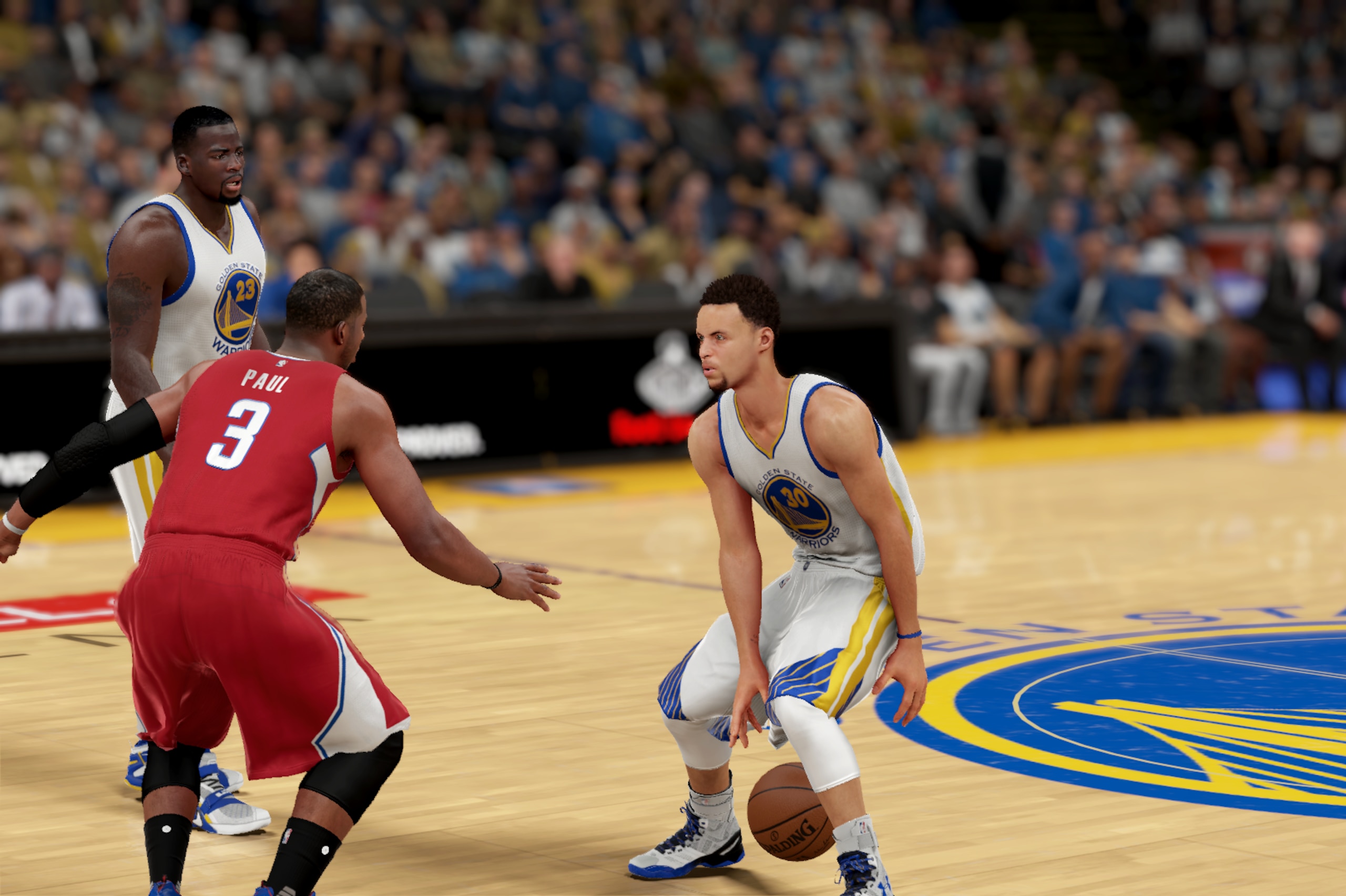
It's only when compared to his current exploits that Curry's 21.8 points, 4.7 rebounds, 6.6 assists, 1.9 steals and 0.2 blocks per outing look less than excellent. Oh, and the sharpshooter joined the vaunted 50/40/90 club in 19 of the 20 sims. He only missed out in Simulation 13, when he shot just 89.9 percent from the charity stripe.
Joining him in the backcourt, Klay Thompson didn't have much trouble scoring either. There was virtually no defensive attention paid to him with Curry and Durant spreading out the opposition, so he thrived as a spot-up marksman to the tune of 20.6 points, 4.5 rebounds, 2.9 assists, 1.3 steals and 0.9 blocks per contest.
That's already 74.7 points per game from the three leading scorers, which means Green didn't need to put up too many shots. Instead, he made one All-Star team after another by averaging 10.9 points, 10.7 rebounds, 6.0 assists, 0.9 steals and 1.5 blocks.
Obviously, the offense didn't struggle. Four of the starters combined to average 85.6 points, and everyone was ridiculously efficient.
But the defense was excellent, too, as you can see from the progression of two-way ratings below:
The offensive rating peaked at 115.8 and never fell below 110.8, which would be the No. 4 mark during the 2014-15 season, behind only the Warriors, Thunder and San Antonio Spurs. Meanwhile, the defensive rating fluctuated between 98.9 and 103.4. Even that latter number would fall inside the top 10 during the campaign still in progress.
As a result, the net rating was pretty strong each and every season.
My databases show that the 1995-96 Chicago Bulls have the best net rating of all time, outscoring the opposition by a staggering 13.4 points per 100 possessions. Well, the Durant-led Warriors topped that mark during four different sims, highlighted by their 14.5 net rating in Simulation 5.
Their worst score was a 9.2 net rating, (that would go down as one of the 20 best in NBA history), and the average (11.9) would trail only the '96 Bulls and '97 Bulls on the all-time leaderboard.
Was it Worth It?
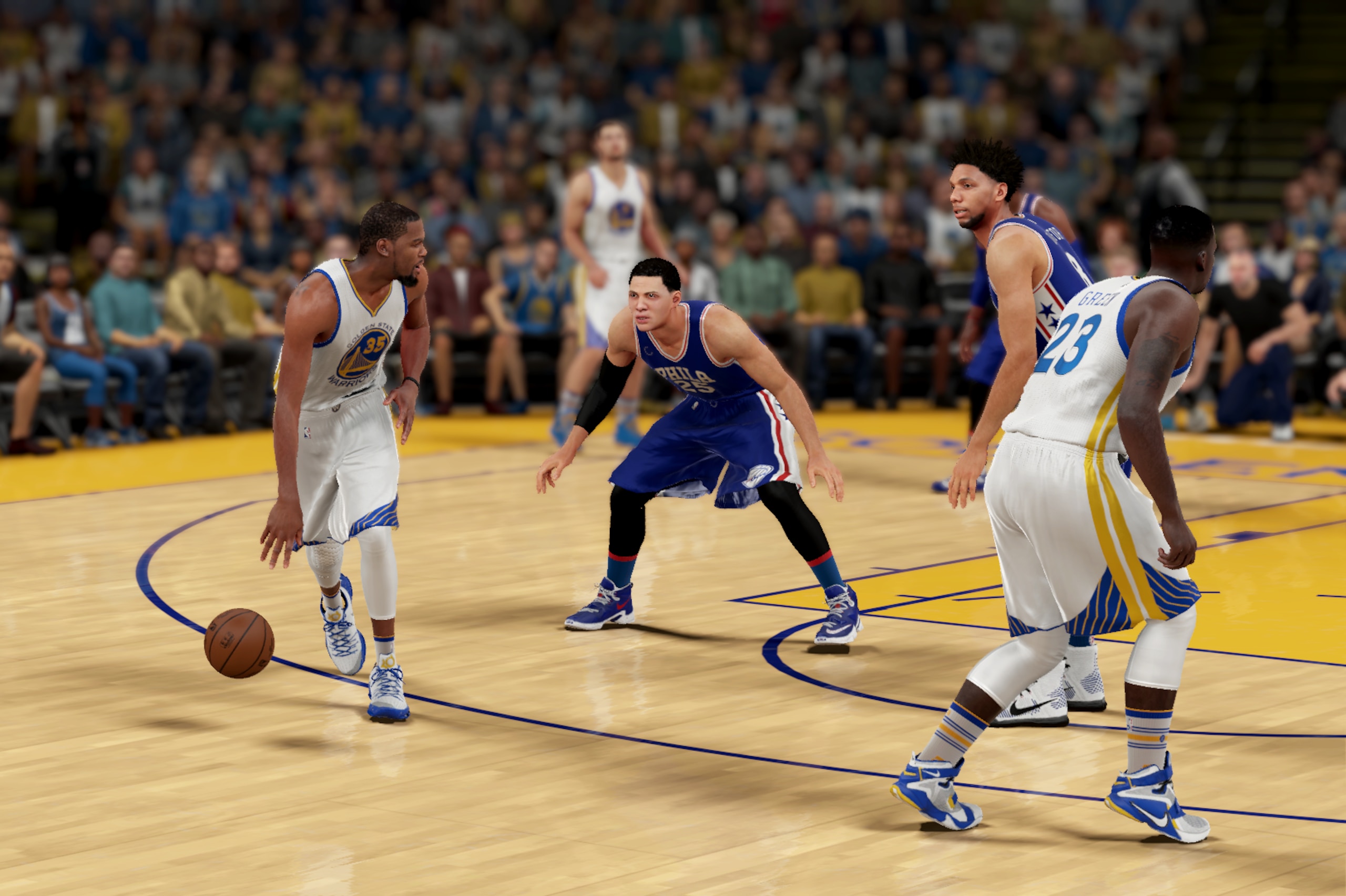
But did the regular-season success translate enough into the playoffs to justify this path? It depends on how high your expectations are.
The Warriors "only" won championships in nine of the 20 simulations, though five of the losses did come in the finals. The Clippers eliminated them in the Western Conference Finals three times, and the Memphis Grizzlies, New Orleans Pelicans and Thunder managed to dethrone them once apiece during the second round.
Based on this relatively small sample, we'd have to give the Warriors a 45 percent chance of winning a title. For perspective, the Westgate Las Vegas SuperBook recently gave them 6-5 odds at emerging victoriously this season, per ESPN.com's Ben Fawkes, and that also corresponds to a 45.4 percent chance.
There's just one catch.
The current Warriors are built to withstand injuries to basically anyone but Curry and Green. They have the advantage of depth and a system that's built to maximize the production of virtually everyone in the lineup.
Go after Durant, and you lose that safety net. One injury to a starter, and progress could come to a screeching halt. Just imagine if Ezeli was knocked out for the year, forcing the Warriors to go with a makeshift center in a constant small-ball lineup.
So, is signing Durant worth it? That's up to you.
Adam Fromal covers the NBA for Bleacher Report. Follow him on Twitter @fromal09.
Unless otherwise indicated, all stats are from Basketball-Reference.com or Adam's own databases and are current heading into games on Feb. 3.


.jpg?w=2560 "NFL investigating 2 referees for separate viral exchanges")
.jpg?w=2560 "Report: Chiefs Contact Hill's Agent")
.jpg?w=2560 "OBJ Calls Out Giants 😳")

.jpg?w=2560 "Tyreek makes another cryptic post amid Chiefs rumors")