FLORHAM PARK, N.J — It’s the normal Thursday routine at the New York Jets practice facility.
Right after the team’s daily workout concludes, those in the media room are summoned together as the coordinators speak for 10-15 minutes. Unlike when New York head coach Todd Bowles talks, these conversations are a bit more game plan-oriented and offer reporters a chance to get a little more in-depth with details on the X’s and O’s.
On this particular day, one reporter cut right to the chase during the opening seconds of defensive coordinator Kacy Rodgers' press conference.
TOP NEWS
.jpg?w=2560 "Colts Football")
Jonathan Taylor Landing Spots
.jpg?w=2560 "NFL Paris Football")
NFL House in Paris Closes for Protests (AP)
.jpg?w=2560 "Seahawks Chiefs Football")
Trevon Diggs Cut by Seahawks
“Yeah, if you could just tell us how you plan to stop Tom Brady, Rob Gronkowski and Julian Edelman, then we’ll be done,” he joked.
“Ugh,” Rodgers responded. “You just made my stomach want to throw up.”
Sunday afternoon, the Jets will look to do what no other team has to this point: Slow down and stop the unstoppable and unbeaten New England Patriots. While the Jets are sitting pretty at 4-1, the Patriots are playing at a level that hasn’t been seen since 2007. So, how exactly can the Jets pull out a surprising victory? Here’s the game plan entering Sunday’s divisional matchup.
Offensive Game Plan
Following the Jets 34-20 victory over the Redskins a week ago, Washington head coach Jay Gruden made an innocent comment, but it is one that those following the Jets haven’t heard in quite some time.
Having watching receiver Brandon Marshall torch his team’s secondary, running back Chris Ivory run rampant through his front seven and quarterback Ryan Fitzpatrick do enough not to lose, Gruden was asked to evaluate the Jets offense as a whole.
Were they great? Were they good? Was it just a bad day from his defense? What made the Jets so successful that particular October day at MetLife Stadium.
“They have a nice offense there with (Ivory) and Brandon and (Eric) Decker,” Gruden said, “And Fitzpatrick didn’t make many mistakes.
“That’s where we’d like to get to. We’d like to have that same balance going.”
Wait...rewind that one second? After the Jets had been anemic for nearly a decade, another team in the NFL actually wants to be what they are? On offense?
Oh my...
Oh what a difference a year makes.
All joking aside, what the Jets will need to do on offense against New England is exactly what they’ve done in each of their four wins: Run the ball, attack in the passing game when the opportunity presents itself and don’t force the issue. That same balance that Gruden wants to replicate will be at the center of any victorious game plan. Because if the team decides to get into a shootout with New England, well, that’s not a battle New York going to win.
See, when the Jets offense is at its best, Ivory is running rampant throughout a defense. Be it Decker, Marshall, Bowles or anyone else associated with the team, all will say the workhorse of the offense is Ivory and that the offense runs through him.
But the issues that defenses are having when facing the Jets is the fact the offense isn’t just Ivory. Yes, he is the focal point, but he’s not the only point or option. Decker and Marshall cannot be overlooked.
Here are two examples: If a defensive coordinator decides he wants to limit what Decker and Marshall do, thus playing just a seven-man front (not a stacked box), things like this happen:
Now, in order to stop plays like the one above from taking place, an extra player needs to be put in the box to create an eight-man front. The issue? By doing that, Marshall and Decker can then take advantage of single coverage on the outside:
This is the balance Gruden was talking about, and it’s the same balance that offensive coordinator Chan Gailey touched upon Thursday.
“If (the Patriots) want to stack the box, I like our matchups outside,” Gailey said. “If they want to roll the coverage and leave the box open, I like our matchups there, too. Our line has done a good job being physical up front. We’ll take that. They’re pretty physical up front themselves.
“We’ll have to end up taking advantage of whatever it looks like and you have to go into it generic and see what they’re doing and evolve from there offensively.”
Against the Patriots, the opportunity will be there to run the ball. New England’s offense has been unstoppable through the first quarter of the season, but its defense has shown areas of vulnerability, specifically against the run.
Per Pro Football Focus, New England has graded out at minus-15.7 versus the run; that’s the fifth-worst rating in the NFL. If the Jets defense can keep the game close, there’s no reason to believe Ivory won’t be able to find rushing lanes against the Patriots. But again, in order for that to happen, the game is going to have to remain tight.
With Tom Brady and the Patriots offense dominating, opponents have had to forgo the run. Down three or four scores, the opposition has to thrown in order to keep the game from getting out of hand or to fight back into the game and prevent a blowout. As a result, New England’s defense has been able to key in on just one area of the game: Rush the passer and stop the pass. It hasn’t had to worry about the run.
But when the game is close, and an offense is able to use its full playbook, things like this happen:
Defensive Game Plan
On offense for the Jets, the game plan is relatively simple. On defense? Things couldn’t be any more complicated. What New York will be attempting to do on Sunday is something that hasn’t been done this year.
Forget stopping the Patriots—if the Jets can even slow them, it’ll be a first for 2015. The stats are mind-boggling. Here are the two most staggering:
- Tom Brady is completing 70.6 percent of his passes and has thrown 14 touchdowns and just one interception.
- The Patriots offense, in the last three weeks, has scored 134 points.
What the Patriots do so masterfully is how and when they rotate their players in and out to get the matchups they want. It’s not as simple as "OK, Darrelle Revis you cover him, Antonio Cromartie, you cover him and Buster Skrine, you cover him." Before the ball is even snapped, New England can manipulate a defense to get the exact look it wants.
| Player Name | Position | |||
| Tom Brady | QB | 5,436 Passing Yards | 45 Touchdowns | 3 Interceptions |
| Julian Edelman | WR | 1,436 Receiving Yards | 128 receptions | 12 Touchdowns |
| Rob Gronkowski | TE | 1,360 Receiving Yards | 73 Receptions | 16 Touchdowns |
As pointed out by WFAN's Boomer Esiason, the Patriots will occasionally send out three tight ends and a bigger running back for their “jumbo front” on any given play. When a defensive coordinator sees this, he counters by sending out his heavy package, expecting a run. But when the Patriots get to the line and just before the snap, the skill position players will stand up and change formation.
The next thing you know, you have your second-team, run-stopping linebacker one-on-one with running back Dion Lewis outside.
The technique works the same when New England wants to run it. The team will take the field with four wide receivers, get a defense to counter with its dime formation and then simply run the ball out of the shotgun against a now "smaller" defense.
It’s all about matchups with head coach Bill Belichick and Brady. But the difference between this year and years past is the Patriots don’t have to rely on matchups to win games. Sure, it helps, but even if a defense defends a play perfectly, the team now has the players who can simply win matchups no matter the situation.
And no better player perfectly describes that than tight end Rob Gronkowski.
At 6’6" and 265 pounds, Gronk is a nightmare for any defensive coordinator. He can catch, he’s strong, and he’s fundamentally sound. He’s as impactful blocking as he is receiving. There really isn’t anyone else in the NFL like him.
So, how do the Jets plan to slow him? No one knows.
“He’s one of the hardest to (game-plan),” Rodgers said. “There are a lot of good tight ends in the league, but when you start listing them, his name is going to be one, two or three.
“His size, his strength, his catching ability, his blocking ability, his versatility. I could go on and on. He’s a very talented player."
Key Matchups and Players
Dion Lewis vs. Demario Davis, David Harris
In the Jets' one loss this season, there was a glaring observation on the defensive side of the ball. See, the Philadelphia Eagles posed a difficult task: They had receivers that the Jets had to worry about, along with two tight ends.
Thus, the Jets' game plan, naturally, was to use their cornerbacks to cover the Eagles receivers and their safeties to cover the tight ends. It worked. Brent Celek and Nelson Agholor went catch-less, while Jordan Matthews and Zach Ertz combined for just eight receptions and 79 yards.
But that didn’t mean the Eagles passing attack was putrid. The team simply turned to its running backs, who were regularly being covered by Jets inside linebackers David Harris and Demario Davis.
While Ryan Mathews and Darren Sproles combined for just six receptions for 39 yards and a touchdown, the two each had drops that would have both gone for touchdowns of 60-plus yards.
It was alarming and an issue that would likely look to be exploited by others down the road. With scatback Dion Lewis up next, the Jets may have another tough challenge.
“When you look back at that Philly game with Sproles,” Rodgers said, “Anytime you have a receiving threat like that, it’s a matchup problem. You wanna put a safety on him, but then you’re taking a safety out of the middle of the field. (Lewis) is a bad matchup for your backer. It’s definitely a matchup of great concern.”
How the Jets plan to cover Lewis will likely be determined by how they cover Rob Gronkowski. If they elect to use All-Pro cornerback Darrelle Revis one-on-one with the big-bodied tight end, something Rodgers wouldn’t comment much on Thursday, that would free up safety Marcus Gilchrist to cover Lewis.
If Revis tracks wideout Julian Edelman, then the Jets may be stuck with either Harris or Davis on Lewis. If that situation comes to fruition, expect Brady to look Lewis’ way over and over again.
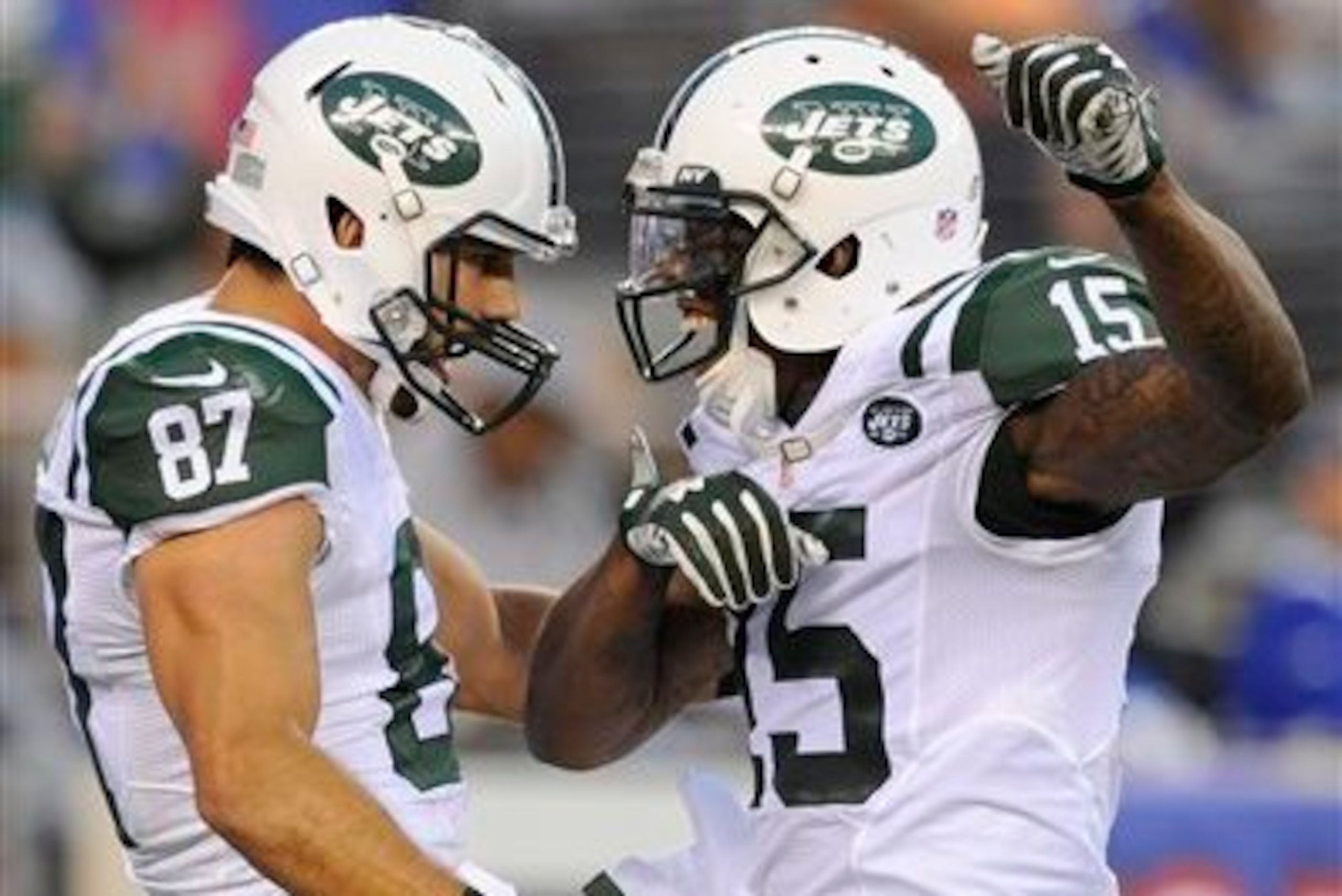
Brandon Marshall, Eric Decker vs. Malcolm Butler, Logan Ryan
It’s the most glaring difference from last year’s Patriots team that won the Super Bowl and this year’s edition that’s off to a 5-0 start.
For 19 weeks in 2014, New England covered receivers with the likes of Darrelle Revis and Brandon Browner. Through the first quarter of 2015, the tandem on the back end has been Logan Taylor and Malcolm Butler. Neither has been bad, but both are downgrades from what the team had a year ago.
Of cornerbacks who have played at least 50 percent of their team’s snaps, Butler is ranked as PFF's 24th-best in the NFL. Ryan, meanwhile, is No. 45. Both face daunting challenges this week in Jets receivers Eric Decker and Brandon Marshall.
When Decker signed with the Jets as a free agent a season ago and Marshall made his way over via trade this offseason, general manager Mike Maccagnan and coach Todd Bowles hoped they’d just constructed a one-two punch that would be one of the best in the league. Marshall was a true No. 1, and Decker was the perfect complement.
It’s still early, but it looks as if the pairing is a perfect match. The two have combined for 55 catches, 750 yards and eight touchdowns. If the Patriots elect to stack the box to contain running back Chris Ivory, that means Ryan and Butler will be one-on-one on the outside. Can they hold up?
With a Jets Win
This would easily be the biggest win for the team in a few years, maybe since the Jets defeated the Patriots in the playoffs back in 2011.
While New York is 4-1, the teams it has beaten aren’t exactly contenders. The Jets were favored in each of their games against the Washington Redskins, Miami Dolphins and Cleveland Browns, and the group got Andrew Luck and the Colts at their lowest point.
The Patriots, though, are the cream of the crop in the NFL. If the Jets pull out a victory, it will not only label the team as a serious contender in the AFC East but also the AFC as a whole.
With a Jets Loss
It’s not so much if the Jets lose but how they lose. If the Patriots drop 35-45 points in a rout, all will be saying the Jets are pretenders who simply beat up on the bottom-dwelling teams in the NFL. But if the Jets lose a close one, it’ll show maybe the team is legit after all.
Prediction
The Jets defense is built to beat the Patriots. The group can pressure Brady with simply the front four and then drop the rest back and play coverage. Take away Brady’s step-up area in the pocket and he struggles. The New York Giants proved that twice on the largest of stages.
The issue with Sunday, though, is that the Patriots offense can feast on the one weak spot on the Jets defense: David Harris and Demario Davis in coverage.
On Sunday, look for Dion Lewis to have a huge game as the Jets try to figure out a way to cover both him and Gronkowski. In a way, it’s almost a "pick your poison." The Jets don’t really have a linebacker capable of covering a good, let alone Gronk-level tight end in the NFL or one who can keep up with Lewis out of the backfield.
With that being said, this won’t be a blowout. The Jets will keep it close, but Brady will pull it out at home. With two minutes left to play, Jets quarterback Ryan Fitzpatrick will throw an interception, sealing a six-point victory for New England.
Final Score: Patriots 26, Jets 20
Connor Hughes is the New York Jets beat writer for the Journal Inquirer and Scout.com. All quotes, practice observations and advanced stats referenced are gathered firsthand unless otherwise noted.
Connor can be reached on Twitter (@Connor_J_Hughes) or via email (Connor_j_hughes@yahoo.com).
.jpg?w=2560)