What's the Secret to Dion Lewis' Sudden Stardom?
Dion Lewis was a nobody prior to 2015. The running back had already reached NFL journeyman status after pinballing around to three teams.
Then, the New England Patriots threw him a career lifesaver.
He was buried on the Philadelphia Eagles running back depth chart after being their fifth-round pick in 2011, posting an easily forgettable 192 total yards over two seasons.
TOP NEWS
.jpg?w=2560 "Titans Giants Football")
OBJ Calls Out Giants After Release
.jpg?w=2560 "Saints Lions Football")
Rap: Lions, LaPorta End Contract Talks

Live Live: Updates from every NFL game
A broken leg derailed his 2013 season with the Cleveland Browns, when he was expected to emerge as a pace-changing third-down option. Then his comeback stalled when the 5'8" bundle of elusiveness was cut by the Browns as training camp concluded in 2014. The Indianapolis Colts rescued him from free-agency purgatory shortly afterward, then also chose to cut Lewis due to greater roster priorities elsewhere.
It seemed for a time the league didn't have room for a diminutive running back capable of excelling in a specific yet critical role. Then, Patriots head coach Bill Belichick, who long ago mastered the running back bargain-bin dive, blew his pixie dust in Lewis' direction.
He was deemed unfit for three rosters over a four-year span. Fast forward to 2015, and he's posted 325 yards from scrimmage over only three games.
A few inevitable questions emerge when we look at the difference between the Lewis of 2015 and the previous years, when he was either injured or facing a depth-chart burial. For starters: How is this guy suddenly on fire? And why did it take four seasons for him to bust out?
| 2011-2014 (24 games) | 192 | 4.9 | 2 |
| 2015 (3 games) | 325 | 7.2 | 2 |
The answers to both lie in simple faith and the need to reinforce a barren depth chart.
With Stevan Ridley and Shane Vereen set to depart as free agents, Belichick knew he needed to find another running back—preferably one who could be an option on passing downs, because bruising brute LeGarrette Blount already had a claim on early-down work.
There's always a penny-pinching element to Belichick's running back dumpster foraging. A stable of cheap options is ideal at football's most combustible position.
But there was also further motivation when he signed Lewis to a futures contract. The Patriots looked at him and saw a familiar face: Kevin Faulk.
"He's very similar to Kevin," Patriots running backs coach Ivan Fears told NESN's Doug Kyed, reflecting on the long-time pass-catching back who played 13 seasons in New England, amassing 7,308 yards and 31 touchdowns.
He continued:
"Kevin, of course, played at LSU and was a hell of an every-down back. The only limitation that these guys have had is the size factor. Everybody just knocked them because of it. But believe me, they've proven a lot of people wrong. Dion has still got a lot of work to do. We're not giving him any crown right now. We're just saying he's been very good through three games, and we look forward to seeing what he can do for us in the future.
"
Like Faulk, Lewis wears No. 33. And like Faulk, Lewis is a missed-tackle-generating machine.
However, this particular machine makes defenders whiff at a comical rate. He leads running backs in missed tackles created after three games, which is already remarkable from a formerly forgotten castoff.
Then when we consider Lewis' lack of touches compared to his peers, it's clear he's already reached a human stick-of-butter level of slipperiness.
| Dion Lewis | 45 | 20 |
| Carlos Hyde | 61 | 19 |
| Marshawn Lynch | 46 | 15 |
| Latavius Murray | 63 | 15 |
| Giovani Bernard | 53 | 15 |
| Devonta Freeman | 54 | 15 |
Excluding the Seahawks' Marshawn Lynch, whose workload was limited in Week 3 when he suffered a hamstring injury, every other running back on that list is at least eight touches ahead of Lewis. That's not an insignificant gap early in the season. The Bengals' Giovani Bernard, for example, has set a pace for 282 touches, while Lewis would currently finish with 240 opportunities.
They all trail the Patriots' rapidly emerging dual-threat running back, who's forced 10 missed tackles as both a runner and receiver, according to Pro Football Focus.
Lewis is a powerful runner despite his small stature and, perhaps more importantly, a willing one between the tackles.
"That was his M.O. at Pitt when he was in college," Fears told Kyed, referencing a brilliant collegiate career when Lewis totaled 2,860 rushing yards over two seasons, averaging 5.3 yards per carry with 30 touchdowns. "He was a very productive every-down back. He's not unfamiliar with running in between the tackles, so we just let him do what he does."
The punch Lewis carries in a small package was evident immediately during a Week 1 win over the Pittsburgh Steelers. He received a steady diet of backfield work with Blount suspended for one game, and Lewis ran with a punishing one-cut style that often had him surging forward for extra yards after contact.
A fine example came in the second quarter. On 1st-and-10 from Pittsburgh's 20-yard line, Lewis was given the ball on a counter run to the left. A wide hole opened, and it quickly began to close when he reached the line of scrimmage.
Lewis first faced contact from Steelers outside linebacker Jarvis Jones. It was weak contact and an attempted arm tackle. But Lewis was still tripped up, with his momentum stalled only two yards downfield.
That bought Steelers defensive end Cameron Heyward enough time to charge in from the right. Lewis then found himself in a potential world of hurt only a split second after Jones' diving tackle attempt.
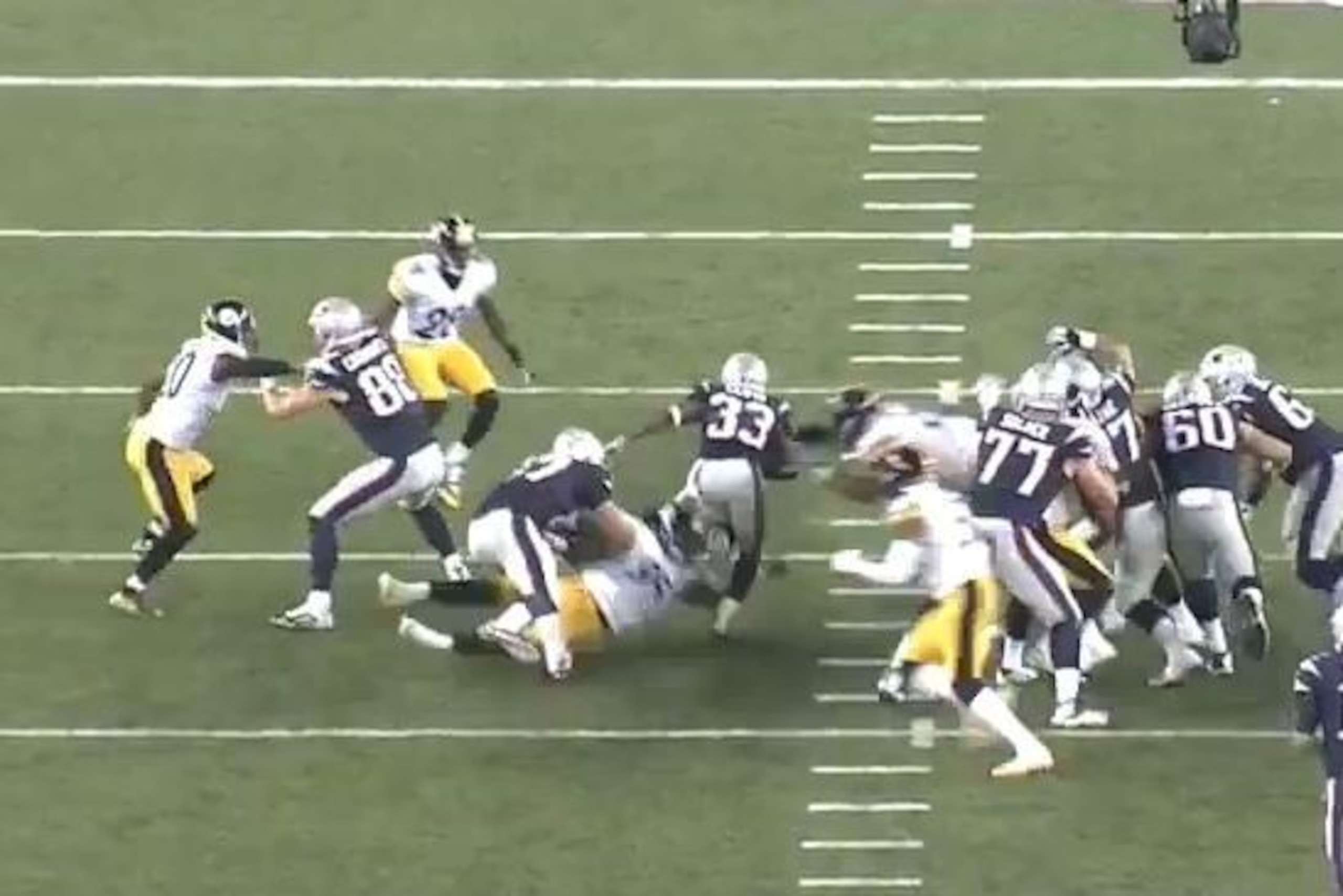
He would have—and probably should have—been stopped for a minimal three-yard gain. He had other plans, though, and reminded us that often, only his height can be described as minimal.
An airborne Lewis bounced off Heyward and was spun around as he absorbed another hit from Cortez Allen, the charging cornerback.

He did all of that while falling forward for another five yards after contact. His legs were pumping, and his shoulders were square. He becomes a difficult tackling target when a naturally low pad level is tossed in.
Lewis frequently ricochets off defenders, which is why he's a quality complementary option alongside Blount. He's averaged 3.13 yards after contact per attempt this season, which ranks fourth among all running backs who have taken at least 50 percent of their team's carries, per PFF.
But although he's effective as a runner, Lewis enters another comfort zone when the ball is sailing toward him, and tackling him one-on-one in the open field usually leads to a face full of grass.
His 179 receiving yards is second among all running backs after three weeks, and as WEEI.com's Christopher Price noted, Lewis is one of only two players with at least 30 carries and 15 catches (Mark Ingram is the other). He's logged 30-plus yards as a pass-catcher in each game so far, highlighted by a Week 2 win over the Buffalo Bills when Lewis turned six receptions into 98 yards.
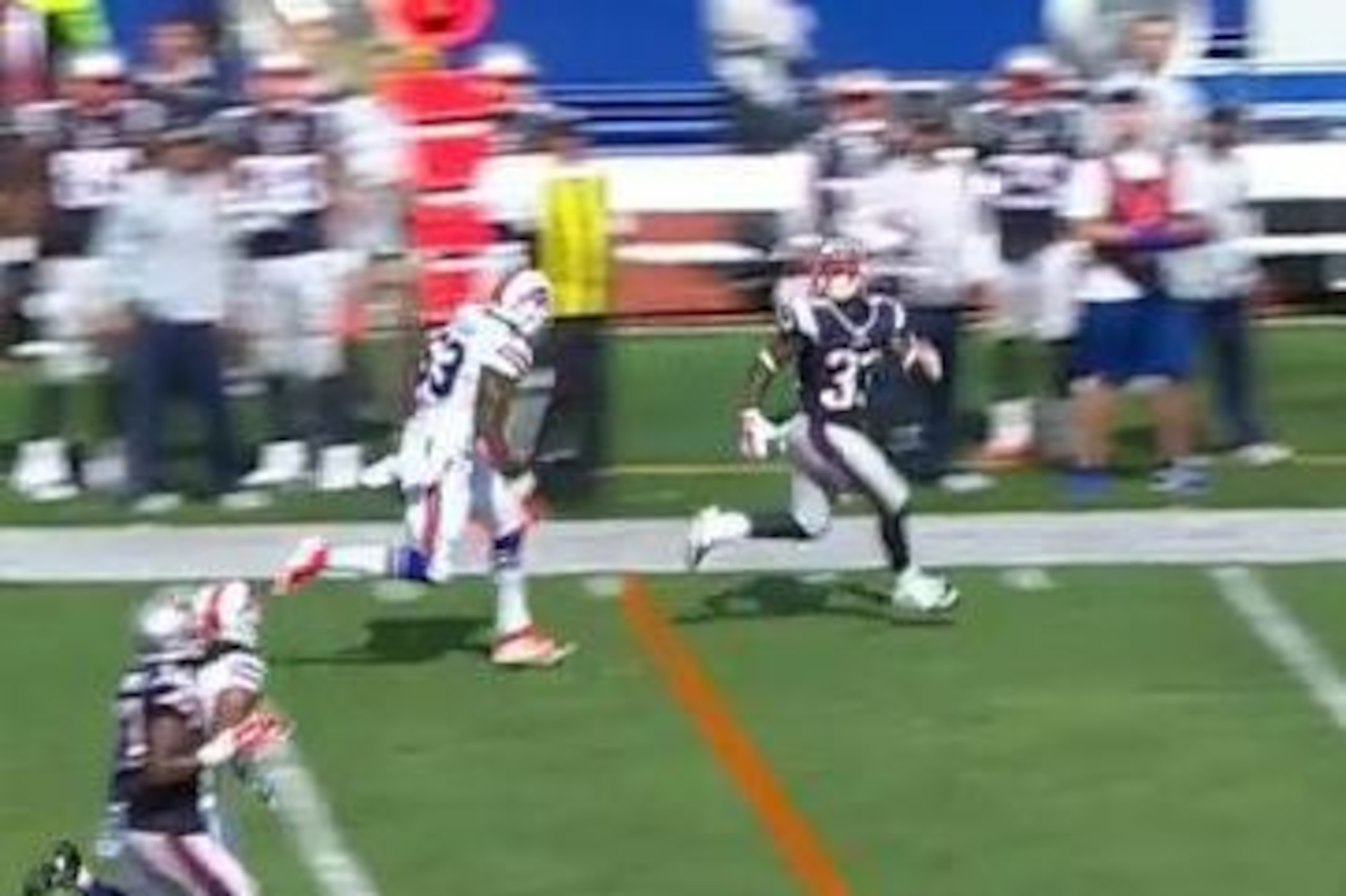
Much of his yardage against Buffalo came when Lewis was on the other end of a 40-yard heave from Patriots quarterback Tom Brady. While he's often used conventionally as a pass-catcher out of the backfield and targeted on screens or swing passes in space, that reception showed how Lewis can provide his team with a unique mismatch-creating weapon.
For one play, he shed his official position title of running back. Instead, Lewis became a wide receiver and was split out wide to Brady's left in a five-receiver set.

Bills linebacker Nigel Bradham was then forced into strange, foreign territory. He was isolated on the outside in coverage.
The end of that matchup was swift and entirely unsurprising. Lewis immediately had Bradham in chase mode, bolting by him with little obstruction. There was quickly about a two-yard buffer between receiver and defender, a throwing window that's the equivalent of roughly three miles for Brady.
Belichick often operates a running back carousel and has famously become stealth-like with his ability to pull convenience-store cashiers from their day jobs, turning them into quality backfield components. That's a slight exaggeration, but could it possibly be true one day? Do your wind sprints, everybody.
In 2014, he plucked Jonas Gray from the practice squad, and the undrafted back ran for 201 yards and scored four times during a Week 10 win over the Indianapolis Colts.
Then, there's Brandon Bolden, who ran for 137 yards in Week 4 of 2012. Bolden has only logged 636 total rushing yards, meaning 21.5 percent of his career production as a runner came in that single game.
Lewis, however, is a more multidimensional option. He addresses a core need, especially with Blount now back from his suspension. He can be the next Faulk, Vereen or Danny Woodhead, and he can do it while still running with power up the middle.
Lewis was once discarded junk but has turned into a useful treasure during the Patriots' search for more trophies.
.jpg?w=2560 "Vikings Buccaneers Football")