
Why Trent Murphy Is Washington Redskins' Best Bet at Outside Linebacker
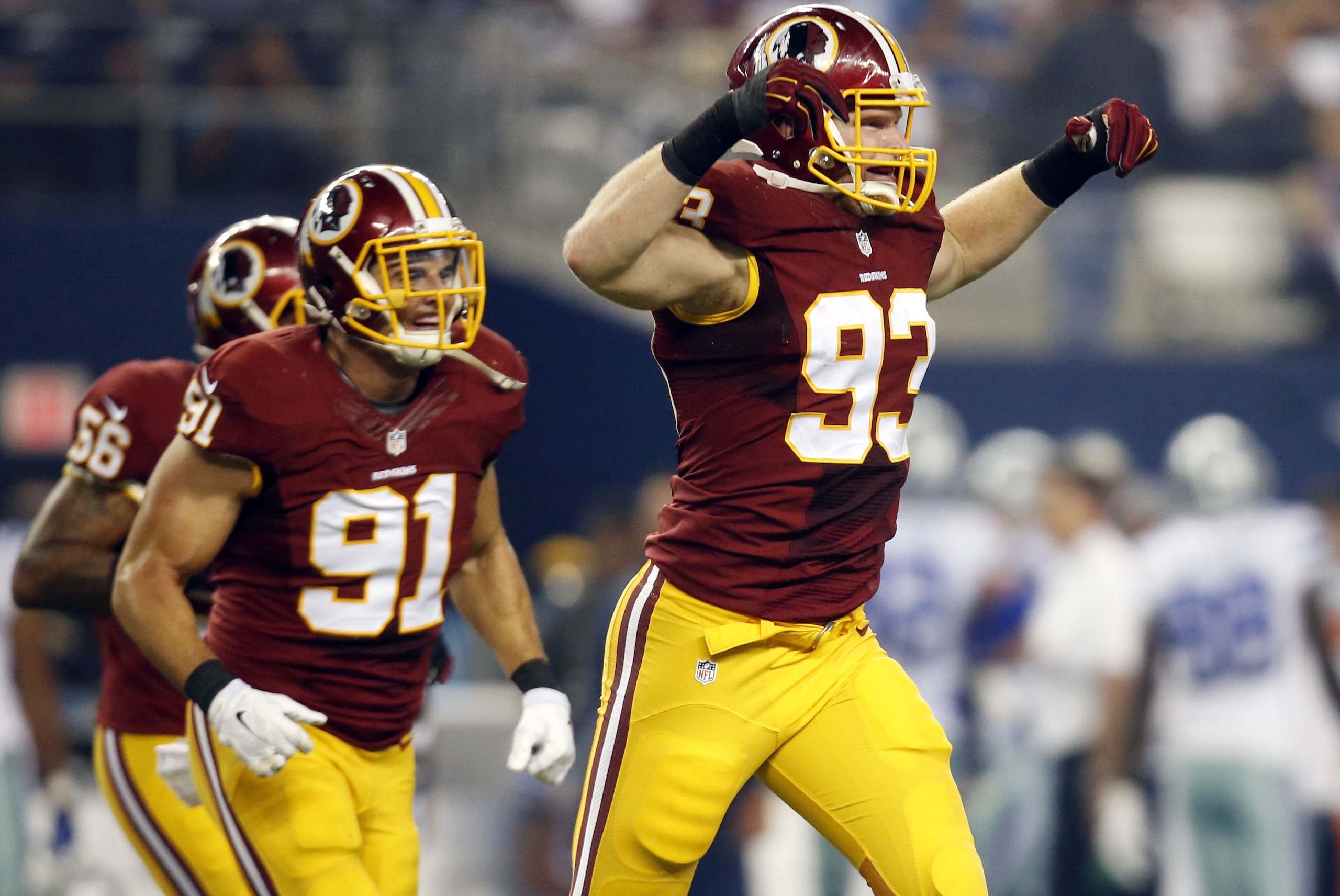
Notching a mere 2.5 sacks as a rookie is hardly the best audition to take over from a Pro Bowl outside linebacker. But Trent Murphy is still the Washington Redskins' best bet to replace Brian Orakpo at one edge of the team's 3-4 defense.
Even the arrival of Preston Smith, like Murphy a second-round pick, in this year's draft, doesn't change that. Murphy's the best bet to start because he's a technician who offers the right qualities to secure Washington's base defense.
The first of those qualities is greater size:

.jpg?w=2560 "Seahawks Chiefs Football")

Bigger and Better
In pro football's land of the giants, even a 6'5", 258-pounder can add more pounds to his frame. That's just what Murphy has spent this offseason doing, according to an interview with Redskins Nation host Larry Michael, per Stephen Czarda of the team's official site.

Increasing his size and playing strength is a smart move from the former Stanford man during an offseason defined by the Redskins getting bigger at several positions. It's a trend that's been most obvious on defense.
The additions of mammoth trench warriors such as nose guard Terrance Knighton and defensive tackle Stephen Paea have redefined the front seven. It's now a bulkier, more aggressive group.
But Murphy's work in the weight room isn't just about him keeping up with the Joneses. Head coach Jay Gruden believes the extra bulk will also help the 24-year-old make more impact plays in year two, according to Liz Clarke of the Washington Post:
"He’s bigger, he’s stronger, he’s rushing the passer extremely well. He’s getting off the ball very well right now. I think I’m expecting him to make the biggest jump from first year to second year on our football team because not only is he bigger, but he knows the position. He’s athletic. And when you put on some extra bulk and strength, it’s just going to give him more. He’s already a smart football player with great instincts. Now you add the extra bulk and we expect big things from him this year.
"
The key to meeting Gruden's expectation will be Murphy building off his core skill. It's a talent that makes him perfect for work on base downs.
A Stout Run Defender
Murphy didn't wow anybody as a pass-rusher last season. But he did stand out when setting the edge against the run.
A combination of power, recognition and agility made him a force against both plays run at him and those designed to go away from him. Consider these two stops against the San Francisco 49ers in Week 12 as superb examples of the former.
On the first play, Murphy aligned in a two-point stance on the weak side of Washington's base 3-4 front. He was immediately matched up against beefy fullback Bruce Miller:
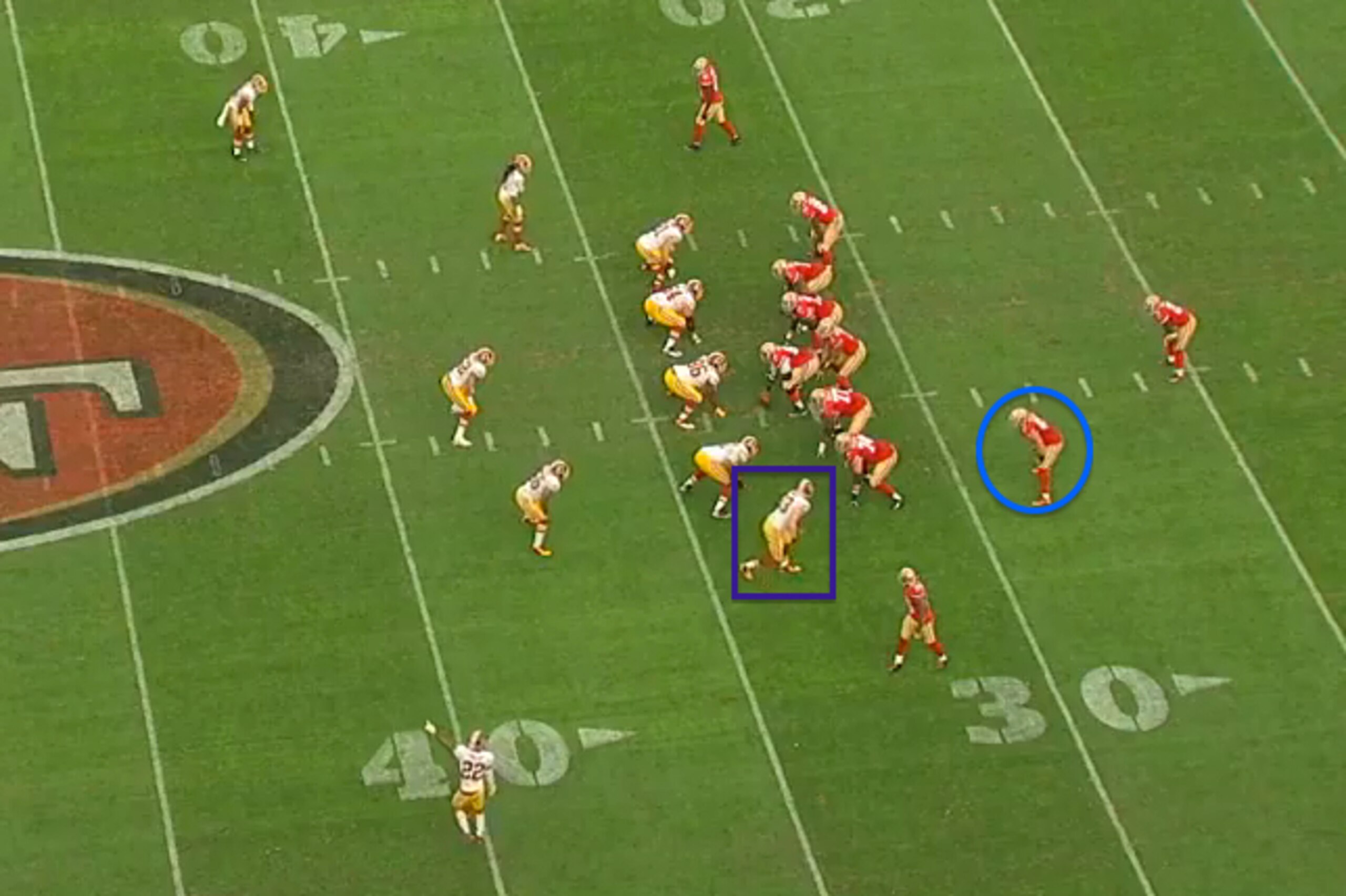
An outside linebacker against a back is the matchup advantage every 3-4 scheme is designed to create. Murphy made the most of it by first beating Miller's attempts to cut him low:
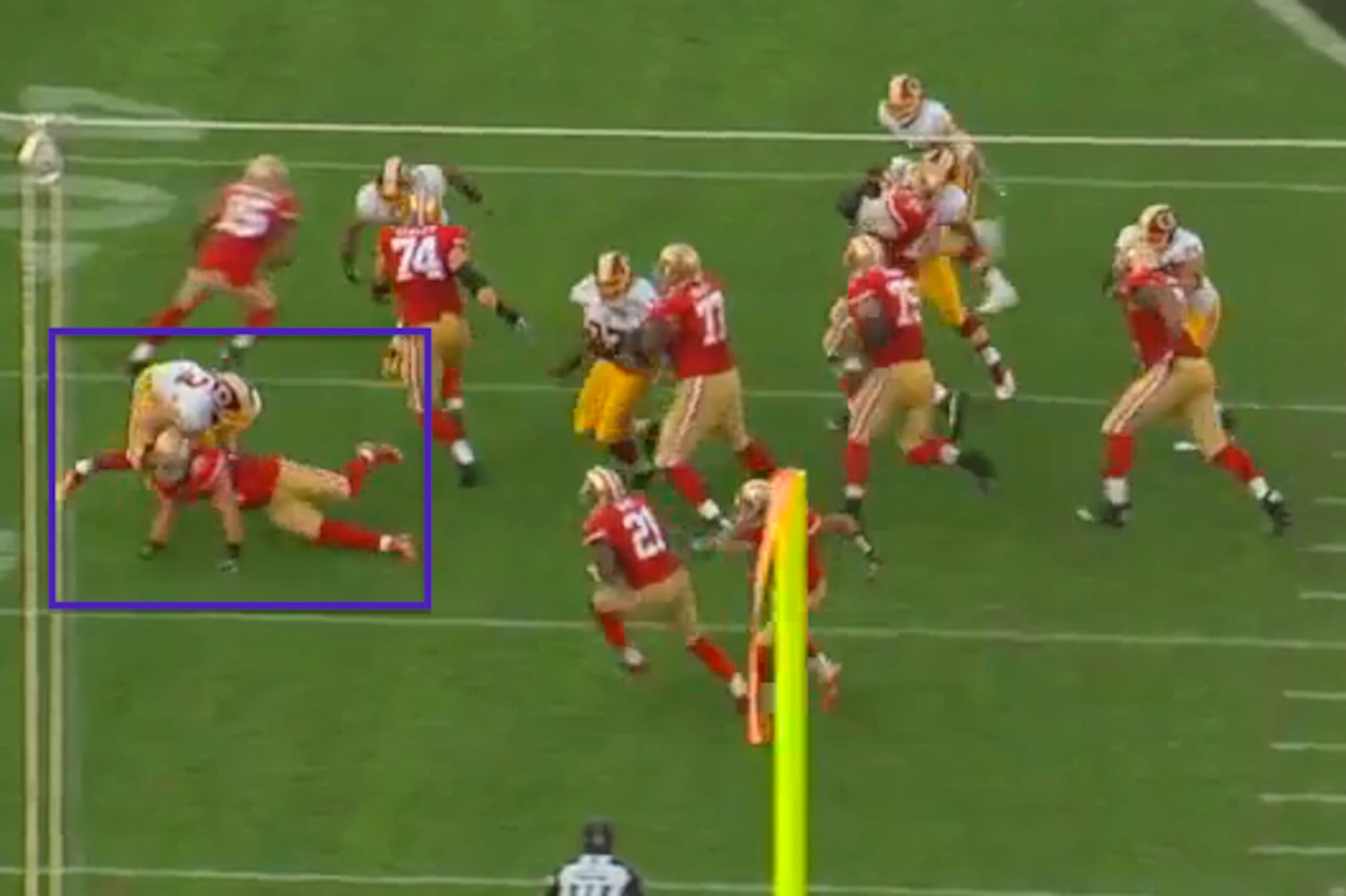
Having avoided the cut block, Murphy took a good angle to match Frank Gore's attempts to head for the corner. Murphy closed fast downhill and wrapped up Gore around the ankles for a three-yard loss:

This play showed everything good about Murphy's potential. He reacted quickly to Miller's attempt to cut him and played off the block. Once he had, he maintained an excellent pursuit angle and showed solid closing speed to deny Gore the edge and make a play behind the line.
After showcasing his flexibility, Murphy gave an ample demonstration of his power on another stop from the second quarter. This time, he had to fight his way through two blockers, tight end Vernon Davis and Miller:
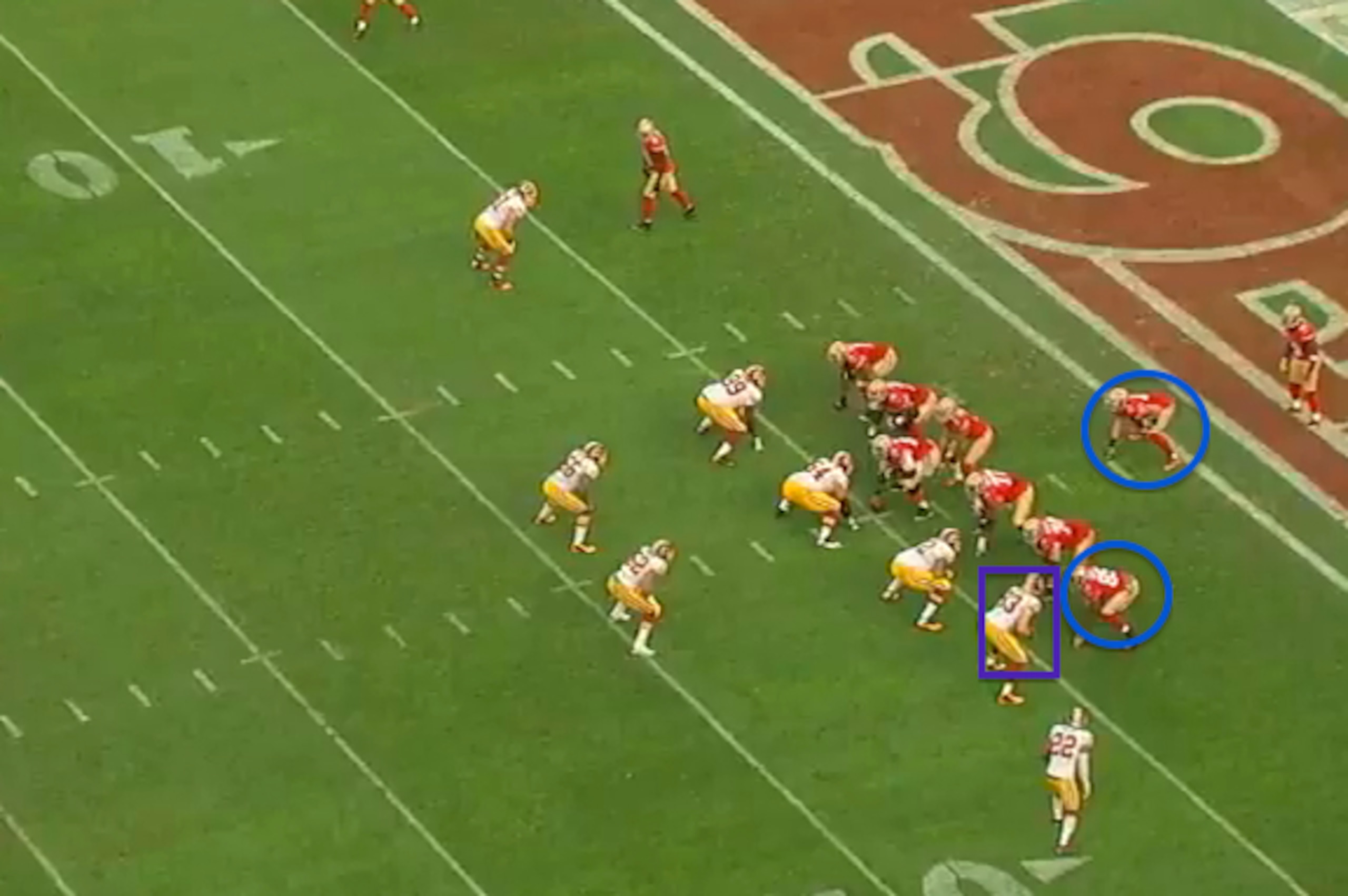
At the snap, Murphy immediately clamped onto Davis and stood him up. From this position, he had the tight end rocking back on his heels:

Having won the leverage battle, Murphy was able to toss Davis aside and zero in on Miller. He slammed into Gore's lead blocker and practically lifted him out of the hole:
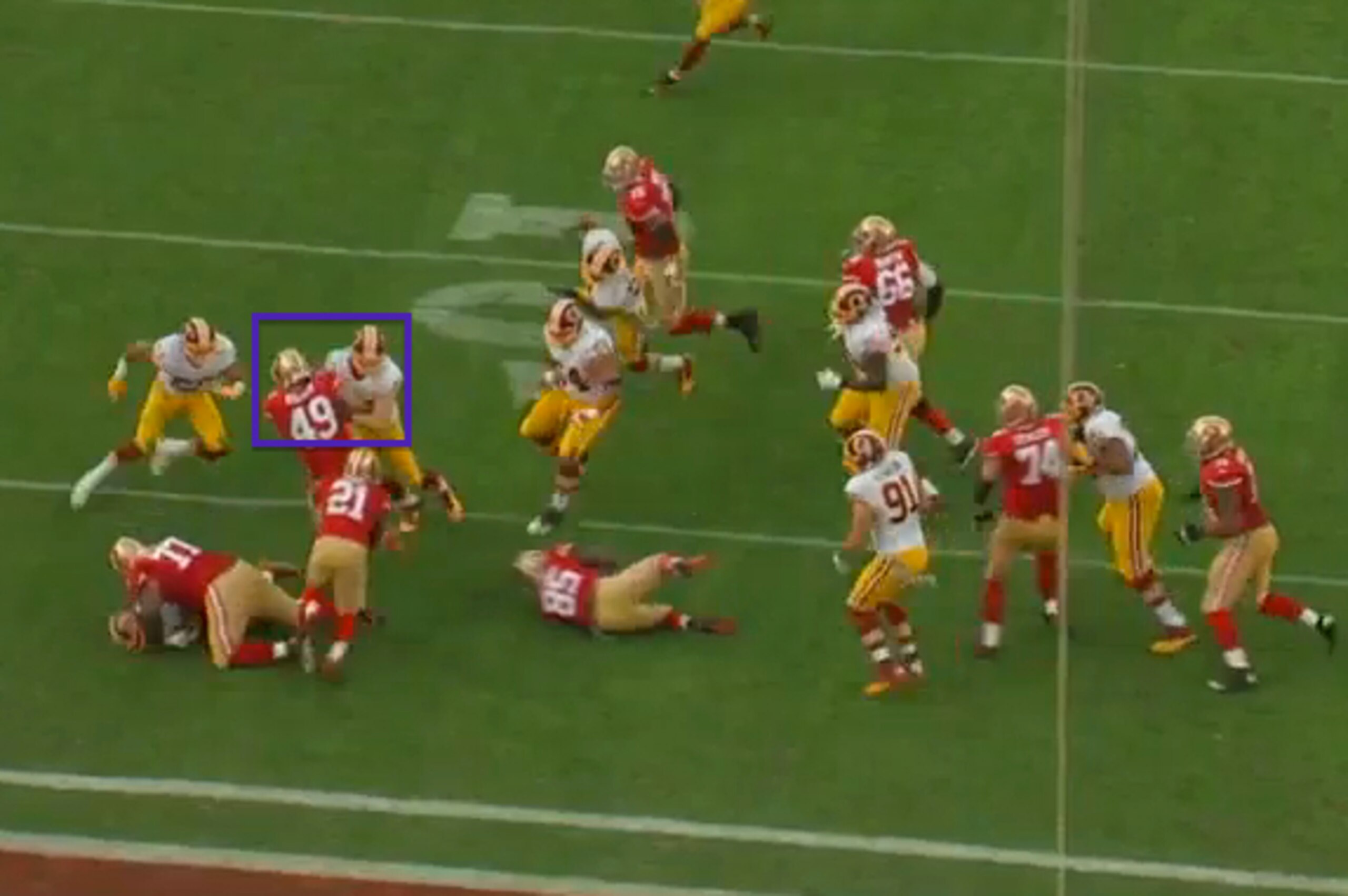
After collapsing Gore's running lane, Murphy engulfed the hapless back for no gain:

What stands out about this play is how the 49ers had shifted the strength of their front toward Murphy. They were clearly aware of his dominance on the edge, so they hoped a tight end would slow him down.
But a tight end against Murphy in the running game is the same as matching a back against him. In other words, it's a win for Washington's defense.
The mixture of quickness, range and brute force is evident in all of Murphy's best plays against the run. Check out these two stops from Week 15's road trip to take on NFC East rival the New York Giants.
In the first example, the Giants had tight end Larry Donnell on Murphy's side of the formation. He'd motioned from the slot to an in-line position specifically to account for Murphy:

Big Blue offensive coordinator Ben McAdoo gambled that his tight end could crack back on Murphy and take him out of the play. But Murphy's inside move was too quick and powerful for Donnell:
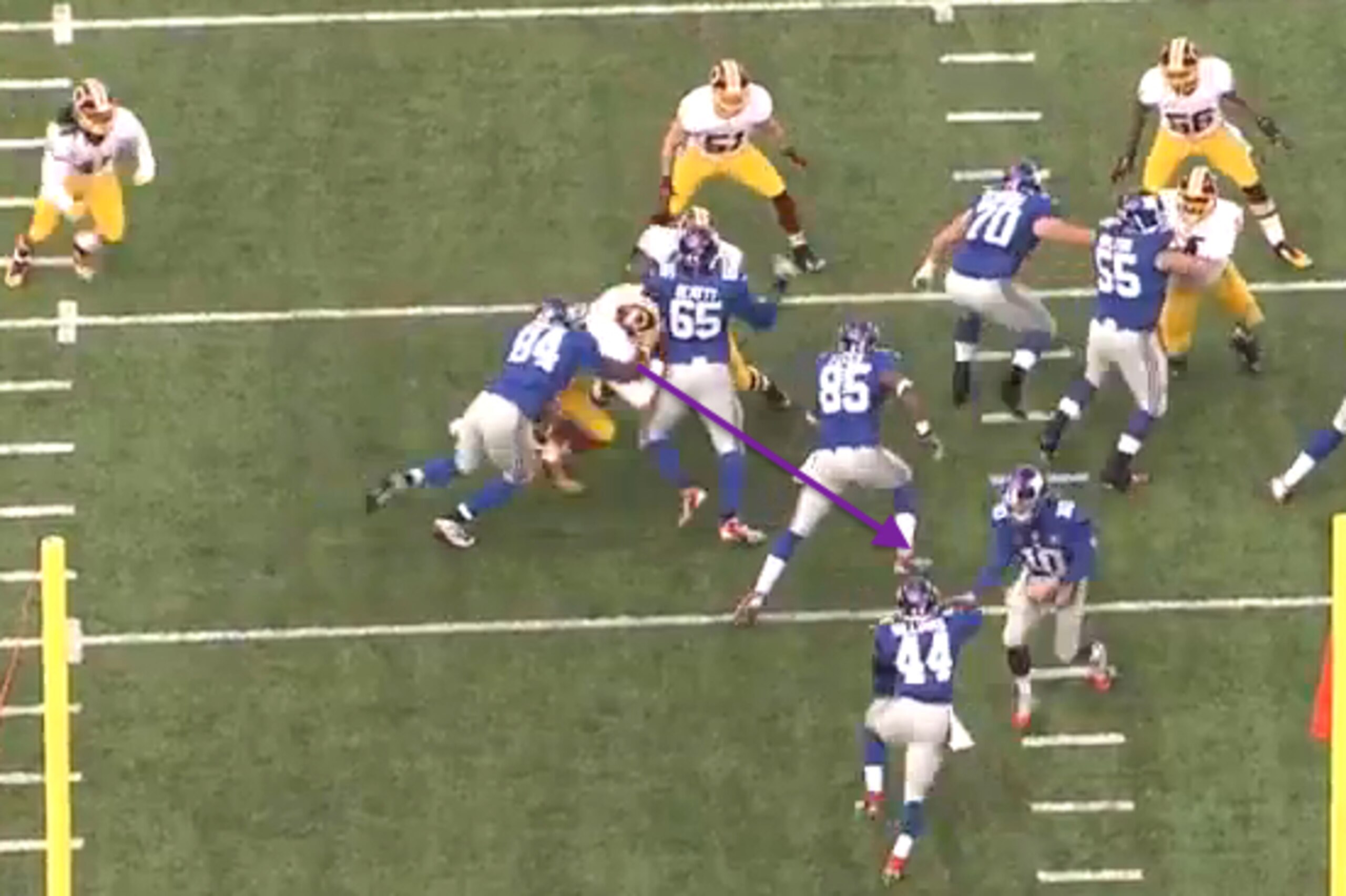
Murphy beat Donnell to the point of attack and met Andre Williams in the hole before dropping him for no gain.
Again, Murphy had quickly diagnosed the play, in this case a lead draw from an I-formation look. Knowing he had to crash down inside, he indulged no wasted motion, acting in a decisive manner to beat his blocker and destroy the play.
When you combine speed with smarts, you're going to have a very good run defender.
But to go from good to formidable, pure power also has to play its part. Murphy proved he possesses plenty of that on an earlier stop from the same quarter.
Perhaps having noted his proficiency against the run on film, the Giants kept Donnell on Murphy's side of the formation most of the afternoon. But this time it wouldn't be the tight end making the block.
Instead, New York would send left tackle Will Beatty (65), all 6'6" and 319 pounds of him, Murphy's way:
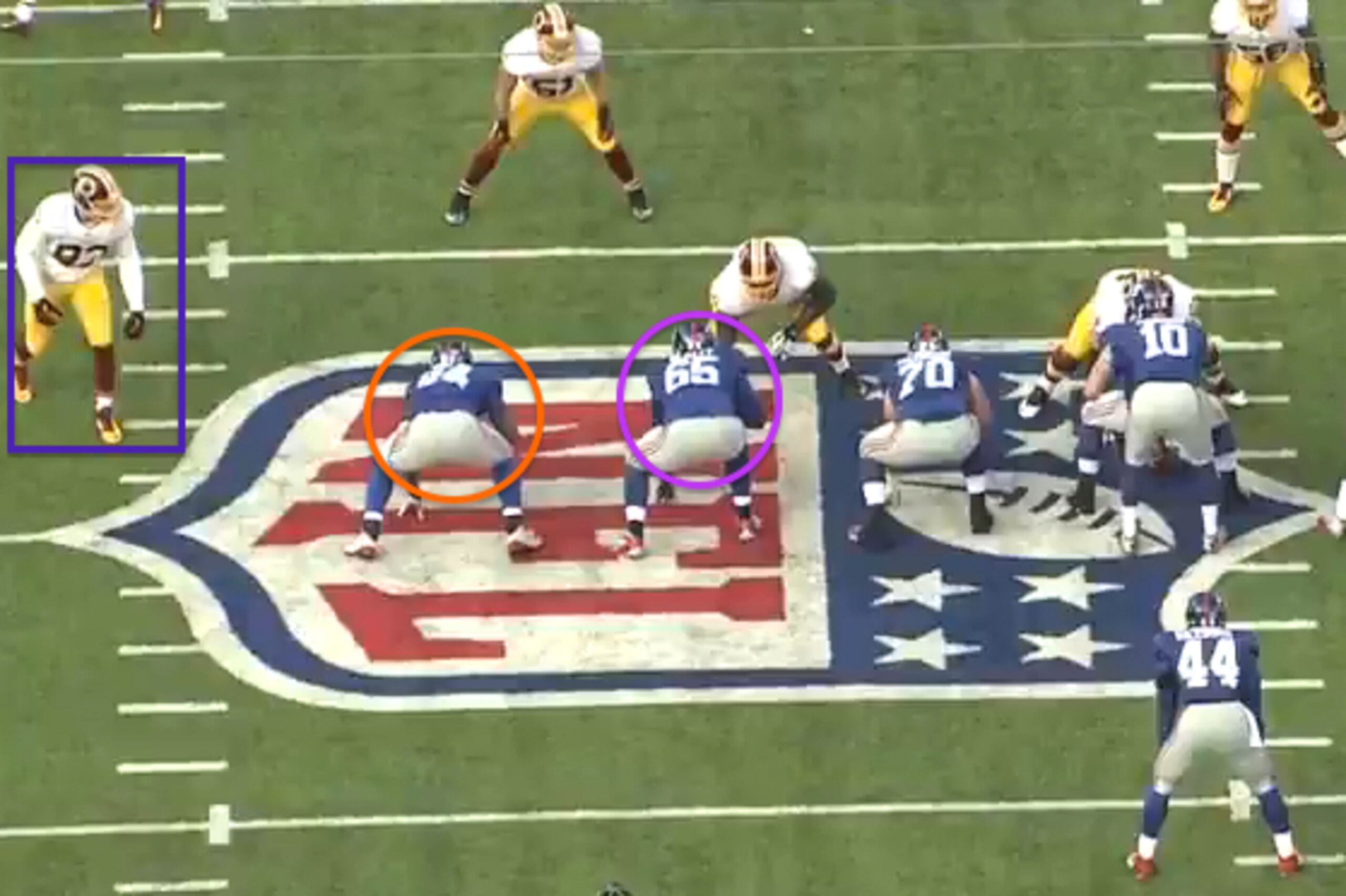
To counter what should have been a matchup win for the Giants, Murphy quickly got his hands into Beatty's chest. He used good leverage to put the tackle on his back foot:

In the process, Murphy took away any path of escape Williams might have had around the outside. With Murphy driving Beatty backward, Williams' running lane was blocked off.
He was soon swarmed on by defenders for a loss of two:
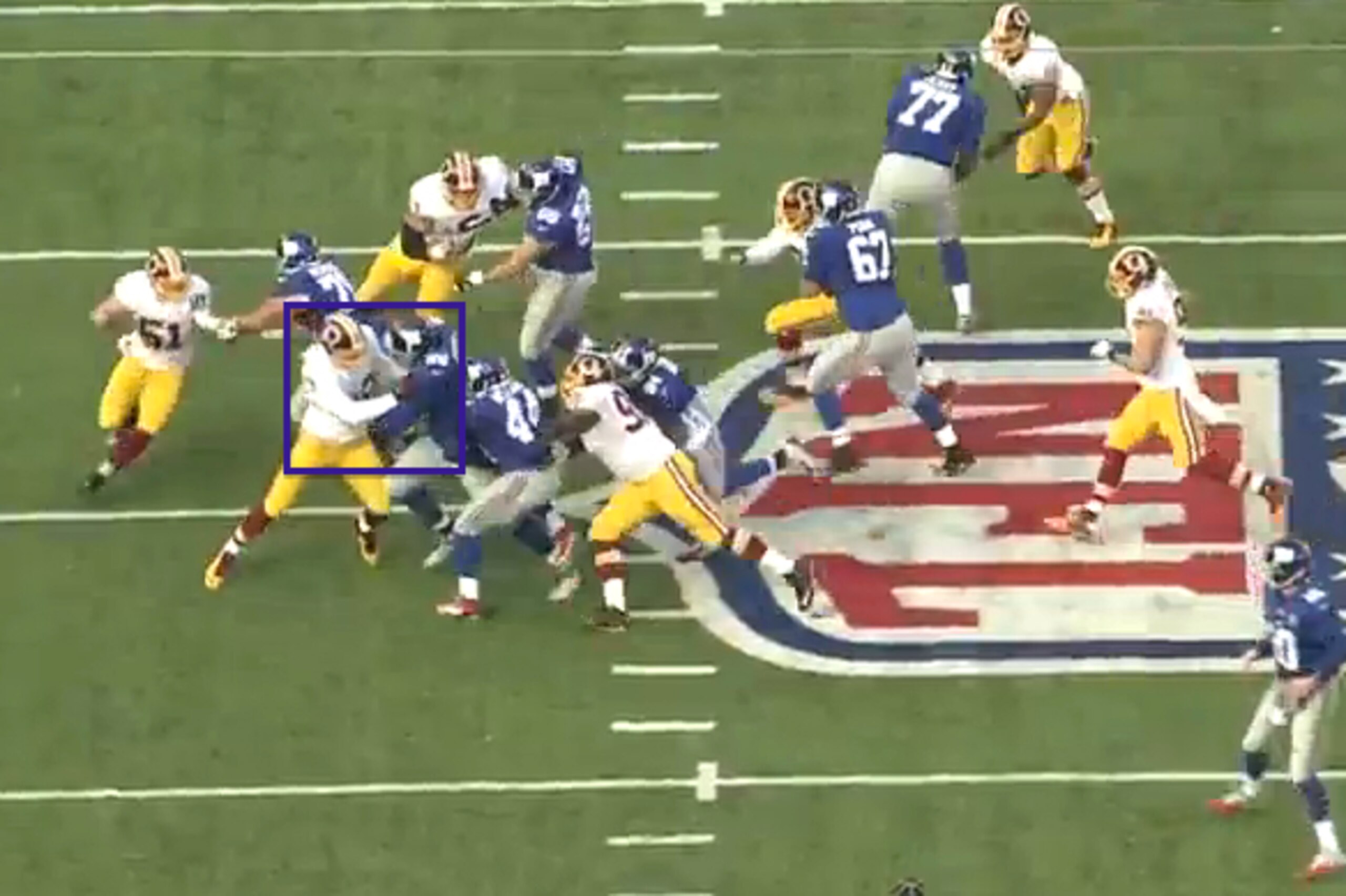
If this is what Murphy the rookie could do to an offensive tackle, imagine how the beefier version will fare.
This play is a great example of why Murphy should start ahead of Smith in 2015. He simply offers greater security for the base front. Backs, tight ends and even offensive tackles can't handle him one-on-one in running situations. Considering those are the situations for which new coordinator Joe Barry is likely to use the 3-4, Murphy is the smartest choice.
Not only will he combine increasing power with the natural flexibility all edge defenders in a 3-4 must possess, he'll also boast more advanced technique than this year's second-round choice.
One thing that really stood out on each of these plays was how well Murphy uses his hands. He's quick and aggressive clamping onto blockers and moving them off their spot.
His ability to engage and shed in a fluid motion consistently puts him in the backfield to meet runners behind the line of scrimmage and create big plays for a defense.
It's a trait Murphy mastered during his collegiate days with the Cardinal. Consider this impressive stop against USC from 2013:
Notice how seamlessly Murphy clasped his hand on the inside shoulder of the tight end, turned him away from the flow of the run and shrugged him off before making the tackle.
This was a true clinic in the art of run defending. Barry's unit will need that level of expertise in 2015.
The NFC East is still home to some quality rushing attacks, most notably the Philadelphia Eagles. Chip Kelly's team are owners of potentially the best one-two punch in the NFL, assuming both DeMarco Murray and Ryan Mathews stay healthy.
Bitter foe the Dallas Cowboys may have lost Murray, but there's still potential in that backfield. Joseph Randle and Lance Dunbar are underrated, while veteran Darren McFadden has 1,000-yard pedigree.
Finally, Williams is a below-the-radar gem for the Giants, one who could surprise many in the new season.
But it's not just opponents closer to home that should concern Washington's run D'. The schedule also features a meeting with the St. Louis Rams, who may be able to turn both Tre Mason and rookie Todd Gurley loose. Then there's the New York Jets and New England Patriots, both expert practitioners of power-based running games.
So are NFC South rivals the New Orleans Saints and Carolina Panthers. Just to complete the picture, the Redskins also face a late-season scuffle with the Buffalo Bills and former annual divisional tormentor LeSean McCoy.
The picture is clear: Washington's defense will be tested heavily on the ground this season. So it makes sense to keep Murphy on the field as often as possible.
But just standing up to the run isn't enough to justify a starting role for any edge defender in a 3-4.
Pass-Rush Potential
Even in the modern era of hybrid riffs on the theme, the 3-4 is still a defense that counts outside linebackers as its primary pass-rushers. After collecting so few sacks as a first-year pro, Murphy has a lot of work to do to prove his worth in this vital area.
Fortunately, the potential is certainly there for him to get better.
Just as he does in the running game, Murphy combines good athletic range with impressive initial power to cause plenty of problems on the edge. A sack he helped notch, along with defensive tackle Jason Hatcher, against the St. Louis Rams in Week 14 illustrates the point.
Murphy lined up in a three-point stance as a classic rush end in the team's four-man front nickel defense:
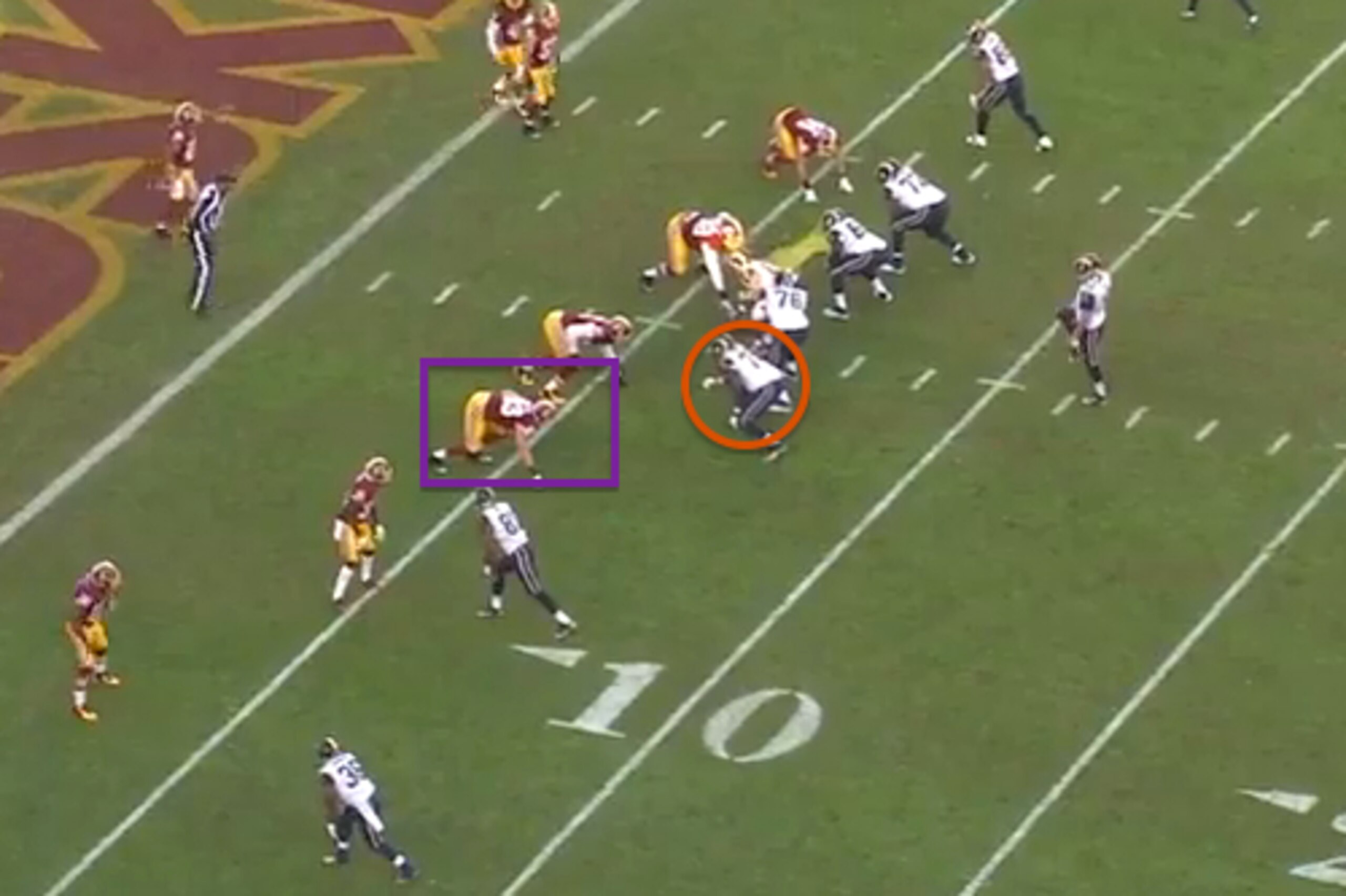
He quickly pressed the edge and beat rookie left tackle Greg Robinson to the corner:
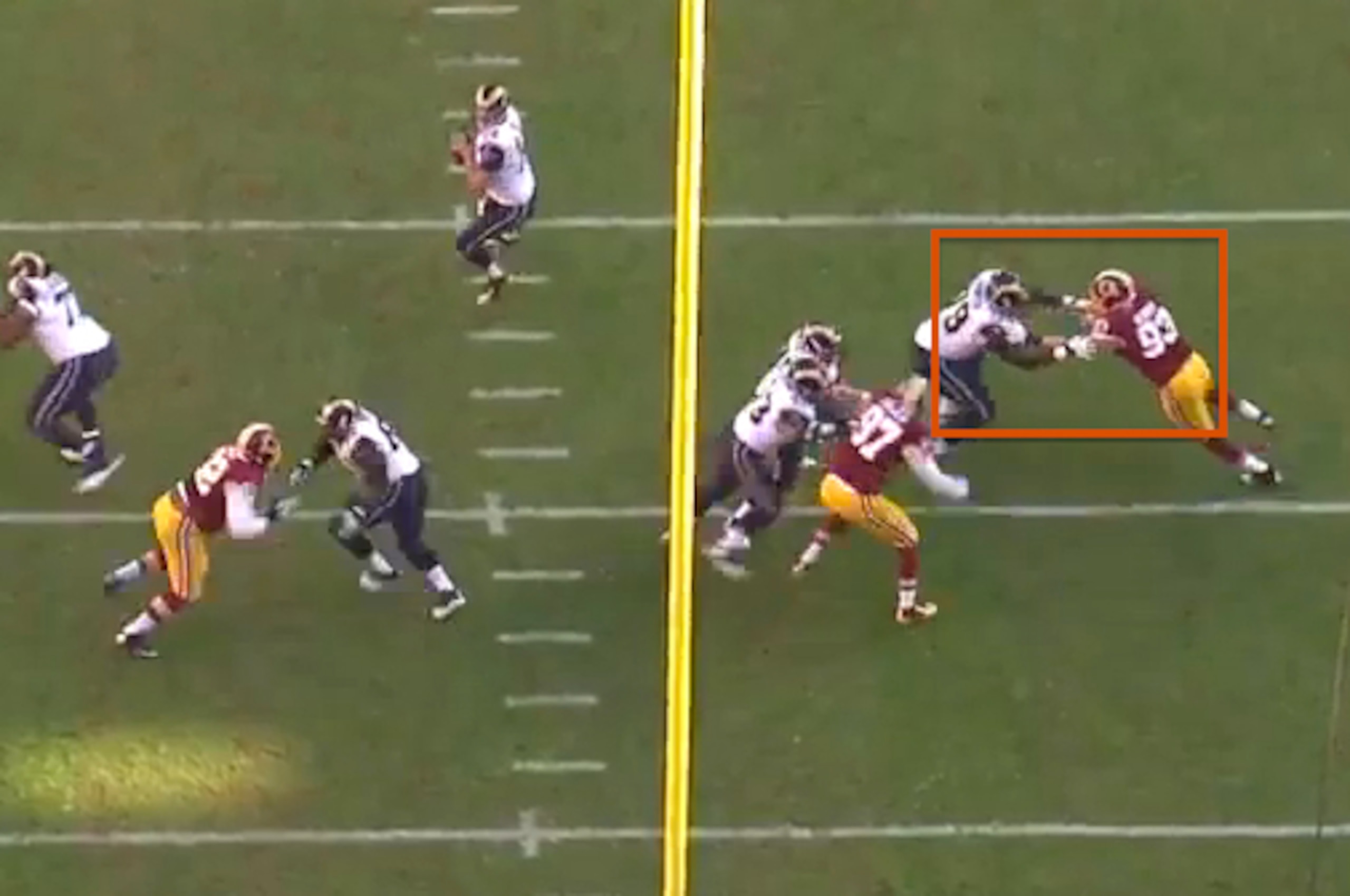
Murphy now had a good angle to either slide underneath Robinson or swat him aside and continue around the corner. Notice again how quickly he got his hands into his blocker.
Murphy has already won the leverage battle and given himself multiple options. He could push off as part of the setup for a second move or simply trust his power to bull Robinson back into his quarterback.
Murphy chose to continue pressing the edge. But Robinson initially played it well, shepherding Murphy out of the rush lane and beyond the quarterback.
At this point, Murphy revealed the deceptive athleticism and flexibility that can key a major improvement in his pass-rush numbers in 2015. Having been pushed beyond the pocket, Murphy knew he needed to redirect, so he chose a spin move to get back around Robinson:

Murphy executed the spin with more agility than any near-260-pounder should possess. He left Robinson snatching at air and wondering what had just happened:
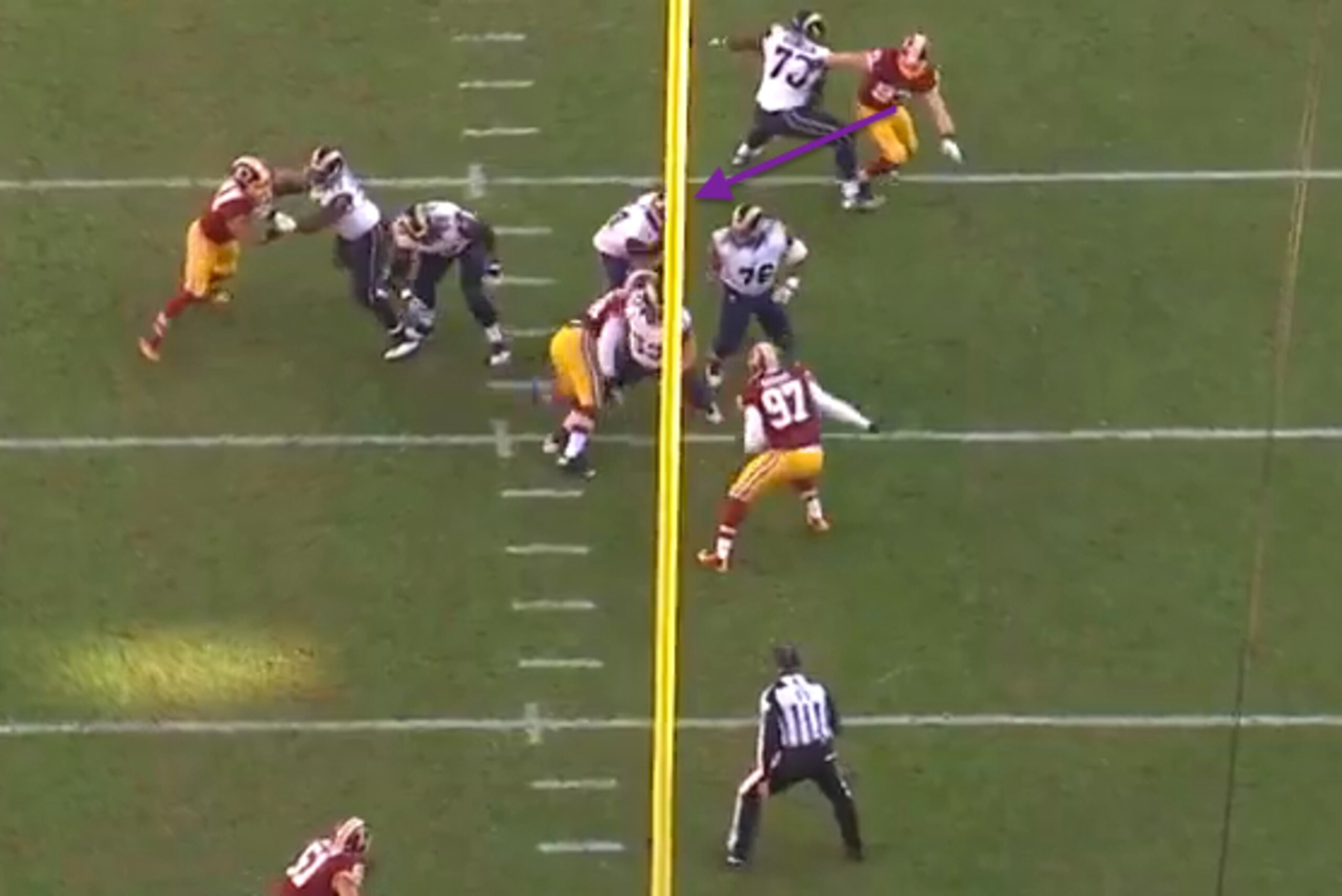
While Robinson was still asking himself, "Which way did he go?" Murphy closed quickly on Rams passer Shaun Hill. He combined with Hatcher to take the signal-caller down for a loss of five:
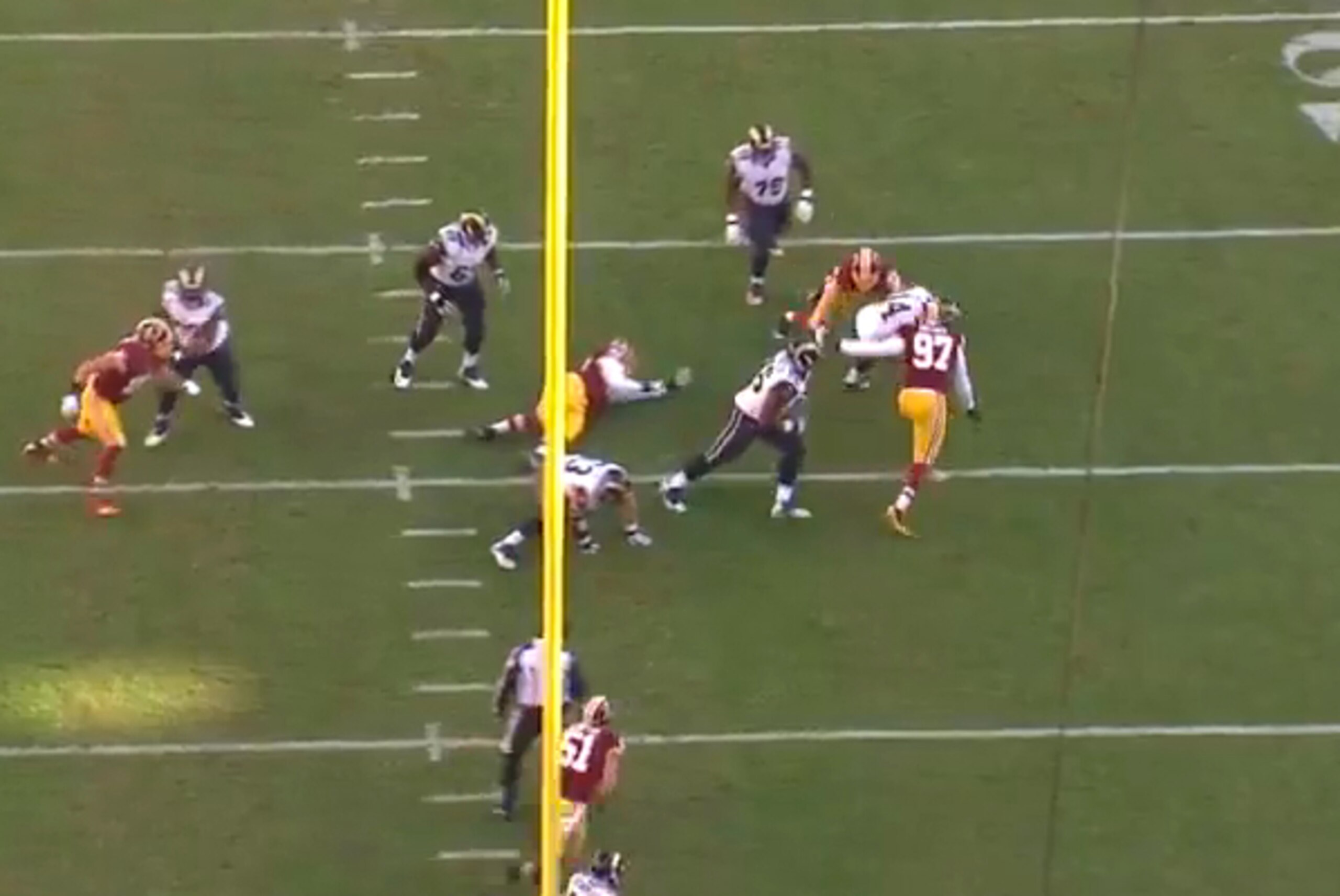
From a technical standpoint, this was a brilliant play. Murphy's initial upfield rush was outstanding. It committed Robinson to the edge and put him in a virtual no-man's land.
As for the spin move, it was a smoothly executed and smart reactionary ploy. But Murphy only needed it because he'd allowed himself to be pushed too far out of the rush lane. Continuing to press the edge was the wrong call after he'd initially rocked Robinson back on his heels.
Redirecting to climb the pocket again might as well be a page from the outside linebacker's manual. But a more naturally instinctive and explosive pass-rusher wouldn't have needed to do either.
The first step in Murphy's bid to be a more productive quarterback hunter should be to lean on one favored move. Despite all the nuance within football, the best players still have a particular skill they do better than anybody else.
In Murphy's case, that could be the quick inside move. Take a look at this sack from Stanford's game at USC:
The stutter step to the outside got the tight end leaning the wrong way. He was in no position to react to Murphy's quick swat and swim move. His inside hand swatted the tight end further toward the edge, while his outside arm came over the top to get behind the line.
This was a textbook example of hand usage and inside leverage. From a technical standpoint, Murphy was simply flawless.
But while Murphy is a great technician, he doesn't flash true dynamism as a pass-rusher. That limitation leaves the door ajar for his competition.
The Case for Smith
Ex-Mississippi State roving front-seven agent of destruction Smith is not as technically sound as Murphy. But the raw 6'5", 271-pounder is potentially more disruptive.
Cast your eyes over these examples from the Bulldogs clash with Auburn in 2014 for evidence of how Smith wrecks a passing game.
On the first play, his quick burst to the edge, along with a natural dip and lean under the left tackle, drew a holding call, putting Auburn's O' in a negative down-and-distance situation:
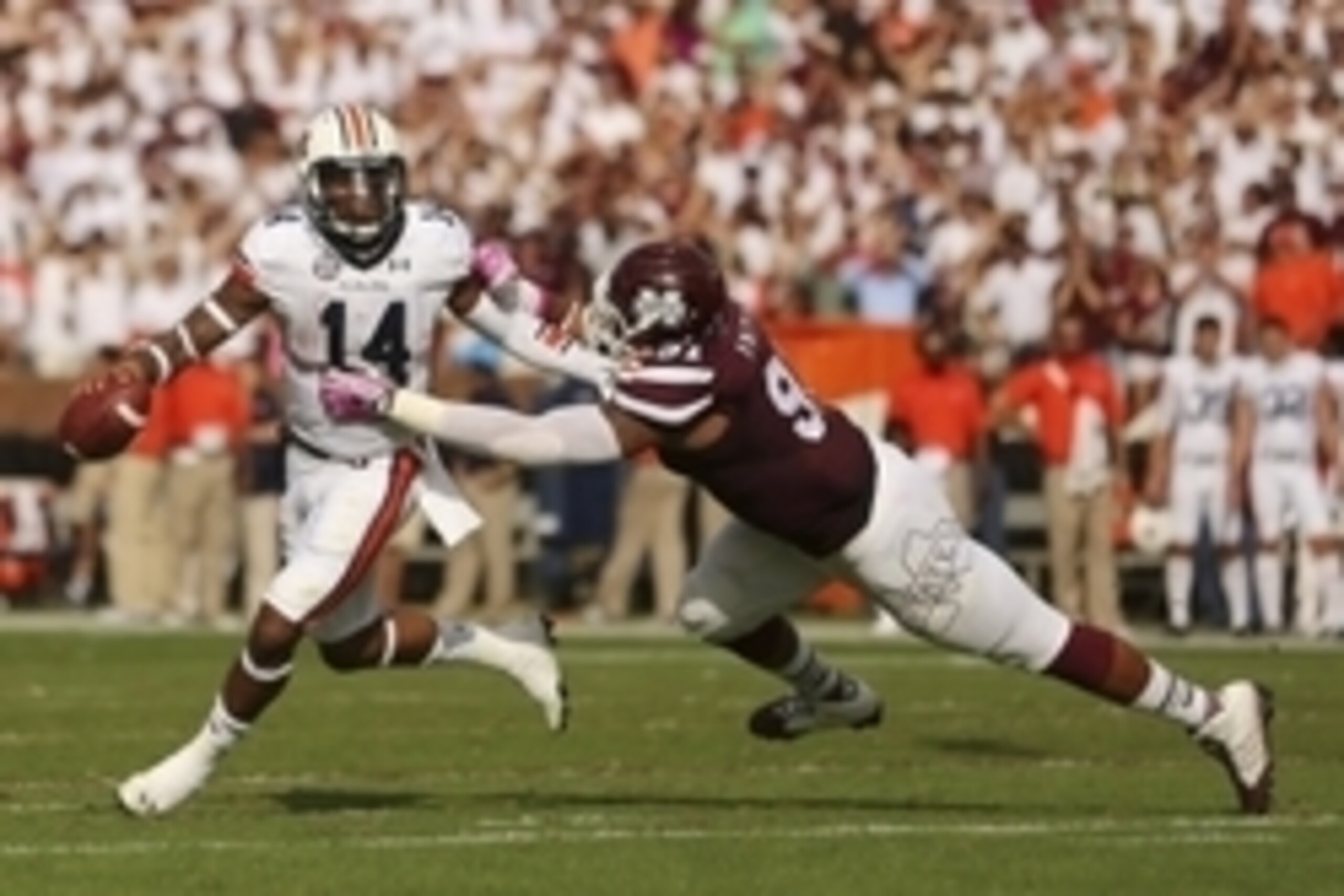
Later in the game, Smith utilized the same inside swim technique that should become Murphy's calling card. Smith broke through and decked Auburn quarterback Nick Marshall, forcing an incomplete pass:
Smith may not have registered a sack on either play. But he certainly disrupted Auburn's aerial attack.
Applying consistent pressure like this makes every pass a risk for an offense. That's the kind of impact modern defenses need from their edge players. It's also what Murphy currently lacks in this phase of the game.
But Smith remains raw. As expected from a rookie yet to play a down in the pros, mistakes are obvious in his game.
A particularly costly error occurred against Auburn. Smith made a play that was two parts excellent, one part dire:
That he wasn't fooled by the zone-read action in the backfield is a good indicator of excellent recognition skills. Smith's speed to close on Marshall was also impressive.
But his failure to wrap the quarterback up and complete the play resulted in a touchdown. Top pros make that play.
Ultimately, Smith's raw with tremendous upside. He just needs some quality schooling. By contrast, Murphy is an outstanding technician. But while he boasts excellence of execution, he lacks the obvious flair for big plays as a pass-rusher.
Perhaps the Redskins can find a middle ground between their two second-round picks.
Borrowing from the Bay Area
The happiest compromise between Murphy and Smith would be to let the former work on base and early downs while the latter cuts his teeth as a sub-package weapon.
It would be a similar dynamic to the one the 49ers used in 2011. Having drafted pure pass-rusher extraordinaire Aldon Smith in the first round, San Fran initially used him as a situational pressure specialist.
Meanwhile, veteran Parys Haralson featured on earlier downs. Haralson started all 16 games that year, according to Pro Football Reference.
With Smith entering the field in obvious passing situations, the Niners were able to create intimidating and productive sub-package pressure fronts. A sack against the Detroit Lions from Week 6 of that season shows how it worked, while also offering a glimpse of what the dynamic may look like in Washington.
Smith was aligned on the edge over the left tackle, while D-lineman Justin Smith hovered as a standing rusher in the middle:
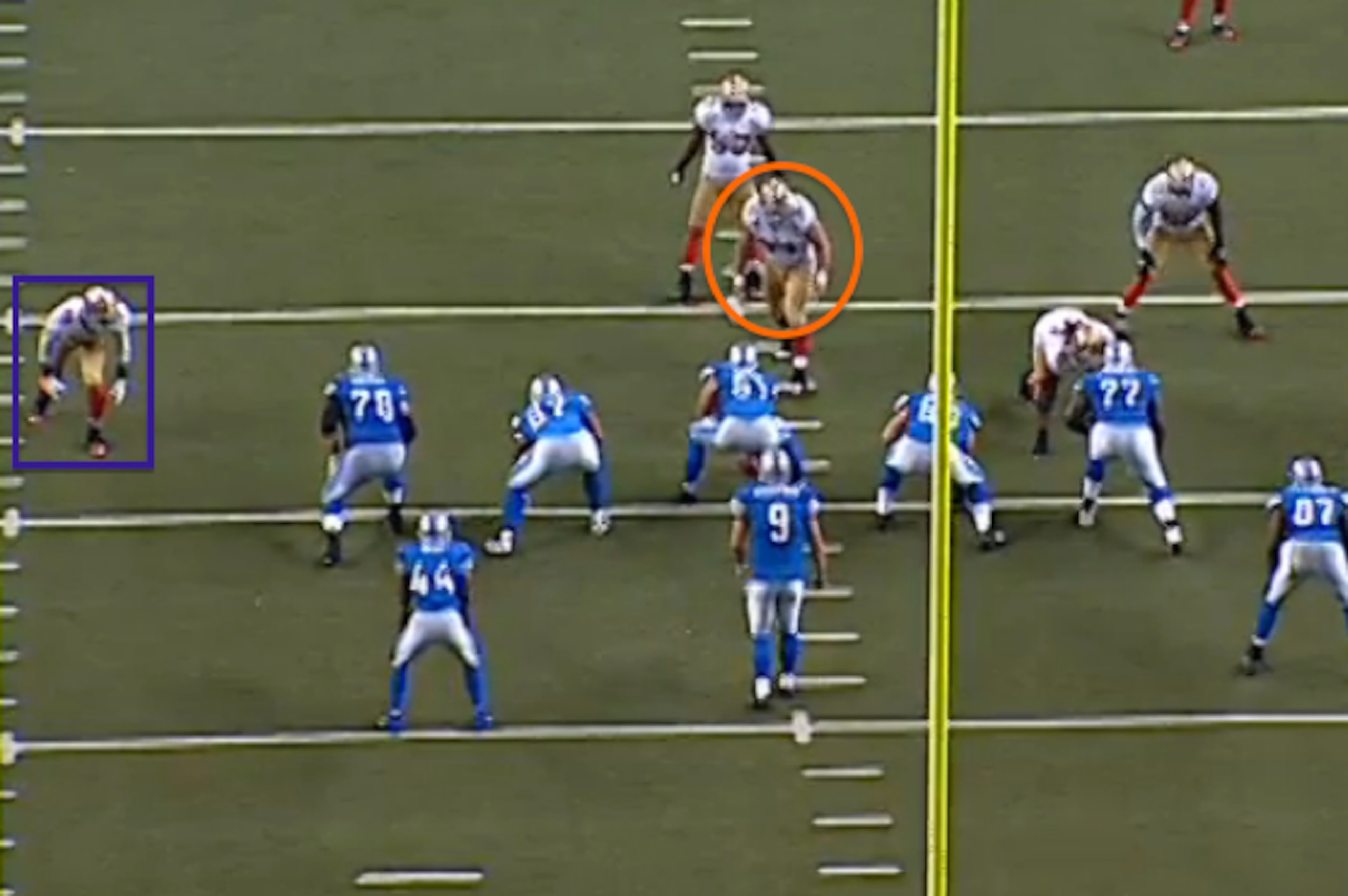
Once the ball was snapped, the latter Smith engaged center Dominic Raiola. He caused so much havoc that left guard Rob Sims (67) was distracted and unable to slide out and help the left tackle on the edge:
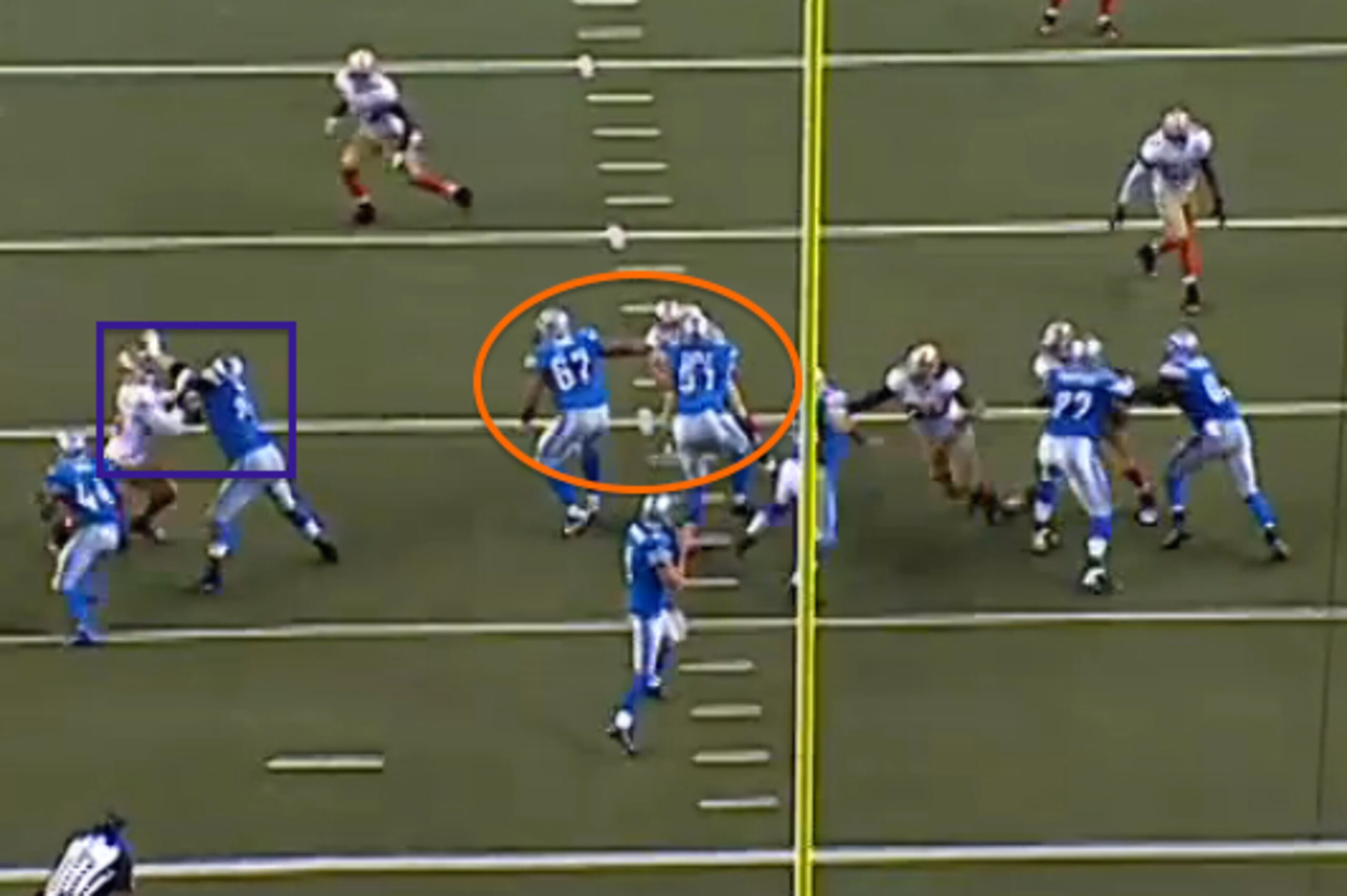
This meant Aldon continued to face a favorable one-on-one matchup on the outside. As the play developed, the elder Smith still occupied two blockers, switching his attention between Raiola and Sims:

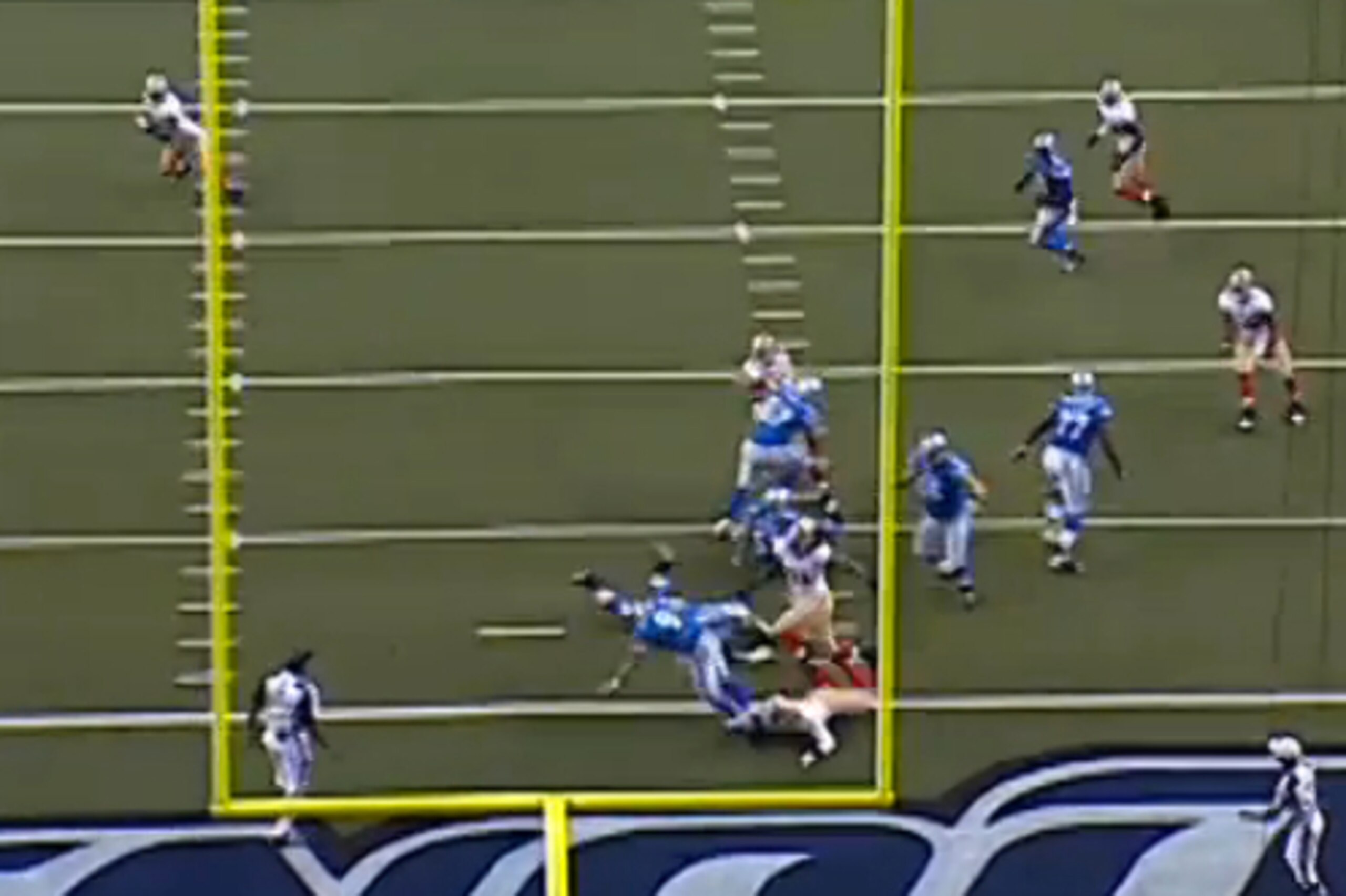
With Raiola shoved to the floor and Sims engaged, Aldon now had a free lane to quarterback Matthew Stafford. He took it and soon dropped the passer for a safety:
By moving pieces around and getting better athletes on the field, the 49ers created a huge defensive play.
But how would this work in Washington?
Well, for one thing, forget the positional distinction of the Niners putting a defensive lineman standing up in the middle. Swap that player for either Smith or Murphy.
The former spent plenty of time rushing from the inside at Mississippi State. NFL.com draft analyst Lance Zierlein noted how much Smith moved around: "As a junior, rushed passer from both ends and over the nose while also dropping into space on occasion."
Meanwhile, Murphy has shown plenty of flexibility this offseason, per ESPN reporter John Keim:
"Murphy is smart and will be used all over; I've seen him stand up, rush with his hand in the dirt and play over the middle and rush. What I also like is that it appears he might rush well on stunts and set up teammates by taking out a blocker or two.
"
Moving Murphy around on football's money down, as well as unleashing Smith as a roving chess piece, will create havoc for quarterbacks and their blocking schemes. It will also increase the pressure potential for Washington's defense without the need to risk extra rushers on the blitz and leave the secondary undermanned.
The competition between Murphy and Smith needn't be a problem for the Redskins. In fact, it's a win-win.
Right now, Murphy is the best bet to start thanks to his excellent technique and niche talent against the run. If he adds some explosiveness as a pass-rusher, Washington will boast a very dangerous edge defender.
Similarly, if Smith learns the nuance to refine the rough edges of his game, he could be a major contributor early on. Either way, the Redskins should emerge from this season with a highly disruptive bookend for Pro Bowler Ryan Kerrigan, as well as an excellent replacement for Orakpo.
All screen shots via CBS Sports, Fox Sports and NFL.com Game Pass.
All statistics and player information via NFL.com, unless otherwise stated.