
Final 2014-15 Season Grades for Every Memphis Grizzlies Player
The Memphis Grizzlies' exit in the Western Conference Semifinals overshadowed several strong player performances exhibited throughout the season.
This was the Grizzlies' best and deepest roster ever, and a close evaluation of each player shows how the team rises above those from the 19 previous seasons. The core appeared stronger, mainly because of Marc Gasol's scoring explosion early in the season and his give-and-take with Zach Randolph later.
Tony Allen's performance didn't fit the wily caricature painted of him, as he was a careful specialist who understood how to be effective on both ends.
Courtney Lee, Jeff Green and Beno Udrih were flashy complementary scorers, even if Lee had his slump and Green had off nights.
These grades are largely based on the regular season with considerations for their roles. Indeed, a few players bumped their grades with solid playoff outings. Check each player's evaluation to see how that contributed to his grade.
Marc Gasol
1 of 11Grade: A-
This was the season Marc Gasol unfurled his scoring ability. He burst through the first 30 games, registering 20.2 points per contest. His four 30-point performances through 21 contests came as a revelation from a pass-first center who only had one in six years prior.
Gasol finally reached the charity stripe with expected frequency. By taking 5.9 free-throw attempts per 36 minutes, he beat last year's mark by 1.5 and his career high by 0.4.
But a shift came midway through the season, as the former Defensive Player of the Year tightened his work on that end. Gasol allowed 98 points per 100 possessions in the last 40 games to finish at 10th with a defensive rating of 99.6.
He only occasionally satisfied the demand for his offense in the last three months of the regular season. Gasol averaged 15.4 points per game in the last 39 contests to finish with 17.4 per game, 2.8 more than his previous career best.
Grizzlies head coach Dave Joerger implicitly stated his displeasure with his laxity as a scorer, telling the Commercial Appeal's Ronald Tillery, "Jeff Green is the least of our problems. Most people on the inside know what it is."
Tillery explained "it" was Gasol's missing scoring drive.
Gasol didn't answer the call to carry the team on both ends until the playoffs, when he led the team with 19.7 points per game while allowing 101 per 100 possessions.
He was effective enough to bulldoze the Portland Trail Blazers in the first round, dropping 20.4 per game.
But he wasn't able to penetrate the interior enough against the Golden State Warriors in the Western Conference Semifinals. He tried to muscle his way to the basket, but the Warriors' big men held their ground as they held him below 37 percent shooting the last four games.
Voters took note of his increased production, making him the first Grizzly ever on the All-NBA First Team.
In Joerger's mind, the honor should surprise no one, as he told Tillery, "He's the best player at his position and it's the most difficult position in the league to fill."
The question remains whether the Spaniard will get the job done offensively for a full season. Now that he's 30, it's hard to say he'll push himself to score 20 per game.
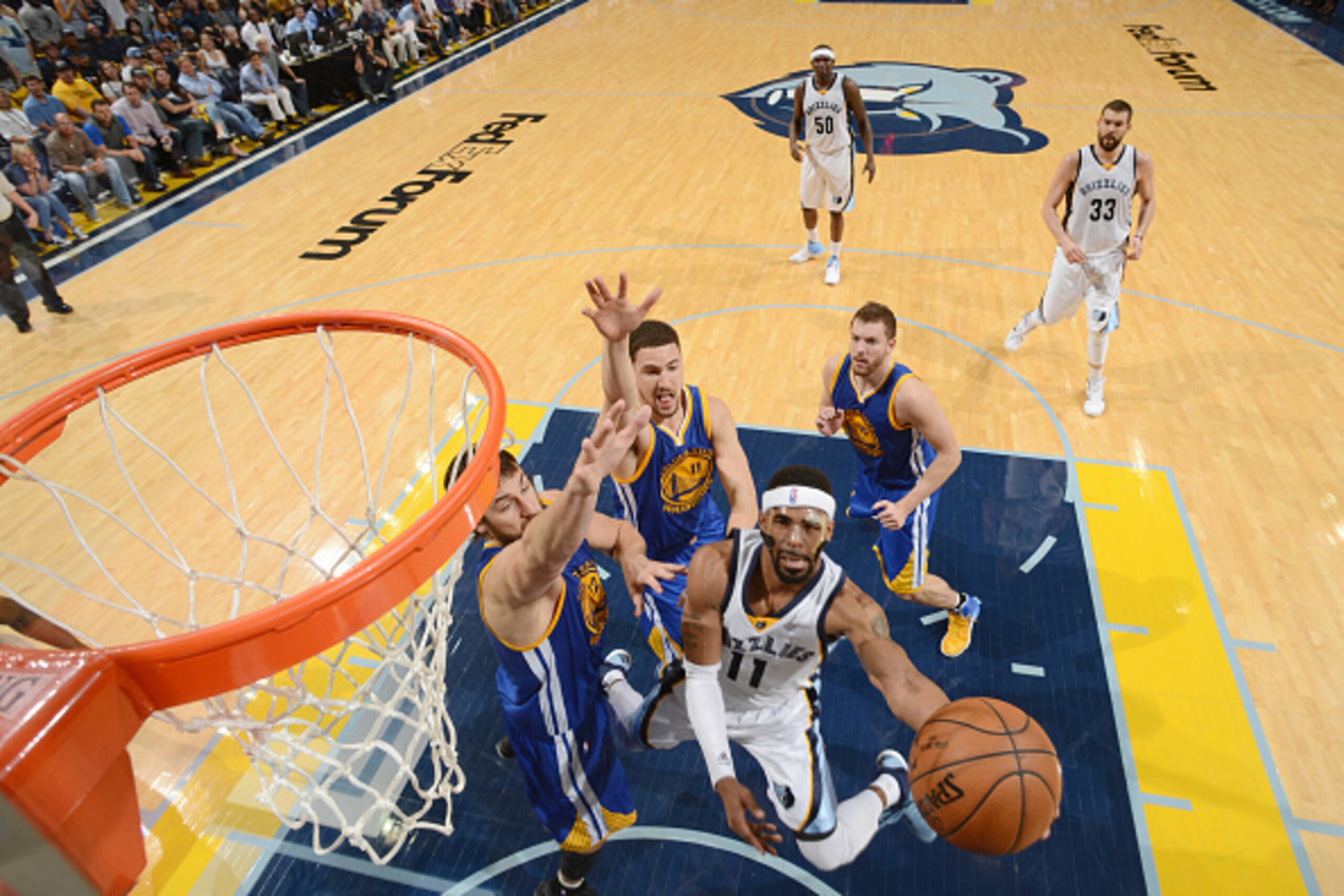
Mike Conley
2 of 11Grade: B+
Mike Conley's production fell short in the regular season as he battled several ailments, but he brought it out by making the Grizzlies competitive with the Warriors.
Conley's 15.4 points and 5.4 assists per game were 1.5 and 0.6 fewer than last year, respectively.
He suffered through a right ankle sprain, left wrist sprain and several other injuries during the regular season. With that, his body only allowed him to score 20 points 19 times, seven fewer than in 2013-14.
Entering the playoffs, CBSSports.com's Matt Moore stated that Conley was unlikely to be at 80 percent health.
Still, the 27-year-old rode his adrenaline rush to a strong series against the Blazers before being taken out upon colliding with C.J. McCollum and suffering facial fractures in Game 3. Conley averaged 16 points per game on 50 percent shooting, which was remarkable considering the level of swelling caused by his left foot sprain.
Conley amazed again with 22 points on 8-of-12 from the field while wearing a mask in his Game 2 return against the Warriors.
"We all knew Mike Conley was tough, determined, and that his determination to win is what sets him apart, and drives him to be as good as he is. ... Mike Conley put the Grizzlies' entire season on his back last night and carried it the best he could, despite his litany of injuries. Last night he became a legend," the Memphis Flyer's Kevin Lipe wrote.
Unfortunately, Conley couldn't produce many more heroics the rest of the series. He averaged 11.8 points per game on 31.3 percent shooting in the last four contests.
Those numbers were only half as painful as the list of six injuries he felt obliged to give, as tweeted by the Commercial Appeal's Peter Edmiston.
His will to shoulder the load without fear that his body would collapse under the burden, which resulted in a few playoff wins for the Grizzlies, makes up for his sagging numbers.
Zach Randolph
3 of 11Grade: B
Zach Randolph keeps reminding the league the type of force he is on the inside.
He maintains a place among the top rebounders after finishing seventh with 10.5 boards per game.
At 33, Randolph beats more athletic big men with the same old tools, strength and positioning.
"Randolph has learned every trick of the trade and applies them with wild panache," Vice Sports' Colin McGowan proclaimed.
The power forward's drop to 16.1 points per game from 17.4 last year was a necessary turn in the frontcourt partnership with Gasol, as the elder was bound to become the second banana.
Still, Randolph wasn't afraid to make his presence felt, posting 19.2 points and 13.3 rebounds per game from Jan. 9 to Feb. 4 after returning from a nine-game absence due to a sore right knee.
The 14-year veteran wasn't on his game in the postseason with 15.6 points and 8.5 rebounds per game, which was his worst playoff production on the glass. After three 20-point nights to start the conference semifinals, he scored 13.3 per game the rest of the series.
Randolph couldn't get the shots he wanted as Andrew Bogut dogged him and kept him outside the paint.
Sustaining his success will require similar perseverance and reliance on Gasol while picking times to take control offensively.



Tony Allen
4 of 11Grade: A+
Tony Allen did his job to perfection. He contended for the Defensive Player of the Year award by placing third with two steals per game and leading the NBA with a 4.1 percent steals rate.
While he went after the ball persistently, he was also among the most effective stoppers, allowing 98.2 points per 100 possessions.
He reminded the world he was "First-Team All-Defense" after creating fast-break points off steals in Game 2 against the Warriors. Voters agreed, placing him among the NBA's top five defenders for the third time.
He might have had a better shot at Defensive Player of the Year if he hadn't missed 19 games, including the last nine due to a sore left hamstring.
The 32-year-old was as selective as ever, ensuring he didn't take many bad shots that would detract from his defensive dominance. He scored a career-low 11.8 points per 36 minutes while shooting 49.5 percent from the field, 1.6 percent better than his career clip.
Breaking down how Allen focused more of his offense on the paint this year, Edmiston said, "Instead of taking poor shots, Allen's focusing on doing the things on offense he does well—cutting to the basket, scoring on offensive rebounds, finishing in transition—and cut out the stuff he doesn't do well (mid-range shooting)."
In the playoffs, Allen terrorized opponents defensively before his hamstring kept him out of Game 5 and most of Game 6 against the Warriors. He had 11 thefts in the first three contests of the conference semifinals and averaged 2.4 per game for the playoffs. His 4.5 percent steals rate was 1.4 percent better than anyone else in the postseason.
No one held up the Grizzlies defense the way Allen did this year. After all, the Grizzlies allowed 8.3 more per 100 possessions with him off the court. Gasol didn't show as much defensive energy in the first half, and Conley wasn't healthy enough to be nearly as effective as The Grindfather.
Courtney Lee
5 of 11Grade: B+
Courtney Lee improved substantially from his first season with Memphis but couldn't maintain his shot in the second half of the regular season.
Lee was unstoppable from downtown through his first 37 games, hitting 48.6 percent, which keyed his 11.6 points per game. He made only 28.6 percent for the next 35 games before finishing at 40.2 percent, 5.7 percent better than his 49 games with the Grizzlies last year.
The slump resulted from a sprained hand and ligament in his knuckle suffered Feb. 25 against the Sacramento Kings.
At the end of the regular season, he told CBSSports.com's James Herbert he was starting to feel there was "minimal pain." He acknowledged that during the injury he felt pain catching the ball and following through on shots.
Lee bounced back in the playoffs, averaging 13.3 points per game with 46.7 percent from three-point range. He helped bury the Blazers by scoring between 18 and 20 points in Games 2 through 5.
His outside shooting will continue to be valuable in spacing the floor next year, helping stretch an offense focused on attacking the paint.
Jeff Green
6 of 11Grade: C-
Jeff Green was inconsistent from his arrival in Memphis after being acquired via trade with the Boston Celtics, and he disappointed during the playoffs.
Green provided a boost in scoring. He was the Grizzlies' No. 4 scorer with 13.1 points per game. The seventh-year player scored in double figures 36 times—80 percent of his Memphis appearances.
But that came with troubling inefficiency. He shot 42.7 percent from the field, connecting on 40 percent only 27 times.
His playoff performance was not representative of someone with whom a team would cast its dice in trying to win a title, as he averaged 8.9 points per game on 33 percent shooting.
In Green's 2-of-8 shooting performance in Game 6 against the Warriors, Three Shades of Blue's Zach Thomas tweeted of the small forward's recurring problem, "The dude takes the worst angles on drives to the basket."
The Grizzlies, who scored 2.3 fewer points per 100 possessions with Green on the floor, saw him drag down the offense as he kept shooting despite how cold he was. If he opts in for next season, Memphis must hope he has a better overall impact during a full season with the team.
Kosta Koufos
7 of 11Grade: A-
Without the pressure he faced last season while starting 22 games in place of an injured Gasol, Koufos was better able to fulfill his role as a marauder under the basket.
Koufos had his second-best rebounding season, averaging 11.4 boards per 36 minutes and posting a 25.8 percent defensive rebounding rate.
He was as strong as ever defensively, allowing 99 points per 100 possessions. He showed tremendous discipline, keeping attackers away from the rim by taking up space on the interior.
His shot-blocking numbers were down a bit, from 1.9 per 36 minutes in 2013-14 to 1.7 this season. But when he wasn't swatting attempts, he was altering them with his long arms perpetually stuck in the air.
His shooting wasn't as good, though. Koufos made 50.8 percent from the field as he tried taking more mid-range shots but made only a third of his attempts outside 10 feet.
The seventh-year pro helped push around LaMarcus Aldridge, blocking three shots in the playoff opener and allowing 103 points per 100 possessions for the series.
Vince Carter
8 of 11Grade: D
Vince Carter's body doesn't allow him to do much at this point in his career. Partly because of that, he never met expectations in his first season with the Grizzlies.
Carter's right ankle soreness in the preseason, five months after surgery to remove bone spurs, set a dismal tone for the 38-year-old.
The man who scored 20 points per game for 10 straight seasons had his worst offensive campaign yet, posting 5.8 per game on 33.3 percent from the field and 29.7 percent from downtown, all of which are career lows.
Even when he seemed to have rhythm, he couldn't hit shots.
Carter, who reinvented his career a couple of years ago in Dallas by focusing on the three ball and hit 39.4 percent from downtown last season, made multiple threes in a quarter of his games this year.
Lipe went so far as to call Carter "washed up."
Fortunately, he performed well defensively, allowing 103 points per 100 possessions and showing great awareness and discipline.
Carter had a few redeeming playoff moments, including double-digit scoring affairs in two of the last three games against Golden State.
While it's safe to say he isn't nearly the scorer he once was, the Grizzlies can hold some hope he'll be better next year.
Beno Udrih
9 of 11Grade: B+
Beno Udrih's explosive offense helped the Grizzlies, especially when Conley was badly hurt.
Udrih was a solid bench scorer, averaging 14.6 points per 36 minutes, his best mark in five years. Also, his 48.7 percent shooting was the second-best mark of his career.
In 12 starts, he scored 11.2 points per game on 53.8 percent shooting.
The 11-year veteran tallied double figures 21 times. He was a great threat inside the arc, hitting layups and mid-range jumpers proficiently.
SB Nation's Austin Reynolds called Udrih Memphis' "most important bench player throughout the season," noting his consistent scoring and status as one of the league's best mid-range shooters.
He created for others, although his 5.3 assists per 36 minutes were 1.2 fewer than last year's total with the Grizzlies and New York Knicks.
He was a force in the first round against the Blazers, scoring 43 points in the first three games, including 20 during the opener.
However, his output dropped against the Warriors, as he scored 4.8 points per game on 35.3 percent shooting.
Lipe tweeted in disgust during Game 5, "Beno Udrih...has not been good in this series. When he isn't hitting mid-range leaners, he's not useful against Golden State."
One can at least appreciate how the Slovenian inserted a jolt of efficient offense off the bench before that series. For next year, it's hard to say if Udrih, who turns 33 in July, can maintain his quickness.
Nick Calathes
10 of 11Grade: C+
Nick Calathes' defense was off the charts in his second season, but his shooting leaves a lack of finish to his game.
Calathes is rising as a perimeter stopper, showing great energy and aggression. He allowed 99 points per 100 possessions and grabbed 2.7 steals per 36 minutes.
During a stretch from Feb. 22 to March 6, he had 22 steals in seven games.
With a misleading measure of pop, Calathes, who shot 42.7 percent from the field, produced by attacking the basket. He show 63.2 percent at the rim but couldn't hit 40 percent anywhere beyond that. His decision to take 17.4 percent of his attempts from long range, where he shot 25.4 percent, was baffling.
That detracts significantly from the distribution prowess of a guy who dished out 6.3 assists per 36 minutes.
After the 26-year-old shot 0-of-4 and committed three turnovers in Game 1 against the Warriors, Edmiston served the Twitterverse with the notice, "NOT BREAKING NEWS: Nick Calathes is a wonderful defensive player and a frustrating, at best, offensive one."
That dichotomy left him as the third-string point guard. If the free-agent-to-be chooses to stay with the Grizzlies and try to succeed Allen in his role as a key defensive specialist, improved shooting will help.
Others
11 of 11Jon Leuer: D+
Leuer didn't succeed in becoming an interior-focused power forward after faring well as a stretch 4 last year. His field-goal clip dropped 4.9 percent to 44.3 percent, and his 24.1 percent three-point mark was a 22.8 percent drop.
Taking 10.6 percent of his shots from downtown seemed insufficient after he took almost a fifth of his attempts from that range in 2013-14.
The Commercial Appeal's Chris Herrington speculated that Leuer "lost confidence in his shot."
Leuer's added bulk didn't change his rebounding output. His nine rebounds per 36 minutes were only 0.1 more than last year.
As his production withered, he fell from the rotation, appearing in nine of Memphis' last 23 games. The Grizzlies seemed to have lost faith in him as they cycled through big men from the D-League, such as Tyrus Thomas and JaMychal Green.
Leuer received nine minutes in four playoff games and tallied four points and five rebounds. He had one consequential postseason moment, a two-and-a-half minute stretch of Game 4 against the Blazers in which he acted as part of a listless offense during Portland's 6-0 run.
The 25-year-old's inability to help as Jeff Green went cold symbolized how he had faded.
Leuer's 2015-16 contract is nonguaranteed, and the Grizzlies might find it easier to keep JaMychal Green, who showed more promise in his first NBA year.
JaMychal Green: B+
After bouncing around for a couple of years, Green earned a place with the Grizzlies with a nice late-season performance. Green, who saw four games with the San Antonio Spurs and 20 with the NBA D-League's Austin Spurs, posted 2.7 points and two rebounds in seven minutes per game while hitting 57.5 percent from the field.
He had two double-digit scoring performances for Memphis.
After Green registered 10 points and eight boards against the Warriors on April 13, Lipe stated he showed "promise as a future backup big man."
When the Grizzlies gave him a multiyear deal this spring, Green received a shot at that future.
Jordan Adams: B
Adams didn't get many chances to gain NBA experience as a rookie, but he was clean and crafty when he did. He averaged 3.1 points in 8.3 minutes per game while shooting 40.7 percent from the field across 30 contests. While ball-handling was a concern in the DraftExpress scouting report of him by Jonathan Givony, Adams had a 12.7 percent turnover rate.
The UCLA product dropped double digits three times.
Not only is his ball control impressive, but he is also fearless as a playmaker. After Adams deposited 19 points while leading a Grizzlies comeback from a 32-point deficit in a 111-107 loss to the Warriors on April 13, Joerger was spellbound by one play.
"Jordan Adams drives through three guys. I was going to choke him, but then he made the shot," Lipe quoted Joerger as saying in a tweet.
Adams is a firecracker of a scorer, and his growth will be intriguing to watch in his second season.
Jarnell Stokes: B-
Stokes was productive as a high-energy player in short minutes as a rookie. He posted three points and 1.8 rebounds in 6.6 minutes per game while hitting 56.8 percent from the field across 19 appearances. Of his 9.7 boards per 36 minutes, 4.6 were on the offensive glass. Stokes' aggression in grabbing teammates' misses was further shown by his 14.6 percent offensive rebounding rate.
The Tennessee product fought hard defensively, allowing 100 points per 100 possessions.
Grizzlies TV color commentator Brevin Knight lauded Stokes' energy in a Knoxville News Sentinel Sports Page podcast interview.
While noting the power forward's need to work on his mid-range jump shot, Knight said, "He just has to continue to work on his game and find out what his niche will be long term, but when you have the type of work ethic and motor that he has, you're always going to be an available player for teams."
That hard work should put in the past Stokes' Jan. 28 fight with teammate Kalin Lucas on the bench of the Grizzlies' D-League affiliate, the Iowa Energy, which landed him a three-game suspension and a more difficult path to Memphis' rotation.
At the very least, if Stokes earns more minutes next season and keeps fighting on the boards, he could help the Grizzlies rise from 21st in offensive rebounding.
Russ Smith: C
The Grizzlies only saw a brief flash of potential from Smith in his sparse moments on the court for them. He averaged 4.2 points in six minutes per game while shooting 40 percent from the field during six appearances for Memphis after being acquired from the New Orleans Pelicans in the Jeff Green trade.
He aided the comeback against the Warriors on April 13, scoring 16 points on 5-of-8 shooting.
Smith, whose deal for next year is nonguaranteed, will have more time to impress the Grizzlies in summer league.
Unless otherwise noted, advanced metrics come from Basketball-Reference.com.
Tom Firme is a Memphis Grizzlies Featured Columnist for Bleacher Report. Follow him on Twitter @TFirme.

.jpg?w=2560 "Raiders Could Start Mendoza")

.jpg?w=2560 "Rodgers Iced Out on Plane 💎")
.jpg?w=2560 "🚨 Week 8 AP Top 25 Poll")
.jpg?w=2560 "Packers Safety Slams Refs 🤬")
