3 Keys for Atlanta Hawks to Win Eastern Conference Finals
The Atlanta Hawks will face a superstar challenge in the Eastern Conference Finals against the Cleveland Cavaliers, their biggest test of the postseason thus far.
While the Hawks have faced questions about their lack of star power all year long, the Cavaliers have no shortage of go-to options on offense. Small forward LeBron James is a perennial MVP candidate and probably still the best player in the world while point guard Kyrie Irving is a dribbling and finishing maestro. The balance of the Hawks versus the top-heavy roster of the Cavs will make for an intriguing matchup.
And how did both teams get to this point?



Atlanta closed out the Washington Wizards in Game 6 Friday, following a Paul Pierce buzzer-beater that wasn't. The win actually clinched the franchise's first conference finals series since 1970 (then called the divisional finals) The Cavaliers also took six contests to dispose of the Chicago Bulls, ending the series with three straight victories as the Hawks also did.
In this conference finals matchup, Atlanta had the better regular-season record and will have home-court advantage, but the Linemakers' betting odds and the majority of pundits favor Cleveland to win.
How can the Hawks prove their doubters wrong and defeat the Cavaliers? Let's look at Atlanta's three biggest keys to victory.
Making Open Shots
Since the beginning of the playoffs, the Hawks' normally hot shooting has cooled off. They've nailed just 43.4 percent of their attempts from the field and 34.3 percent from the three-point line. Those success rates are down from 46.6 and 38.0, respectively, in the regular season.
It's not that Atlanta isn't getting good looks; it's that those looks are inexplicably rimming out, whether wide open or tightly contested.
Kyle Korver has been the biggest culprit. The knockdown shooter has seen his long-distance percentage drop from an NBA-leading 49.2 in the regular season to 39.7 and 28.6 in the first and second rounds of the playoffs, respectively.
Take a gander at the below graphical comparison between Atlanta's shot-making abilities in the regular season compared to its shooting in the two playoff rounds.
Doing some quick math, this means Atlanta could have scored a total of 49 extra points in the Wizards series had the team shot its regular-season percentages at each degree of contest from Washington.
Forty-nine points divided by six games is approximately 8.2 points per game, which means the Hawks' scoring differential in their Eastern Conference Semifinals matchup against the Wizards could've been plus-11.0 instead of plus-2.8.
Eight extra points per contest also would've pushed Atlanta past Washington in Games 1 and 3, which means it wouldn't have been a stretch for the Hawks to pull off a sweep under normal shooting circumstances.
Against Cleveland, Atlanta will need to convert more than ever on the shots it is given. The Cavs, even without the injured Kevin Love, are more talented than the Nets and Wizards, and the Hawks can't afford to leave precious points on the hardwood.
HawksHoop's Bo Churney provided a solid point after Game 1 against the Wizards regarding the danger of missing too many open looks.
Keep an eye on NBA.com's SportVU tracking statistics (particularly the shooting ones) throughout this series to see if Atlanta starts to progress to the mean.
Letting DeMarre Carroll Take LeBron James One-on-One
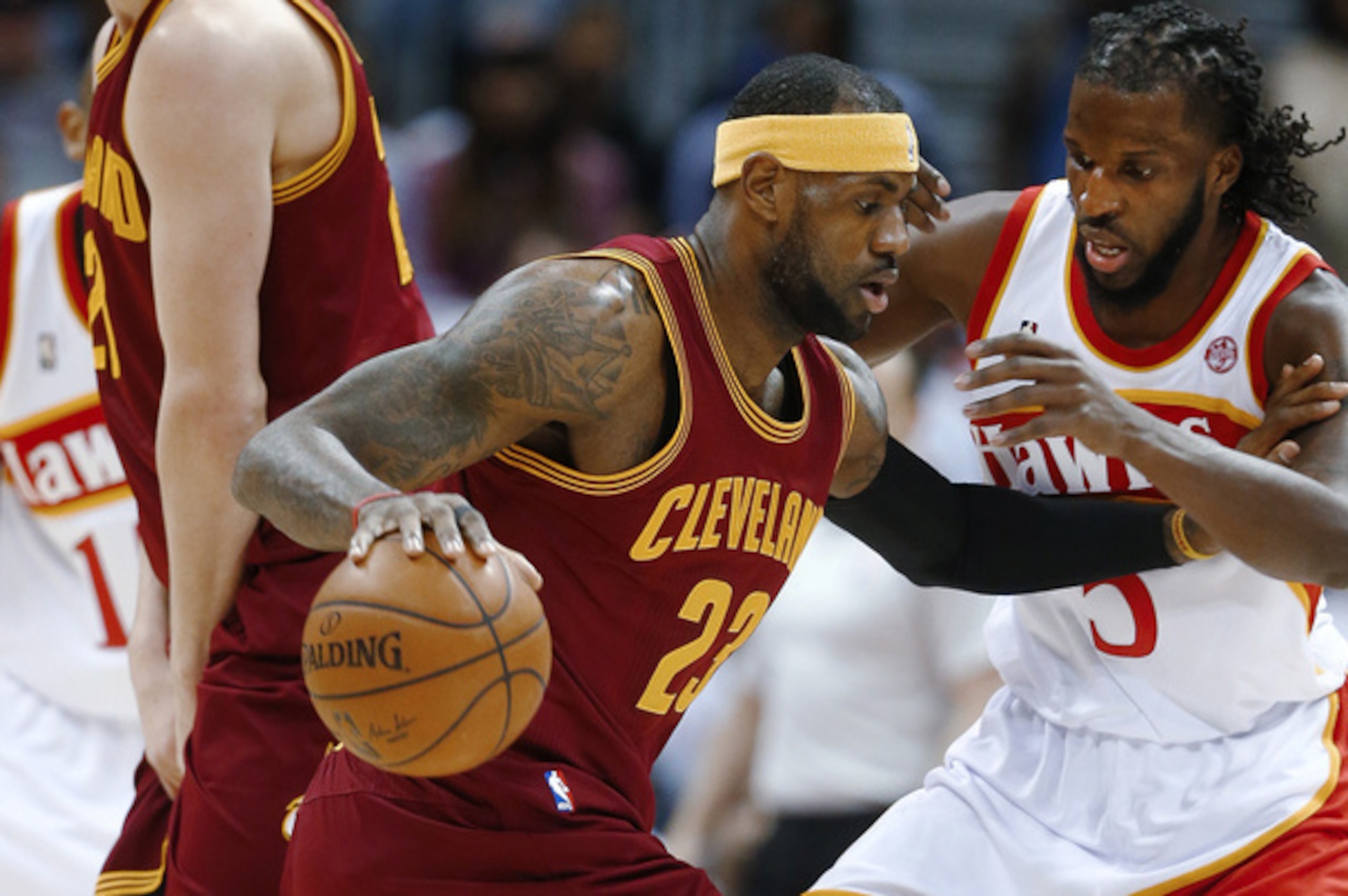
James is a player unlike any other in the NBA. With the brute strength of a center and the dribbling, passing and athletic abilities of a point guard, the 6'8", 250-pound small forward requires a defensive cover who is equal parts quick, strong and smart.
LeBron, meet DeMarre Carroll.
Junkyard Dog, at 6'8" and 212 pounds, has the physical and mental tools to thrive in his matchup with the Cavs superstar. But if he wants to limit what LeBron can do, he must stay engaged and disciplined.
Carroll was successful, to say the least, against James in the two head-to-head matchups they had in the regular season. DeMarre's Hawks beat LeBron's Cavs both times when the starting small forwards were active, with Atlanta winning the Dec. 17 matchup 127-98 and the March 6 contest 106-97. Carroll missed the Nov. 15 matchup (a 127-94 Cavs win) with a groin injury and James was sat out the Dec. 30 game (a 109-101 Hawks win) due to knee soreness.
| James | 19.5 | 4.5 | 5.0 | 5.5 | 54.8 |
| Carroll | 12.0 | 5.5 | 0.5 | 1.0 | 70.6 |
The Hawks small forward even offered a memorable sound bite regarding his defense after the March 6 game, according to the Atlanta Journal-Constitution's Chris Vivlamore:
Junkyard Dog has allowed his defensive energy to slip a bit in the postseason, which is understandable considering how badly the Hawks have needed his scoring services. Carroll has averaged a team-leading and remarkably efficient 17.1 points per game, and sometimes, it's seemed like he's been the only one who could hit a shot.
However, there are statistics to prove his decline as a point-preventer. Carroll's defensive box plus/minus was a solid plus-0.5 in the regular season, but his postseason number in the same category is a meager minus-0.6. This is despite playing two playoff opponents that were both below-average offensive squads during the regular season.
The Hawks small forward's mentality must change heading into the Cleveland matchup. The majority of his effort will have to come on defense.
Along with this, Carroll's teammates must trust him to guard LeBron one-on-one without help. The Chicago Bulls' Jimmy Butler did an admirable job against the Cavs forward in the Eastern Conference Semifinals, but when his teammates tried to sag off their marks to help him, LeBron fired assists to wide-open shooters.
Take the play starting at the 56-second mark in the below video, for example. Derrick Rose unnecessarily helped Butler guarding James, and Rose's defensive assignment, Matthew Dellavedova, got a clean spot-up look.
In the Bulls series, Cleveland players not named LeBron shot a fantastic 55-of-134 (41.0 percent) from behind the arc, largely due to their talented teammate's penetration. Atlanta will need to ensure that LeBron's supporting cast doesn't find that same rhythm and, in doing so, take away the Cavs' offensive balance.
For that reason, Hawks head coach Mike Budenholzer should let Carroll deal with LeBron by himself in almost every circumstance, only having his squad provide defensive help when James has gotten around DeMarre. Yes, this probably means the Cavs superstar will put up a couple of gaudy scoring lines in the series, but his assists will be down and Cleveland's role players will have trouble finding a rhythm without many open looks.
If Carroll's postgame interview with ESPN's Chris Broussard following Game 6 against the Wizards is any indication, he's up to the task.
Making Al Horford and Paul Millsap Offensive Options 1A and 1B
The main Cavaliers weakness the Hawks should be looking to exploit this series the Cleveland's poor quality and depth of big men. With Love out, Cleveland's three best post players are Tristan Thompson, Timofey Mozgov and Kendrick Perkins (LeBron also sees some time as a 4 or 5, but those aren't his natural positions).
If you didn't know the rest of the roster, would you guess a team with those three as its best big guys could make the conference finals? I sure wouldn't.
The Hawks' Al Horford and Paul Millsap form an All-Star interior duo who can make life extremely difficult for any of Cleveland's bigs. Both have shooting range out to the three-point line and can drive past slow-footed posts (hello, Perkins!).
In Game 1 of the Cavs' second-round series, we saw the damage a mid-range-shooting big man (Pau Gasol) could do to the Cleveland defense. Mozgov is a fantastic rim protector, but the Cavaliers don't have a versatile post who can defend the paint and the perimeter capably, outside of an engaged LeBron.
Thompson and Mozgov are the starters, but what happens if the Atlanta bigs are feeling particularly aggressive one game and draw two early fouls on both players? In that scenario, James may have to shift over to play the 4 with Perkins at the 5, a combo Cavs fans would probably prefer not to see much of.
Also, the more Thompson and Mozgov have to sit, the better for the Hawks. The two combined for 17.7 rebounds per game against the Bulls and could make life difficult for the Hawks big men on the glass. Atlanta ranked just 27th in rebounding differential during the regular season, so the team's performance on the boards will be something to watch out for.
If Horford and Millsap find ways to take advantage of their versatility, the Hawks' chances of advancing to the NBA Finals will increase dramatically.
All statistics are from Basketball-Reference.com, NBA.com and ESPN.com (including ESPN's Hollinger Stats) and updated through May 18 unless otherwise indicated.

.jpg?w=2560 "Raiders Could Start Mendoza")

.jpg?w=2560 "Rodgers Iced Out on Plane 💎")
.jpg?w=2560 "Packers Safety Slams Refs 🤬")
.jpg?w=2560 "🚨 Week 8 AP Top 25 Poll")