Are Houston Rockets Suffering from Playoff Scheme or Execution Letdowns?
During the Houston Rockets' second-round game with the Los Angeles Clippers, TNT announcer Reggie Miller raised the point that you “can’t come up with adjustments for non-execution.” He was speaking in regards to the sloppy offense being run by the Rockets.
That was manifesting itself in an astonishing number of turnovers. So far in the second round of the playoffs, the Rockets are donating the ball 19.0 times per contest, which is a good way to lose games, especially when that leads to 24.5 points for their opponents—worst in the league, per NBA.com/Stats.
So what’s to blame? Is it the scheme, the execution or a combination of the two? To answer that we first need to look at the offense.


Offensive Predictability
It’s been pointed out that the Rockets depend on James Harden for a lot of their offense. ESPN Stats and Info made that clear with this tweet. What that does, though, is make for a severely limited half-court arsenal.
I looked at the remaining playoff teams and how they’re getting their points during the postseason based on play type. I focused on the points which specifically come out of half-court plays. I excluded transition (because it’s not half court), putbacks (because that’s not an actual play) and miscellaneous (because those tend to be broken plays).
Here is how the remaining eight playoff teams generate their set points:
The play types are arranged, bottom to top, based on their dependence on Harden.
He’s their most ball-dominant player. He’s notched 41 points in isolation and the rest of the team has seven. He’s accounted for 47 of the team’s 91 points as the pick-and-roll ball-handler.
And then there’s his passing. Of the 477 field goals attempted this postseason by Rockets not named Harden, 131 of them—27 percent—have come off his passes.
A large number of the Rockets’ points in the spot-ups, roll man and cut play (the next three segments in the chart) come from those Harden passes.
So, basically, everything from the orange down depends on Harden’s penetration, scoring or passing to a fairly significant degree.
Furthermore, the Rockets tend to shoot from only two zones of the floor, as I wrote about extensively here. They are either inside the little semi-circle or outside the big one. While it’s a good idea to shy away from the mid-range, shunning it altogether has negative consequences because it makes you predictable.
Then you throw in the heavy emphasis of Harden, and it exacerbates things even more. The Clippers know what Houston is going to do, who is going to do it and where he’s going to do it from. It doesn't take a Rocket scientist to figure that out.
Offensive Inactivity
Miller failed to mention something significant in his little rant. Teams aren’t turning the ball over because it seemed like a good idea at the time, they’re doing so because the other team has scouted them and is doing things to make it happen.
If offensive schemes don’t deal with defense, perfect execution becomes nearly impossible. Turnovers inevitably follow. One way of doing that is effectively using screens.
Vantage Sports tracks every game in incredible minutia. That includes screens. This year, Houston set a league-low .87 screens per chance. The Charlotte Hornets set the most, at 1.40, and the league average was 1.10.
During the playoffs, the Rockets have set even fewer—just .64.
Not setting many screens can cause turnover issues for two reasons:
First, defenders are less obstructed, so they can shoot gaps to snatch passes. They can also crowd driving lanes because they don’t have to be concerned about the difficulty of getting to three-point shooters if they need to close out quickly.
Nothing’s in their way, and the shooters aren’t going anywhere.
Houston is so generous with the ball because, in addition to the fact their offense is so incredibly predictable, it’s also practically inert.
Solving the Problem with Space
Prior to Game 2, coach Kevin McHale told Jenny Creech of the Houston Chronicle:
"The biggest fallacy is that you get turnovers by playing fast, I really don’t believe that. There are more possessions but when you play fast there is more room. When you play slow there is less room. That is the biggest crock of crap I have ever heard. I don’t know who came up with that crock of crap, but they sold it well.
You have less turnovers when you are running, you really do. There is more space, more room to make plays. Turnovers come with low clock and low space and when you are running, you surely shouldn’t have low clock and you surely should have a little more space.
"
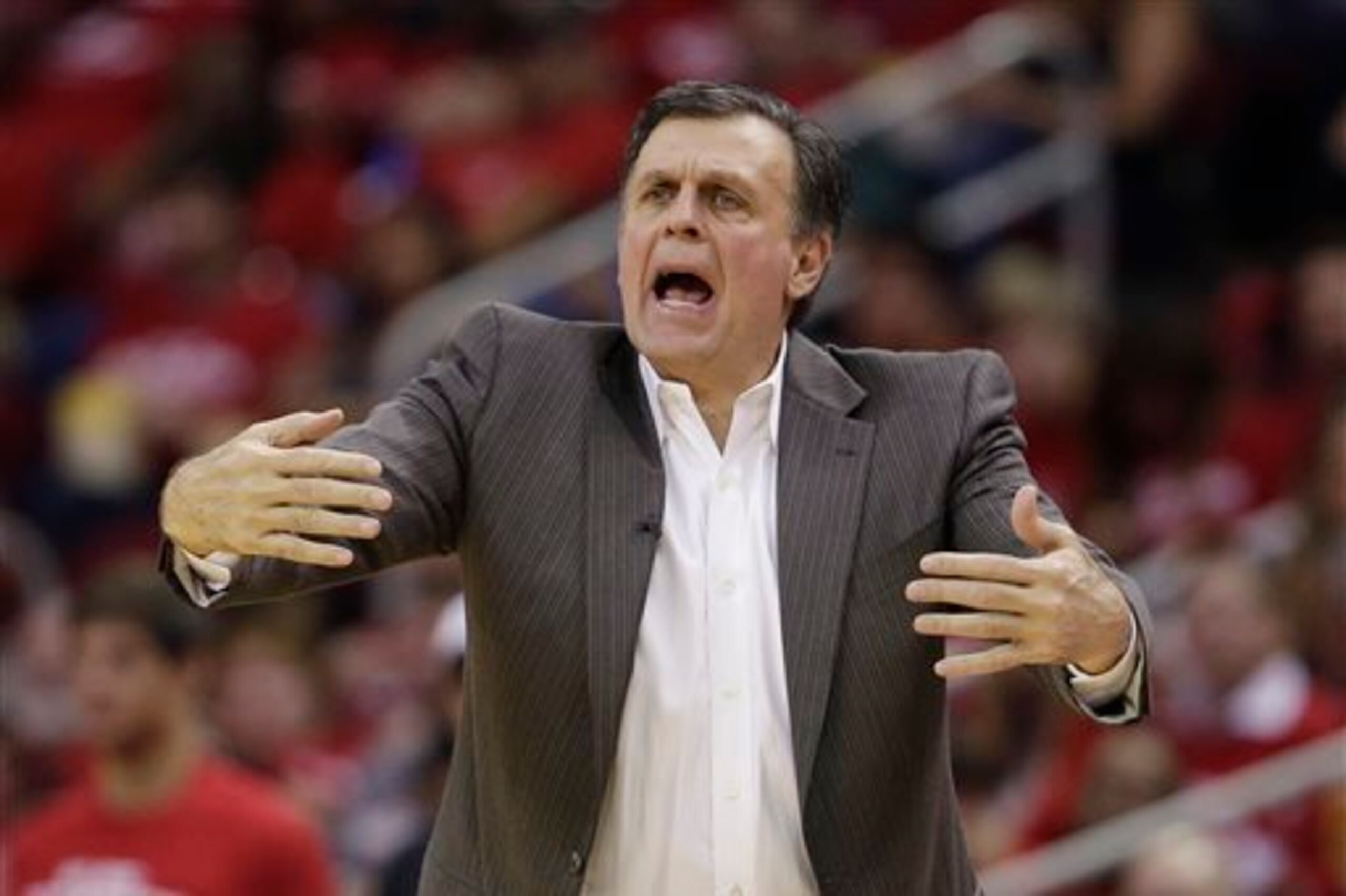
McHale isn't entirely wrong. Houston is running an insane pace of 105.81, so the turnovers are slightly exaggerated. It's only third-worst in turnover ratio.
And it is true that running faster offense doesn't mean more turnovers. Looking at the relationship between turnovers and pace this season shows almost no correlation at all (R2 of .00054 for the curious). So, he’s right about that being a fallacy.
However, no correlation also means that he’s wrong that pace decreases turnovers. Clearly it doesn’t. If it did, Houston wouldn't have so many. They’re running their pants off. Pace does not create space.
However, McHale is correct in stating that a lack of space is an issue. Setting more screens off the ball could unclog lanes and increase efficiency. Interestingly, per Vantage, the Rockets are first in Set Screen Outcome Efficiency, which is the percent of set screens that result in a score or scoring opportunity.
The Rockets do good things when they set screens, so why not set more of them?
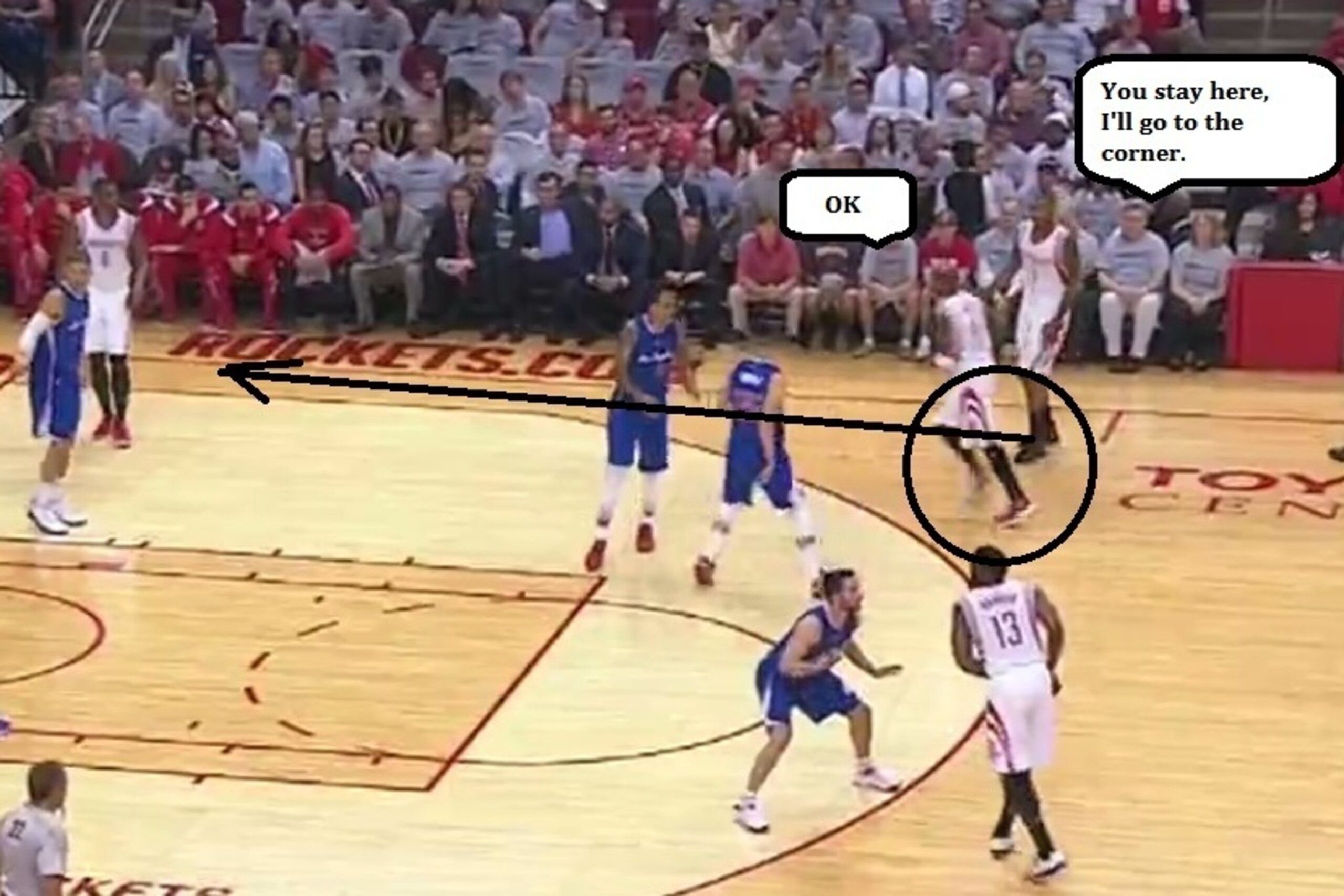
Because of the way Houston is stagnantly “attacking”, the Clippers are camping out in a basic 2-3 zone (or something that just appears to be one in response to the Rockets' inanimate offense), practically begging Harden to drive the ball inside.
That means they’re keeping two players in front and three players in back. They keep one defender close enough to both corner-three areas to close out on would-be shooters but also close enough to help on Harden penetration.
When Harden tries to penetrate, he’s not getting through the defense and he’s not able to get the ball to the shooters. And that’s resulting in turnovers. In other words, this:

The Rockets can use screens to loosen up the Clippers defense. For example, instead of that travesty, the Rockets could run a variation on the “Chicago” play, detailed at The Coach’s Clipboard.
First, rather than Terry going to the corner, the Rockets could have Ariza drop down instead.
Then, Dwight Howard could set the pick on DeAndre Jordan while Terrence Jones screens Blake Griffin. That frees up Trevor Ariza for a straight line to the basket. Austin Rivers (or Matt Barnes if they’re switched) would just be caught on Jones’ pick.
Then Harden can loft the ball up for an alley-oop.

This is just one example, but it illustrates how Houston can use a little bit of screening to go a long way toward producing fewer turnovers and more points. The nice thing is that adjustments like this don’t require a tremendous amount of practice, overhauling the offense or changing the personnel.
There are other turnovers. Some are just caused by inattentiveness on the player's part. At least two come to mind where Harden was unaware of a defender behind him when his dribble was deflected. There are several lazy passes on multiple players.
These, however, are the minority of problem. There's an overall structural issue in the offense, and that's on the architect, not the builders. You can't blame them for following the blueprint.
In a battle between the Rocket ships and the Clipper ships, screens can make all the difference. Because, well, it’s obvious which does better in space.
Vantage Sports stats used by special permission. Other stats provided by NBA.com/Stats.

.jpg?w=2560 "Raiders Could Start Mendoza")

.jpg?w=2560 "Rodgers Iced Out on Plane 💎")
.jpg?w=2560 "Packers Safety Slams Refs 🤬")
.jpg?w=2560 "🚨 Week 8 AP Top 25 Poll")