
Re-Grading Denver Broncos' Past 5 Drafts
With the draft a little over a week away, it’s time to reflect on the past drafts for the Denver Broncos. Pro-Football-Reference.com shows how the Broncos have drafted in recent years.
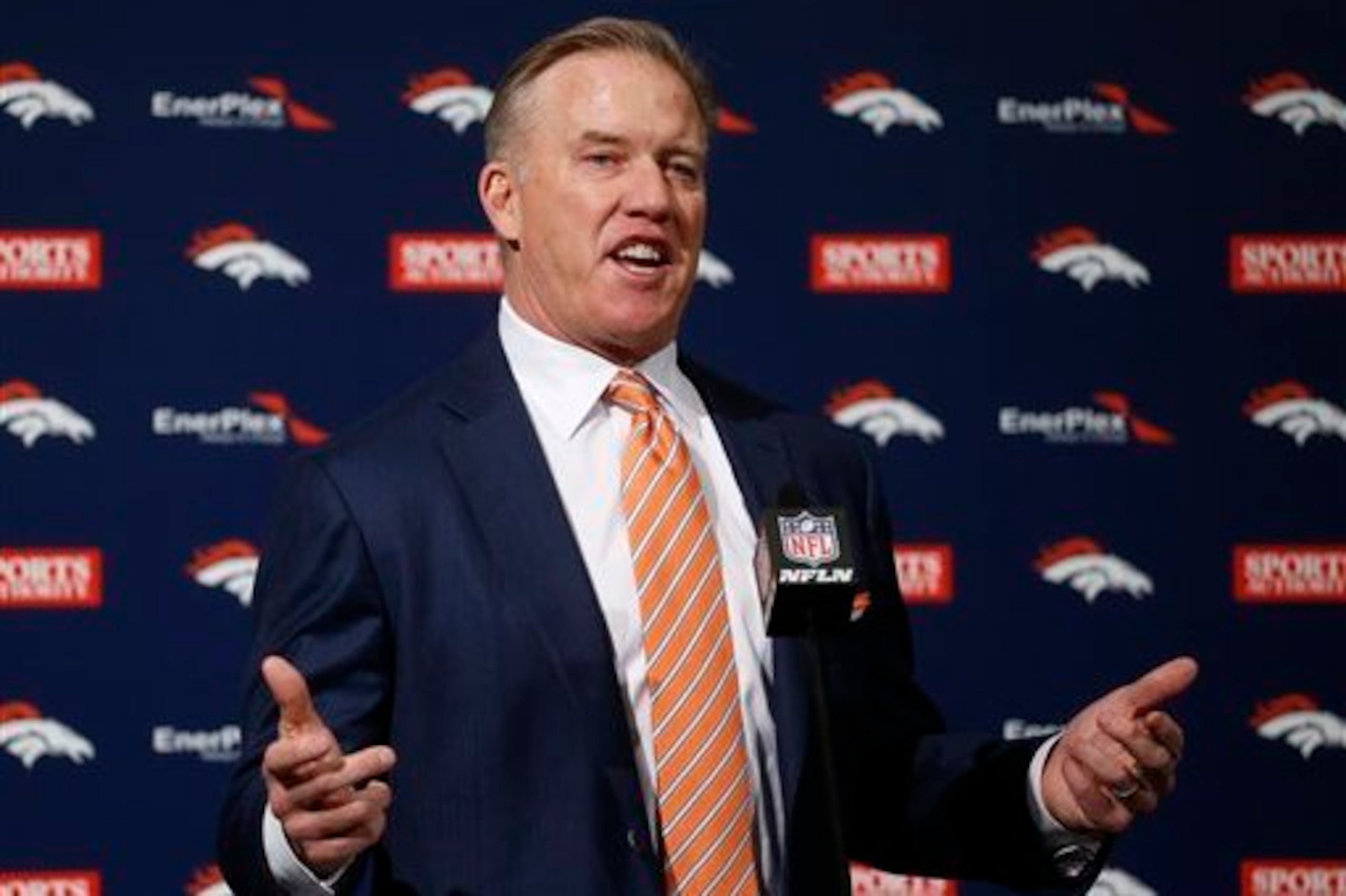
This upcoming draft will be the fifth in which general manager John Elway has been in charge. He took over in January 2011, tasked with pulling the Broncos from the slump they suffered during the short-lived Josh McDaniels era.
In this article, I will re-grade the past five drafts for the Denver Broncos.
2010 NFL Draft
1 of 5
Round 1, Pick 22, WR Demaryius Thomas (Georgia Tech)
The Broncos had to choose between Thomas and Oklahoma State’s Dez Bryant at this juncture. Josh McDaniels may not have gotten everything right (not even close), but he made a wise decision in adding Thomas here.
Today, Thomas is one of the most dominant receivers in the league. Over the last three seasons catching passes from Peyton Manning, Thomas has 94, 92 and 111 catches. Even in the new offense under Gary Kubiak, Thomas has the ability and potential to snare over 100 passes for the second year in a row.
Grade: A+
Round 1, Pick 25, QB Tim Tebow (Florida)
After picking up Thomas, McDaniels decided to grab his quarterback. Tebow finished his college career with the Florida Gators as the most accurate quarterback in SEC history. Many think Tebow is the greatest college player in history, and a sound argument can be made for that case. However, college superstardom does not translate into pro success.
Tebow has bounced around from the Broncos to the Jets to the Patriots (where he failed to make the final roster). He was out of football for the entire 2013 and 2014 regular season, but Tebow just signed with the Philadelphia Eagles on Monday. It will be interesting to see if he can keep his dream alive and make Chip Kelly’s team.
Grade: D
Round 2, Pick 45, LG Zane Beadles (Utah)
Over the course of his Broncos career, Beadles made several improvements to his game. A tackle in college at Utah, Beadles moved inside to left guard for the Broncos. He played in every game of his Broncos career, and Beadles honed his skill set to become an effective starter inside.
During the 2014 free-agency period, Beadles was quick to sign a long-term deal with the Jacksonville Jaguars. The Broncos were not going to match the five-year, $30 million deal Beadles earned on the open market.
Grade: B-
Round 3, Pick 80, C J.D. Walton (Baylor)
The Broncos went back to back on offensive linemen here. Too bad this wasn’t as strong of a pick as Beadles. Walton was not a good starting center for the Broncos, and he consistently failed to recognize zero-gap blitzes during his entire time with Denver.
The Broncos waived Walton late in 2013, and he’s bounced to Washington, New York (Giants) and Miami.
Grade: D
Round 3, Pick 87, WR Eric Decker (Minnesota)
Even though they had chosen Thomas in the first round, the Broncos went back to the wide receiver well to add Eric Decker in the third round. Like Thomas, Decker was banged up with a foot injury during the predraft process and that may have cooled his draft stock.
Decker became a star with the Broncos. Yes, there were stripes on the field that would trip him up on occasion, but Decker was a reliable target who came through for his teammates. Decker also honed his nose for the end zone, and during his Broncos career scored 33 receiving touchdowns.
The Broncos had to let him go in free agency last year. The New York Jets came through with a five-year deal in excess of $36 million that the Broncos weren’t going to match. With lesser quarterback play, Decker was still able to be his reliable self for the Jets last year by snaring 74 catches for 962 yards and five touchdowns.
Grade: B+
Round 5, Pick 137, CB Perrish Cox (Oklahoma State)
The Broncos have long had a knack for finding quality talent on the final day of the draft. Cox was considered one of the best corners in the draft, but a 4.58 40-yard dash at the scouting combine that year caused his stock to fall. Denver scooped him up but kept him on the roster for only one season.
Cox has bounced around the league since then. He’s made two stops in San Francisco, played in Seattle and signed with Tennessee earlier this year.
Grade: C-
Round 6, Pick 183, C Eric Olsen (Notre Dame)
The Broncos missed here. A 31-game starter for the Fighting Irish, Olsen was supposed to compete with fellow rookie J.D. Walton for the starting center position. Instead, Olsen was released before the start of the 2011 season. He’s bounced around to several teams since that time.
Grade: D
Round 7, Pick 225, CB Syd’Quan Thompson (California)
The final round of the draft is the time to take a chance on athletic playmakers who are still on the board. Thompson flashed a bit as a rookie in 2010, but a ruptured Achilles tendon forced him to miss the entire 2011 season. He was released during final cuts before the start of the 2012 season. Thompson soon found a home in the Arena Football League, playing in 2014 for the Los Angeles Kiss.
Grade: D-
Round 7, Pick 232, DE Jammie Kirlew (Indiana)
This late in the draft, the Broncos decided to add competition on the defensive line. Kirlew did not make the team as a rookie, bouncing to play in Buffalo and Jacksonville. His pro career continued in the Canadian Football League, the German Football League and the Arena Football League.
Grade: F
2011 NFL Draft
2 of 5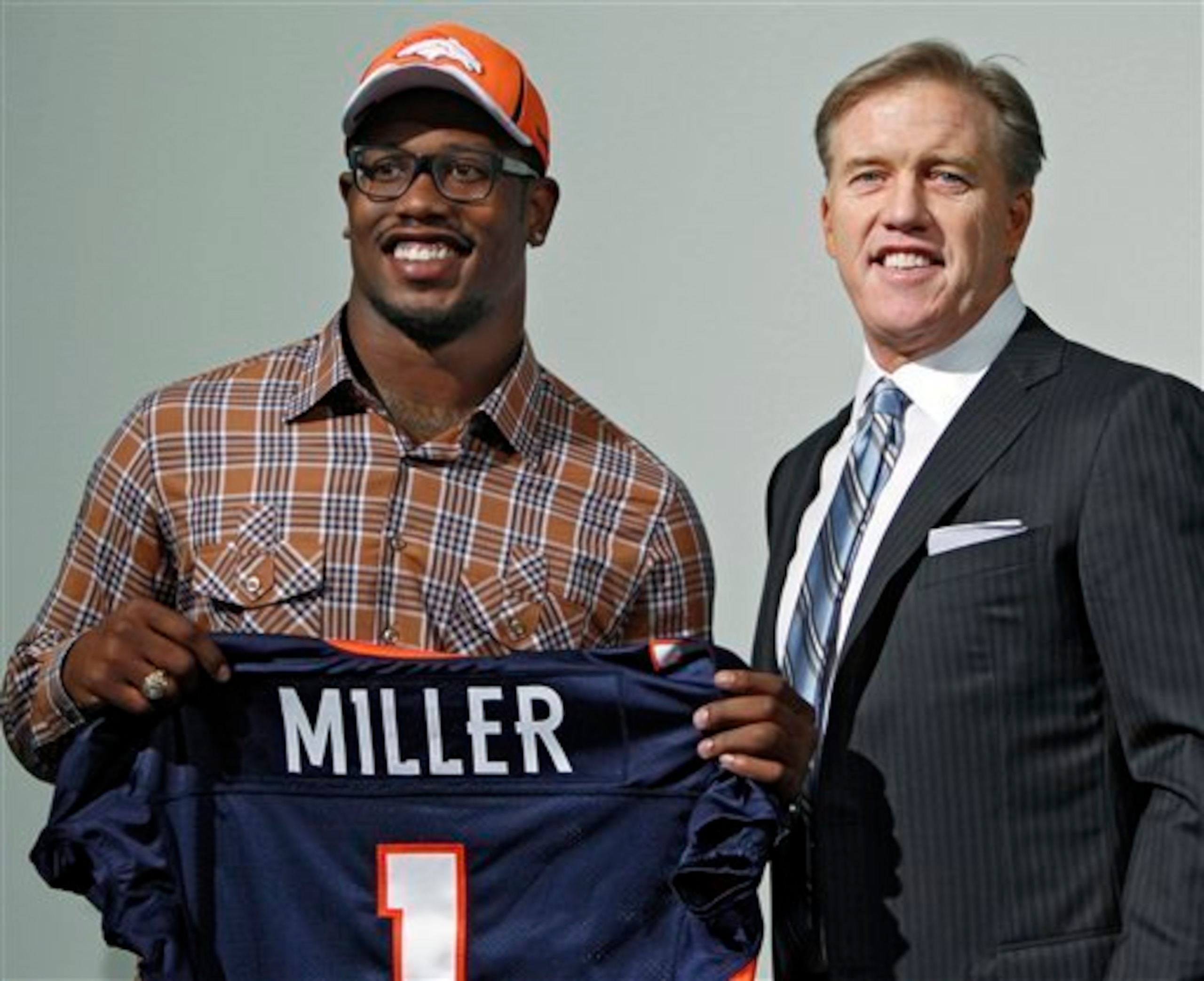
Round 1, Pick Two, LB Von Miller (Texas A&M)
Elway had seen enough on film and at the 2011 Senior Bowl to know that Miller had superstar potential in the NFL. In college, Miller played in both a 3-4 and 4-3 defense—starring in both systems.
Miller’s ability to get after the quarterback has been on full display for most of his career. He has the speed to bend around the edge at impossible angles to get underneath offensive tackles tasked with blocking him. Miller isn’t just a speed guy, and he has countermoves to get to the passer.
He also can bull rush a tackle if need be. Miller may not be the biggest player, but he has incredible strength for his size and he can walk tackles back into their quarterback.
The 2013 season was a problematic one for Miller. He was suspended for six games to start the season after violating the league’s substance abuse policy. When he returned, Miller didn’t look like himself—largely because of the 15 pounds he added that offseason. The weight gain was on purpose, as Miller felt it would help him stay stronger against larger offensive linemen.
All the 15 pounds did was slow Miller down. His 2013 season was cut short in Week 16 against the Houston Texans with an ACL injury.
Miller worked like a madman to get back in time for the regular-season opener in 2014. He wasn’t 100 percent healthy at the beginning, but began to look more like his old self as the season went on. Rushing the passer opposite childhood idol DeMarcus Ware, Miller racked up 14 sacks for the Broncos in 2014.
The team had no problem picking up his fifth-year option, and 2015 is a contract year for Miller. With a big season this year, Miller could break the bank next offseason. There’s a chance Miller could snare 15-20 sacks for the Broncos this year in Wade Phillips’ 3-4 defense.
Grade: A
Round 2, Pick 45, S Rahim Moore (UCLA)
The Broncos wanted a ball-hawking safety, and that’s why they selected Moore in the second round. During his college career for the Bruins, Moore played the ball like a cornerback and was known for his ability to intercept passes and turn them into touchdowns.
Moore never quite played up to his potential with the Broncos for a couple of different reasons.
First (and foremost), confidence was a problem for Moore at times. Early in his pro career, Moore would get beat in coverage and that would linger with him for a game or two. No Broncos fan will ever be able to forget Joe Flacco arcing a pass over Moore’s outstretched hand and into the arms of speedy wide receiver Jacoby Jones in the 2012 divisional round.
Moore took some time to bounce back from that play, but his 2013 season was cut short by a rare leg injury.
He came back in 2014 fully healthy and put in arguably the best performance of his career. Moore finished the season with 50 tackles and four interceptions. He seemed to be energized by the star players around him like Chris Harris, Aqib Talib and T.J. Ward.
Moore wanted to stay with the Broncos, but instead he left in free agency for the Houston Texans. He signed a three-year, $12 million contract earlier this year.
Grade: B
Round 2, Pick 46, OT Orlando Franklin (Miami)
Denver added a heavyweight on the offensive line with Franklin in the second round. Franklin was known as a road-grader during his time with the Hurricanes in college, and he carried that same skill set, mindset and playing style over to the Broncos.
Franklin played in all but one game during his time in Denver. He spent the first three years as a starter on the outside at right tackle. However, after the team lost Zane Beadles in free agency last year, Franklin was moved inside to left guard.
He wasn’t happy initially about the position switch, but you couldn’t tell from his play on the field. The Broncos offensive line had a ton of struggles in 2014, but left guard was not one of their problem areas.
Franklin left the Broncos in free agency this year to join the San Diego Chargers.
Grade: C+
Round 3, Pick 67, LB Nate Irving (North Carolina State)
Even though Oklahoma running back DeMarco Murray was still on the board, the Broncos decided to take an athletic linebacker with their pick of Irving. The team hadn’t had a “set-it-and-forget-it” starter at middle linebacker since the days that “Smoke Dog” Al Wilson patrolled the field.
Irving was supposed to be the guy who changed all that. Instead, he struggled to stay healthy and impress during his time with the Broncos. Irving was tried at middle linebacker multiple times and he couldn’t hang onto the job.
During the team’s run at the Super Bowl in 2013, Irving did play well as a reserve strong-side linebacker, but that’s not the spot he was supposed to star in. Irving was a two-down thumper for the Broncos, but he struggled to make plays in coverage.
Another knee injury, this time in November last year, ended his time with the Broncos. Earlier this offseason, Irving signed a new contract with the Indianapolis Colts.
Grade: C-
Round 4, Pick 108, S Quinton Carter (Oklahoma)
Moore was added to play free safety because of his athleticism and nose for the ball. Carter was added because he loved to hit and he could fly all over the field.
During their rookie season it was Carter who ended up winning the starting free safety job opposite starting strong safety Brian Dawkins. Carter showed his playmaking ability during the 2011 playoffs by picking off Ben Roethlisberger and Tom Brady in that miraculous postseason run.
The story with Carter will always read “what might have been” because of a microfracture knee injury that robbed him of a couple of seasons with Denver. It also robbed him of the athleticism he used to have.
Carter returned to the field for the Broncos last year, but he struggled to stay healthy again. At this time, Carter remains unsigned as a free agent.
Grade: C
Round 4, Pick 129, TE Julius Thomas (Portland State)
Elway was in charge, but he still was advised by executive Brian Xanders. The Broncos decided to keep Xanders from the McDaniels staff (where he was hamstrung by the diminutive coach) to help teach Elway the ropes of the front office. At the 2011 East-West Shrine Game, Xanders got to see Thomas flash amazing potential—and Thomas became a favorite of the Broncos executive.
Thomas entered training camp after the 2011 lockout and did not attend rookie minicamp or OTAs as a result. In four days of training camp, Thomas went from a fourth-round rookie to running with the first-team offense. He continued to flash amazing potential, but Broncos fans would have to wait to see it during the regular season.
He missed most of the first two years of his pro career due to an ankle injury that later required surgery. Thomas flashed onto the scene in Week 1 of the 2013 season with a five-catch, 110-yard and two-touchdown performance against the Baltimore Ravens.
Over the next two years, Thomas scored 24 touchdowns for the Broncos. His speed and athleticism helped create mismatches every time he was on the field. This is what led the Jacksonville Jaguars to have so much interest in Thomas that they made him the highest-paid tight end in the league this offseason.
He signed a five-year, $46 million deal, which included $24 million guaranteed. In 2015, his numbers (like Eric Decker) should go down without Peyton Manning, but Thomas certainly left his mark on the Mile High City.
Grade: A+
Round 6, Pick 189, LB Mike Mohamed (California)
The Broncos missed with this pick, but Mohamed seems to have found a good spot with the Houston Texans the past two years. After being drafted by the Broncos, he was released, bounced to the Jaguars and Titans, bounced back to the Broncos and then left again. The Texans added him with a futures contract at the beginning of 2013, and he’s been there ever since.
Grade: D
Round 7, Pick 204, TE Virgil Green (Nevada)
The Broncos made up for their miss on Mohamed by crushing it with the pick of Green. During his college career at Nevada, Green was a favorite target of Colin Kaepernick and was known as a reliable receiver in the open field. He was not known as a blocker.
Over three years, Green was an unsung hero for the Broncos. He would line up at tight end, H-back or even fullback. Green did it all, playing special teams, running the ball, blocking and catching passes.
Green worked diligently to improve his weakness, and he’s become the best blocking tight end on the Broncos roster. He’s underrated as a receiver, and Green should thrive in the tight end-heavy offense ran by Gary Kubiak.
Grade: B+
Round 7, Pick, 247, DE Jeremy Beal (Oklahoma)
This pick didn’t help the Broncos. Beal was a playmaker in college, but he peaked with the Sooners. He stayed with the Broncos until 2013. He then played in the Canadian Football League.
Grade: F
2012 NFL Draft
3 of 5
Round 2, Pick 36, DE Derek Wolfe (Cincinnati)
The Broncos' first pick happened on the second day of the draft when they called Derek Wolfe’s name. They moved back not once—but twice—in order to find the right spot to add Wolfe to the roster.
When healthy, Wolfe has been a solid player for the Broncos. He has the strength to set the edge as a run defender. He also plays with proper discipline to keep containment and force ball-carriers back toward the inside.
Wolfe is not a rock star, but he’s a good player who any team would love to have on the roster. This season, it will be interesting to see how he fits as a 3-4 defensive end.
Grade: B
Round 2, Pick 57, QB Brock Osweiler (Arizona State)
At this time, the Broncos had no idea whether Peyton Manning could still play at a high level. They needed to find a quarterback in this draft for a couple of reasons. First, they needed to find a backup to Manning who could learn and develop. Second, they needed a player they could trust as a starter if Manning was hurt or just washed up.
Osweiler has barely seen the field during the regular season as Manning has been better than anyone under the sun expected when the Broncos added him.
He has been working hard to develop his game. Osweiler has cleaned up the footwork problems that plagued him at Arizona State. He has also improved his throwing motion from what it was in college. Osweiler used to have a 3/4 release (almost sidearm) in college, but now passes leave his hand from the proper over-the-head spot.
Osweiler is entering the final year of his rookie contract this year. At this time, there has been no clues revealed that would indicate the Broncos have interest in extending his deal. Manning has two more years left on his deal, and if he stays healthy then Osweiler will have to keep waiting if he stays in Denver beyond this year.
It’s looking like the Broncos could lose Osweiler as a free agent next year. They would certainly receive a compensatory pick for the 2017 NFL draft, but they would be losing out on all that precious time the staff spent improving Osweiler’s game.
Grade: C-
Round 3, Pick 67, RB Ronnie Hillman (San Diego State)
John Fox had a long history of selecting talented running backs in the draft who can produce at the NFL level. During his time with the Carolina Panthers, Fox added several backs who went on to become quality players (only Eric Shelton was a complete bust). Hillman was supposed to be the next in line of successful running backs under Fox, and there were some comparing his skill set to that of DeAngelo Williams.
As a rookie, Hillman spent most of the year as a backup behind Willis McGahee. When McGahee was lost late in the year to a knee injury, Hillman did not get promoted to the starter’s job. Instead, it was Knowshon Moreno who earned that spot—even though he had been inactive for eight games prior to McGahee’s injury.
Hillman entered 2013 at the top of the depth chart for the Broncos. Even though they had added Montee Ball in the second round, it was Hillman who worked almost exclusively with the first team. He looked good in training camp, but the preseason rolled around and disaster struck for Hillman.
With three fumbles (two returned for touchdowns) in the first two preseason games, Hillman literally dropped the ball. He was overtaken by both Moreno and Ball. Hillman spent most of the last half of that year on the inactive list as C.J. Anderson earned a jersey instead.
Nobody knew what to expect in 2014. Anderson was the best back in training camp, but Ball was pretty much anointed the starter. Hillman initially won the second-string job, and he started a few games after Ball’s groin injury knocked him out of action.
Hillman had two 100-yard rushing performances during his brief time as the starter. His speed and quickness certainly came in handy on the Broncos high-octane offense. His lack of size created problems inside the tackles, and Hillman ended up getting hurt with a large role. This opened the door for Anderson, and he never looked back.
This year is likely to be Hillman’s last in Denver. His juke moves and quickness are a bit of an odd fit for the zone-blocking system that asks running backs to be more precise and more decisive. It will be interesting to see how Hillman responds in a contract year.
Grade: C
Round 4, Pick 101, CB Omar Bolden (Arizona State)
Secondary help is always welcome, and that’s what the Broncos were going for with the pick of Bolden in the fourth round. Bolden plays with a ton of attitude, and he certainly has no lack of confidence in his game.
However, too often Bolden will bite on play-fakes or pump-fakes as he’s caught peeking in the backfield instead of covering his man. Bolden wants to make a big play, but he’s best used with the play in front of him.
This is why Bolden should just be considered a free safety at this point in his career. He can also contribute on special teams.
Grade: C-
Round 4, Pick 108, C Philip Blake (Baylor)
You think the Broncos would have learned their lesson with Baylor centers when J.D. Walton struggled to impress. They did not, and Blake was added to be an interesting developmental prospect with starter upside.
Instead, Blake never suited up for a regular season game in 2012 and was released in 2013. He was picked up by the Arizona Cardinals, where he lasted about a year. He was out of football in 2014, but Blake did sign a deal with the Montreal Alouettes in the Canadian Football League earlier this year.
Grade: F
Round 5, Pick 137, DE Malik Jackson (Tennessee)
The Broncos found a ton of value with this pick. Originally starting his college career with USC, Jackson transferred to Tennessee and flashed his ability.
Jackson plays with a ton of heart and hustle. He is loud, proud and supremely confident in his ability. He plays with a fire and energy that few can match—and Jackson can certainly intimidate opponents on the football field.
He’s been mostly used as a rotational player, but Jackson can bring the heat from the edge. Jackson will play without discipline at times because of his aggressive mindset. He’s mostly a guy to create pressure on the outside, but Jackson is not a bad run defender.
A larger role could lead to even more big plays for the Broncos.
Grade: B-
Round 6, Pick 188, LB Danny Trevathan (Kentucky)
Denver added a star when it selected Trevathan late in the draft. He was a standout player in college at Kentucky, and Trevathan also impressed the Broncos scouting department at the 2012 Players All-Star Classic after his senior season.
He’s incredibly athletic and can cover from sideline to sideline. Trevathan can bait opposing quarterbacks into bad throws, and he plays like a ball-hawking free safety at times.
Trevathan is not a run-stuffer, but he’s a sound tackler who can quickly bring his man to the ground. He has high football intelligence and does a good job of diagnosing plays as they unfold in front of him.
Grade: A-
.jpg?w=2560 "Chiefs Giants Football")
.jpg?w=2560 "Colts Football")
.jpg?w=2560 "Titans Colts Football")
2013 NFL Draft
4 of 5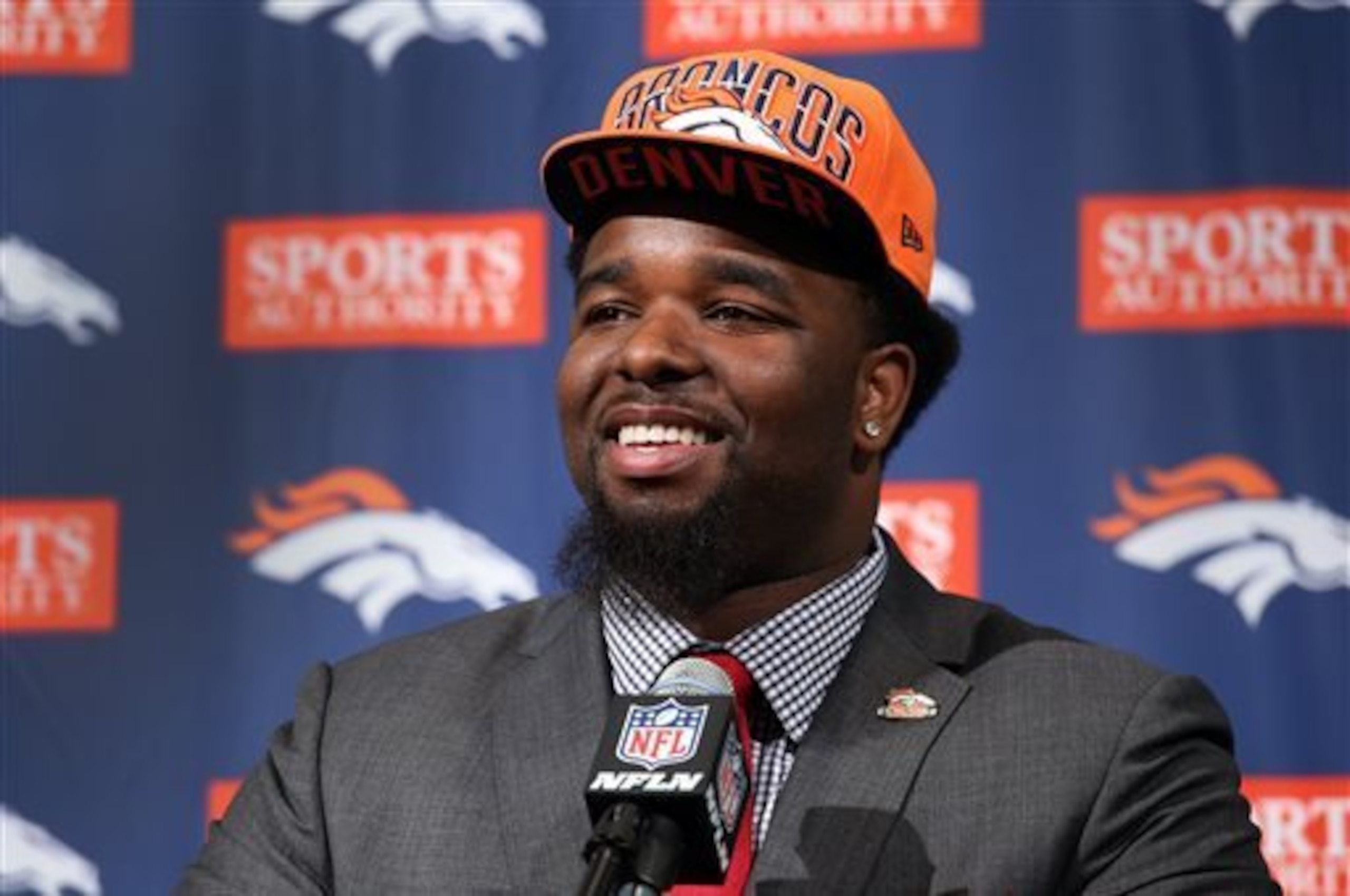
Round 1, Pick 28, DT Sylvester Williams (North Carolina)
Many mock drafts did not have the Broncos taking Williams in the first round, as he was supposed to be off the board by the late first round. Perhaps other teams knew something Denver did not.
As a rookie Williams didn’t play much until Kevin Vickerson suffered a hip injury about halfway through the year. He came in to start for Vickerson and flashed a bit of skill opposite Terrance Knighton in the trenches.
Last year, Williams was supposed to take another step and become the dominant player the Broncos envisioned when they picked him up. Instead, Williams struggled to get any push despite constantly facing one-on-one situations.
Entering 2015, Williams can be penciled in as the starting nose tackle in Wade Phillips’ 3-4 defense. If Williams struggles, then he could be replaced by Marvin Austin or another player yet to be added to (or already on) the roster. Defensive tackles take a little time to get up to speed in the NFL. Williams’ struggles were forgivable as a rookie, but his slide back last year does not bode well for his future with the Broncos.
Grade: Incomplete
Round 2, Pick 58, RB Montee Ball (Wisconsin)
The Badgers have a long history of producing great college backs. Those same backs tend to struggle at the pro level, and Ball may be the next in that long line. Bypassing Eddie Lacy, the Broncos chose Ball because of his durability (even though he had over 600 more touches than Lacy in college). While Lacy has 3,001 all-purpose yards in two seasons, Ball, at 938, has not even hit the 1,000-yard mark in rushing and receiving.
Ball was supposed to take over for Knowshon Moreno last year, but an appendectomy in training camp slowed him down at the start of the season. A groin injury that lingered pretty much ended up knocking him out. Ball now is staring up the depth chart at C.J. Anderson as we head into 2015.
He’s a good backup running back, and this zone-blocking system should help Ball look better. The problem is he’s not going to play much as Anderson shines in 2015. A team in a Super Bowl window should’ve taken Lacy and not Ball.
Grade: C
Round 3, Pick 90, CB Kayvon Webster (South Florida)
Cornerback was a hot commodity in the 2013 NFL draft. By the time Webster was selected, 22 secondary players (corners and safeties) had been picked in the draft. Even though Webster might have been graded lower than the third round by some, the Broncos felt they had a need and picked up the big corner.
There is no doubt that Webster loves to hit. He does not shy away from contact and will get physical with any player he’s covering on the field. Webster does get beat due to his aggressive style and lack of recovery speed.
The team has experimented with putting Webster at free safety, and the position switch may become more permanent as other players at corner continue to outperform him.
Grade: C-
Round 5, Pick 146, DE Quanterus Smith (Western Kentucky)
The final grade isn’t going to be kind, but this was a good place to take a chance on a player like Smith. During his final season at Western Kentucky, Smith was leading the NCAA in sacks when a knee injury cut his year short.
Smith didn’t look like himself during rookie minicamp and his rookie training camp. He ended up missing his rookie season still recovering from his college knee injury. Last year, Smith looked more explosive but he failed to do much with his opportunity. Playing in 15 regular-season games, Smith was put on injured reserve for the playoffs due to another knee injury.
The story of Smith might always read “what might have been” and this season is certainly a make-or-break year for him.
Grade: D-
Round 5, Pick 161, WR Tavarres King (Georgia)
The Broncos missed on this pick, but early on King showed some promise. During rookie minicamp and the early portions of training camp, King showed off the speed to eat up cushions in a hurry. He also flashed better route-running ability than he did in college at Georgia.
King was cut to be placed on the practice squad after training camp as a rookie. He stayed there until the Broncos cut him loose (still hoping to bring him back) and he was scooped up by the Carolina Panthers. King played there in 2013 and part of 2014. He was cut by the Panthers and spent 2014 with both the Jacksonville Jaguars and Tampa Bay Buccaneers.
Grade: F
Round 6, Pick 173, OT Vinston Painter (Virginia Tech)
This was not a good pick. Painter is a huge prospect, and the Broncos were supposed to develop his raw upside. Instead, Painter bounced on and off the practice squad for his first season. Before the start of the 2014 season, the Cleveland Browns stole Painter off Denver’s practice squad.
Grade: D
Round 7, Pick 234, QB Zac Dysert (Miami, Ohio)
Every team should take a developmental quarterback each year in the draft (or pluck one from the remaining college free agents). That’s what Denver had in mind when they acquired Dysert.
His big arm and athleticism are intriguing, but (just like in college) Dysert struggles to play consistently or throw with accuracy. He’ll make one pass that makes you say “wow!” then he’ll throw 10 in a row off the mark. He was on the practice squad last year, and this season he may struggle to even make that spot.
Grade: D-
2014 NFL Draft
5 of 5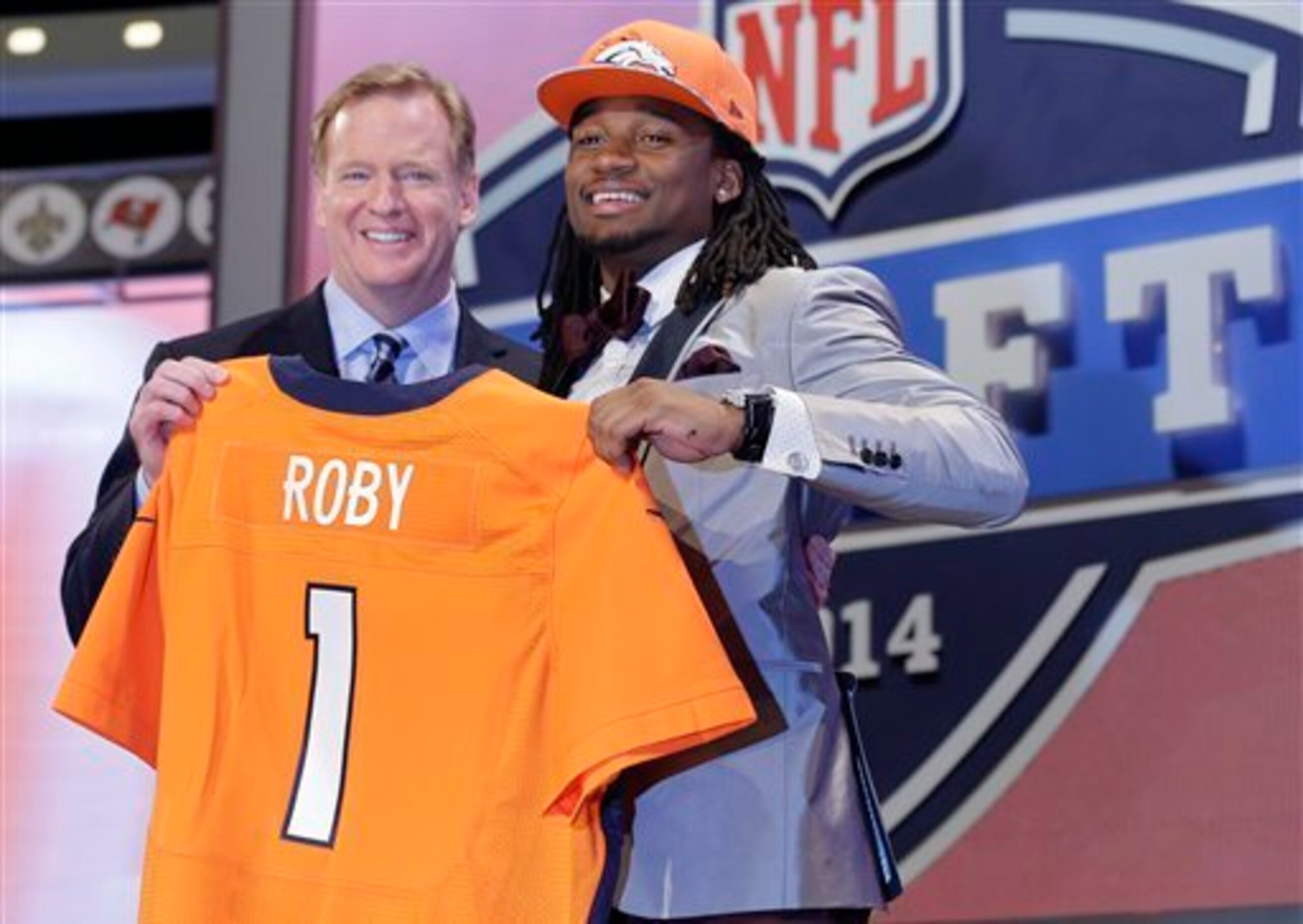
Round 1, Pick 28, CB Bradley Roby (Ohio State)
The Broncos smashed this pick out of the park. Roby was a confident (some say cocky) cornerback during his time with the Buckeyes. He flashed incredible athleticism as a collegian, and Roby tested as one of the most explosive corners in his draft class.
Denver had to be thrilled to see Roby still on the board when its pick came up. Even though it had Chris Harris as a starter—and had signed Aqib Talib in free agency to start—Roby was the pick.
During his rookie season, Roby was tested early and often. Opposing quarterbacks tried to test the rookie, and he continuously came up with big plays at crucial moments in the game.
A sign of the star he could be came in Week 1 with Andrew Luck and the Colts driving to potentially win at the end of the fourth quarter. On a fourth-down play, Luck targeted savvy veteran Reggie Wayne to keep the sticks moving. Instead, Roby batted the pass away—he drew no pass-interference penalty—and the Broncos won. That’s only one example as Roby was tested more as the season went on—but he regularly came out on top.
Grade: A+
Round 2, Pick 56, WR Cody Latimer (Indiana)
Denver may have another star wide receiver on its hands with Latimer. The Broncos liked what they saw in Latimer at Indiana so much that they moved up in the second round to acquire the talented wide receiver. Then, they barely used him as a rookie.
Latimer struggled to grasp the Peyton Manning offense, but the incredible raw talent was on display every day in training camp. He routinely made difficult catches, and Latimer used his leaping ability and wingspan to snare passes that seemed out of reach in the back of the end zone. Even though he was a camp star, former head coach John Fox didn’t use Latimer much as a rookie.
During the regular season, Latimer was active for only eight games. He ended his rookie season with only two catches for 23 yards. That stat line isn’t going to attract much attention, but Broncos fans need to know that bigger things are on the horizon for Latimer.
In the new Gary Kubiak offense, Latimer is going to play some on the outside opposite Demaryius Thomas with Emmanuel Sanders moving inside to the slot. It won’t be a surprise to see Latimer breakout in 2015.
Grade: C (potential A)
Round 3, Pick 95, OT Michael Schofield (Michigan)
This year will tell a lot about the value of this pick. Schofield started more than 20 games for the Wolverines at right tackle in addition to starting at left guard for 10 games. He looked small last year, and his weight problems weren’t the only issue. Schofield looked lost in pass protection, and that kept him on the inactive list for his entire rookie season.
With the Broncos this year, Schofield is in line to compete for the starting right tackle position. His main competition at the position is veteran Chris Clark, but expect the Broncos to select a right tackle in this draft—perhaps with a premium pick.
Grade: Incomplete
Round 5, Pick 156, LB Lamin Barrow (LSU)
In today’s NFL, teams are looking for athletic linebackers who can cover and make plays in space—precisely what Barrow can do. He was active for every game as a rookie, but Barrow didn’t see much playing time. Barrow ended his rookie season with only one tackle and one assist—both recorded in the Week 3 game against the Seattle Seahawks.
Grade: C- (potential B)
Round 6, Pick 207, C Matt Paradis (Boise State)
Like the Schofield pick in the third round, the pick of Paradis in the sixth will reveal its value this season. A walk-on at Boise State, Paradis spent his rookie season on the practice squad for the Broncos. He’ll be competing for the starting center position with the Broncos in 2015. He has the athleticism to work well in the new zone-blocking system.
Grade: Incomplete
Round 7, Pick 242, LB Corey Nelson (Oklahoma)
While the Broncos waited for Barrow to strut his stuff, Nelson took the spotlight as the rookie linebacker who needed more playing time. Nelson appeared in a small handful of games last year, starring for the Broncos on special teams and a reserve defender. His best game as a rookie was a seven-tackle performance against the Jets in Week 6.
Grade: C+ (potential B)
All quotes and injury/practice observations obtained firsthand. Record/statistical information provided via the Broncos' media department unless otherwise noted.
Contract and salary-cap information provided by Spotrac. Transaction history provided by Pro Sports Transactions. Draft grades provided by NFLDraftScout.com.
.jpg?w=2560)
.jpg?w=2560 "Cardinals Giants Football")






