

How Will Doomed 2014-15 Season Impact OKC Thunder's Future?
There are no excuses around an Oklahoma City Thunder locker room that's endured protracted hardship throughout an injury-riddled 2014-15 campaign.
"We put ourselves in this position," Russell Westbrook told reporters after a 101-90 win against the Portland Trail Blazers this week. "But at the same time, we've just got to go out and take care of our business and see what happens."
Oklahoma City again took care of business on Wednesday night, erupting for a 76-point first half and eventually prevailing over the Minnesota Timberwolves by a final margin of 138-113.
TOP NEWS

Brown with an all-time summary of relationship with Tatum
Jokic says booing fans not welcome in Denver
Worst NBA Predictions 🫣
But it wasn't enough—not in a season torn apart by injury, not in a conference that's so obscenely competitive. The tiebreaker-holding New Orleans Pelicans took care of some business as well, beating the San Antonio Spurs en route to that coveted No. 8 seed.
With the present now on hiatus, a look to the future seems in order. What becomes of an exceptionally talented young core? Is OKC a perennial contender in the making or an experiment destined to end prematurely?
Already, the organization was forced to part ways with the likes of James Harden and Reggie Jackson on account of fiscal restraint. On paper, the Thunder's supporting cast has been replenished with the likes of Dion Waiters, Enes Kanter and D.J. Augustin, but none of the acquisitions will count for much in the event 2014 MVP Kevin Durant goes elsewhere as a free agent in 2016.
That's not the only looming question, of course. Westbrook and power forward Serge Ibaka will be free agents in 2017. Head coach Scott Brooks remains in perpetual limbo—an inspirational savior to some, an easy scapegoat to others.
If there's a sure thing, it may be general manager Sam Presti—and his ability to always figure things out. His job's difficulty level depends on a few of unknowns, questions that could well define the next decade of Thunder basketball.
KD and His Options
To hear him explain it, Durant has already paid his loyalty dues to Oklahoma City.
"I was loyal," he told GQ's Zach Baron in March. "If it comes down to that, I mean: I was. My deal's up in 2016. I'll have been here nine years. I could have easily wanted out. I could have easily not signed the extension after my rookie contract. I could have not played as hard every night. But people tend to forget."
They won't forget what he does next. A departure from OKC may not outshine LeBron's Decision in the defection department, but it would have a jarring impact on the league and its well-chronicled balance of power. Just take a look at the LBJ-deprived Miami Heat.
But has the loyalty run its course? To be sure, Durant isn't the fickle type. And it's hard to imagine him leaving a winning situation. It's just that he's not yet sure where that situation will be, leaving open the suddenly real possibility that it's not OKC.
Asked about returning home to Washington, D.C., Durant was generally noncommittal.
"I just don't know who's gonna be competitive, who's not gonna be, you know?" he explained to GQ. "That's why I can't really think too far in my mind. Because you don't know who's going to be where. You know what I'm saying? It's something you can't control."
If the Thunder are healthy, they should remain competitive. That's the lesson we learned directly and indirectly since 2012's trip to the NBA Finals. Without Westbrook in 2013 and Ibaka in 2014, things fell apart.
With little margin for error in a hyper-contested Western Conference, that's destined to be the case. OKC is very good but only when fully intact. Most teams work like that.
The danger is that injuries could derail things again in 2015-16, leaving Durant with a skewed sample when evaluating his options. It wouldn't necessarily make that Washington Wizards backcourt (John Wall and Bradley Beal) more appealing, but it would sour an otherwise promising stint with the franchise.
It's just as true, however, that a healthy and successful season would weigh heavily on Durant's interest in staying. He wants to win. And he could probably do that if Oklahoma City's luck changes ever so slightly.
The "Other" Guys

Westbrook was on the brink of missing Monday's meeting with Portland on account of a 16th technical foul that the league office quickly rescinded. Instead, he poured in 36 points, 11 rebounds and seven assists in a determined effort that was microcosmic in scope. Then he outdid himself in an ultimately meaningless season finale, racking up a ridiculous line of 37 points, eight rebounds and seven assists.
If there was ever any doubting how much Westbrook wanted that playoff berth, it ended after the first quarter.
The MVP candidate has been the lone bright spot in a season that's featured notable absences of Durant (foot) and Ibaka (knee). He won the scoring title with 28.1 points per contest and secured a league-best 11 triple-doubles.
OKC only played 15 games without Westbrook, who heroically added 8.6 assists and 7.3 rebounds during a season in which he's simply dominated since the All-Star break.
| Month | Games | Min | Pts | FG% | Ast | Reb | Stl |
| Feb | 13 | 35.2 | 31.2 | .457 | 10.3 | 9.1 | 1.6 |
| March | 14 | 37.3 | 30.9 | .403 | 10.2 | 8.5 | 2.5 |
| April | 7 | 37.9 | 31.9 | .425 | 8.3 | 8.0 | 1.6 |
One learned lesson is that Russ is absolutely good enough to lead his own team. With a slightly healthier or better supporting cast, he might have even led these Thunder to a playoff appearance in spite of the stiff competition. The individual effort has been exceptional, one of the season's best stories by a long shot.
And it's raised an always-present question to new heights: How much longer will he be satisfied as KD's sidekick? Short of an unlikely role reversal, that has to be somewhere in the back of Russ' mind. If he feels like his potential is stymied next season—and if Durant re-signs in 2016—could there be a breaking point in 2017 when Westbrook himself becomes a free agent?
It seems counterintuitive to leave a talent like Durant behind, but chemistry is everything. It's been there before, but few things last anywhere near forever in this business. So far, Westbrook's larger-than-life personality has been content to play things out in Durant's far quieter shadow. Maybe that lasts.
If it doesn't, Presti and Co. will be in the market for a playmaking point guard two years from now.
Ibaka seems less likely to leave in 2017. There's just no incentive to part ways with an ordinarily successful organization that's willing to pay him.
The near-term futures of Enes Kanter and Dion Waiters may be slightly more complicated. They're scheduled to become restricted free agents this summer and next summer (respectively), and there should be fairly robust markets for their services. Well as Kanter has played, one would think Presti will spend whatever it takes—within reason—to keep him in the fold. That should be easier to do with the league's increasing salary cap.
Waiters' future depends largely on what he does over the next two seasons. If he can settle in as the sixth man Reggie Jackson refused to be, he just might have a future with the team. If he outgrows the role and demands a starting job, his fate may resemble Jackson's.
Presti is of the San Antonio Spurs school of thought that continuity is everything. With more liberty to spend, that continuity should be even easier to preserve—in theory anyway. Money isn't everything to guys like Durant and Westbrook, so there's little certainty about what they'll decide in due time.
The Skipper
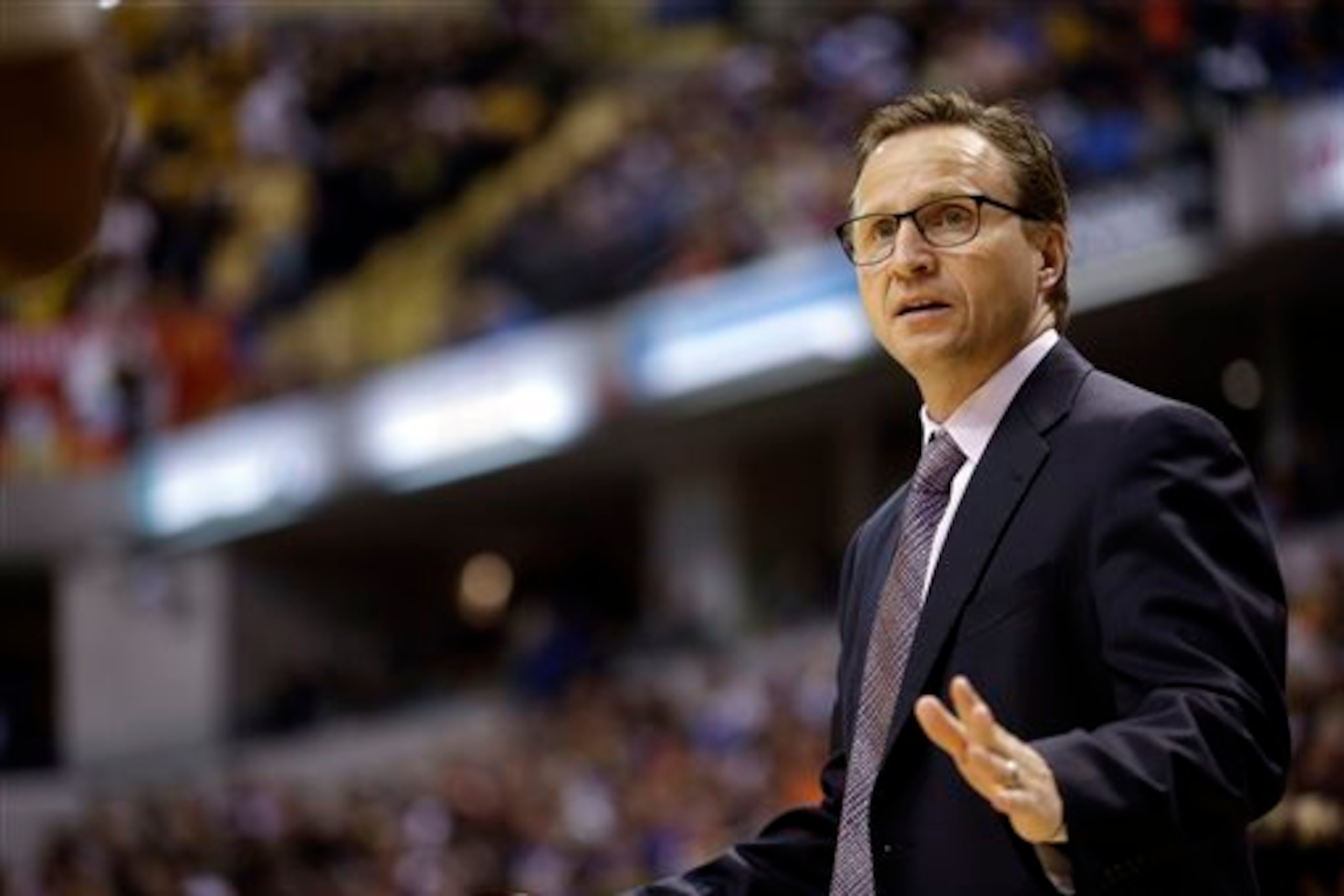
Whether Brooks is in fact a good coach really depends on whom you ask. It's hard to blame him for anything that happened this season, though. To the contrary, he's been a source of confidence and stability for a squad that was often overmatched by far healthier opposition.
"We're in a rough patch right now," Brooks told SI.com's Chris Mannix after a 100-92 loss to the New York Knicks in January. "But [GM] Sam [Presti] has always been focused on staying consistent. That comes from the philosophy from our ownership. That hasn't changed with us, with me. We always go back to what we do every day."
That process-based approach seemed to pay dividends this season. Even with Westbrook in the lineup for most of the year, the Thunder were severely disadvantaged more often than not. To whatever extent they've succeeded in spite of that, Brooks deserves a large share of the credit.
His Thunder ranked in the top 15 in both offensive and defensive efficiency this season, scoring 104.1 points per 100 possessions while allowing 103, per Hollinger Team Stats. It sounds average, but it's not bad given the circumstances.
But however one assesses his recent performance, there's still an open question as to whether he's the right man to lead Durant and Westbrook. His willingness to rely so heavily on their individual talents has almost certainly atrophied whatever semblance of an offensive system might otherwise have been created in OKC.
Brooks gives his players considerable freedom on the floor, and that can be a good thing. It just hasn't been good enough to win a title or to truly contend for one in the absence of injured star power.
Much as this lost season spoke to Brooks' merits, it also spoke to his limitations. He'll have plenty to prove when the Thunder are at full strength again.
And so will a franchise attempting its return to the top of the Western Conference.

.jpg?w=2560 "Mahomes Told Teammate to Leave Meeting")
.jpg?w=2560 "5 Teams Eyeing Jonathan Taylor")



.jpg?w=2560 "NFL investigating Eagles")
.jpg?w=2560 "Jonathan Taylor Landing Spots 📍")