

Is Torrey Smith Really Just Another Mike Wallace?
The NFL offseason flows with a series of comparisons. Attempting to predict what could happen is easier and more convenient when a connection is made to what’s already happened.
At the combine, we’re repeatedly told that really great Prospect X plays like Established Superstar Y, a process that continues throughout draft season. Some comparisons, however, double as cautionary tales. Such as whenever Mike Wallace’s name is mentioned as the days tick down to free agency.
This year’s edition of Wallace name-dropping was far more open and public—and a blatant jab at the Miami Dolphins for the bloated monstrosity of a contract they gave the wide receiver when he was a free agent in 2013. But it was also correct, and a fine show of budgetary restraint by Baltimore Ravens owner Steve Bisciotti.

.jpg?w=2560 "Rams Eagles Football")
.jpg?w=2560 "Falcons Saints Football")
“The difference between what we can pay Torrey Smith and what he gets on the open market… Mike Wallace got $10 million [his signing bonus was actually $11 million, with $30 million guaranteed], and I don’t think anyone thinks that was a good deal,” Bisciotti said during a Tuesday press conference, via ESPN.com’s Jamison Hensley.
And with that, a barrier was dropped. The dreaded Wallace barrier.
Smith is scheduled to become a free agent on March 7. If he’s not re-signed by the Ravens, the 26-year-old will enter a top-heavy wide receiver free-agent class that’s slated to include Randall Cobb, Jeremy Maclin and Michael Crabtree.
Bisciotti and the Ravens front office want to keep Smith. Of course they do, because every offense wants a young receiver with blazing speed who’s just entering his prime. But when that receiver’s production is mostly found in a specific offensive setting—running far, running vertically and doing it again and again—some hesitancy is needed.
First from the Ravens, who need to carefully allocate every penny with only just over $6 million in salary-cap space, according to OverTheCap.com. And then also from every other general manager if Smith hits the open market.
Creating another salary-cap anchor is the wrong kind of trend to set, and Smith has the potential to be another Wallace if a team tries to shoehorn him into the wrong situation.
What’s the wrong situation? Mainly, one that ends with a receiver who will account for a cap hit of $12.1 million in 2015 (nearly $2 million more than the Bengals’ A.J. Green). Now only two seasons after signing Wallace, the Dolphins are giving long thought to releasing their best offensive weapon.
With Wallace and now Smith, talent isn’t under scrutiny. Instead, scheme fit is the problem, along with potentially being linked to a quarterback whose arm doesn't provide the required steady supply of deep balls.
Wallace has failed in Miami because both of those ingredients for success have been absent.
What we can learn from Wallace’s spiral
When Wallace entered free agency in 2013, the wide receiver pool wasn’t really made for adults. It was more of a kiddie pool, the kind easily occupied by your massive dog.
He was alone at the top, followed by Greg Jennings and Wes Welker, who are both much older. Like Smith, he was set to enter his prime and turn 27 just prior to the 2013 season.
The scarcity of the market drove Wallace’s value up significantly, but the Dolphins were still paying for the Wallace they saw during his four previous seasons with the Pittsburgh Steelers.
This is when you practice your best shocked face while remembering that a vertically obsessed Bruce Arians was the offensive coordinator during three of those Pittsburgh years.
| Over two seasons in Miami | 896 | 56.0 | 12.8 | 10.5 |
| Over four seasons in Pittsburgh | 1,010.5 | 64.2 | 17.2 | 16.8 |
The two most damning tumbles there are attached to the deep ball, or a lack thereof. That’s a fatal flaw for the Dolphins because they’re paying a young and speedy receiver to be, well, young and speedy. And it’s an error of their own making.
Wallace’s first season with the Dolphins was also quarterback Ryan Tannehill’s sophomore NFL year. The intention, of course, was to jolt Tannehill’s development with a firmly established deep option to provide support. But the problem at the time still exists now: Tannehill lacks deep accuracy.
Wallace just completed his age-28 season, a time when those legs are still fresh and pumping furiously. Yet even during a season when Tannehill improved and took a bounding leap forward in terms of overall accuracy (66.4 completion percentage, up from 60.4 in 2013), Wallace was still largely an underused ghost.
Tannehill completed only 37.7 percent of his attempts that traveled over 20 yards through the air downfield, according to Pro Football Focus. That success rate was sadly an improvement over 2013, when Tannehill connected on 32.8 percent of his 20-yarders, again per PFF.
That’s why Wallace’s yards per reception average has taken a swift plummet in Miami. Worse, with the Dolphins and awesomely named offensive coordinator Bill Lazor catering to Tannehill’s deep-ball weakness, Wallace was rarely used for his intended purpose in 2014. A receiver who thrives while stretching the field saw only 24 targets beyond 20 yards, per PFF.
Lazor was hired by the Dolphins after spending a season as the Philadelphia Eagles quarterbacks coach under Chip Kelly. He then brought most of Kelly’s principles with him, including a greater focus on the running game and read-option plays to maximize Tannehill’s athleticism.
Wallace was a casualty of that scheme shift and has been exposed when removed from a vertically based offense. Smith could suffer a similar fate if he’s also plopped into the wrong system or paired with the wrong quarterback.
The similarities are striking
Bisciotti’s comment Tuesday and his comparison to Wallace were purely financial. But the similarities between the two receivers go beyond Wallace’s bank account and what Smith could soon have in his.
They have nearly identical lean body types, with Wallace standing 6’0” and weighing 200 pounds, while Smith is the same height and only five pounds heavier.
When he entered free agency in 2013, Wallace was coming off a poor season after his only year in Todd Haley’s offense, one rooted in heavy running and short passing. He finished 2012 with 836 receiving yards, a sharp decline from his 1,193 yards the previous season.
Smith’s role was also minimized during Gary Kubiak’s single season as the offensive coordinator in Baltimore, and he produced a contract year that was less than shining. In a run-based offense he did more busting than booming, finishing with a career-low 767 receiving yards. It was a fiery crash after his single-season high of 1,128 yards in 2013.
| 2013 | 65 | 1,128 | 17.4 | 70.5 | 4 |
| 2014 | 49 | 767 | 15.7 | 47.9 | 11 |
The exception there is Smith’s touchdown total in 2014, which rose sharply as his athleticism and ability to high-point the ball in the red zone were leaned on often.
A prime example of those skills came in Week 17 during a win over the Cleveland Browns. In the fourth quarter, Ravens quarterback Joe Flacco looked to his left after executing a play fake. That’s where he saw Smith running deep on a 9-route and matched up one-on-one with two-time Pro Bowl cornerback Joe Haden.
Flacco launched a throw that was a few yards short, because overthrowing Smith is hard. Smith adjusted to the flight of the ball while under duress and battling Haden. That meant turning completely as the throw descended and securing the ball 53 yards downfield as he fell backward.
No problem.
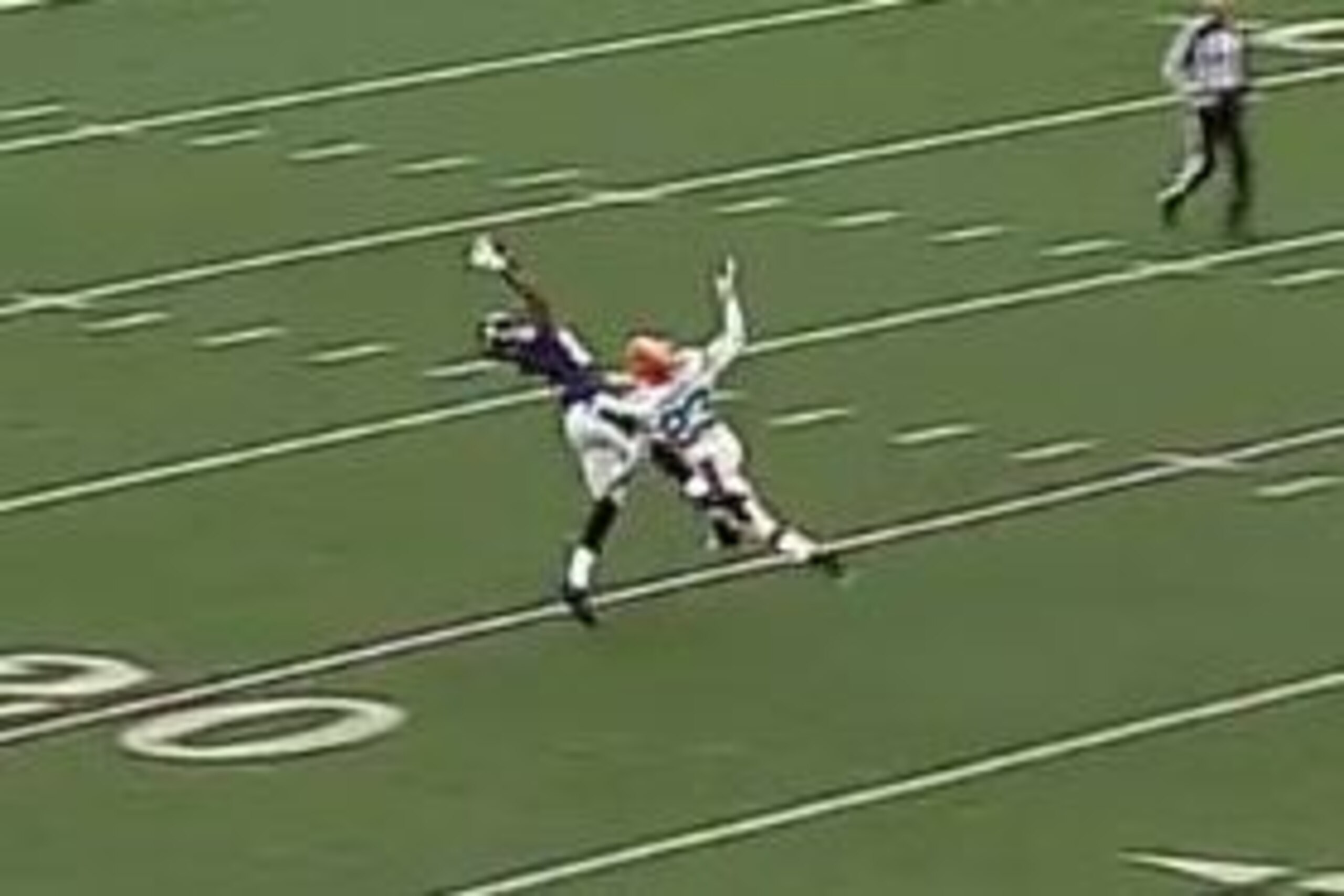
Smith is one of the NFL’s premier deep threats. He has the body control, hands and wingspan to make difficult catches and an abundance of speed to separate. Those attributes will lead to a hefty paycheck at his age, just as similar skills did for Wallace.
So how much is too much?
Properly utilizing a uniquely explosive wide receiver and justifying a contract that pays Smith something in the vicinity of $9 million each year means having plenty of long, vertical lines in the playbook. And he could be awarded a cash dump on that level if his 16.9 career yards per reception (a league high since 2011) creates a sizzling market.
However, something closer to the Ravens' first offer reported by Jason La Canfora of CBS Sports is much more comfortable:
That would fall in line with the top of the receiver market in 2014, a high watermark set by the Redskins' DeSean Jackson when he signed on to receive $8 million annually. It would also reflect Smith’s status as a premier deep threat, though an inconsistent one.
Wallace is a cautionary case study, and we’re nearing a time when delicate approaches tend to fade away.
Memories become short as thoughts of sprawling grabs deep downfield fill the mind’s eye. Dollars fly when the market opens, and later flowery thoughts about potential often get replaced with regret.
.jpg?w=2560 "Texans-Mixon Released Football")
.jpg?w=2560 "Commanders Eagles Football")
.jpg?w=2560 "Grading WWE Raw 🔠")



