

Grading Every Oklahoma City Thunder Player Heading into 2015 NBA All-Star Break
The Oklahoma City Thunder will gratefully use the NBA All-Star break to rest and regroup before resuming the grueling journey back to the playoffs. The rest is only for the players, however, as the coaching staff and front office are sure to be evaluating the state of the roster with the Feb. 19 trade deadline approaching.
General manager Sam Presti has typically been averse to making significant in-season trades, but he has already made one such move this year by acquiring Dion Waiters. Another one may be in the works as the Thunder attempt to keep up in the Western Conference arms race.
For Presti, all judgments need to be made with the entire team in mind. Fit and chemistry are just as important as talent in the NBA, so every player needs to be evaluated not just in terms of skill but with regard to how he fits into the larger picture of the OKC machine.
As a result, these player grades will attempt to do the same thing. It’s impossible to grade everyone on the roster on the same curve. If that were the case, Kevin Durant and Russell Westbrook would seriously wreck the GPAs of their teammates.
Instead, these grades will assess how each player has performed relative to their preseason (or in the case of Waiters, post-trade) expectations and how well they are fulfilling their roles for the Thunder.
End of the Bench
1 of 11
Grant Jerrett: D+
Stats: 5 gms, 5.0 mins, 1.4 pts (17.6 FG%), 0.8 rebs, -11.2 PER
It’s hard to judge a player you haven’t seen. Jerrett has yet to play a meaningful second this season, logging all 25 minutes at the end of blowouts where the result was already decided and his numbers were meaningless. There were no expectations for Jerrett, who doesn’t play a role for the Thunder, but his horrendous shooting and negative PER get the former Arizona Wildcat a D.
Ish Smith: B
Stats: 29 gms, 5.2 mins, 1.3 pts, 1.0 asts, 0.9 rebs, 10.2 PER
Ish Smith was signed using the hardship exception granted to OKC as a result of their injury problems earlier in the season. The general perception was that he was going to be a temporary stand-in until the Thunder could accumulate enough healthy bodies to fill out their roster, but Smith played well enough to hang around.
Eventually, OKC decided to keep him over Sebastian Telfair, and he is now the third-string point guard. That’s pretty good for a guy who wasn’t even on the roster to start the season.
Perry Jones III: D-
Stats: 30 gms, 17.8 mins, 5.4 pts (41.7 FG%), 2.1 rebs, 7.1 PER
After a promising start to the season that included games of 32, 20 and 16 points, Perry Jones is not even in the rotation anymore. Andre Roberson is now the designated utility defender on the roster, and Jones' three-point shooting has dropped off from last year (2013-14: 36.1 three-point percentage; 2014-15: 23.1 three-point percentage).
It’s extremely disappointing to see him fall out of the rotation considering that OKC doesn’t have another backup small forward on the roster.
Jeremy Lamb: F
Stats: 34 gms, 16.0 mins, 7.4 pts (42.0 FG%, 37.0 3P%), 2.6 rebs, 1.2 asts, 15.6 PER
Like Jones, Jeremy Lamb has completely fallen out of favor. He hasn’t played double-digit minutes since the end of December, and since that point, he has only received spot minutes at the end of games that weren’t close.
With Durant and Westbrook missing time, Lamb had an opportunity to take the next step, but that train appears to have left the station. OKC has to seriously consider flipping him for assets while he still has some kind of value around the league.
He’s been the most disappointing OKC player this year, earning him a failing grade.
Mitch McGary: A
Stats: 4 gms, 14.3 mins, 9.8 pts (65.2 FG%), 6.0 rebs, 31.0 PER
Mitch McGary has exploded onto the scene with back-to-back double-doubles. In doing so, he has become an instant fan favorite thanks to his uncontainable exuberance. His numbers are inflated, but not by as much as the casual fan may think.
The stats he’s racking up are the result of his energy. He’s battling on the boards, running the floor, crashing the offensive glass and cutting well off the ball. There are defensive issues, but those are part of the package with most rookie bigs.
The Michigan product won’t continue to take over games as he has done so far, but he will definitely be an impact player over the rest of the season and could end up stealing some minutes from Kendrick Perkins and Nick Collison.
Nick Collison
2 of 11
Stats: 45 gms, 15.8 mins, 3.6 pts, 3.4 rebs, 1.2 asts, 9.6 PER
The numbers are far from exciting, but the box score has never captured Nick Collison’s value to his team. His energy isn’t infectious like that of Mitch McGary, but Collison does all the dirty work that you need to win games.
He takes charges, dives for loose balls and knows his role. On offense, he rarely takes a bad shot and is a very good passer from the high post. He’s even incorporated a three-point shot that he uses on some occasions.
Despite all of those positives, there are a few issues that Collison brings to the table. For starters, his age appears to be catching up with him. He’s never been the fleetest of foot, but he’s looked a half-step slower than normal on some of his defensive rotations.
He hasn’t been able to protect the basket very well, allowing opponents to shoot 54 percent against him on attempts at the rim, according to NBA.com. Other OKC defenders such as Serge Ibaka, Kendrick Perkins, Steven Adams and even Andre Roberson are defending better in those situations.
Overall, the Thunder’s net rating is better when Collison sits, and their pace slows down significantly with Collison on the court (94.82 with Collison, 98.1 without), per NBA.com. That may be a result of OKC’s rotations and whom Collison is playing with, but those are not flattering numbers.
On the whole, Collison is a valuable player. His high basketball IQ and willingness to fulfill his role are important traits that OKC needs. For this season, he remains an integral part of the Thunder’s frontcourt rotation.
He’s been pretty much what we expected, but there are some signs that his value is decreasing, which makes the decision to extend him a little curious.
Grade: C
Kendrick Perkins
3 of 11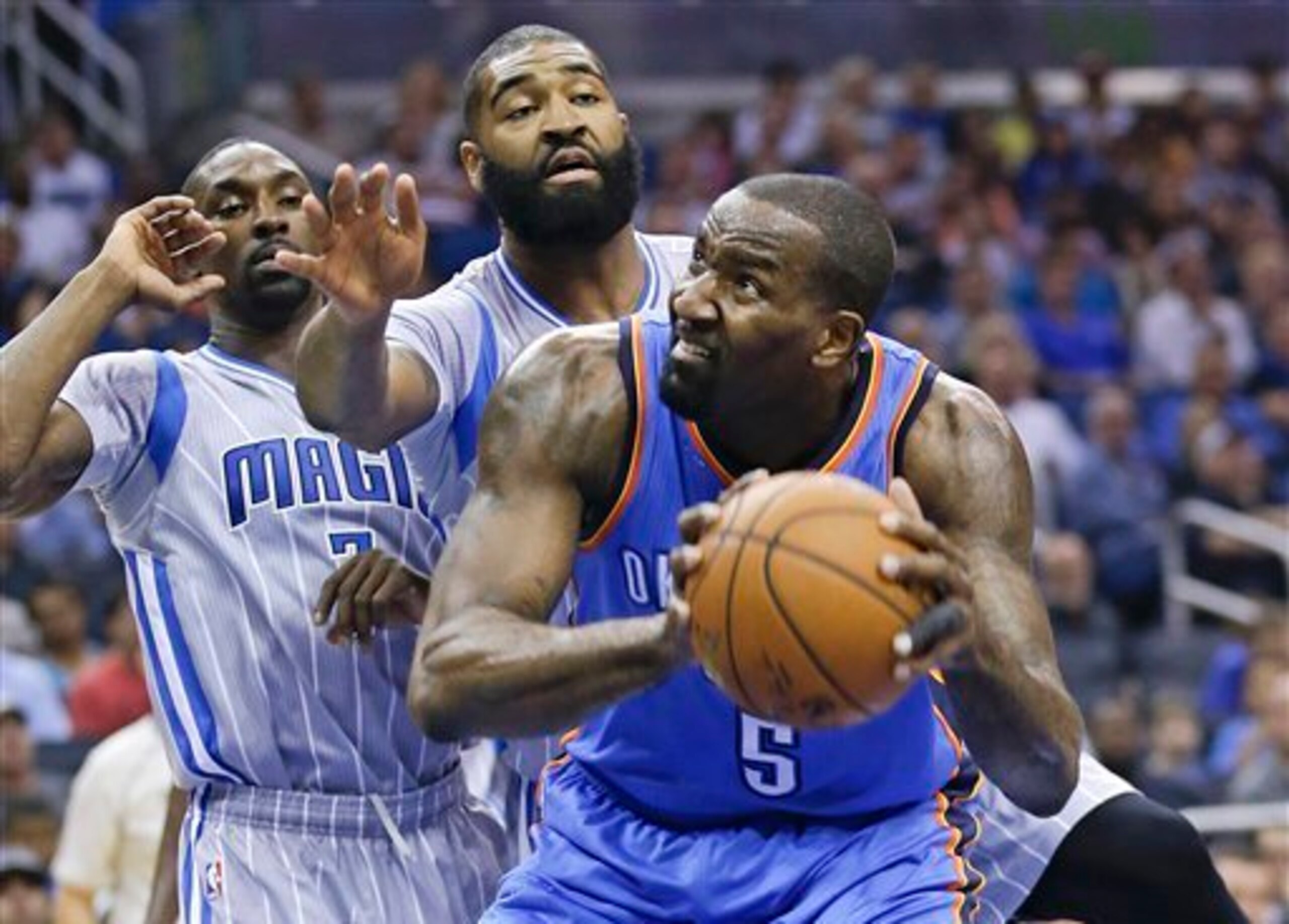
Stats: 50 gms, 19.2 mins, 4.0 pts, 5.5 rebs, 0.7 blks, 7.4 PER
People love to hate Kendrick Perkins, and it’s not really his fault. You could criticize head coach Scott Brooks for starting him for all of last season, but Perkins has always competed when he’s on the court.
This year, he lost his starting job to Steven Adams but looks rejuvenated as the backup center. Unlike Collison, he actually appears a half-step quicker this season and has once again been a strong defender. According to NBA.com, he ranks 12th in the league in opponent field-goal percentage at the rim (minimum of three attempts per game).
Offensively, he’s a non-factor, but that hasn’t been a glaring issue for bench units anchored by Reggie Jackson and Dion Waiters. Perkins has been good in this limited duties, and he’ll play an important role in the playoffs (if OKC gets there) against the likes of Dwight Howard, Marc Gasol, Zach Randolph, LaMarcus Aldridge and Tim Duncan.
Perkins has been a pleasant surprise so far this season, surpassing initial expectations and continuing to be a very valuable member of the rotation.
Grade: C+


Andre Roberson
4 of 11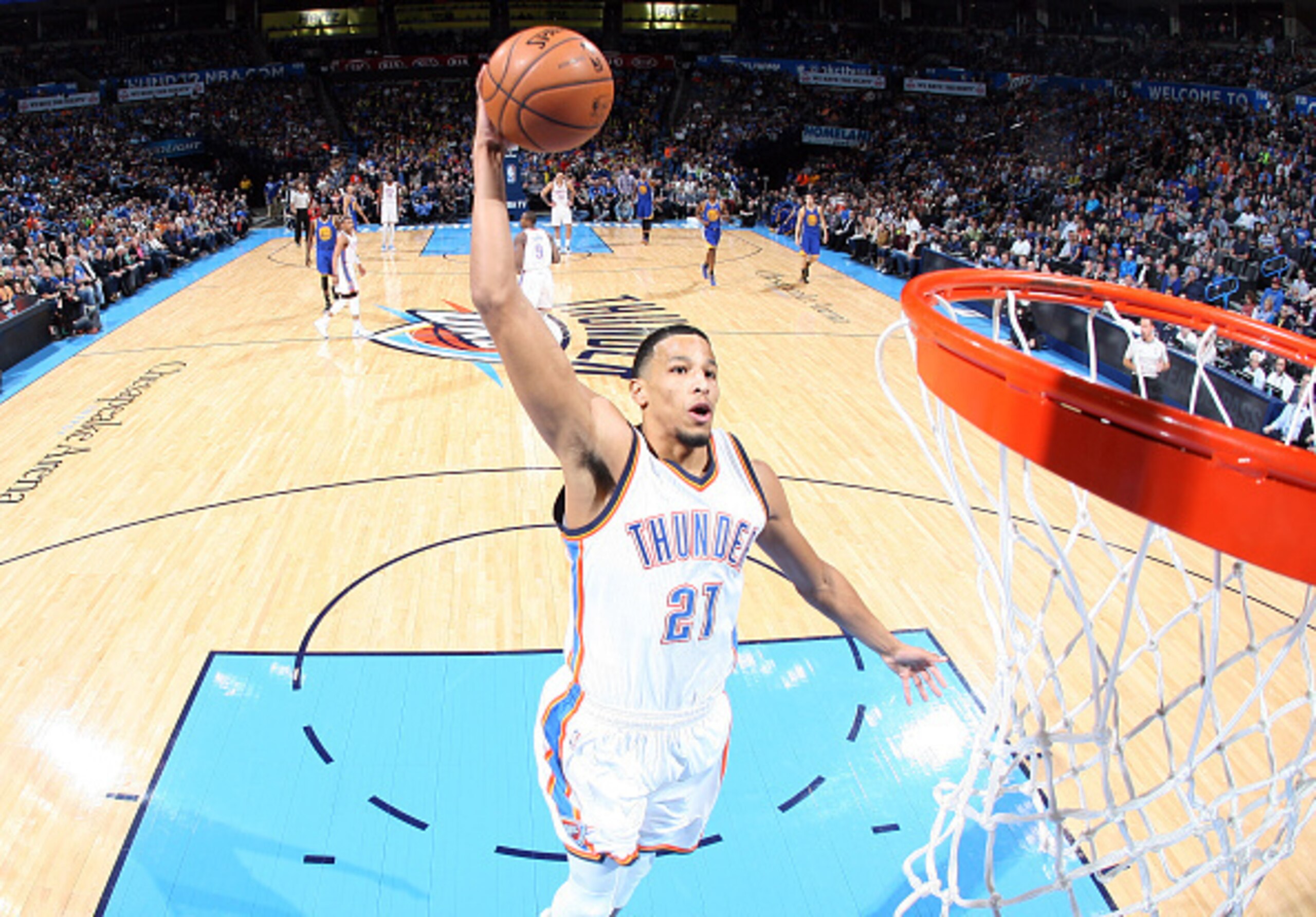
Stats: 44 gms, 20.7 mins, 3.8 pts (47.2 FG%, 25.0 3P%), 4.1 rebs, 0.9 stls, 0.6 blks, 10.0 PER
Coach Brooks definitely has a type. Andre Roberson (or Thabo Sefolosha 2.0) has slid into the starting lineup, and you can’t blame Brooks for wanting a defensive stalwart sandwiched between his two offensive juggernauts.
Like his predecessor, Roberson’s numbers are underwhelming, but that’s to be expected. His job is to harass the league’s premier perimeter players and set the bar for defensive intensity. To his credit, he’s doing this very well. He’s still doing it mostly off his athleticism, but he’s a tenacious on-ball defender and will make most wings work pretty hard for their shots.
The most obvious issue is on offense. Sefolosha was a knockdown shooter at his best (42 percent on 258 attempts in 2012-13). Sure, defenses would leave him to focus on Durant and Westbrook, but Sefolosha could hit enough open threes to make it a tough decision.
Last season, Sefolosha’s shooting stroke abandoned him, and it killed OKC in the playoffs when teams could leave him open with absolutely no fear. Unfortunately, that’s started to happen with Roberson as well. He’s been more accurate as of late, but defenses have no qualms about leaving him open behind the arc.
Roberson already has more skill as a slasher than Sefolosha, but he’s not as intelligent about his off-ball cuts. With time, he can refine his jumper and become a two-way player, but for now, he’ll be a major liability when the postseason rolls around.
Grade: C+
Anthony Morrow
5 of 11
Stats: 44 gms, 24.1 mins, 9.5 pts (38.0 3P%), 12.9 PER
Anthony Morrow is another in a long line of one-way wings Coach Brooks has struggled to handle. The offseason signing has shot the ball well from beyond the arc, which is of vital importance to a Thunder offense that severely lacks any kind of consistent floor-spacing.
The problem is that Morrow can’t carve out more than 25 minutes per game because he can’t stay in front of anyone on the defensive end. He has the worst defensive rating on the team, conceding 108 points per 100 possessions.
That’s basically what we expected anyway since nobody had any misconceptions about Morrow being a stopper, but it is a problem that will carry over into the playoffs if the Thunder allow it.
Grade: C-
Dion Waiters
6 of 11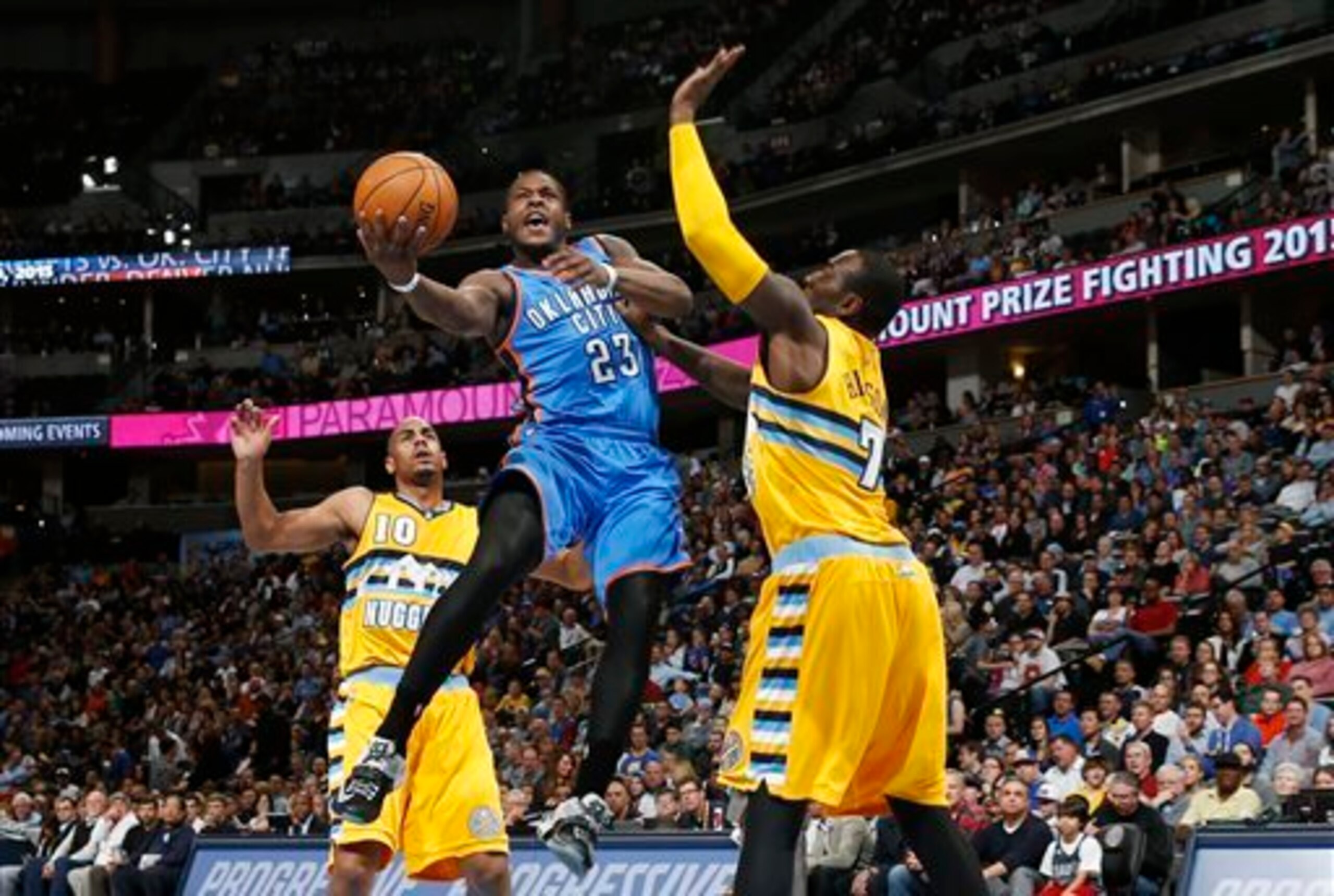
Stats: 17 gms, 27.4 mins, 10.9 pts (37.6 FG%, 23.9 3P%), 2.6 rebs, 1.4 stls, 9.4 PER
It’s way too early to make any definitive conclusions about the Dion Waiters trade, but so far, it’s been a mixed bag. On a positive note, Waiters has been very competitive on the defensive end. He’s been the most engaged wing defender on the team not named Roberson and is constantly bodying up his man and playing them hard.
He’s not a stopper by any means, but the effort is evident, and that’s a good sign considering that defense is his ticket to playing time.
The offense, on the other hand, has been hideous. Those shooting percentages above are not typos, and he’s struggled to find his role regardless of the lineup. While the trade was a no-brainer in terms of asset management, the pieces have to fit together on your team, and this roster clearly doesn’t mesh well with Waiters.
He’s always sharing the court with at least one of Reggie Jackson, Westbrook or Durant, so he doesn’t have the ball in his hands as much as he’d like. This isn’t to label him a “selfish player” or anything like that. He has said the right things since coming to OKC and has been a more willing passer than he was in Cleveland.
Nevertheless, he’s a volume scorer who needs to create his offense off the dribble. He is definitely not a spot-up shooter (at least not this year), and it means the offense is usually mucked up when he’s on the court (as you’d guess from his gruesome offensive rating of 88 points per 100 possessions).
He’s clearly a fiery competitor, but he doesn’t fit in well with this team as constructed, and that’s not his fault. That’s on the front office for trying to fit a square, ball-dominant peg into triangular hole that needs floor-spacing.
Grade: D
Reggie Jackson
7 of 11
Stats: 49 gms, 28.2 mins, 12.9 pts (43.0 FG%, 27.8 3P%), 4.0 rebs, 4.3 asts, 0.8 stls, 15.6 PER
Reggie Jackson was a statistical monster when Russell Westbrook was out, but he’s been disappointing in the transition back to sixth man. Part of that is due to the Waiters trade, since those two are still trying to figure out how to play together.
Other parts of the problem are very much on Jackson himself. Last year, he knocked down 34 percent of his threes, and it looked like he would continue that development to become a reliable long-range shooter. That has not manifested yet, as he’s shooting a lowly 28 percent this season, joining Waiters, Westbrook and Roberson as OKC’s answer to the Splash Brothers: the Clank Brothers.
Jackson has been very strong in the other aspects of his offensive game. He’s still a deadly slasher and does a very good job of finding his teammates in scoring position, but the shooting (or lack thereof) is a big deal on this team.
Furthermore, Jackson showed the potential to be a strong defender, but he’s looked lost and generally disinterested on that end of the floor.
He deserves a ton of credit for his stellar play during the period without Westbrook and Durant, but his recent showings have been disappointing because we’ve already seen how talented he can be.
Grade: C-
Steven Adams
8 of 11
Stats: 50 gms, 24.3 mins, 7.4 pts (54.7 FG%), 7.0 rebs, 1.2 blks, 13.7 PER
OKC will have to do without Steven Adams for a few weeks as he recovers from a fractured hand, and that’s a big loss for the Thunder. After surprising everyone with a very strong rookie season, Adams has built on that to become a quality starting center, and he’s still only 21 years old.
The biggest improvement has been on the defensive end, and that’s saying something since he was a strong defender last season. He looks more aware of his teammates on defense, and his rotations are quicker as he’s adjusted to the pace of the NBA game.
Per NBA.com, opponents are shooting 48.7 percent against him at the rim, a mark that’s equal to Anthony Davis and better than Marc Gasol and DeAndre Jordan.
He’s also strong on the glass (especially on offense), and nobody doubts his toughness and physicality. Adams can improve as an offensive player (especially at the charity stripe), but he’s already a tremendous asset for OKC and forms an intimidating front line along with Serge Ibaka.
Grade: B+
Serge Ibaka
9 of 11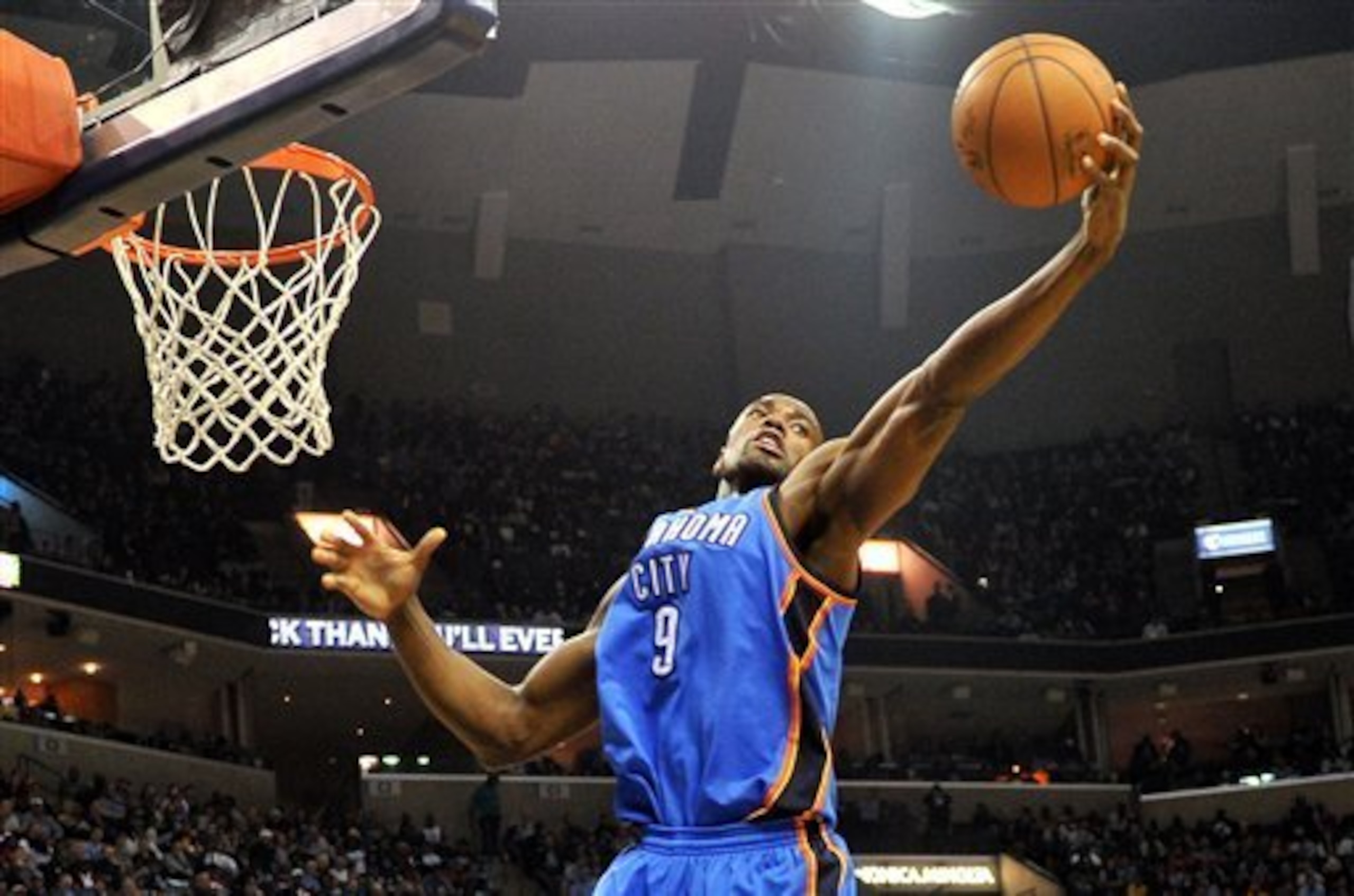
Stats: 52 gms, 32.9 mins, 13.9 pts (45.9 FG%, 39.2 3P%), 7.5 rebs, 2.3 blks, 15.9 PER
Serge Ibaka doesn’t get enough credit for how good he really is. The traditional box score numbers are good but not great, and he’s playing alongside two of the most dynamic stars in the game. But we’re in the age of analytics, an era where teams place a premium on athleticism, floor spacing and rim protection.
In the midst of it all stands Ibaka—a near-7-footer who runs like a gazelle, protects the rim like few others and can now knock down threes at a blistering rate. He may not be an All-Star, but he’s an exceptionally valuable player thanks to his unrivaled skill set.
His low-post game hasn’t developed, and he’s starting to get a little too comfortable hanging out beyond the arc, but do those flaws really outweigh all the other things he does?
He’s been the third-best rim protector in the league, according to NBA.com, and is the anchor of the OKC defense. Furthermore, given the rest of the shooters on the team, it is extremely valuable that he’s developed a three-point shot to give the Thunder the spacing they sorely need.
Grade: A
Russell Westbrook
10 of 11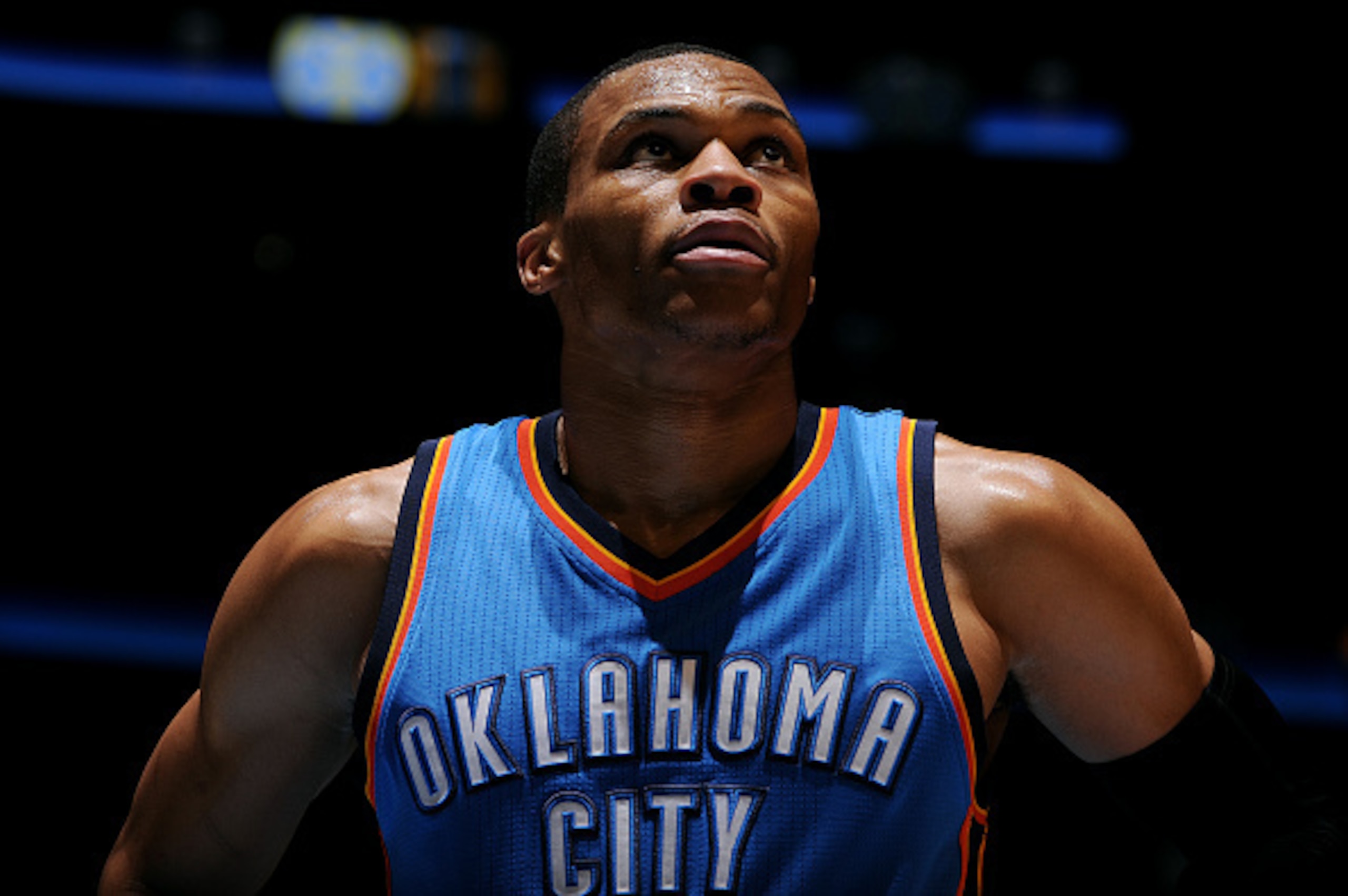
Stats: 38 gms, 32.7 mins, 25.9 pts (43.5 FG%, 28.0 3P%), 6.3 rebs, 7.6 asts, 2.2 stls, 3.7 TOs, 28.5 PER
Russell Westbrook is an experience. He’s one of the only players I’ve ever seen who can dominate a game with the force of his personality, and we’ve seen plenty of his personality this season.
Just look at those numbers. They’re stupid good. The shooting has cooled off and the turnovers are high, but are you really going to look at that entire stat line and complain about Westbrook?
He has been absolutely spectacular this season, carrying the team through Durant-less stretches and continuing to grow as a basketball player and leader. Stubbornness and self-confidence are both his biggest strengths and weaknesses, but it’s something you can live with as a coach or a fan.
The three-point percentage is down from the last few years, but he’s also taking fewer threes and getting to the free-throw line at an absurd rate. There is definitely still room for him to grow, but don’t discount the fact that he’s already improved from last season.
Grade: A+
Kevin Durant
11 of 11
Stats: 25 gms, 33.6 mins, 25.9 pts (51.4 FG%, 39.5 3P%), 6.5 rebs, 4.1 asts, 0.9 stls, 0.9 blks, 2.9 TOs, 28.2 PER
The scary side of Kevin Durant’s numbers is that he still might not be at 100 percent. After an extended absence to start the season, Durant has missed even more games due to nagging injuries. Despite it all, he’s still posting remarkable numbers while hovering around another appearance in the 50-40-90 club.
He’s been a devastatingly efficient scorer, and he’s doing it all for this Thunder team. Additionally, he’s been very good defensively—something he doesn’t get nearly enough credit for.
Even though he’s participating in the festivities, the All-Star break should be a nice opportunity for Durant to get a little more rest and charge those batteries for the postseason push. If OKC makes the playoffs, Durant’s limited minutes during the regular season should mean he’s fresher than we’ve ever seen before in the playoffs, and that’s a terrifying thought for the rest of the Western Conference.
Grade: A+
Note: All stats are courtesy of Basketball-Reference.com unless otherwise noted.

.jpg?w=2560 "Grading WWE Raw 🔠")

.jpg?w=2560 "Bijan's INSANE 1st Half 🤩")
.jpg?w=2560 "Viral Rams Coach Vid 🖕")
.jpg?w=2560 "Injury-stricken Seahawks signing veteran RB")

.jpg?w=2560 "2 NFL Officials Suspended")