

Biggest Keys to Oklahoma City Thunder Securing 2015 Playoff Spot
Finally healthy, the Oklahoma City Thunder still have some work to do in order to nab a playoff spot in a deep Western Conference. At 18-20, the team trails the Phoenix Suns by three-and-a-half games for the eighth seed (with the New Orleans Pelicans and Denver Nuggets between them).
Oklahoma City isn't accustomed to this kind of struggle. The franchise has won at least 61 percent of its games in each of the last five seasons. That stretch includes three trips to the conference finals as well as a title shot against the Miami Heat during the 2011-12 season.
This year, the Thunder spent the first two months of the campaign decimated by injuries. Making matters worse, competition in the West has gotten even stronger. The emergence of young teams such as the Suns, New Orleans Pelicans and Sacramento Kings has led to a battle royal with 12 squads fighting for eight spots.
Last season, 49 wins was the threshold to make the postseason on the left coast. That means OKC will need to go at least 31-13 in the final 44 games to stand a chance if last year is an indication of what to expect. In his most recent projections, Bleacher Report's own sultan of stats, Adam Fromal, has Kevin Durant and Co. missing the playoffs at 46-36.
The bright side is the Thunder's current problems are fixable, and there's plenty of season left to right the ship. The team is also close to full strength and is now bolstered by the addition of shooting guard Dion Waiters.
Oklahoma City has the talent to be a tough out in the playoffs. Of course, it has to make it there first.
Note: All stats current as of Jan. 15 and are courtesy of NBA.com unless otherwise noted.
Defensive Improvement
1 of 6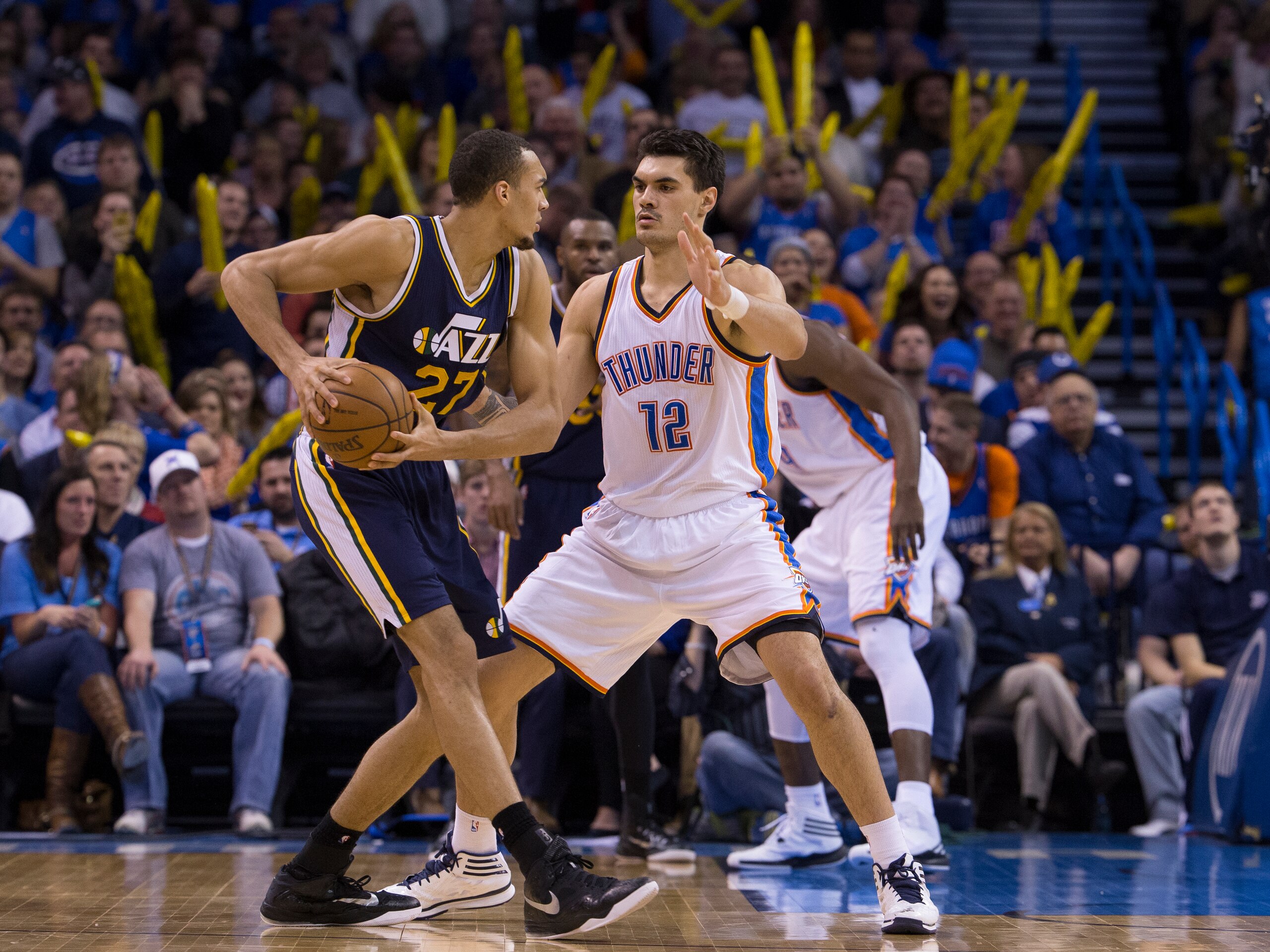
Statistics will tell you that the Thunder have been playing some outstanding defense this season. They are 11th in points allowed (98.3 points per game), third in opposing field-goal percentage (43.1 percent), and eighth in defensive efficiency (101.3).
So, how does a team like this lose by 20-plus points in back-to-back road games against the Golden State Warriors (Jan. 5) and Sacramento Kings (Jan. 7)? Darnell Mayberry of The Oklahoman has some ideas:
"While there have been stretches of shutdown defense, close observers also have witnessed OKC assemble prolonged periods of worrisome effort that has exposed the Thunder’s so-called defensive identity as being suspect. The problem areas, in no particular order, have been inadequate ball pressure, guards getting beat off the dribble, gaping driving lanes, ball watching, slow rotations, insufficient resistance at the rim, poor transition defense, crummy or nonexistent contests on shots from the perimeter and, of course, fouling.
"
Another potential problem could be the recent decline in playing time for the team's best perimeter defender, Andre Roberson. Since Dion Waiters' Thunder debut against the Kings, Roberson has played all of 30 minutes in three games. Waiters, on the other hand, has logged 80 minutes during that same stretch.
The Thunder have also mysteriously abandoned the zone defensive scheme that worked well when injuries left them shorthanded earlier this season. OKC has instead opted to go man-to-man, which is most effective when you have stoppers like Roberson on the floor.
Head coach Scott Brooks said the zone could be making a triumphant return.
"We definitely will throw that in," Brooks said, per Mayberry. "There’s a time and a place for it. We haven’t used it a lot lately. We’re still bringing everybody back. But we will definitely bring that back. It was good early and it will come back. It’s not like it’s not there."
For the sake of the Thunder's playoff chances, the hope is that Brooks brings back the zone sooner rather than later. As impressive as the club's offensive firepower is, all of that scoring becomes moot if you can't get stops at the other end.
Fix the Reggie Jackson Situation
2 of 6
By the numbers, this has been the best season of Reggie Jackson's career. He's averaging 14.9 points, 4.9 assists and 4.3 rebounds per game. All three are career highs. He even got to temporarily fulfill his wish of being a starter, contributing 20.2 points, 7.8 assists and 5.2 rebounds during 13 games playing in place of the injured Russell Westbrook.
However, outside of the gaudy stats, these last three months couldn't be what Jackson had in mind for his contract year.
During the summer, the Boston College product would tell anyone who would listen that he wanted to be a starter. Not in the interim, but permanently. The team had other ideas, opting to leave RJ in his sixth-man role and give the starting shooting guard job to Andre Roberson.
Now, it appears Jackson will have to share the role he never really wanted with the newly acquired Dion Waiters. The move was yet another kick to Jackson's diminishing morale. The result was the 24-year-old giving a half-hearted effort like the one Darnell Mayberry of The Oklahoman explains here:
"In his fourth season, Jackson’s defense continues to disappoint and his erratic offense simply hasn't justified the points he yields at the other end. Thunder coach Scott Brooks reached his breaking point Friday against Utah when, early in the fourth quarter, Jackson failed to hustle to a loose ball after a dribble-handoff with Nick Collison and Anthony Morrow went awry. The ball squirted out near halfcourt. Jackson jogged. Jazz guard Dante Exum jetted. Exum recovered it and raced the other way for a two-on-one fast break that ended with him finding Trey Burke for a layup.
Jackson compounded the problem by hoisting an 18-foot pull-up jumper on the next trip. There were 16 seconds showing on the shot clock and Jackson’s miss ended an empty possession that didn't include a single pass. Jackson then jogged back defensively as the Jazz got another fast break opportunity, this one ending with a Trevor Booker alley-oop dunk from Burke. Jackson was benched 90 seconds later and did not return.
"
Jackson hasn't asked for a trade, but the situation is rapidly approaching a high level of toxicity.
The Thunder are now faced with an awkward situation. They can attempt to mend fences with Jackson and hope his pending free agency reignites his fire. They can diminish the value of their best trade chip by continuing to go to Waiters, or they can opt to send him packing.
Regardless of what option they choose, they must decide quickly
One way or the other, they must find a way to keep Jackson happy.
Incorporate Dion Waiters
3 of 6
Regardless of how the Reggie Jackson situation plays out, the Thunder need to carve out a concrete role for Dion Waiters. After news broke that Waiters would be coming to Oklahoma City, reigning MVP Kevin Durant put an emphasis on making his new mate feel welcomed, per Yahoo Sports' Marc J. Spears.
"We are going to make him feel wanted," he said. "I don't know that he has felt that the last few years. We want him here and are happy to have him here."
Waiters' last season-and-a-half with the Cleveland Cavaliers was rocky, to say the least. He was seemingly shunned on the court by superstar LeBron James. He clashed with head coach David Blatt and reportedly feuded with fellow guard Kyrie Irving.
In OKC, the Thunder wasted little time showing trust in their new addition. In a 99-94 win over the Utah Jazz on Jan. 9, Waiters played the final eight minutes and nailed the three-point dagger to put the game out of reach.
Afterward, the 23-year-old spoke about the differences in his surroundings, per The Associated Press.
"It's a lot different," Waiters said. "I'm able to play. I don't got to look over my shoulder, anything like that, if I make a mistake. Coaches tell me to play, be aggressive. Be me. Once you get told that, the game's easy."
The Thunder can only hope the game comes as easy to Waiters this year as it did last season, when he averaged 15.9 points per game and shot 36.8 percent from behind the arc. His presence bolsters the second unit and gives the Thunder another player who can create offense for himself.
The more comfortable he becomes playing alongside Durant and Russell Westbrook, the more dangerous this team becomes. For now, the club has quelled all of Waiters' fears and vice versa. He's content. He's motivated and he has the trust of his high-profile teammates.
The next step is continuing to integrate him into the offense and keeping the momentum going.

Solve Russell Westbrook's Shooting Woes
4 of 6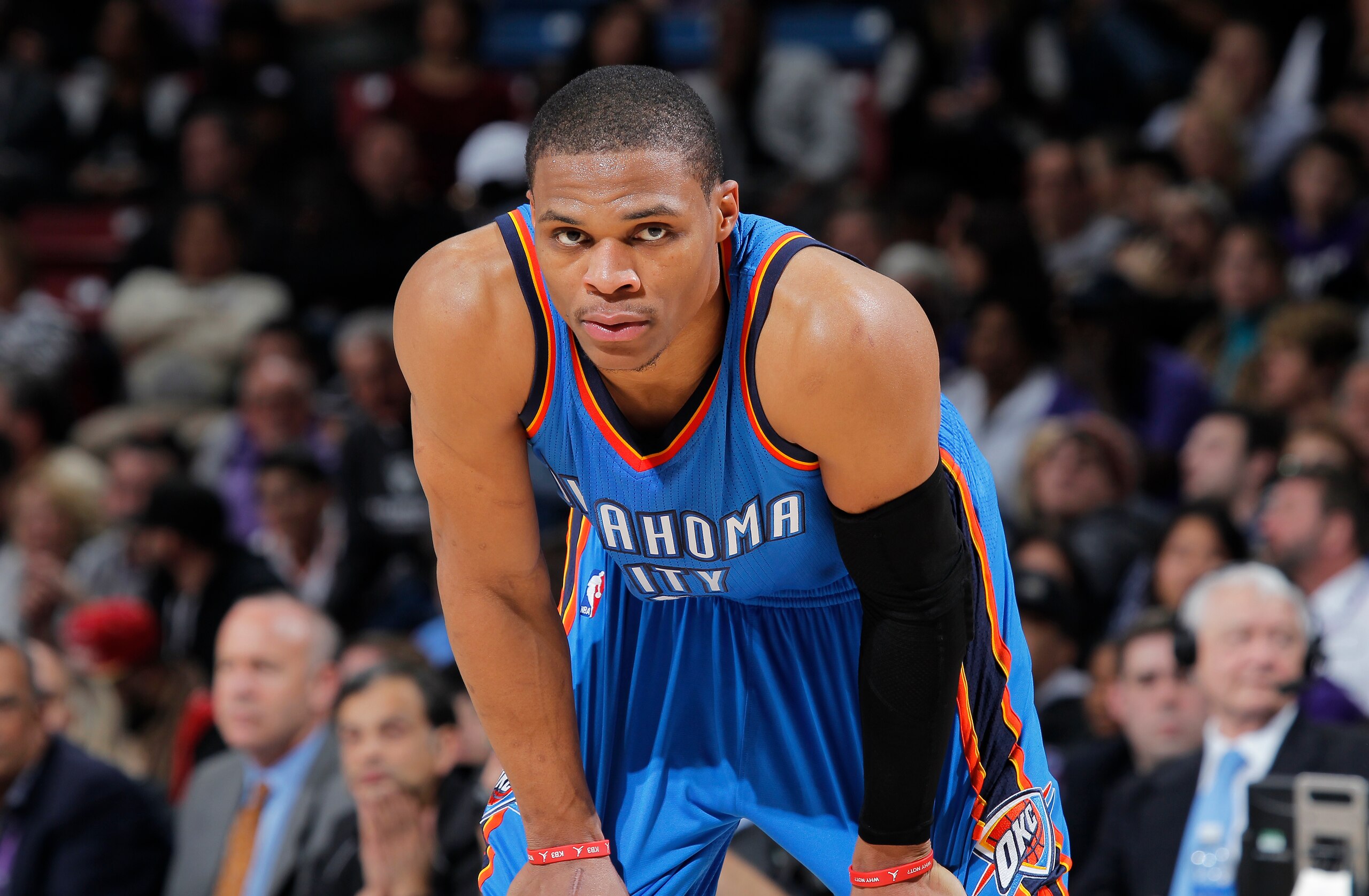
In just 24 games this season, the Oklahoma City Thunder have seen the good and bad Russell Westbrook. On one hand, there's the human wrecking ball who has jumped out to an impressive stat line of 25.8 points (unofficially tied for second-best in the NBA), 7.1 assists and 5.7 rebounds per game.
On the other, there's the overly aggressive gunner who has recently gone back to his old habits of shooting his way out of slumps. Here's what the UCLA product did in the five games prior to his 9-of-17 (25 points) performance against the Utah Jazz on Jan. 9:
- Jan. 7 vs. Sacramento Kings: 3-of-19 shooting (0-of-5 from three), 10 points
- Jan. 5 vs. Golden State Warriors: 5-of-21 shooting (1-of-5 from three), 22 points
- Jan. 2 vs. Washington Wizards: 8-of-23 shooting (0-of-3 from three), 22 points
- Dec. 31 vs. Phoenix Suns: 5-of-13 shooting (1-of-2 from three), 20 points
- Dec. 28 vs. Dallas Mavericks: 6-of-23 shooting (0-of-1 from three), 18 points
Optimists will point to the fact that Westbrook still managed to score at least 20 points in three of those five games, but it's the amount of shots he took to get there that's disturbing. It's also worth mentioning that the Thunder went 2-3 during that stretch.
The blame here is two-fold. First, Westbrook has been around long enough to know better. He even cited "missing shots" as the main reason behind the team's 104-83 drubbing at the hands of the Kings, per Anthony Slater of The Oklahoman.
However, it's tough to ask a human Ferrari to slow down.
That's where head coach Scott Brooks comes in. It's up to him to hold Westbrook accountable for his shot selection and have the guard find ways to score more efficiently. In the end, the Thunder's failures will fall on Brooks' shoulders before they fall on anyone else's.
While Westbrook's aggressiveness is a large part of his game, he should focus that energy on attacking the basket instead of settling for jumpers. He has the size (6'3", 187 lbs), speed and athleticism to blow by defenders and get to the rim at will. He's also adept at drawing fouls. In the aforementioned five-game stretch, a good chunk of those points came at the charity stripe.
According to NBA.com, the Long Beach blur has an effective field-goal percentage of 50.2 percent on attempts of less than 10 feet. He also converts 47.7 percent of his shots when he takes three to six dribbles. In short, there are few things scarier for an opponent than Westbrook charging the lane with a head of steam.
The Thunder should use that to their advantage. At a time where losses are even more costly, the team can't afford to have one of its two best players shooting it out of games.
Expand Serge Ibaka's Role
5 of 6
As Russell Westbrook and Kevin Durant continue to work their way back from significant injuries, the Thunder need to find ways to take some of the load off the dynamic duo's shoulders. One method they can use is by expanding the role of power forward Serge Ibaka.
The team signed Ibaka to a four-year, $48 million extension in 2012 with the idea of turning him into a solid third wheel. Even with the Congo native's annual improvement, Oklahoma City still relies heavily on Durant and Westbrook.
This season, Westbrook (39.7 percent) leads the league in usage rate, while Durant unofficially ranks seventh at 31.5 percent. As for Ibaka, he's only being used 19.7 percent, which is roughly the same as last year despite him taking a huge step forward as a three-point shooter.
In his sixth pro season, Ibaka has shifted away from the paint and become more of a stretch 4. He's averaging a career-high 3.5 trey attempts and converting 41 percent, which is 16th-best in the NBA. With those kind of numbers, you'd like to think OKC would do a better job of getting its big man the ball.
Instead, shots have been hard to come by for the 25-year-old. In the team's recent 112-101 loss to the Houston Rockets, the star forward had just 11 attempts in 33 minutes. Key reserves Dion Waiters and Reggie Jackson put up 16 and 12, respectively.
"I think we got to do a better job of running sets to get Serge a couple more touches," Kendrick Perkins said, per Darnell Mayberry of The Oklahoman. "Find the hot guy. Probably involve him more in the pick and roll and pick and pop.”
To Perk's point, using the pick-and-pop to get Ibaka the ball in open space could turn him into a dangerous weapon. Per NBA.com, the big man is nailing 52.3 percent (eFG) of his attempts on open looks (when a defender is four to six feet away). He's also converting 52.5 percent (eFG) of his takes in catch-and-shoot situations, while shooting 52.3 percent from between 10 and 14 feet.
The Thunder's inability to get Ibaka involved in the fourth quarter is especially disheartening. In 38 games this season, he's taken all of 76 shots in the final frame, per Basketball-Reference.com. With Waiters now in the fold, Ibaka could move down another rung in Oklahoma City's offensive pecking order.
That's a recipe for failure. Ibaka is being paid to be the third star. He should be treated as such. With his athleticism and shooting touch, he should be a bigger part of the offense. He also has the chops to be a factor in the post, which is something the team sorely needs.
For as many wins as the team has accrued over the years, the reliance on the two-man game has not culminated with a championship. If this season is going to be different from previous ones, OKC will have to develop the guys around Durant and Westbrook.
That list starts with Ibaka.
Get Kevin Durant Back into the Swing of Things
6 of 6
The year after his MVP campaign hasn't gone quite as Kevin Durant had hoped. He missed the first 17 games of the season following foot surgery. Nine games into his comeback, he sprained his ankle and missed six more. In his absence, the team went 8-15 and face an uphill battle for a playoff spot.
Now that he's healthy, the team must successfully integrate him into its scoring attack in order to help him get his groove back.
"I'm one of those rhythm-type of players who gets his rhythm throughout a stretch, a week, a month," Durant said back in December, per Yahoo Sports' Marc J. Spears. "It's just timing. Obviously, I want to make all the shots that I take. I know it's a part of the process. I know it's going to take a little time to get exactly where I want to be. And that's fine."
Rust was an issue during KD's return from his first injury but was less of a hindrance the second time around. He bid adieu to 2014 by dropping 44 points, 10 rebounds and seven assists against the Phoenix Suns on New Year's Eve.
In the six games since his second reintroduction, The Durantula is averaging 28.7 points, 8.7 rebounds and 3.2 assists. On the season, he's unofficially the league's third-leading scorer with 24.9 points per contest.
Going forward, the Thunder must find a happy medium between unleashing the NBA's best pure scorer and not running their best player ragged. His 31.5 percent usage rate is just a tad lower than last year's league-leading 33 percent.
The team may want to consider going back into the trade market to find a more suitable backup to help keep Durant fresh down the stretch. Perry Jones hasn't offered much since coming back from a knee contusion last month.
KD may not be an MVP this year, but he's the most valuable star in Oklahoma City. The quicker he returns to elite form, the quicker the Thunder return to the postseason.
.jpg?w=2560 "Chiefs, Steelers Eye WR Trades")





.jpg?w=2560 "Raiders Sticking with Cousins")