
It's not often malleable second-year talents like Philadelphia 76ers point guard Michael Carter-Williams generate buzz on the NBA trade block. However, that's exactly what's happened ever since the 23-year-old captured 2013-14 Rookie of the Year honors by routinely stuffing stat sheets.
First, the Sixers appeared willing to discuss trades involving Carter-Williams during last June's draft, according to Grantland's Zach Lowe. Now the thought of dangling a seemingly promising floor general has resurfaced, according to ESPN.com's Chad Ford:
"I've heard a lot of rumblings from GMs that Carter-Williams is available. There are some in ownership and in the front office, though not all, that don't see him as a long-term piece of the puzzle. There was a lot of chatter that direction before the draft and in the past few weeks I know several teams have had exploratory discussions with the Sixers. I think the challenge right now is that the Sixers will want a lot in return and MCW's play, to date this season, hasn't warranted multiple first round picks for him. That makes him tough to deal.
"

The Sixers' reported interest in making Carter-Williams available is fascinating for several reasons.
While he's made some productive strides, Carter-Williams' value doesn't figure to peak until his jump shot rounds into form. Second, point guard is the league's most saturated position, meaning suitors willing to part with assets of considerable value in exchange for his services will be few and far between. And finally, it further demonstrates general manager Sam Hinkie is willing to entertain offers that will help the franchise acquire more lottery-bound prospects in the draft.
But we'll start with Carter-Williams' fluctuating stock.
Whether or not he's viewed as a franchise building block, Carter-Williams clearly possesses a unique skill set few floor generals boast.
As things stand, Carter-Williams is one of three guards averaging at least six rebounds per game, with Rajon Rondo and Lance Stephenson qualifying as the other two, according to Basketball-Reference.
He's also one of 10 players averaging at least 15 points and seven assists following Wednesday night's 100-84 loss to the Toronto Raptors that saw the Syracuse product finish with a season-high 29 points (12-of-25 shooting), seven boards and four dimes.
Clearly he doesn't struggle to load up box scores, especially when the ball's in his hands. In fact, when fellow floor general Tony Wroten has been sidelined this year, Carter-Williams' numbers have ballooned quite a bit, according to Rotoworld.com's Adam Levitan:
Dissenting opinions regarding Carter-Williams revolve around his plummeting shooting percentages—38.1 percent from the field and 23.7 percent from three—and propensity to cough up the ball (league-leading 4.4 turnovers per game). Those are overwhelmingly fair criticisms.
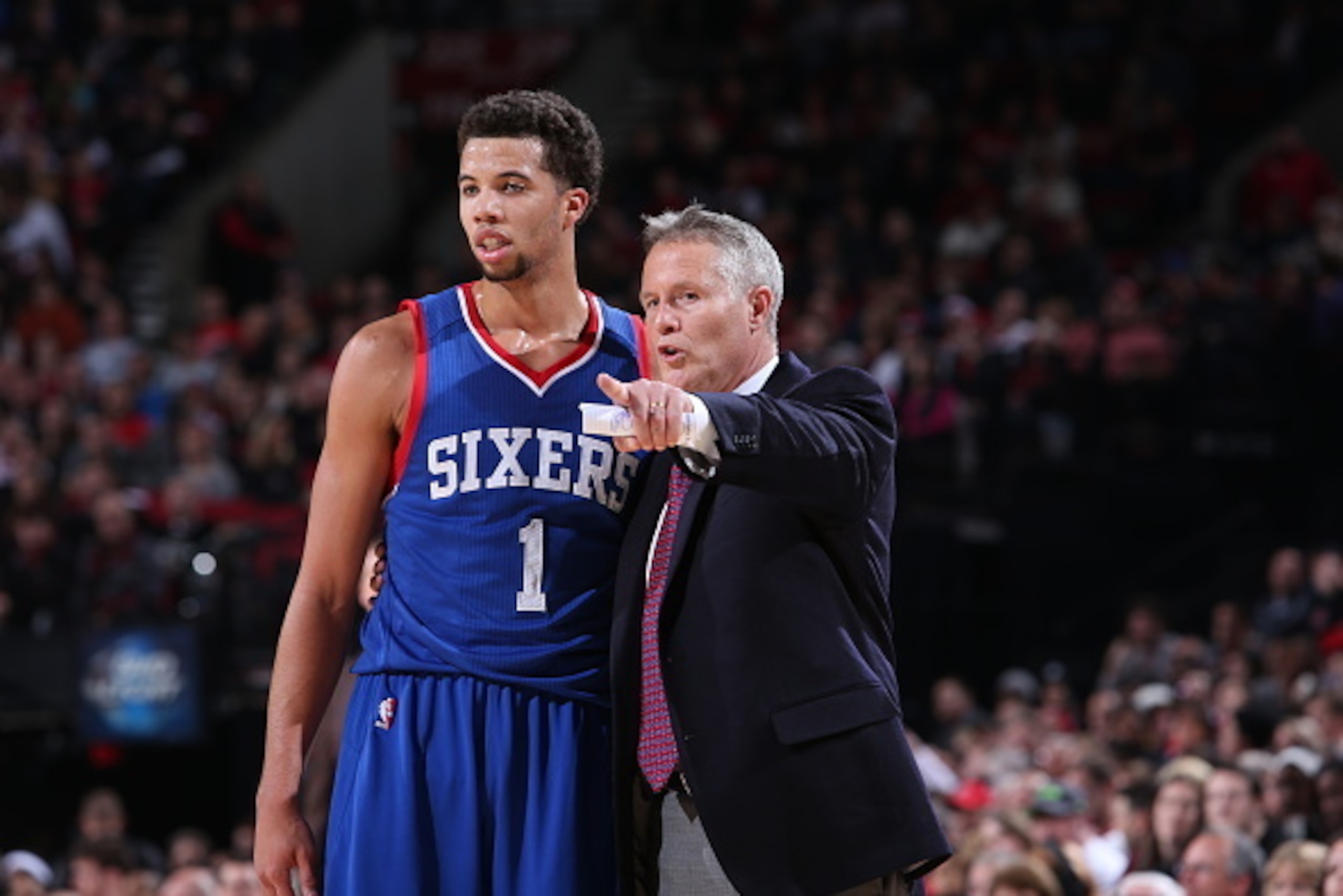
Yet as head coach Brett Brown explained to the Philadelphia Daily News' Bob Cooney shortly before the New Year, Carter-Williams is working hard to correct those flaws:
"We're showing him about his reads. Like I tell him, he's Tom Brady. How do you study? How do you understand outlets? How do you understand how a team is rotating? How do you know that Nerlens [Noel] needs a shot. How do you drive your car? That is a point guard. Reads and attacking and point-guard study is his growth. He's fantastic. He came back late [Sunday] night for a long time and put up shots to cleanse himself of his 2-for-20 performance. I've seen that quality in players where they just can't live with themselves, they can't sleep at night. He got to [go] a gym. We had to find one for him, and we did.
"
Additionally, offensive struggles have been accompanied by marked defensive improvement.
According to NBA.com, the Sixers' defense is 8.4 points better per 100 possessions with Carter-Williams on the floor. During his rookie season, they were 1.5 points worse per 100 defensive possessions with him zooming around the perimeter and trying to stymie pick-and-rolls.
Although perceptions of such an incomplete product will understandably be polarized, the foundation for a prosperous career in a meaningful capacity has been laid.
The question is, are there any teams in the market for a starting point guard?
Scanning depth charts around the Association, it's clear there are very few franchises in need of another floor general. It's a market inefficiency the Sixers have to deal with, and as CBS Sports' Matt Moore noted, even teams feigning to be scanning the trade block for another floor general aren't in dire straits:
"Really only Miami, Utah, New York, the Lakers, and potentially the Rockets or Pacers would consider it. The Knicks won't give up picks, the Lakers have nothing to trade, Miami can't give up picks and wouldn't give up enough for him, Utah is probably better off with what they have, Houston needs someone with playoff experience, and the Pacers' entire problem is that they can't score, so MCW doesn't fit.
"
Put simply, the Sixers' biggest roadblock to accomplishing a trade may have less to do with Carter-Williams' raw skill set than the supply-and-demand conundrum that has whittled the list of potential buyers to a scant few franchises.
There's also the matter of finding return value that's commensurate with Carter-Williams' upside. At present, it's hard imagining rival general managers parting with future assets of significant value for a point guard whose stock is trending into the red.
On the flip side, Philadelphia can't be in the business of selling low on a sophomore talent who's embarking on a rigorous journey up a steep NBA learning curve. Growing paints litter the process, sure, but the eventual dividends could be well worth the patience.

Should the point guard market self-regulate in tandem with Carter-Williams' rise up the backcourt ranks, a deal could feasibly be in order.
After all, Lowe noted back in October that "the team knows point guard is the most replaceable position in the league today, and it will seek out any deal that adds to its stockpile of high-value draft picks."
Ultimately, it's hard to envision a substantial market forming for Carter-Williams' services over the next four weeks. That's not necessarily a bad thing for the Sixers, though. Plenty of room for growth remains, and eventual improvement in a number of problem areas can provide the boost his trade value sorely needs.
And with urgency and all of its synonyms eliminated from the team's lexicon for the foreseeable future, it's only fair to allot Carter-Williams the time necessary to play his way in or out of the franchise's long-term plans.
.jpg?w=2560 "Chiefs, Steelers Eye WR Trades")