One NBA conference's cumulative futility may end up becoming a coveted free-agent opportunity.
At a time when the Eastern Conference is more notorious for its hoarded haplessness than projected promise, there is one potential break in the clouds that looms large for those craving competitive balance: free agency.
When 2014-15 ends and another champion is crowned, scores of talented players will reach the open market, some of them searching for new homes. And when those players inevitability look at Eastern Conference locales, they will see a collective, contender-cold dumpster fire that's clearly inferior to the Western Conference's powerhouse-packed bloodbath.


But it's this disparity that could give East teams a leg up in pursuing available talent, the prospect of clearer title paths weighing heavily and appealing to those keen on improving championship resumes and, in some cases, escaping the wild, wild West.
Widening Gap
Let's get this out of the way now: We're absolutely at a point where we should be considering the possibility of the East's bleak playoff picture becoming a selling point.
Seven Western Conference squads have won at least 60 percent of their games this season, and with the Oklahoma City Thunder at full strength—not to mention 9-2 with Kevin Durant in the lineup—the postseason picture is basically complete.
Seeding admittedly doesn't matter in this case. Every playoff-bound team from the first-place Golden State Warriors to the seventh-place reigning champion San Antonio Spurs is capable of making a legitimate championship run.
The Eastern Conference, meanwhile, is home to just six above-.500 contingents. With the Milwaukee Bucks only clinging to their above-.500 standing, there's a chance three of the East's playoff teams enter postseason play with losing records. Consider too that if the 11-23 Los Angeles Lakers—the West's second-worst team—played in the Eastern Conference, they would be just 3.5 games back of the final playoff spot.
This interconference chasm isn't especially new either. The West has long been superior to the East.
Looking at the regular-season records of either conference's No. 8 seed over the last 10 years, the West's eighth-place factions have registered the better winning percentage every time, usually by a wide margin:
Only twice in the last 10 years has the East's eighth seed been within three percentage points of the West's. On average, the West's No. 8 slot has been more than 8.3 percentage points better than the East's. Over the course of a standard 82-game season, that's roughly seven wins, which, you know, is just insane.
It's showed when the stakes are highest as well. Eleven of the last 16 champions have hailed from the Western Conference—a difference that would likely be far greater if it weren't for the title-toting Miami Heat in 2011-12 and 2012-13.
So, while the West's resulting dominance makes for interesting playoff series, it drums up the difficulty of hoisting that Larry O'Brien. Teams have to be great just to make the postseason. And once they're there, a labyrinth of powerhouses and, in certain instances, dynasties awaits.
Benefits of Conference-Wide Uncertainty
Securing a Conference Finals appearance is inherently easier out East—especially as a legitimate powerhouse.
Take the LeBron James-led Heat who came out of the East in four consecutive years. Their emergence became a formality. It even reached a point in which an Indiana Pacers-Heat Eastern Conference Finals rematch became reality before it was actually fact.
No such inevitability exists this season. As Bleacher Report's Ethan Skolnick explained in December, the East, while horrid, has never been more forgiving:
"East teams know they have more breathing room because, typically, at least four or five teams simply can't be taken especially seriously in the conference's playoff chase. So they can take more time nursing their key players back to health without fear of irreversible slippage in the standings. First, they're playing fewer games against the West due to the imbalanced schedule. And second, they won't lose complete touch with the conference leaders, even if their best players are out. ...
... Losing a few games in the West is a capital crime, running the risk of a season's death; losing them in the East is a misdemeanor, with the punishment probationary at most.
"
The star-stuffed Cleveland Cavaliers were supposed to run away with the conference but have stumbled in the face of injuries and chemistry deficiencies. Surprise teams like the Atlanta Hawks, Washington Wizards and Toronto Raptors, along with the Chicago Bulls, have been left to duke it out for alpha-dog status.
Even if the Cavaliers and another team—say, the Bulls—assume seemingly immovable posts atop the rest, the Eastern Conference would remain a hotbed for opportunity. Impact free agents looking to win—specifically those from the Western Conference—can join a team and instantly elevate its status to that of an East contender if only because of surrounding incompetence.
Staying put would only help perpetuate a Western gauntlet that doesn't look like it's fading anytime soon.
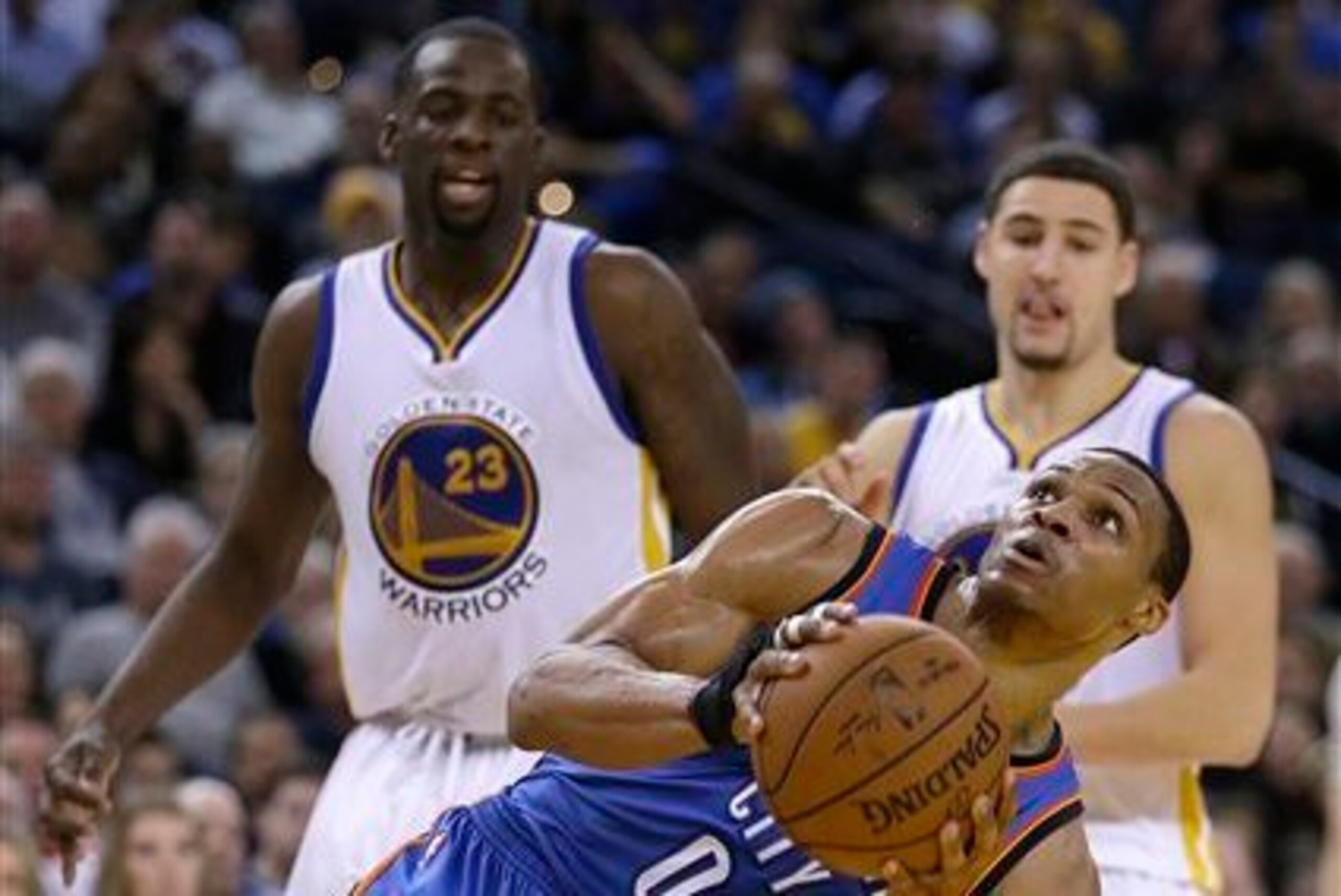
The league-leading Warriors have most of their core locked up beyond this season; the Houston Rockets will have both cap space and their three best players—James Harden, Dwight Howard, Trevor Ariza—under contract; the Los Angeles Clippers, while in decline, will still have Chris Paul and Blake Griffin; Rajon Rondo has already given the Dallas Mavericks the edge in re-signing him, per USA Today's Sam Amick; and the Thunder will be relevant so long as Durant and Russell Westbrook are in town.
Not even the most realistically removable teams are in dire straights.
Manu Ginobili and Tim Duncan could both retire, but the Spurs are still the Spurs; four members of the Portland Trail Blazers' starting five will be eligible for new contracts—Damian Lillard, LaMarcus Aldridge, Wesley Matthews, Robin Lopez—but Aldridge already committed to re-signing, and Lillard is only up for an extension, so he isn't a flight risk; and the Memphis Grizzlies need only worry about Marc Gasol's free agency.
In the event any or all of those teams fall off the prestigious map, there are others lurking in the shadows.
Anthony Davis has the New Orleans Pelicans one savvy addition away from contender status; the Phoenix Suns are an asset-cosolidation away from landing the star who will vault them up the West's ladder; and the Sacramento Kings, for all their questionable decisions—firing Mike Malone for one—have a star center in DeMarcus Cousins and are actively seeking other upgrades, per Bleacher Report's Howard Beck.
Switching conferences, then, would be the difference between fighting against seven or eight powerhouses compared to maybe two. And though there's definitely something to be said for the West's NBA Finals dominance these last 16 years, free agents can—and should—think about the big picture if it's rings they're after: Make it out of your conference first, and then go from there.
And, as of now, there's no doubt that big picture is easier to paint as a member of an Eastern Conference contender.
So...Will They?

There really is no telling whether the East-West disparity is on the minds of impending free agents.
Ask them about it, and they're liable to give you a diplomatic answer similar to what they will say when pressed about free agency in general.
"I haven’t weighed anything yet," said Gasol of his free agency, per the Los Angeles Daily News' Mark Medina. "We’ll sit down and have a human eye-to-eye conversation. We’ll see what we’re looking for the next four or five years of my life with this team, different teams and my family...I won’t say no to anything right now."
"Every team that is going to be available for me is going to be an option," Goran Dragic explained of his own free agency, via Jonathan Lehman of the New York Post.
"There’s always some potential here [in Atlanta] for sure," Paul Millsap admitted of his free-agent jaunt, per the New York Post's Marc Berman. "But I’m trying not to think about it, trying to put it as far in the back of my head as possible until the end of the year and see what happens."
Months ahead of free agency being reality, some version of those answers will invade headlines. Rare is the player who will divulge any more if he's not wholly unhappy with his current situation.
Too much needs to be figured out between now and July. Some futures will play out or be affected by the Feb. 19 trade deadline through arrivals and departures.
Incumbent teams can also offer more than any other suitors in most cases. There are exceptions—like that of Millsap and the Atlanta Hawks—but big-name players must typically leave money on the table to explore new frontiers. And when tens of millions of dollars can be on the line, there's little point predicting what happens next.
Playing in the Western Conference has yet to obviously scare the masses either. For every Pau Gasol, who left the Lakers for the Bulls, there's a player in his prime, like Dwight Howard, who has the opportunity to leave and doesn't.
Still, this remains something for premier free agents to think about. If it's rings that Gasol, Dragic, Rondo, Monta Ellis, DeAndre Jordan and others seek, the East-West imbalance should be a point of emphasis—the former's inferiority being so stark it's viewed as an opportunistic goldmine worth exploiting.
*Salary information via HoopsHype.
.jpg?w=2560)
.jpg?w=2560 "Chiefs, Steelers Eye WR Trades")
.jpg?w=2560 "WWE Raw Live Grades 🔠")

.jpg?w=2560 "Cowboys Handle Eagles on MNF 🤠")
.jpg?w=2560 "🚨Jay-Z Headlining Super Bowl")