
San Francisco 49ers: 2014 Offensive Report Card
The San Francisco 49ers’ 2014 season is over, and it’s time to pass out their season-ending grades.
We did this exercise once at midseason—a progress report, as it were. This was back at the 49ers’ bye week, with the team sitting at 4-3 in the thick of the playoff race. Since then, the team has had widely divergent runs—they’ve put together a three-game winning streak in November and a four-game losing streak to end the year.
One thing to keep in mind here is that we’re grading the 49ers by the standards of the NFL and not their own recent success. Obviously, an 8-8 season is profoundly disappointing for a team that made three straight NFC Championship games and was a play or two away from multiple Super Bowl titles.
At the same time, however, realize how great an 8-8 year would seem to, say, the St. Louis Rams, who haven’t reached that point since 2006. It’s good to keep the year in perspective overall.
Bleacher Report’s national writer Michael Schottey has already given season-ending grades for every team, giving the 49ers a “C,” but we’re going to go a bit more in-depth, going position by position. It’s not right to say the 49ers were average across the board—they were “average” in the same way that a man with one hand on fire and the other hand in a block of ice is, on average, comfortable.
My training before becoming a sportswriter actually was as a teacher, so I know the importance of giving feedback, rather than just a straight letter grade. I’ll try to highlight something each unit did well, as well as what it'll need to improve on to bounce back into the playoffs in 2015.
We’re focusing on the disappointing offensive side of the ball here; we’ll handle the more promising defensive side of the ball in the next slideshow.
Quarterback
1 of 6
Midseason Grade: C+
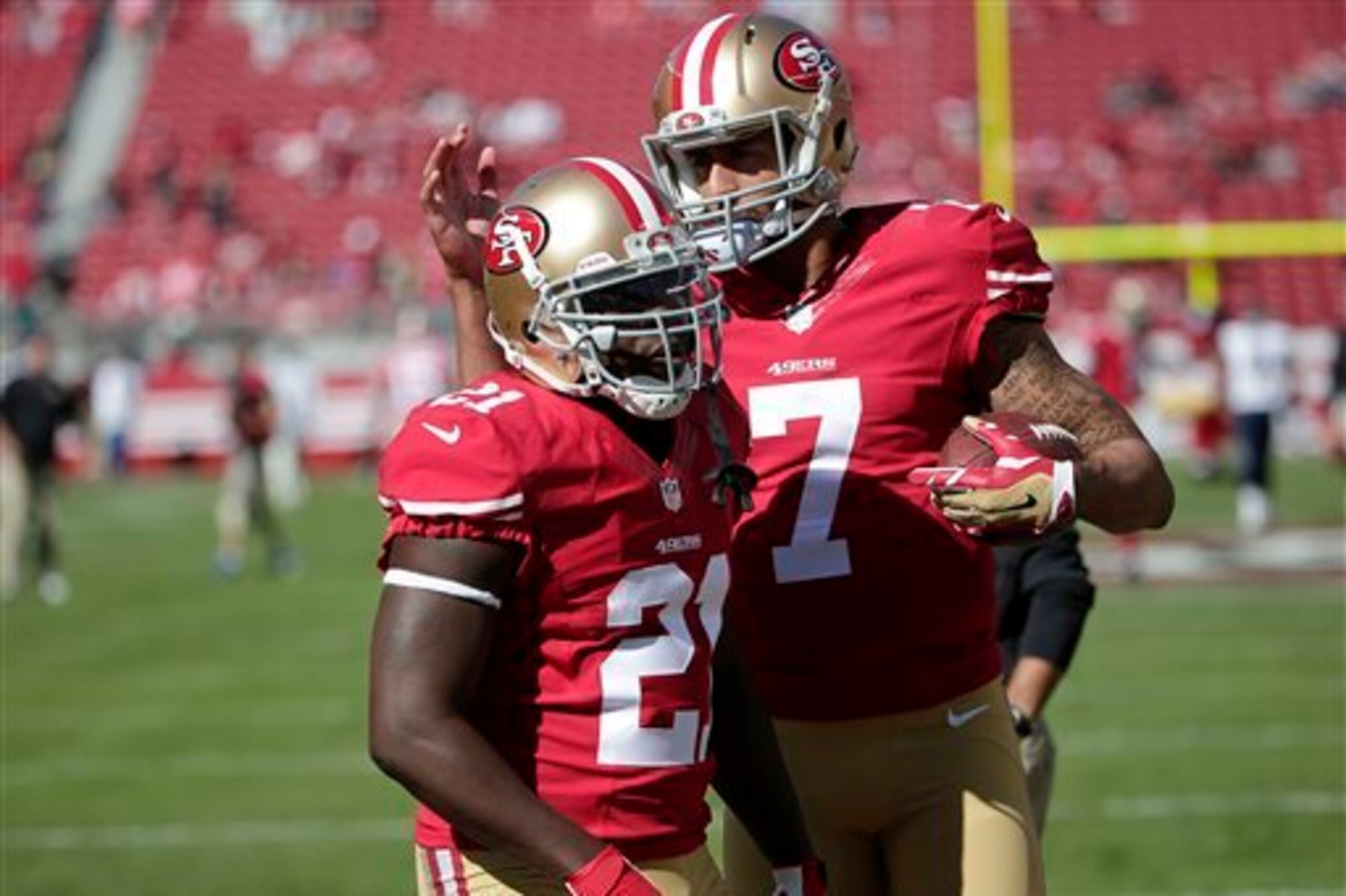
While Blaine Gabbert got a handful of snaps at the end of the Denver game, this grade is all about Colin Kaepernick, and it’s not a fantastic one.
Last season, Kaepernick was a true dual-threat quarterback, able to deliver with both his arms and his legs when the situation required. Yes, he will always be more dangerous on the move than standing in the pocket, but he threw for nearly 3,200 yards in 2013 with only eight interceptions to his name. He’s not just a player who pulls the ball down and makes what he can with his legs.
He started this season in a similar vein, as well, throwing for 246 yards a game before the bye, with a 63.8 percent completion percentage. That’s actually well above his career averages, so there’s plenty to build on there.
After the bye, however, things fell apart somewhat. Kaepernick averaged only 183 yards through the air and only completed 57.5 percent of his passes. His quarterback rating dropped from 94.3 to 79.3. These are bad signs.
A 94.3 rating is just as good as Russell Wilson or Matt Ryan put up this year—and both of those players are either considered “elite” or right on the cusp. The 79.3, however, puts Kaepernick down with the EJ Manuels and Drew Stantons of the world. The first group is more-than-adequate for a playoff-bound team; the latter is filled with backups and emergency options.
Over the course of the full season, then, Kaepernick was just about average in the passing game—we’re splitting the difference between the good first half of the season and the below-average second half. Obviously, 49ers fans will want to see more of the Kaepernick who played in Week 17 against Arizona, where he was 15-of-26 for 204 yards and a couple of touchdowns going forward.
His rushing prowess stayed about where it was last season—it actually increased from 5.7 yards per attempt to 6.1 YPA, though it seemed like he was running for his life more than executing planned offensive plays.
He didn’t produce Russell Wilson-like escapes and daring plays with his legs, but he was still a positive asset with his legs. The next head coach will have to find an offense that utilizes Kaepernick’s mobility better than Greg Roman’s offense did.
The single-most frustrating thing about Kaepernick, however, has to be his game-management ability and specifically his seeming lack of ability to get a play off on time.
The 49ers tied for the league lead in delay-of-game penalties, per NFLPenalties.com, with Kaepernick being responsible for six of them. That made Kaepernick tied for the team lead in accepted penalties. Worse, it felt like San Francisco was burning two or three timeouts a game just trying to get the play straight.
That’s an utter failure somewhere, be it getting the plays sent in on time or Kaepernick actually executing them. That’s simply not acceptable on an NFL level, and it has to improve.
All in all, Kaepernick’s wild swings from great to terrible and back again will have him end up as an average quarterback. His grade drops from midseason, but it could be worse—a team like Jacksonville would love to have a quarterback as inconsistent as Kaepernick has been.
Passing Grade: C+
Running Grade: B
Game-Management Grade: F
Overall Grade: C
Running Backs
2 of 6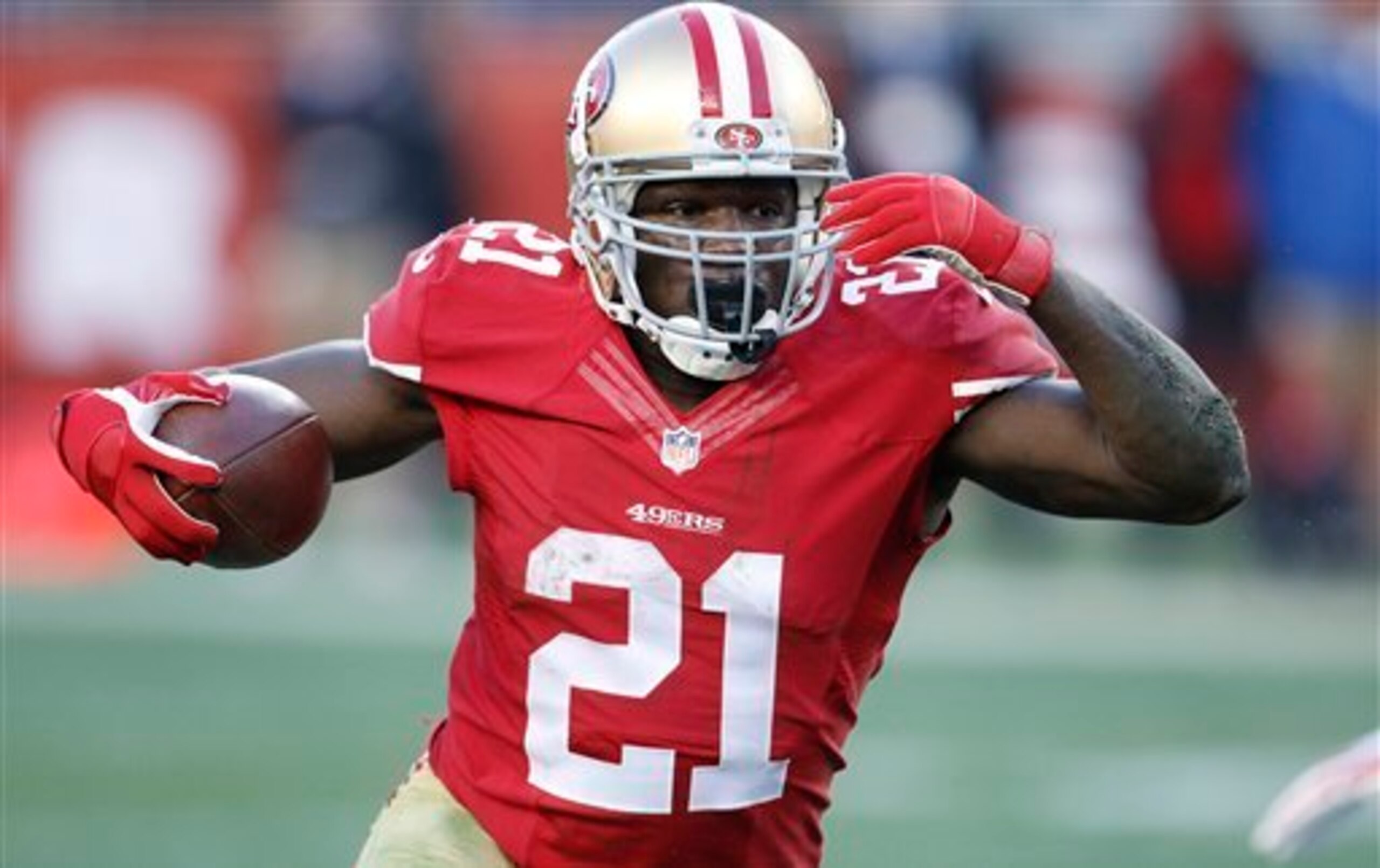
Midseason Grade: C+
Frank Gore may be on his last legs, but the last two weeks have reminded 49ers fans just what he is capable of, as he’s topped 140 yards in each of the last two weeks. It’s been enough to put his season yards-per-carry average up to 4.3 for the season, which is more in line with his career averages.
Before these last two weeks, he was just at 3.9 yards per attempt. I think it’s clear he’s on his last tank of gas, but there’s still some fuel left in that tank. I’d like to see him back for one more year.
When it comes to actually running the ball, though, more carries should go to Carlos Hyde from here on out. While Gore handled about three-quarters of the carries for the top two backs, it was Hyde who did better with them.
Yes, Gore’s 4.3 yards per attempt trumped Hyde’s straight 4.0, but Hyde was consistent through the entire season, rather than having a couple of huge games at the end salvage his numbers. Hyde’s power through the holes and ability to keep his legs moving bodes well for the future; he should receive at least half the carries next season.
Neither are exactly weapons in the receiving game—they combined for just 23 receptions, and Greg Roman wasn’t exactly in the habit of throwing screen passes. That might be something a new offensive coordinator can work on adding to the offense. Of course, neither Hyde nor Gore is exactly a LaMichael James-esque weapon, so it may just not be in their particular skill sets.
If the running back corp was just Gore and Hyde, then, the 49ers would have an average unit. The combination of an aging veteran squeezing every drop out of his career and a rookie figuring out how to work on the NFL level is a solid combination, but it's nothing world-beating. However, the 49ers have a third player in their backfield—fullback Bruce Miller.
No fullback in the league played more snaps in 2014 than Bruce Miller did, according to Pro Football Focus (subscription required), and Miller responded with the second-highest grade among all fullbacks. He’s still one of the best in the game at plowing holes in the running game.
It seemed, at times, the 49ers abandoned the power-rushing game behind Miller, Joe Staley and Mike Iupati. Whenever they went back to it, however, it worked. The 49ers have an excellent run-blocking asset in their backfield, and the new head coach needs to continue to utilize him.
Running Grade: C
Receiving Grade: D+
Blocking Grade: A
Overall Grade: B-
Wide Receivers
3 of 6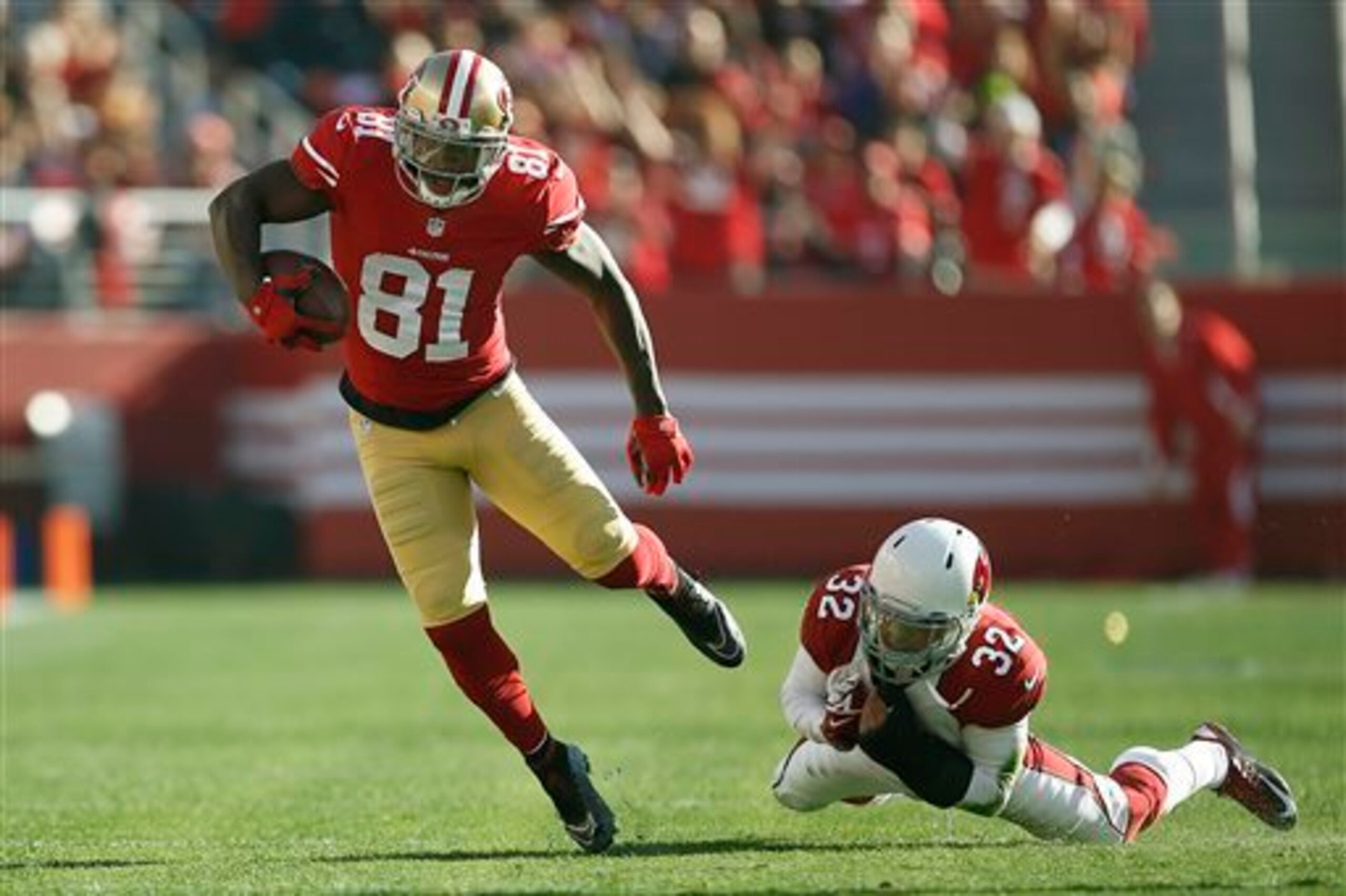
Midseason Grade: B
The receiving corp is a tale of two sets of receivers.
On the one hand, you have Anquan Boldin and Stevie Johnson, both of whom had very solid seasons catching the ball. Boldin became only the fourth player in franchise history to have multiple 1,000-yard receiving years, after Jerry Rice, John Taylor and Terrell Owens. Boldin was especially key on third downs, with 30 receptions coming in those key situations.
When Stevie Johnson was healthy, he had quite a good year as well. The ex-Buffalo Bill caught more than 70 percent of the passes thrown his way for a total of 435 yards. It was looking to be a very solid season for him before a lingering knee injury kept him out of much of the second half of the year. While his contract is a bit unwieldy going forward, he definitely produced on the field.
Then, you have the other pair of receivers—Michael Crabtree and Brandon Lloyd. Lloyd made some of the most spectacular highlight-reel receptions you’ll ever see this season, but he caught less than half the balls thrown his way and ended the season with just 14 receptions. He ended up with just 1.26 yards per pass route, per PFF, about half of what Johnson was able to put up on a similar number of snaps.
As for Michael Crabtree, the glory days of the 2012 season seem like a distant memory now. While Crabtree started every game this season, lingering injuries severely limited his effectiveness, and he ended up with over 200 less snaps than Boldin, according to PFF. When he was healthy, he suffered from drops, letting 10 balls hit the turf. His drop-rate, per PFF, was the 11th-worst in the league.
The 49ers' best strategy moving forward is to go with Boldin, Johnson, either Bruce Ellington or Quinton Patton and a rookie pick in this year’s draft. Crabtree and Lloyd are free agents, and they should be moved on from.
The only issue I have with Boldin is a tendency to pick up lots of penalties. Boldin had three offensive- pass-interference penalties in 2014, tied for second-most in the league, according to NFLPenalties.com. He also was flagged in a key spot in the first Arizona game for unnecessary roughness on a headbutt. These sorts of things can really hurt a team. He more than makes up for it with his receiving skills, but it’s something to work on.
Receiving Grade: B
Blocking Grade: C-
Penalty Grade: C
Overall Grade: B-
.jpg?w=2560 "Commanders 49ers Football")
.jpg?w=2560 "Colts Football")
.jpg?w=2560 "DOLPHINS-AIKMAN")
Tight Ends
4 of 6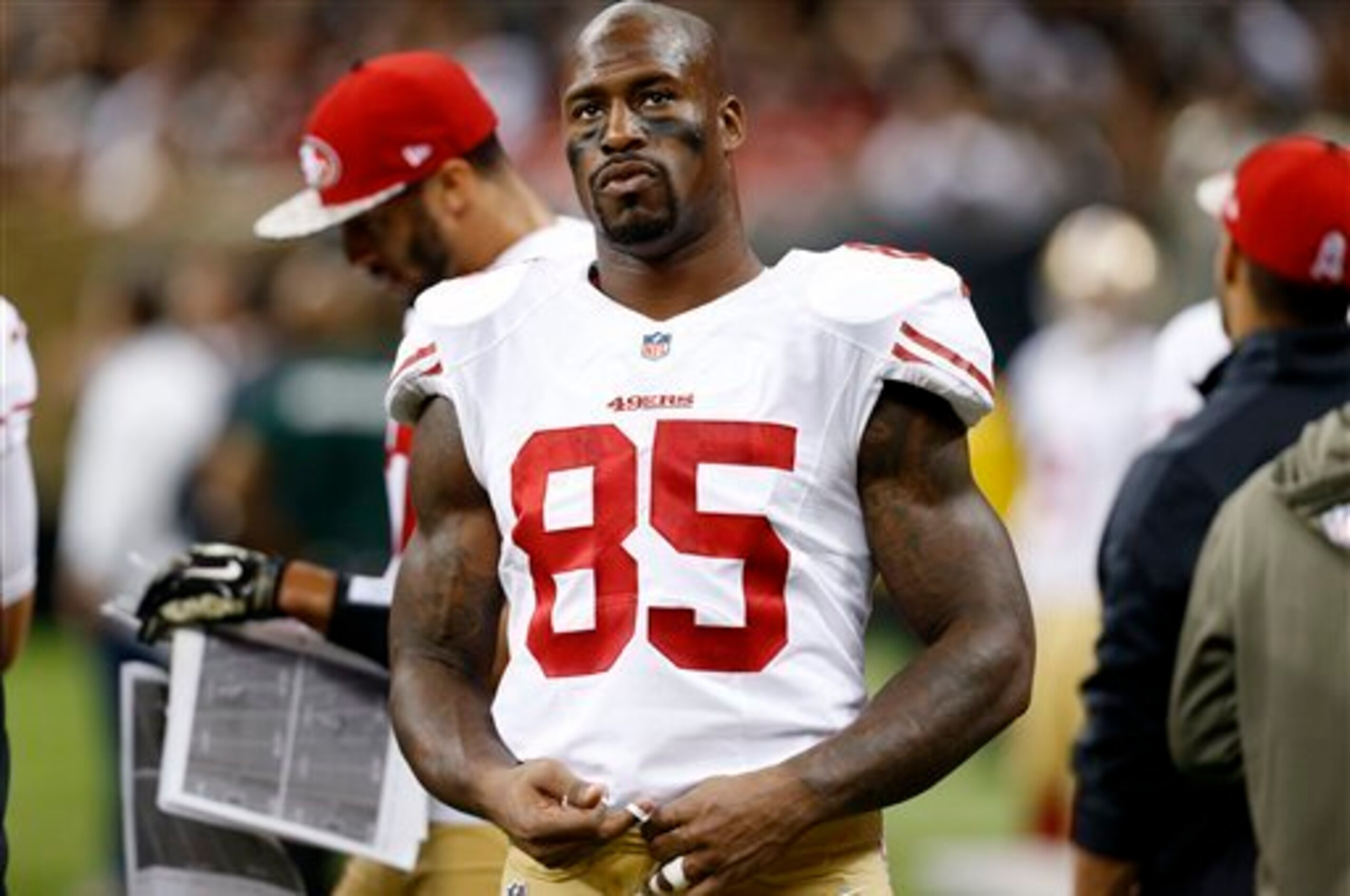
Midseason Grade: C
It’s a good thing that this isn’t solely a grade for Vernon Davis, because you’d probably see an overall “F” here—or at least, a gentleman’s "D-."
Davis was terrible this season. He only caught 26 passes, his lowest total since his rookie season. He only had 245 yards, his lowest total ever. He barely caught over half the passes thrown his way, suffering six drops. Two games in a row—against Seattle and San Diego—he suited up, and yet, he caught no passes. If anything, he got worse as the season went along. In the last five games, Davis caught only five passes.
His run-blocking skill, another usual strength of his, also fell off a cliff. He often seemed overmatched and outgunned by opposing linebackers and defensive ends, and he lacked the same domination that made him one of the best all-around tight ends in the game, not just a big wide receiver like Jimmy Graham. Everything went wrong for him this year.
Fortunately for this grade, Vance McDonald bounced back from a very poor rookie season. Before ending up on injured reserve with a back injury, he had put together a very good season blocking for Frank Gore and Carlos Hyde.
If you have some free time this offseason, watch the victory over the New York Giants again. McDonald, mostly lining up next to right tackle Jonathan Martin, helped shut down both Robert Ayers and Mathias Kiwanuka in what might be his most impressive game to date.
That’s good, but it’s not enough to overcome Davis’ total egg of a season. He was a Pro Bowler as recently as 2013, so the 49ers could justify giving him another shot next season. However, with a cap number of $7 million in 2015, per Spotrac, we may have seen the last of him in a 49ers uniform. His performance this season was simply unacceptable.
Receiving Grade: D-
Run-Blocking Grade: C-
Pass-Blocking Grade: B
Penalty Grade: B-
Overall Grade: D
Offensive Line
5 of 6
Midseason Grade: C+
I can see the objection already, so I’ll address my thinking right off the bat. The 49ers allowed 52 sacks, tied for third-most in the league. How can their pass-blocking grade be even as high as a "C-"?
There are a number of factors. First and foremost, not all of the sacks were the offensive line's fault. Some of them, for instance, are Colin Kaepernick's fault as he holds the ball for too long. Others came on blown blocks by Frank Gore or Vernon Davis.
Secondly, two-fifths of the starters on the offensive line were actually above-average in pass blocking. Both Joe Staley and Alex Boone graded out positively, according to Pro Football Focus (subscription required). That’s 2,048 snaps by offensive linemen with a positive pass-blocking grade, and 3,431 snaps by linemen with a negative grade.
Other advanced stats disagree—Football Outsiders, for example, has the 49ers 30th in pass-blocking efficiency. That, however, includes all sacks, not just the ones given up by the offensive line.
I’m giving the offensive line a little credit for having to block for Kaepernick, who tends to hold onto the ball forever. He holds the ball for an average of 2.96 seconds before he throws it, per PFF, third-longest in the league. The offensive line often finds itself having to block for almost four full seconds before Kaepernick makes his read, which is a really tough job.
Quarterbacks such as Peyton Manning and Tom Brady average less than two-and-a-half seconds per play. They’ll throw it away if nothing develops.
I’ll give much more credit to the 49ers line, which holds up for 3.72 seconds before Kaepernick gets sacked, than I will for New England’s line, which holds up for an average of just 2.92 seconds before Brady gets sacked. It’s wrong to lower both Kaepernick’s and the offensive line’s grade for the same problem.
Finally, I’m adding a bit of an injury adjustment as well. The 49ers started eight different combinations of offensive linemen and had a large number of snaps from Jonathan Martin, Marcus Martin and Joe Looney. This wasn’t in the plan before the season began, and the lack of continuity hurt them significantly. Of course Jonathan Martin isn’t as good as Anthony Davis; if he was, he would be the starter.
All that being said, the 49ers still took far too many sacks, and it’s not like I’m giving the offensive line flying colors here or anything—a "C-" is just barely above a passing grade. It’s just a more complex issue than just the offensive line being bad at blocking, and it could rebound next season with just some added health.
Pass-Blocking Grade: C-
Run-Blocking Grade: B+
Penalty Grade: C+
Overall Grade: B-
Overall
6 of 6
Greg Roman’s offense can never be accused of being one of the most dynamic or innovative in the league, but it’s not the worst I’ve ever seen. They finished 20th in yards gained, and their 5.2 yards per play is nothing to write home about.
The 49ers ranked fourth in rushing yards, but that’s in large part a factor of them simply running the ball a lot. Similarly, they ranked 30th in passing yards in large part because they ranked 29th in pass attempts. They definitely were a better team running the ball than passing it, but it's not to the extremes either raw number shows.
Roman gets dinged more for specific situational football problems. The 49ers struggled again in the red zone, scoring a touchdown on only 43.18 percent of their red-zone drives, according to TeamRankings.com. They scored the fewest points in the fourth quarter of any team in football, with only 2.1 points per game coming in the final 15 minutes, also per TeamRankings.com.
If you had to pick two stats that highlighted the 49ers’ offensive struggles in 2014, those would be the two you’d point to. Whoever runs the offense in 2015 needs to dramatically improve both those numbers. If you can’t score six points a game in the fourth quarter and can’t convert at least half of your red-zone opportunities into touchdowns, you’re not going to be a playoff team most years.
We can’t let those two numbers outweigh everything the 49ers offense could do this year. Football Outisders ended up ranking it 16th in total DVOA, pointing in particular to a top-10 running offense when you account for the tough schedule.
Two games against Seattle, two against St. Louis, two against Arizona and one each against Denver and Washington is an extremely tough set of opposing run defenses, and yet the 49ers still topped 2,100 rushing yards. This isn’t a case of the cupboard being bare; it’s just a cupboard that needs a few shelves fixed.
I think the 49ers offense was slightly better-than-average—but slightly better than average is not enough to be a playoff team. Improving the passing offense has to be the first priority for whoever is in charge next season.
Overall Offensive Grade: C+
Bryan Knowles is a featured columnist for Bleacher Report, covering the San Francisco 49ers. Follow him @BryKno on Twitter.
.jpg?w=2560)
.jpg?w=2560 "NFL Paris Football")


.jpg?w=2560 "Malik Beasley Negotiating Plea Deal (AP)")