
Breaking Down What's Behind the Surprising Start for Red-Hot Atlanta Hawks
Maybe it's the market, maybe it's the years of playoff-bound but non-championship-contending teams. Whatever the reason, the Atlanta Hawks have always seemed to fly under the radar.
Except unlike in years past, when the Hawks' noise mostly sputtered out in the first or second round of the postseason, Atlanta is now a surefire Eastern Conference power threatening to make a deep run.
According to NBA.com, the Hawks sport the sixth-best net rating in the league. Their +5.9 points per 100 possessions outpaces that of multiple Western Conference powers, including the San Antonio Spurs, Memphis Grizzlies and Houston Rockets.
TOP NEWS

Pic of LeBron's Helicopter Commute 🚁

Duren Calls Out 'False' Rumors

NBA Power Rankings Entering Preseason 🔢
The key has been balance. Their offense isn't otherworldly and their defense isn't quite lockdown, but both are statistical top-10 units capable of ramping it up on any given night.
From a scheming perspective, Atlanta's ability to score the ball is mostly due to a refined shot selection that seeks the most efficient shot locations.
They attempt the fourth-fewest mid-range shots per game and third-most right corner threes. Also, 27.5 percent of their points, on average, are generated by threes, the fifth-highest rate in the league.
Six players on the team are shooting above 35 percent from deep, and Kyle Korver is keeping up his ridiculous 50-plus percent pace at 53.9 from beyond the arc. Even with a hand up on jumpers, the team is still shooting 40.8 percent on catch-and-shoots, according to Synergy Sports (subscription required)—fourth-best in the NBA.

Not every team is built with so many spot-up weapons, and the front office deserves credit for meshing their personnel acquisitions with head coach Mike Budenholzer's preferred style of play.
But the key isn't simply jacking it from long range and hoping for the best. An offense needs a primary ball-distributor out of the pick-and-roll to find these shooters, and he has to be threatening enough as a scorer at the rim to warrant extra attention.
Without a guard's ability to suck in multiple defenders, these shooters never come open. And on top of that, the ball-handler has to have the vision both to locate shooters and deliver on-time passes, a skill only a handful of NBA lead guards possess.
The Hawks have such a player in Jeff Teague. Atlanta isn't necessarily pushing the pace of the game to inflate offensive totals; they're fourth-best in the league in half-court offense, according to Synergy Sports (subscription required), and have demonstrated an ability to play at multiple tempos.
That is because Teague is a constant pick-and-roll threat with an ever-developing patience to make the right play.
The league guards pick-and-rolls in a variety of ways, but most concepts, at least generally, emphasize forcing the pick-and-roll ball-handler to do the scoring in the 7-20 foot range. If he wants to let it fly from the mid-range, fine. If he wants to take difficult floaters over hands, fine again.

That's because off-the-dribble jumpers worth two points are generally a high-30s percentage shot (subscription required), while floaters sit just a slight notch above at 40 percent. They're difficult shots, even for the league's best, and are worth an entire point less than three-pointers.
The concept, quite simply, is no layups and no threes.
The most difficult point guards in the league to defend are the great passers with well above average mid-range games. Even though the shot is still not the highest percentage, they tend to creep into that mid-40s range when left with room to shoot.
From an analytics perspective, this is almost as dangerous as threes and layups and therefore cannot be ignored. That's why you'll see great point guards like Chris Paul and Tony Parker take just enough mid-range shots to keep the defense honest, but not enough to kill efficiency.
Jeff Teague is developing this skill at an alarming speed. He's shooting 41.2 percent on runners and 39.6 percent on all off-the-dribble jumpers, according to Synergy (subscription required), both of which slot him in as well above average.
The key has been using this newfound weapon to keep defenses on a string while reining in his incredible quickness. Take a look at these three pick-and-roll plays against the Brooklyn Nets and how Teague is able to keep the Nets bigs off balance.
In the first example, Teague runs a pick-and-roll with Paul Millsap. Notice how, at least initially, he doesn't attack the screen at 100 miles per hour. He probes it with a relaxed dribble so he can assess the situation.
As Millsap sets the screen, it's clear that Kevin Garnett is going to confront him high up the floor. It's in these situations that Teague is particularly dangerous, because with one quick change of speed he's able to blow by almost anyone.
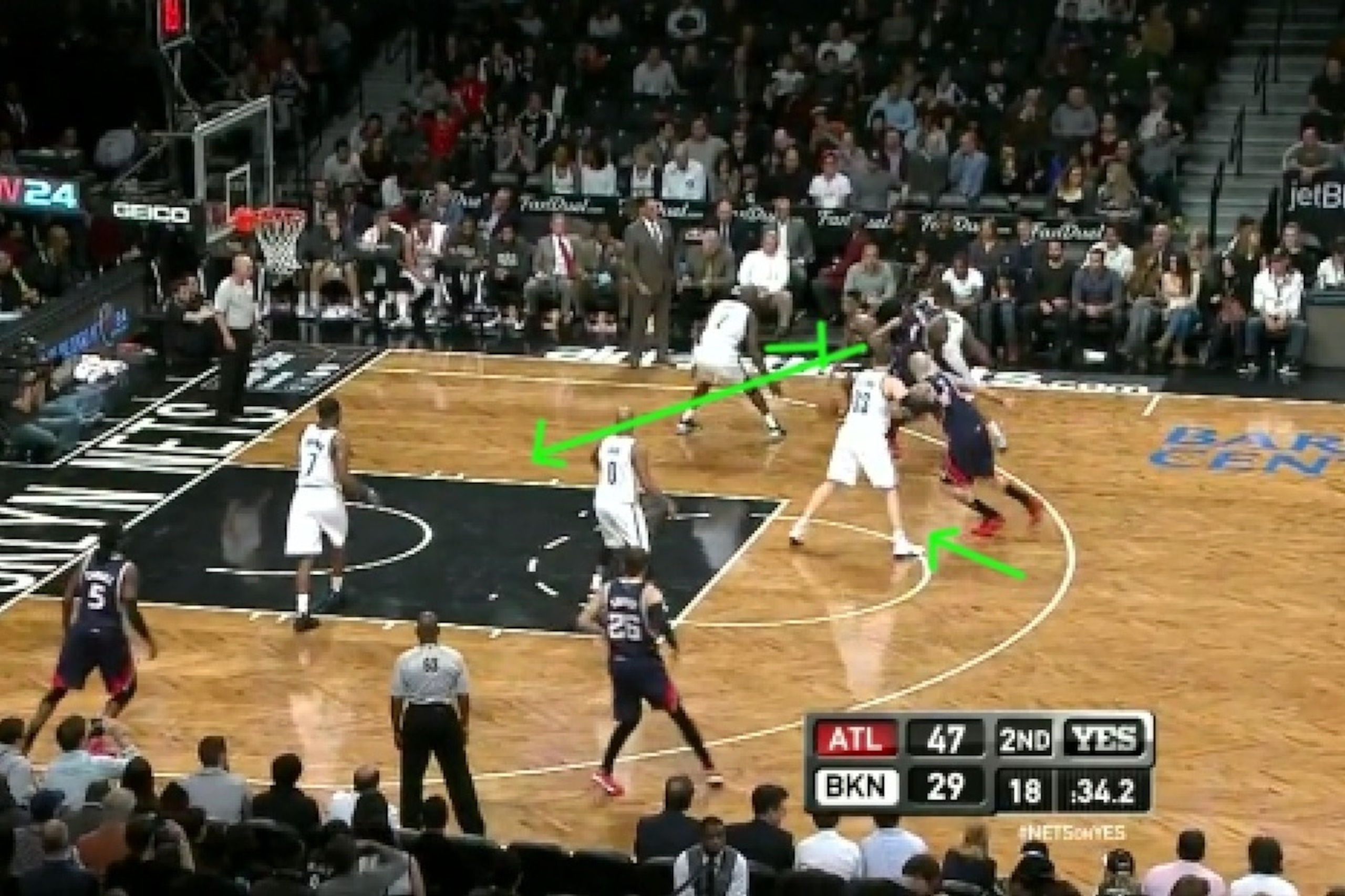
On this play, he does a nice job recognizing that there's no rim protection. With Pero Antic lifted on the perimeter to draw Mirza Teletovic away from the rim, his only obstacle to the hoop is Garnett.
And against a player with such a quickness advantage, Garnett does not stand a chance.
Now compare that to this play from a possession a moment earlier in the game, with Antic setting the pick and Brook Lopez in a more conservative drop.
Lopez is clearly cognizant of Teague's ability to get on the rim and backpedals accordingly. He's almost bracing for the drive at any moment, and Teague does a nice job sensing that Lopez is on his heels.
That's why Teague takes an extra dribble toward the baseline and leaves his feet: He's pushing Lopez down farther toward the restricted area and away from the popping Antic while simultaneously damaging any chance either Brooklyn defender—Lopez or Teague's original man, Deron Williams—has to recover to the three-point line.
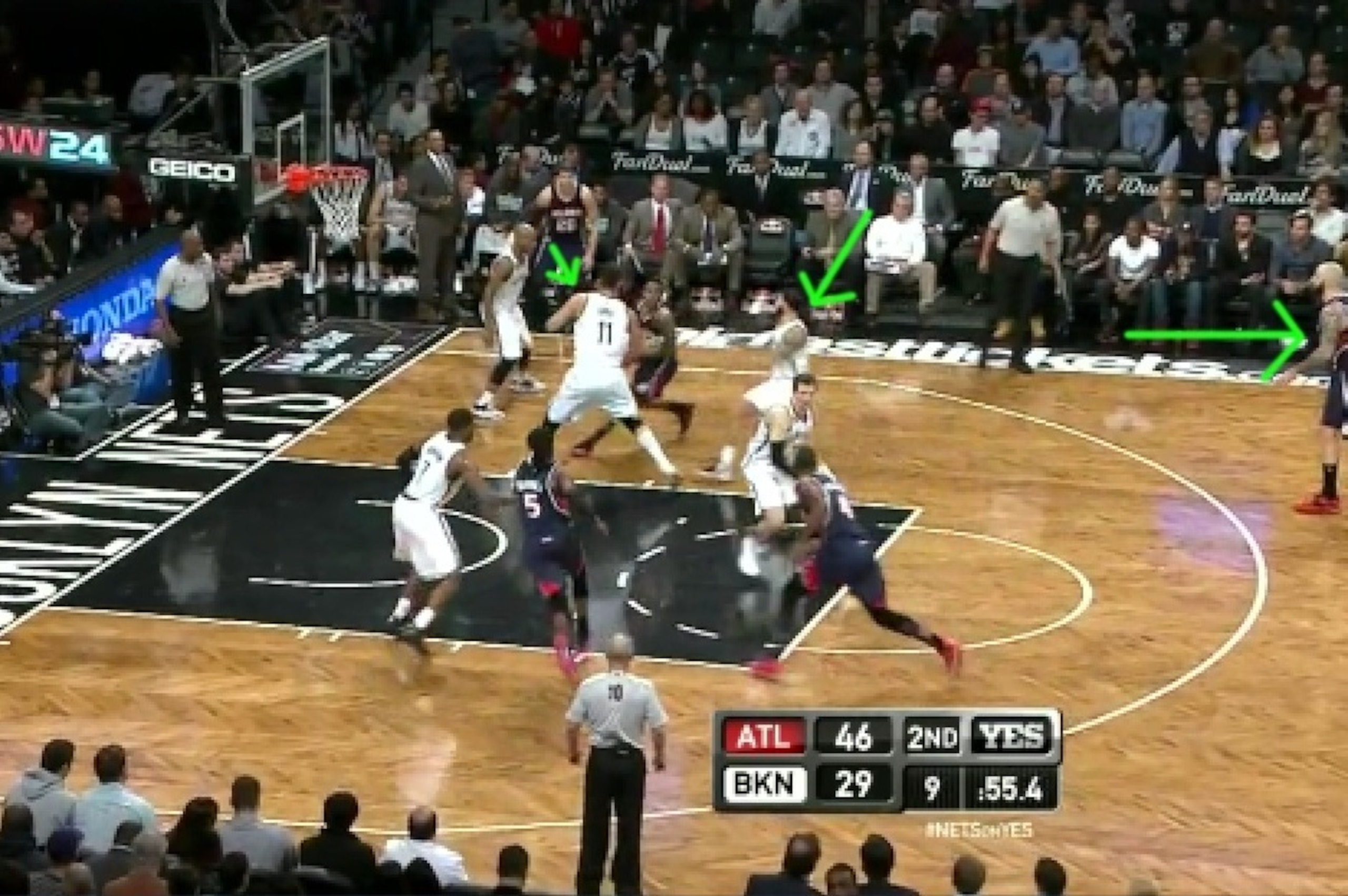
At best, it's an open three-pointer for Antic. At worst, this causes a massive rotation on Brooklyn's part, leading to ball swings and a likely open shot somewhere down the line. In this case, Antic uses the panic of a flying Lopez to draw the foul and earn three shots at the line.
In this final pick-and-roll, Lopez's drop is extremely deep. Joe Johnson tries to go under the pick, and Antic properly sets the screen lower down the floor to punish the tactic.
With Johnson at a disadvantage, Teague attacks the space with his speed before rising for the runner. Lopez is stuck in a two-on-one situation and must account for Antic, leaving his contest both late and too far away.
Speed is an incredible tool in basketball, but it must be wielded properly. Three-point shooting is another crucial component to basketball, but it must be set up properly.
The Atlanta Hawks have both of these skills meshing at the right time. Teague is finally becoming the engine to Atlanta's offense and not just an offensive machine out for himself, and Budenholzer is teaching his perimeter players about ideal shot selection and spacing.
The result is a dangerous offense worth keeping an eye on as the season progresses. Because if the Hawks keep it up, they'll be a force to be reckoned with come playoff time.
.jpg?w=2560 "OBJ Calls Out Giants After Release")



.jpg?w=2560 "NFL investigating referee after viral exchange with player")