

5 Statistics That Are Defining Houston Rockets' Season So Far
There are certain statistics which define the Houston Rockets’ season to date…
Record scratch…
Statistics. There’s that word again. The most awesome, horrible, cool, twisted term in sports. You either love them or hate them, or, in all likelihood, both.
Mark Twain once said of them, “There are lies, damned lies and statistics.”
George Bernard Shaw took the other side, saying, “It is the mark of a truly intelligent person to be moved by statistics.”
And Vin Scully struck the right balance when he said, “Statistics are used much like a drunk uses a lamppost: for support, not illumination."
To use them for support is to have an argument ready to go, and then find a cherry-picked stat to prove your point. To use them for illumination is to study them to see what they say and become enlightened.
The difference between a statistic being a lie and one "moving" one's mind depends on whether it's used solely as evidence in an argument or to shed light on the subject.
These are specific numbers which reveal not just the “what” of the Rockets’ season to date, but the “why.” They are chosen for their ability to elucidate and define where Houston is.
They are listed here in a logical order which tells the story of the Rockets’ season.
5. 101.9 Offensive Rating
1 of 5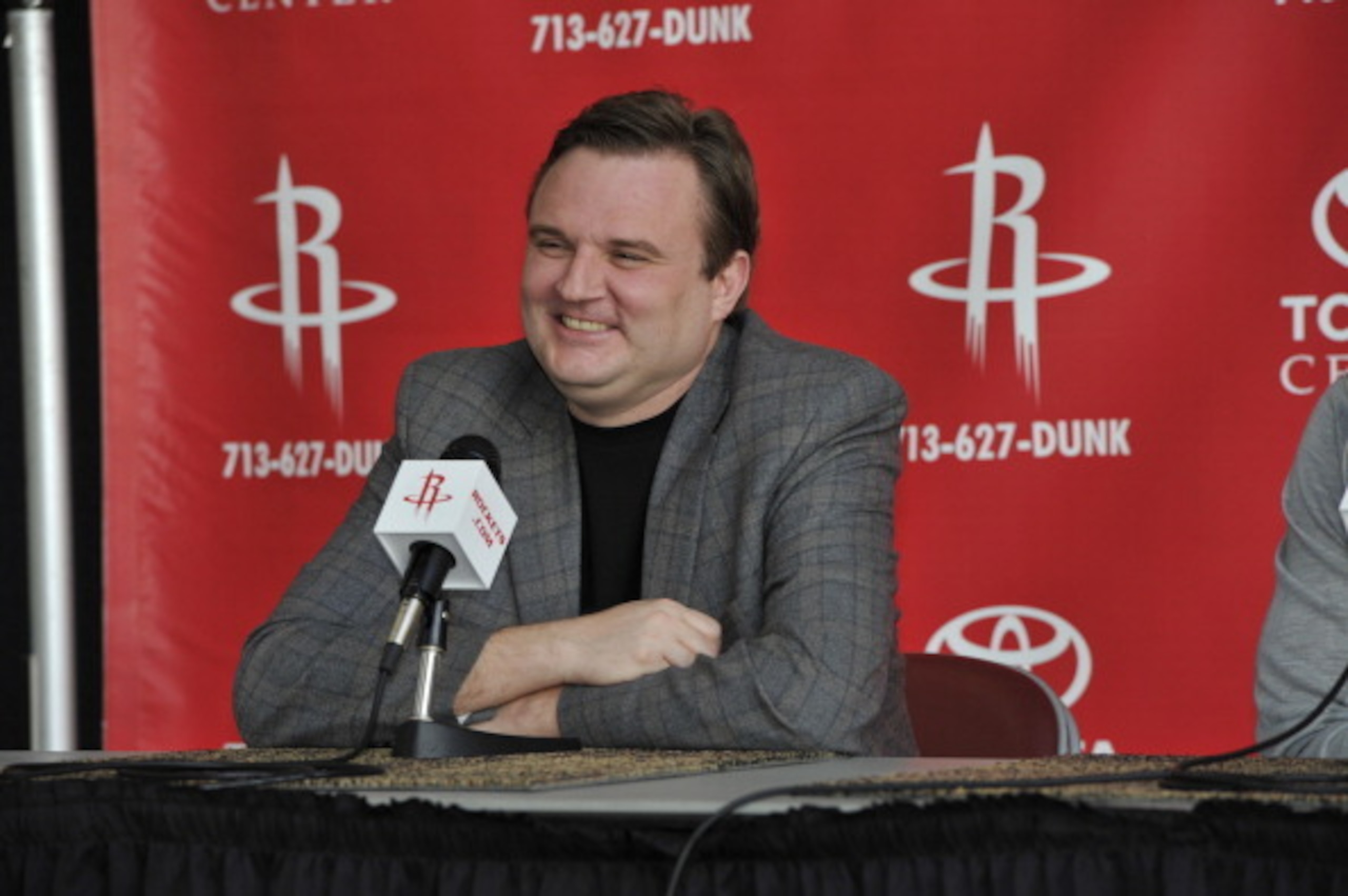
The Rockets are still mostly known for their philosophy on offense. It is what many have dubbed “Moreyball.” It’s named after its originator and Rockets’ general manager, Daryl Morey. And it refers to the notion of analytics-driven basketball which emphasizes the most efficient shots.
Those are attempts near the rim or outside of the three-point line, and almost all the Rockets’ looks have come from there for the last three seasons. This year is no different. In fact, based on data from NBA.com/Stats, 75.8 percent of the Rockets’ shots have come from the preferred areas.
The Philadelphia 76ers are second at 69.6 percent. The Detroit Pistons, at 64.5 percent, are third. The Sixers have the worst offensive-rating in the NBA (91.2), the Pistons have the second-worst (96.6) and the Rockets are tied for the 10th-worst (101.9).
Clearly, just getting shots from the most efficient areas doesn’t guarantee an efficient offense.
However, the next three teams in Moreyball attempts are the New Orleans Pelicans (seventh/107.0), Phoenix Suns (12th/104.9) and Dallas Mavericks (first/113.4).
This raises questions: Can emphasizing efficient zones help, but overemphasizing them hurt? Can forcing the ball into the preferred zones make an offense predictable and easily defended? Is there a threshold, say 65 percent, at which such a philosophy becomes counterproductive? (I actually mean those as questions; I don’t have the answers.)
4. 1.12 Assist-to-Turnover Ratio
2 of 5There are two stats which reveal why the Rockets’ offense is sputtering, and they both go along with the “predictable offense” hypothesis. When combined, they show just how much.
The Rockets are last in the NBA in assist ratio, notching just 15.1 dimes per 100 possessions. What does that mean?
Last year, The San Antonio Spurs led in that category. Think of their brilliant passing display during the NBA Finals. Envision the ball whipping around the perimeter, or in and out of the paint, always seeking the best possible shot, until it’s finally lofted toward the rim, where it smoothly parts the nylon.
Now think of the exact opposite of that, and you have the Houston Rockets. Their passes are often awkward and forced. Their shooters are great but struggle to get good looks. They attempt only 42.0 shots off passes, which is 23rd in the league.
The 19.0 makes off those attempts means they shoot just 46.2 percent on assist-chances, which is second-worst in the league.
They turn the ball over 17.9 times per 100 possessions. Only the 76ers are worse than them.
When you combine those two things, it gives the Rockets a 1.12 assist-to-turnover ratio, meaning they’re nearly as likely to turn it over as they are to get a bucket off a pass. This speaks to the predictability of the offense. Teams can cut off passing lanes and/or trap James Harden.
That results in a lot of turnovers, whether they’re from deflecting passes or stealing the dribble. The Rockets are doing fine when they get the shots off, but too often they’re turning the ball over before they get to that point.
That’s because teams are figuring the Rockets out and know how to slow them down.
3. 58 Games Missed Due to Injury
3 of 5The offense has struggled, in part, due to Moreyball’s predictability, but all the blame can’t be attributed to it. Perhaps, not even most of it. The Rockets have missed 58 games due to injuries this season—an average of more than 2.5 per game.
Making matters worse is the extraordinary number of contests their starters have been out for: 43 in 23 games, or 37.4 percent.
Dwight Howard and Patrick Beverly have missed 12 games each with knee issues, but both are now back in the lineup.
Terrence Jones is still out with a peroneal nerve contusion, and there is no return date for him, according to ESPN.com. However, according to Jenny Dial Creech of the Houston Chronicle, he is shooting again and “slowly but surely he is making his way back.”
Also, per Creech, surprising rookie sensation Kostas Papanikolaou, who has missed four games with a sprained knee, and backup point guard, Isaiah Canann, who has missed nine games with a sprained ankle, were both upgraded to questionable on Dec. 16.
As a result of all the injuries, the Rockets have not courted the same starting lineup more than any four games, and have had to go with eight different ones. That makes developing continuity and chemistry difficult, especially for a team that is sporting as many new pieces as Houston.
Trevor Ariza, Tarik Black, Joey Dorsey, Nick Johnson, Papanikolaou and Jason Terry are all new to Space City.
Considering all the injuries and changing lineups, it’s amazing the Rockets are scoring enough points to win, regardless of where they rank in offensive rating. Yet, at 18-5, they’re sporting the NBA’s third-best record.
That’s a more than commendable job.


2. 28.5 Opponents’ Three-Point Shooting Percentage
4 of 5One major reason the Rockets keep winning in spite of their shooting woes is their tremendous defense. And here, Moreyball philosophy—or its antithesis—is paying off.
They are giving up a meager 28.5 percent from three-point range on defense. They’ve been achieving that with a heavy emphasis on closeouts. And that’s a particularly significant number.
When considering three-point percentage, the general notion is to try to equate the “break-even” point as 33.3 percent, because a third of threes would be equal to hitting half your twos.
However, the average two-point field-goal percentage league-wide is 45.1 percent, not 50 percent, which makes the three-point “break-even” barrier 30.1 percent. What the Rockets defense is doing is making the three-point shot less efficient than a two-point shot.
The Rockets and the other three teams who are doing that—the Oklahoma City Thunder, Portland Trail Blazers and Golden State Warriors—are four of the top six defenses in the NBA. It’s the reason why the Rockets have the second-best defense in the league and one of the biggest reasons they’ve been winning in spite of their injury woes.
They’ve suffered inside some with Howard out. Prior to his absence (through Nov. 17), the Rockets were giving up a 59.1 field-goal percentage inside the restricted area. Since then (from Nov. 18), it’s been 63.5 percent. So their second-ranked defense might actually be underrated.
Or they would be if it weren’t for the terror the Golden State Warriors were wreaking on the league.
1. 26.3 Points Per Game from James Harden
5 of 5James Harden is on pace to win the scoring title by averaging 26.3 points, which on a scoring-challenged team is particularly important.
He’s also contributing the 10th-most points off assists at 16.7. All told, that means 44 of the Rockets’ 99.6 points per game are coming from Harden, either through scoring or passing.
In addition, he’s snatching 6.4 balls off the glass, ranking fourth among all guards.
Just for fun, add to that his defensive numbers, which are surprisingly good. For starters, he’s the only player in the league averaging two steals and one block per game. His opponents are shooting 2.6 percent below their normal averages and 8.5 percent below their three-point average.
And lest you think that’s all help defense, remember that Dwight Howard has been out half the season. Furthermore, the advanced metrics suggest tremendous improvement, too. Per Kevin O’Conner of Vantage Sports, Harden has improved his keep-in-front percentage from 44.83 percent last year to 58.99 percent this year.
O’Conner explains how else Harden’s defense has improved:
"According to Vantage Stats, Harden ranks 23rd of all qualified players in the NBA allowing only 0.78 Points Allowed per Shot, which leads the Rockets. This stat is also a significant increase from last year’s sieve total of 0.99. Harden is consistently displaying effort not only in his man-to-man defense but also in his off-ball awareness.
Part of the reason shooters aren’t scoring at the same rate against Harden is that he’s simply contesting shots more frequently. Vantage’s Contest+ measures all shots that a player blocks, alters, or contests, and Harden comes in at 44.4 percent, which ranks right around league average. That is a notable increase from last year's rate of 38.2 percent.
"
Harden’s defense has gone from god-awful to somewhere between not-so-bad and sometimes-even-good. He’s not a Jimmy Butler-type of lockdown defender, and his numbers aren't coming against elite wings. But that’s why the Rockets got Trevor Ariza this offseason.
Harden is, however, doing his job and then some on the less-celebrated end of the court.
He is on pace to become the first player in history to notch 25 points, six boards, six dimes, two steals and a block per game. And he’s doing that while playing commendable defense. He’s carrying a team beset with injuries to the third-best record.
You can sum all that up in three easy words: Most Valuable Player.
.jpg?w=2560 "OBJ Calls Out Giants After Release")



.jpg?w=2560 "Saquon Out for Game")