


There's no escaping Anthony Davis and DeMarcus Cousins, now that they're seemingly everywhere in the basketball world.
On the court, both individually and in opposition to one another. On magazine covers. In conversations and debates, not just about which young player is best, but of who belongs in the NBA's MVP race.
In these regards, though, they tower over their predecessors and competitors—quite literally, in fact. Davis is a lanky 6'10", albeit reportedly 25 pounds bulkier than before. Cousins, at 6'11" and 270 pounds, is an absolute load.
TOP NEWS

J-Dub, Wallace May Miss Entire Season
Melo's Quote on Confidence 😎
Celtics at Fault for JT-JB Beef? 🤔
Both have taken the Association by storm, just a handful of years removed from short stints in John Calipari's cocoon for big men at Kentucky. Both also rank among the top 10 in points, rebounds and PER, with Davis adding similar statistical accolades in blocks, steals and field-goal percentage.
Each has elevated his team to the fringes of the Western Conference playoff picture, but by vastly different means. Cousins is, in many ways, old-school: a hulking center who commands double-teams, demands the ball down low and has proved prone to emotional outbursts, for better or worse. Davis, on the other hand, is the new-school prototype: long, quick, athletic, capable of dominating a game without the ball in his hands and with a flurry of face-up moves when he does.
Or, to put it more poetically, as Sports Illustrated's Lee Jenkins did:
"He is the invention of a God who already built Kevin Durant and decided to get more creative. Teammates compare Davis to a Gumby doll, a pogo stick and a variety of other outlandish toys, all elastic or spring-loaded.
"
But while Boogie and the Brow are the Next Big Things in basketball, they're hardly the only bigs who've got next.
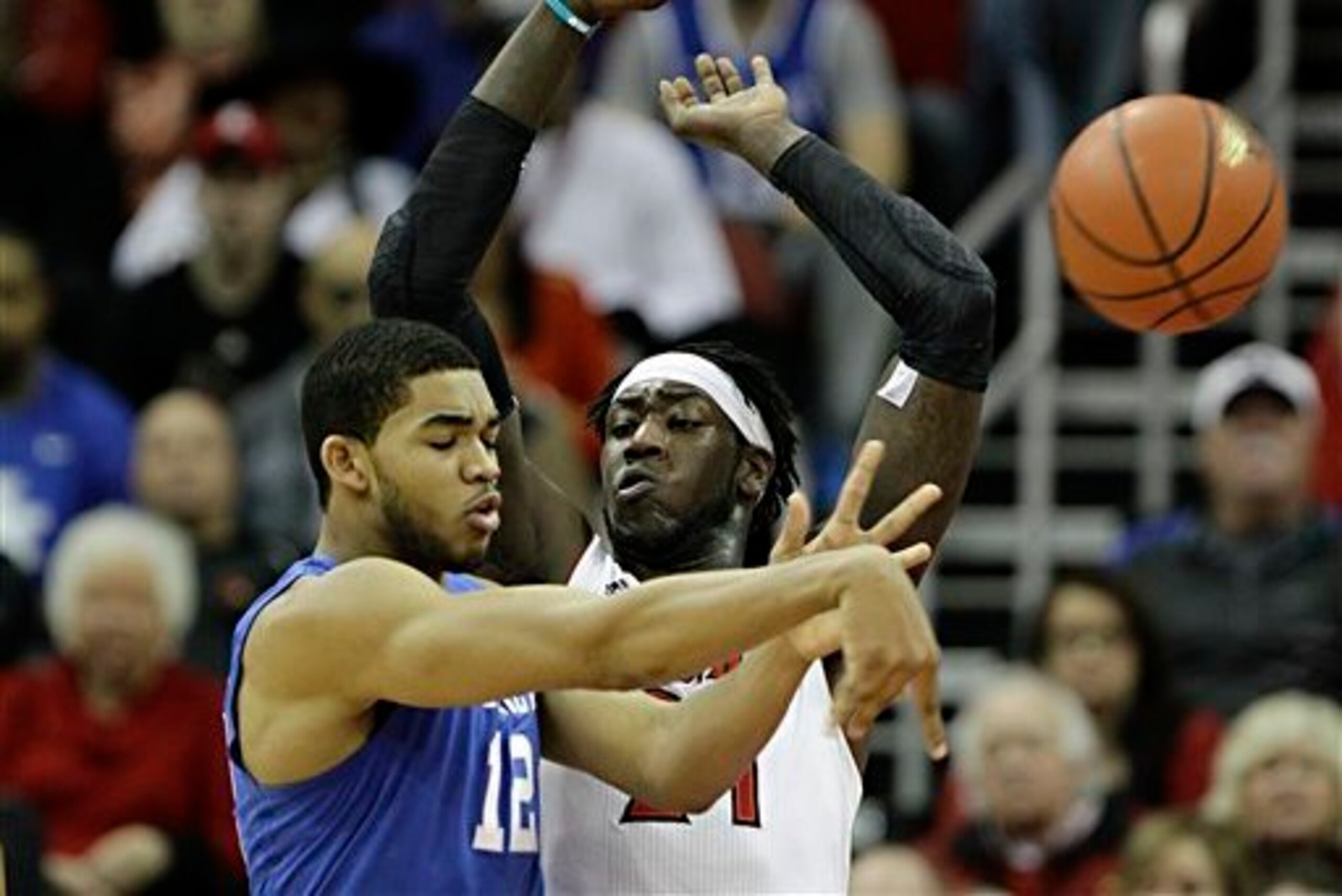
Back in Lexington, Karl-Anthony Towns is following in the massive footsteps of Cousins and Davis to become the Wildcats' latest one-and-done phenom. The Dominican giant has been praised by scouts and observers alike for his length, leaping ability and agility on the defensive end and his surprisingly soft shooting touch on the offensive end—not entirely unlike Davis, though about 30 pounds heavier than the Brow was as a freshman.

Towns isn't projected to be the first player taken in next June's NBA draft. For now, that distinction belongs to Duke's Jahlil Okafor, a low-post throwback whose frame and game more closely fit the mold from which Cousins was cast.
"It had been pretty clear for a while that he was a very special offensive player," said Steve Kyler, the Senior NBA Editor at Basketball Insiders. "We really haven't seen a big guy with his low-post ability coming in from high school to his first year in college. I can't recall a player that was this far along."
Indeed, Okafor and Cousins belong to a rare breed of big men who, once upon a time, dominated the NBA with their backs to the basket, bowling and bullying their way to individual honors and championship trophies. Those who do dominate down low nowadays are so often overshadowed by the league's freakishly gifted wings—LeBron James, Kevin Durant, Paul George and Kawhi Leonard, to name a handful—and its golden age of point guards, led by Chris Paul, Stephen Curry, John Wall, Kyle Lowry, Kyrie Irving and the rejuvenated Rajon Rondo.
But while low-post patrons on par with Shaquille O'Neal and Hakeem Olajuwon appear to have gone the way of the dinosaurs, star-quality bigs have not. Rather, in adapting to a more athletic, perimeter-oriented game, they've evolved a variety of forms, thereby filling more niches with greater aplomb than ever before.
How We Got Here
The origins of the myriad player species that populate today's NBA frontcourts can be traced back two decades, to an aspect of the sport that is at once its most boring and arguably its most crucial: the rule book.
In 1994, the league eliminated hand-checking, thereby freeing perimeter players from a familiar type of impedance. Per the NBA's guidelines:
"A defender may not place and keep his hand on an opponent unless he is in the area near the basket with his back to the basket. A defender may momentarily touch an opponent with his hand anywhere on the court as long as it does not affect the opponent's movement (speed, quickness, balance, rhythm).
"
Three years later, the league outlawed the use of forearms in defending face-up players. Two years after that, the powers-that-be tightened the screws a bit further on contact outside of the paint. By 2004, the NBA had completely codified a regime, including the defensive three-second rule, that would free the league from the slow, grinding style that had come to define basketball in the 1990s and early 2000s.
In doing so, the NBA tilted the table toward smaller, quicker players and, in turn, away from the behemoths who'd long lorded over the courts.
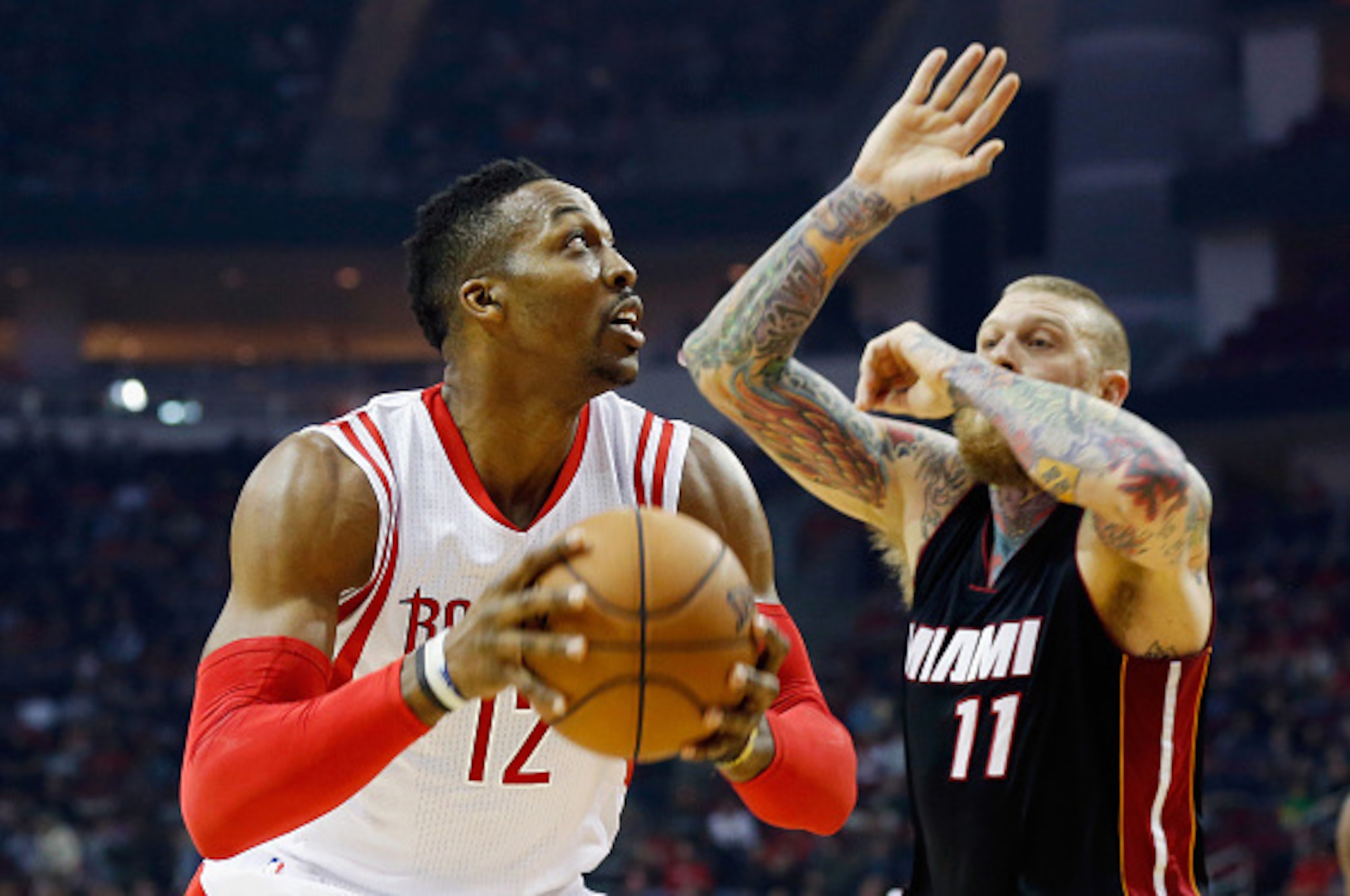
"The rule changes penalize big guys because they can get beat up on without getting fouls," said Kyler. "You see tons of contact in the paint. You see guys like DeMarcus Cousins and like Dwight Howard complaining to the officials because you can just basically mug the big guy whereas you can't breathe on the point guard."
In truth, the sport had long been destined for yet another decisive shift outward. Players were becoming faster and more athletic. They were arriving from overseas in greater numbers, infusing the NBA's stodgier brand of basketball with refreshing doses of passing, shooting and pick-and-roll proficiency.
The newer defensive rules afforded innovative coaches like former Phoenix Suns head man Mike D'Antoni the breathing room to unleash those more worldly, well-rounded athletes and turn the spread pick-and-roll into the NBA's pet set.
But the popularization of a more athletic, uptempo style didn't benefit everyone equally. While sharpshooters and speedsters flourished, many big guys—particularly those who weren't particularly fleet of foot—bore the brunt of all that running and jumping up and down the floor.

"It's tough on big guys. It's a physical grind," Kyler explained. "You've seen it kind of with Brook Lopez. His body's breaking down, his lower body, lower extremity injuries.
"I think that's something that's not talked about enough is, centers just generally, in the nature of being that big, aren't very durable."
Still, that hasn't stopped exceptionally tall kids from pursuing their hoop dreams. Nor has it deterred NBA front offices from spending precious resources (i.e. draft picks and salary-cap space) to acquire, develop and deploy them.
What is has done, though, is highlight perimeter play—and de-emphasize low-post proficiency—at the grassroots level, from whence the future of the NBA inevitably sprouts. For some of the older heads in basketball, this glorification of scorers and shooters has distracted and disincentivized players at the youth levels from learning the tricks of the trade that Olajuwon, Kareem Abdul-Jabbar and other frontcourt greats once mastered to devastating effect.
"If I was an old man, I would say it's just because it's not on SportsCenter. That's kind of the cheap answer," a scout who isn't affiliated with an NBA team told Bleacher Report. "It's not glamorous to have a post game. It's completely valuable, but everybody grows up and—like I said, I hate being the old guy here—they grow up watching three-pointers and dunks on TV and that's what you work on as a kid, unfortunately."
Compounding the problem for big men is the dire deficit of quality coaching for those who would be well suited to playing with their backs to the basket.
"They're playing against much smaller kids, so it's easier to be dominant," Kyler went on. "You go back and look at who Dwight Howard played in high school, there was no competition for him. He was the biggest kid on the floor every game. It tends to lend itself at that level to 'You're big and you're more dominant, therefore we don't have to teach you as much because we don't know how to teach you.'"
Where We Are Now
Fortunately for Okafor, his father, Chucky, worked diligently with his son to teach him how to play in the low post. Together, the Okafors would study tape of the greats, especially Olajuwon, to help turn Jahlil into the skilled interior scorer that he is today.
Most aspiring giants aren't so fortunate to have those sorts of mentors. That being said, there's still a decided advantage to being a seven-footer who can walk and chew gum at the same time, in the parlance of Jalen Rose, regardless of one's low-post skill or lack thereof.
Former Orlando Magic general manager Otis Smith once relayed this bit of wisdom to Kyler: "Look, it's pretty simple: The nature of the game is put the ball in the bucket, and the closer you are to the bucket, the easier it is to score. And big, tall guys are closer to the bucket."
There haven't always been that many big, tall guys with the exceptional ability to put the ball in the bucket. According to Basketball Reference, there have been 51 players listed at 6'10" or taller who have ever averaged more than 20 points per game in a given season, this year's partial results included. That's not many when considering that there are 450 roster spots in the NBA nowadays, and that thousands of players of all shapes and sizes have passed through the league since its inception in 1946.
As it happens, 16 of the 51 bigs who have registered at least one 20-point-average season are currently in the league in some capacity.
| Kevin Garnett | 24.2 | 2003-04 |
| Tim Duncan | 25.5 | 2001-02 |
| Dirk Nowitkzi | 26.6 | 2005-06 |
| Pau Gasol | 20.8 | 2006-07 |
| Andrea Bargnani | 21.4 | 2010-11 |
| Amar'e Stoudemire | 26 | 2004-05 |
| Dwight Howard | 22.9 | 2010-11 |
| Chris Bosh | 24 | 2009-10 |
| LaMarcus Aldridge | 23.2 | 2013-14 |
| Brook Lopez | 20.4 | 2010-11 |
| Kevin Love | 26.1 | 2013-14 |
| Blake Griffin | 24.1 | 2013-14 |
| Anthony Davis | 23.8 | 2014-15 |
| DeMarcus Cousins | 23.5 | 2014-15 |
| Al Jefferson | 23.1 | 2008-09 |
| Marc Gasol | 20 | 2014-15 |
And that's without including All-Stars and All-NBA performers like Joakim Noah, Roy Hibbert, Al Horford, Paul Millsap, Zach Randolph, Tyson Chandler, David Lee, Andrew Bogut and Carlos Boozer—some of whom measure under 6'10", others without a 20-point-per-game season on their respective resumes.
Perhaps, then, the NBA's big men aren't disappearing after all. For all the glory that point guards and high-scoring wings get, and for as many quality contributors as there are at those spots nowadays, the NBA may well be in the midst of a golden age of big men, even though so few play like their forebears once did.
What's changed is that there are so many different types of bigs filling various roles based on their respective skill sets. "In the NBA, you don't have five positions," said Ryan Blake, who works as a scouting consultant for the NBA and whose father, Marty Blake, was honored by the Hall of Fame for his work as a general manager and as the league's Director of Scouting. "You have anywhere between 10 and 17 different positions," depending on a given player's capabilities.
ESPN's Kevin Pelton and Jordan Brenner recently divvied up the NBA's bigs into eight designations based on specialties:
| Floor Stretchers | Dirk Nowitzki, Chris Bosh, Kevin Love |
| Finishers | Dwight Howard, Blake Griffin, Tyson Chandler |
| Post Scorers | DeMarcus Cousins, Al Jefferson, Pau Gasol |
| Facilitators | Marc Gasol, Joakim Noah, Andrew Bogut |
| Rim Protectors | Roy Hibbert, Anthony Davis, Serge Ibaka |
| Rebounders | DeAndre Jordan, Andre Drummond, Dwight Howard |
| Post Defenders | Marc Gasol, Tim Duncan, Zach Randolph |
| Mobile Defenders | Anthony Davis, DeAndre Jordan, Serge Ibaka |
This diversification of bigs hasn't left the league with many low-post purveyors, but from an efficiency standpoint, that might not be such a bad thing. Post-ups tend to yield tough, contested shots in the tricky 3-to-10-foot range for those on the block. According to Basketball Reference, the league as a whole is currently shooting 38.9 percent from that distance—the lowest percentage of any shot type inside the three-point line.
Where the post has always been valuable, and where it remains vitally so, is as a venue for the facilitation of an offense. "It's so important to have a great-passing big man," said Blake.
Where We're Going

It's possible, then, that the success of blue-chip bigs like Okafor and Towns at the next level will depend less on scoring and more on everything else, most notably passing and defending.
In Okafor's case, his advanced (and now unique) abilities in the low post could set him apart from the competition and allow him to be a difference-maker right away. Some scouts have likened Okafor's game to that of Al Jefferson, one of the NBA's foremost low-post maestros. Hence, all the talk about another Blue Devil going No. 1 overall.
But, like any modern-day big, Okafor can't and shouldn't be pigeonholed as a pure throwback. "Jahlil’s not a guy who really wants to grind it out in the post," Kyler said. "He can, but he has a nice little 12-foot, 13-foot jump shot and hook shot, and he's got a good running move across the lane."
A look through the prep ranks reveals that Okafor's arrival hardly portends a coming flood of kids reliant on drop steps and hook shots to do their damage. Most of the highly regarded high school bigs are long, lithe, live bodies who can run the floor and roll to the hoop, just as today's game demands.
The most hyped of them all—Thon Maker, currently in the high school class of 2016—is closer in style to a guard than he is to a center, despite his 7'1" frame. The development of Maker's peculiar skill set for his size was partly the result of his own choice but was also dictated by his exceedingly slender build.
"He said, 'I want to be like [Kevin] Durant, Kobe [Bryant] and [Kevin] Garnett combined,'" Edward Smith, Maker's coach and legal guardian, told Bleacher Report over the summer. "I was like, 'Whoa.' I said, 'Well, you have the body type.'
"If you learn the guard skills now, I can teach you the post skills later… He was too skinny to be a post player at that time, but he could be a big-ass guard and he could handle the ball."
Maker may well wind up at Kentucky, where Calipari has stockpiled a slew of potential draft picks in his frontcourt. Towns aside, the Wildcats figure to send Willie Cauley-Stein and Dakari Johnson to the pros at some point, and they could do the same with Marcus Lee.
Kentucky alone could have multiple bigs taken in the first round of a 2015 draft that's widely considered to be weak. Throw in Wisconsin's Frank Kaminsky, Louisville's Montrezl Harrell, Kansas' Cliff Alexander, Texas' Myles Turner, UNLV's Christian Wood and Latvia's Kristaps Porzingis, and it would hardly be a surprise to see a third of the NBA's guaranteed roster spots for rookies go to guys with the size to play down low.
The fact of the matter is that teams will always need good bigs, regardless of the game's ever-changing rules and trends. And since seven-footers are so much harder to find than six-foot point guards or 6'7" wings, those bigs with serious skills will always have plenty of value.
"If it comes down to a footrace between Emmanuel Mudiay and Jahlil Okafor, you're taking the big guy. You just are," Kyler insisted. "I think every team, unless they've already invested in a guy they believe is a franchise center, is probably going to take the center because it's a whole lot easier to find a guard than it is a really good center."
Just ask the Philadelphia 76ers, whose top prizes from each of the last two drafts have been centers with serious injuries: Nerlens Noel in 2013 and Joel Embiid this past June.
There's no guarantee that Noel and Embiid will lead the Sixers out of their self-inflicted slog. Nor can the franchises that end up drafting Okafor and Towns be assured that they'll have the next Boogie or Brow on their respective squads.
One thing is clear, though: The NBA has been and will likely always be a big man's league. Whether Okafor and Towns fit into that lineage or flop their way to the "bust" files will have as much to do with their ability to find a niche that suits them as it does with their development into the players they could become.
Not that the league's lineage of legendary big men—from George Mikan to Bill Russell and Wilt Chamberlain, to Kareem Abdul-Jabbar, to Olajuwon, O'Neal, Tim Duncan and beyond—needs any help sustaining itself for the foreseeable future. So long as Cousins is carrying the Sacramento Kings back to respectability and Davis continues to soar past a ceiling that might not actually exist, this particular torch should be in good hands.
All quotes obtained firsthand unless otherwise noted.
Josh Martin covers the NBA for Bleacher Report. Follow him on Twitter.

.jpg?w=2560 "Chiefs, Steelers Eye WR Trades")





.jpg?w=2560 "Raiders Sticking with Cousins")