Dreadful Offensive Line Will Destroy Washington Redskins' Season
The Washington Redskins offensive line remains a major liability, one that will destroy the team's chance for a winning season. The latest example of the Burgundy and Gold's inept blocking up front came during Week 5's 27-17 loss to the Seattle Seahawks.
It was a defeat that couldn't be laid at the feet of Kirk Cousins. He had a solid outing against Seattle's fearsome defense, passing for 283 yards and a pair of scores.
The loss can't even be blamed on the team's usually feeble defense. Despite having no plan for the scrambling of escape-artist Seahawks quarterback Russell Wilson (shame on you, Jim Haslett), the unit kept Seattle in check during the third quarter.
TOP NEWS
.jpg?w=2560 "NFL Paris Football")
NFL House in Paris Closes for Protests
.jpg?w=2560 "Seahawks Chiefs Football")
Trevon Diggs Cut by Seahawks
.jpg?w=2560)
B/R's Expert Week 7 NFL Picks 🔮
But Cousins' heroics and the brave rebound by the defense counted for nothing thanks to the dire O-line. The Redskins couldn't adequately protect Cousins and certainly failed to knock open any holes for normally prolific running back Alfred Morris.
He managed just 29 yards on 13 carries. That limp production was part of an overall rushing effort that accounted for just 32 yards.
Failures on the ground are becoming a pattern for a once-dominant Washington rushing attack that has been stuck in neutral in recent weeks. A look at the rapid decline in Morris' numbers since the start of this season proves it:
| Week | Game | Carries | Yards | Average |
| 1 | Away vs. Houston Texans | 14 | 91 | 6.5 |
| 2 | Home vs. Jacksonville Jaguars | 22 | 85 | 3.9 |
| 3 | Away vs. Philadelphia Eagles | 23 | 77 | 3.3 |
| 4 | Home vs. New York Giants | 12 | 63 | 5.3 |
| 5 | Home vs. Seattle Seahawks | 13 | 29 | 2.2 |
Not all of the blame should be put on the offensive line. Dubious play-calling is also at the root of this problem. There's no way Morris should be getting fewer than 15 carries in three out of five games.
Head coach Jay Gruden would likely point to his team facing big deficits early against both the New York Giants and the Seahawks as the reason for the lack of rushing attempts.
However, that's only half the story. Gruden has to learn to choose his moments to run. For instance, against the Seahawks, Gruden regularly chose to run against stacked fronts that featured three defensive tackles and rush linebacker Bruce Irvin.
Gruden also opted not to run against pressure fronts that put ends Michael Bennett and Cliff Avril together on the same side. That's just poor play selection within too rigid a system.
Gruden needs to re-examine what type of offense he wants. Yet even a change in play-calling will count for naught until the blocking improves.
Washington's linemen were routinely pushed around by the Seahawks. Defensive tackles Brandon Mebane, Kevin Williams and Tony McDaniel weren't moved off the ball all night by Washington's tiny tots up front.

Being greeted by a lineman as soon as he takes the handoff is something Morris is getting used to. The Redskins O-Line couldn't control Philadelphia's Fletcher Cox in a Week 3 loss.
The team's lightweight interior blockers are being manhandled too often. Deploying a small line is a tradeoff the team is willing to make to facilitate its zone-based blocking schemes.
The compensation is supposed to be the mobility to get to the second level and absorb linebackers. But the Redskins couldn't even get that right. Seattle's K.J. Wright and Bobby Wagner regularly outran or overpowered blockers to explode through gaps and dump Morris for losses.
Morris himself identified this a major issue, per Bob Condotta of The Seattle Times:
"They’re just very active. They were doing a good job of shedding blocks. They would shed guys and fall back into holes. It was definitely causing problems in the running game.
"
It was a complete, collective failure up front. The line wasn't helped by some horrible efforts from tight ends Niles Paul and Logan Paulsen.
The former in particular was easily swatted aside by Irvin on several occasions. With a line so weak, it's staggering Gruden and general manager Bruce Allen haven't recruited a natural blocking tight end.
As bad as they were blocking for the run, the Redskins hardly fared any better protecting the pass pocket. The Seahawks managed only one sack but put Cousins under duress all game.
Once again, failure to win individual matchups was a major issue. Avril found too much joy around the outside.
Morgan Moses and Tyler Polumbus both tried blocking him from right tackle, but neither looked at all convincing, as Jason Reid of The Washington Post pointed out:
Speaking of the right side, guard Chris Chester must be every interior pass-rusher's favorite opponent. Whenever Bennett slid inside, he simply ran through Chester as though the veteran lineman was a mirage.
This was a common problem last season, and it seems Chester is no less of a liability in 2014.
Just as Morris is getting used to being met by packs of swarming defenders in the backfield, throwing with a rusher in his face is becoming a familiar reality for Cousins.
The Giants were all over him in Week 4. Judging by Week 5, Cousins had better develop some Wilson-style escape skills if he's going to survive.

However, the truth is that few quarterbacks could survive behind this offensive line. All of the failings up front are inevitable when a team returns four of five starters from what was already a poor group.
Yet that's just what Allen and Gruden did. Their two third-round picks, Moses and guard Spencer Long, haven't made the grade.
They were supposed to regenerate a weak position but instead couldn't beat out Polumbus and Chester. That doesn't say anything good about how this team scouts linemen.
The truth is that Washington hasn't devoted enough of its resources to the O-line and is now paying the price. The Chicago Bears had a weak group for years but wasted no time adding four new starters last season.
Look at the benefits the Dallas Cowboys are reaping from spending several high draft picks on blockers such as Zack Martin, Tyron Smith and Travis Frederick. That line is paving the way for the NFL's second-ranked ground game and allowing Tony Romo (yes, THAT Tony Romo) to quarterback a 4-1 team.
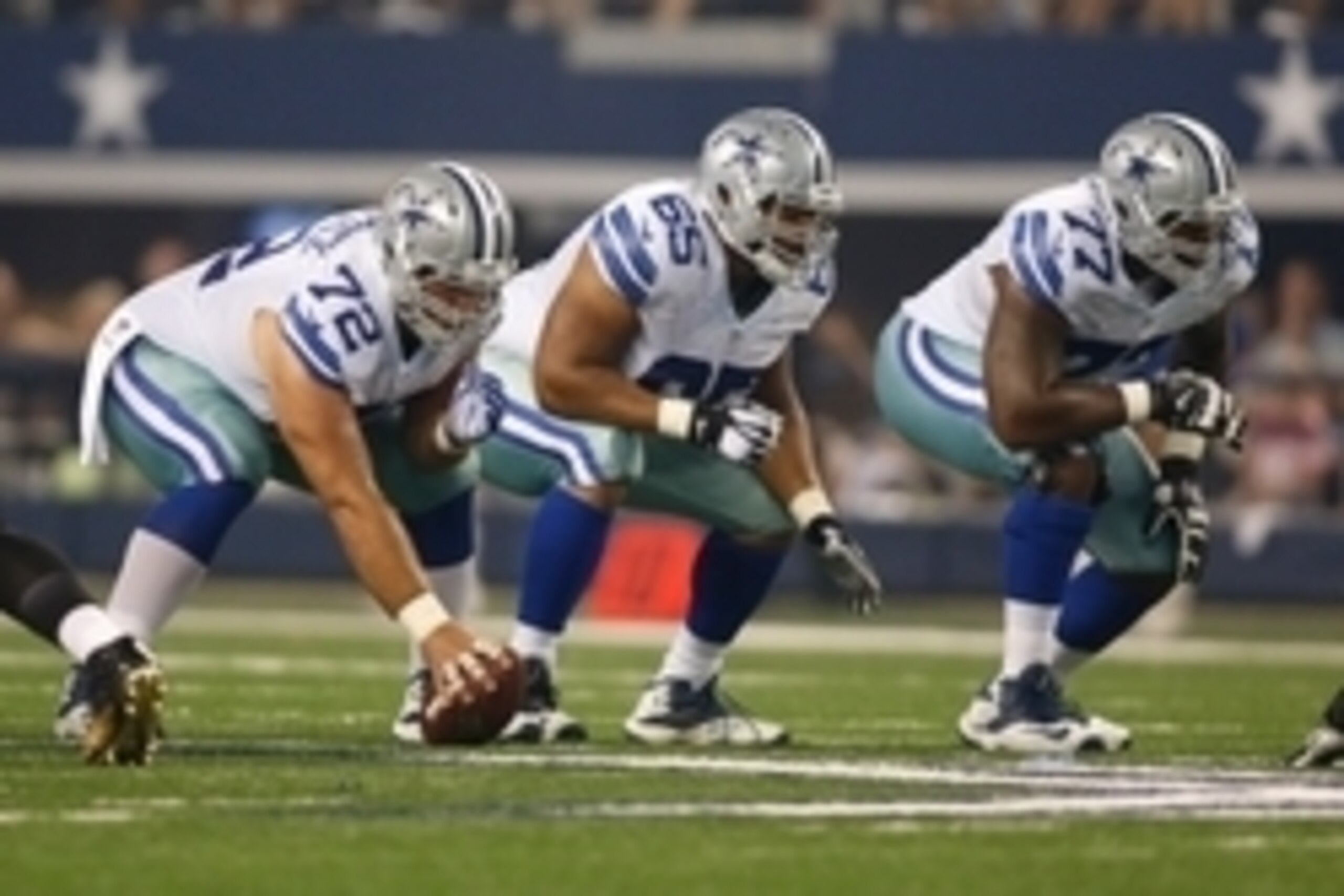
Meanwhile, as Long and Moses join Josh LeRibeus on the list of recent draft failures, and free-agent flops like Chester continue to flounder, the Redskins are staring at a 1-4 start.
Given how bad this line is, that record is likely to get a lot worse. Next week, the Redskins face the Arizona Cardinals, owners of a stingy and powerful run front.
If Gruden's blockers can't win inside, Morris will again be stopped and Cousins will be at the mercy of pressure. Center Kory Lichtensteiger had certainly better improve his blitz recognition before he faces a Todd Bowles-coordinated defense.
But the Cardinals aren't the only problem looming for this beleaguered front five. There's also the San Francisco 49ers and rough-and-tumble D-tackle Justin Smith to worry about.
Then there's the St. Louis Rams and lightning-fast edge-rusher Robert Quinn to contend with. The Redskins also shouldn't be in any hurry to see the Giants and their deep stable of talented pass-rushers again.
With this schedule, it's going to be a long season for the players who try to make a living behind Washington's offensive line. That's a real shame for a team boasting a stellar back like Morris and receivers as good as Andre Roberts, Pierre Garcon and DeSean Jackson.
Today's rules may be geared toward protecting quarterbacks and helping skill players thrive, but football is still won in the trenches. Without a credible line, all the toys in the toy store aren't going to help Washington put up enough points to consistently win games.
All statistics via NFL.com.
.jpg?w=2560 "Titans Colts Football")