

Why the Raiders Could Be Forced to Trade Up in 1st Round of 2014 NFL Draft
No one really knows what the Oakland Raiders are going to do with the fifth overall pick. Everyone probably knows what general manager Reggie McKenzie would like to do and that’s draft linebacker Khalil Mack, wide receiver Sammy Watkins or defensive end Jadeveon Clowney.
Every team would love to land one of the top few players on its draft board, but that’s not always realistic. It’s becoming clearer every day that the players the Raiders want are not going to fall to No. 5 barring some kind of miracle.
That leaves the Raiders three options: stay at No. 5 and take the best player they can, trade down to get more picks or trade up to get the player they want. Virtually no one expects the Raiders to step through door No. 3, even though that very well could be their best option.
TOP NEWS
Contenders starting to separate themselves after Week 7
.jpg?w=2560 "Rams Raiders Football")
Raiders Could Start Mendoza

Geno Explains Wilson Exchange
Would trading up be out of character for McKenzie? There is no doubt that it would be, but McKenzie has also never been in this exact situation before. The stars could also align in such a way that McKenzie would be crazy not to consider it.
There are no built-in excuses for the Oakland Raiders in 2014. McKenzie can’t blame the salary cap or a lack of draft picks for the lack of talent on the roster. Head coach Dennis Allen can’t blame the lack of talent for his team not being competitive.
If the team doesn’t perform, owner Mark Davis may decide McKenzie and Allen are to blame. There is no guarantee that McKenzie or Allen will return in 2015 if they don’t turn things around.
Trade Down, Just Not at No. 5
When McKenzie was with the Green Bay Packers, the highest they ever drafted was No. 5 overall in 2006. That just so happens to be the same pick the Raiders have in 2014, but the situations couldn’t be more different.
The Packers replaced head coach Mike Sherman with Mike McCarthy that offseason in what was also Ted Thompson’s second year as general manager. The front office was at no risk of losing their jobs if the team didn’t perform the following year.
What did the Packers do with the No. 5 pick in 2006? They selected linebacker A.J. Hawk, who is a decent player even if he never lived up to his lofty draft status.
The Packers didn’t trade up or down, but they didn’t need to because 2005 was their first losing season in 13 years. If the Raiders don’t win nine games in 2014, it will be their 13th season at or below .500.
The 2006 NFL draft was similar to the 2014 NFL draft in some ways. The first five picks in 2006 included a defensive end, quarterback, offensive tackle and linebacker. There’s a very good chance the same four positions are drafted early in 2014.
Running back Reggie Bush went No. 2 overall in 2006, but if you simply exchange one offensive playmaker for another, it’s not hard to imagine the top five positions drafted in 2014 being exactly the same. The NFL has shifted away from running backs in the first round, but wide receivers like Watkins are now hot commodities.
| 5 | A.J. Hawk | 104 | Cory Rodgers |
| 36 | Traded for 52, 75 | 109* | Traded for 115, 185 |
| Javon Walker | Traded for 37 | 115* | Will Blackmon |
| 37*, 139 | Traded for 47,93,148 | 148* | Ingle Martin |
| 47* | Darryn Colledge | 165 (Comp.) | Tony Mol |
| 52* | Greg Jennings | 174**+ Mike McKenzie | Nick Collins (51st overall - 2005) |
| 67 | Adbul Hodge | 183* | Johnny Jolly |
| 75* | Jason Spitz | 185* | Tyrone Carter |
| 93* | Traded for 109, 183 | 212** | Brad Bedell (206th overall - 2000) |
| *Pick Acquired During the Draft | ** Pre-Draft Trade | 253 (Comp.) | Dave Tollefson |
The Packers ended up with 12 picks in 2006 including two in the second, third, fourth, five and sixth rounds. The Packers started with their original seven picks and two non-tradable compensatory selections. They did all of this without trading the fifth overall pick.
How did the Packers do it? First, they traded wide receiver Javon Walker to the Denver Broncos for a second-round pick. Walker was coming off a year in which he played just one game. Then, the Packers traded down four times, including twice in the second round alone.
The Raiders have a very expendable wide receiver in Denarius Moore, who they could dangle in a trade for more picks, plus plenty of room to trade down in each round. It’s a deep draft, so moving down in the middle rounds has the potential for a big payoff.
Why Moving Up Makes Sense
The Packers chose to stay at No. 5 in 2006, which was a good move for them at the time. Had they tried to move up, it likely would have cost them the ability to convert one of their two second-round picks into more draft picks.
In the case of the Raiders, staying put may not be a good move. The Raiders need a franchise-altering type of player and not just a solid contributor like Hawk. Maybe the Raiders will get lucky and find that player at No. 5 or later in the draft, but teams typically make their own luck in the NFL draft.

Jobs in Oakland may be riding on finding an instant star in the 2014 NFL draft. When a team believes a franchise-altering player is available, it would be silly not to consider moving up to get him.
Joey Clinkscales—now the director of player personnel in Oakland—was the vice president of college scouting for the New York Jets when they moved from No. 17 to No. 5 to select quarterback Mark Sanchez.
While the trade up for Sanchez didn’t pan out, it does suggest that something like that could happen in Oakland in 2014. At the time, the Jets believed Sanchez was going to be a franchise quarterback.
The Jets gave up their second-round pick to move up 12 spots, and the trade value chart popularized by Jimmy Johnson suggests the Raiders would have to give up their second-round pick to move into the top three with the possibility they could also get a fifth-round pick back as part of the deal.
Last season, the Miami Dolphins gave the Raiders a second-round pick to go from No. 12 to No. 3 overall, but the Raiders wouldn’t be going as far up the board. There also may be a bidding war this season, whereas the Raiders couldn’t find any other takers last season in a weaker draft.
| 2013 | Dolphins | 3 | Dion Jordan | Raiders | 12, 42 | D.J. Hayden, Menelik Watson |
| 2012 | Redskins | 2 | Robert Griffin III | Rams | 6, 39, 22 (2013), 2 (2014) | Michael Brockers, Janoris Jenkins, Alec Ogletree |
| 2012 | Browns | 3 | Trent Richardson | Vikings | 4, 118, 139, 211 | Matt Kalil |
In 2012, the Cleveland Browns moved up one spot from No. 4 to No. 3 for the right to draft running back Trent Richardson. The Browns surrendered picks in the fourth, fifth and seventh rounds to make the deal happen.
When teams decide to trade down, it’s not just the picks they get in return. Teams in the top five of the draft are often in need of elite players, so when they drop down they need to make sure they can still get the player they want.
A perfect example of this was the Raiders last season. McKenzie knew he could get cornerback D.J. Hayden much lower than No. 3 overall, so he was willing to move down to a point where he still had a very reasonable shot to draft him.
Finding a Trade Partner
The St. Louis Rams sitting at No. 2 overall would be ideal trade partners for the Raiders. The Rams were 7-9 and drafted a wide receiver at No. 8 last year. In addition, the Rams have two good pass-rushers already on the roster.
The Rams can afford to trade down without issue because they don’t need a 4-3 outside linebacker like Mack. The Rams could use a wide receiver like Watkins, but not as much as an offensive tackle, which they can still get at No. 5.
From the perspective of the Rams, it makes a lot of sense to move down and add a few more draft picks. The Rams might even take Moore and a mid-round pick from the Raiders, which would also address their need for another wide receiver.
If the Rams were planning on taking offensive tackle Greg Robinson at No. 2, why not drop down to No. 5 to get him? Sitting at No. 3 are the Jacksonville Jaguars who drafted offensive tackle Luke Joeckel at No. 2 overall last year. At No. 4, the Cleveland Browns have Joe Thomas at left tackle—probably the best left tackle in the entire league.
Both the Jaguars and the Browns also use a zone-blocking scheme that may not be a good fit for Robinson early in his career. While it’s possible Robinson could still go off the board before the Rams pick at No. 5, the risk is small.
Even if it did happen, the Rams could draft offensive tackle Jake Matthews, who is the son of Hall of Fame offensive guard Bruce Matthews. The elder Matthews played for Rams head coach Jeff Fisher in Tennessee for many years.
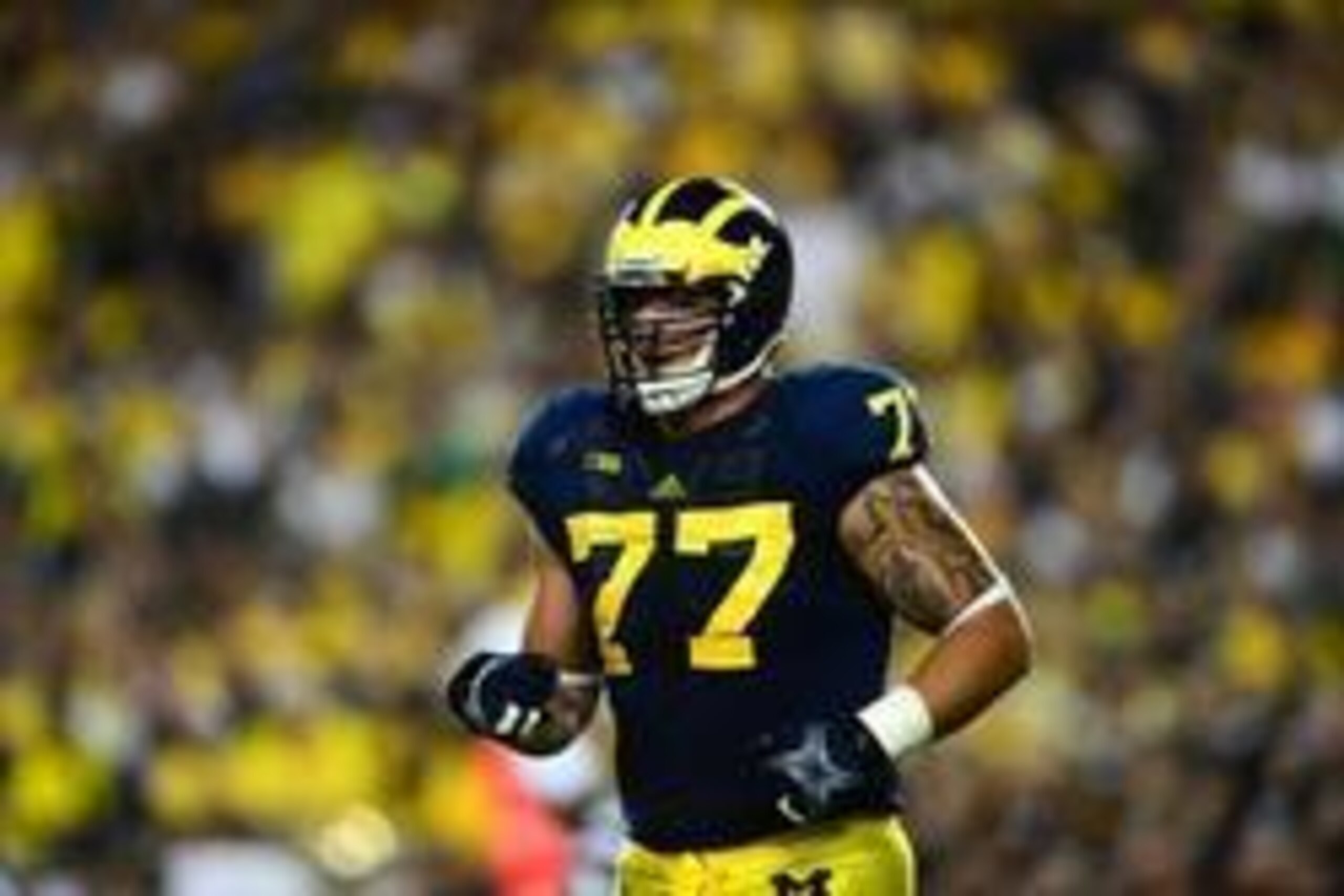
Another option for the Rams would be former Michigan left tackle Taylor Lewan who is like a clone of current Rams offensive tackle Jake Long. ESPN’s Mel Kiper Jr. recently said via MLive.com that he doesn’t think Lewan will make it past the Atlanta Falcons at No. 6 overall.
Conclusion
While it flies in the face of what everyone believes McKenzie will do, the Raiders trading up to No. 2 makes a lot of sense. When compared with staying at No. 5 or trading down in the first, it actually seems preferable.
While trading down sounds like a good plan, it also takes a willing trade partner. If no teams want to move up for a quarterback, chances are the Raiders aren’t going to see the kind of return on a tradedown that they want.
With the way the talent falls in this draft, the Raiders are in a tough spot. McKenzie has the power to turn things around, but he’s going to have to be more aggressive than he has in the past.
.jpg?w=2560 "Steelers Saints Football")



.jpg?w=2560 "🚨 Week 8 AP Top 25 Poll")
