NBA Metrics 101: How LeBron, Giannis Should Draft All-Stars, by the Numbers
When LeBron James and Giannis Antetokounmpo actually draft the All-Star teams that will compete in New Orleans, they'll take plenty of different factors into account.
Maybe pure production matters, but only if it comes wrapped in an entertaining package. Personal relationships could play into the order, as could James' desire to lure some Eastern and Western Conference representatives into a Los Angeles Lakers uniform.
But what if only the numbers determined the draft order?
Along with Bleacher Report's Dan Favale, I've already completed a mock draft taking all of the above (and more) into account. But now, let's remain purely objective and see what would happen if we divvied up the starters and reserves according to pure, unadulterated math.
To objectively determine the order, we'll turn to a composite metric called player score that's built from a number of different catch-all metrics: minutes played (to credit those who filled big roles and stayed healthy), total points added, box plus/minus, win shares, win shares per 48 minutes, real plus-minus and RPM wins. That gives us a healthy blend of different calculations, some favoring volume and others efficiency. By finding the z-scores for every player in each category and summing those results, we can arrive at the numbers you'll see listed parenthetically throughout this article.
Player score is all that matters, but remember our intention: We're looking at the selection order purely from a value standpoint, intentionally eschewing the entertainment factor that won't be ignored in reality.
Editor's note: The 2019 All-Star draft will be aired 7pm et Thursday, Feb. 7, on TNT.
1-2: James Harden and Paul George
1 of 8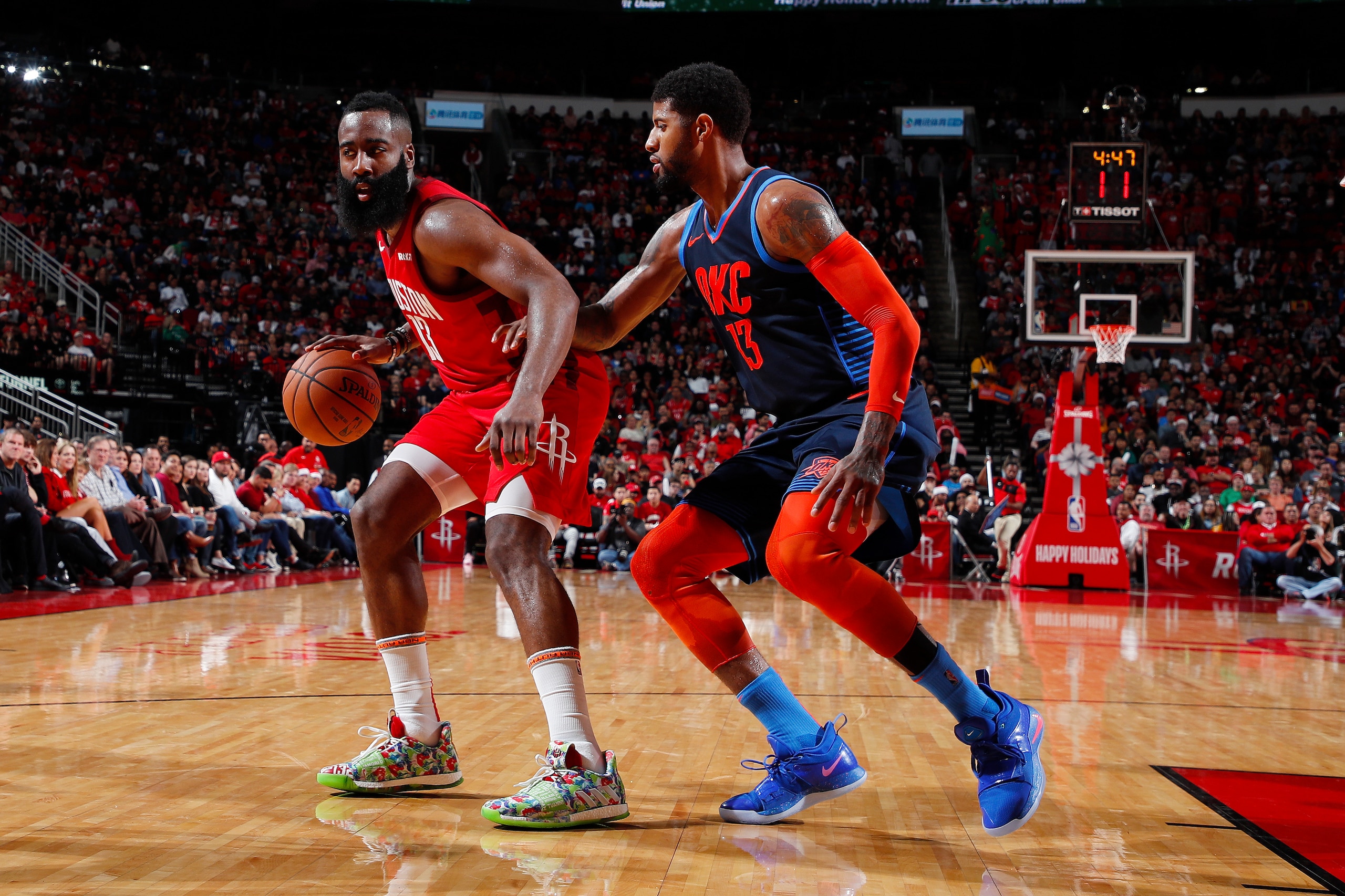
No. 1 Pick (Team LeBron): James Harden, Houston Rockets (25.7)
Whether you have Antetokounmpo or James Harden leading the MVP charge midway through the 2018-19 campaign, only one of them is available with the first pick. Since the former is doing the selecting at No. 2, a certain bearded guard has to be the top selection.
Sure, Harden's style can rub some the wrong way. He dribbles the ball into oblivion on a number of possessions, racking up more shots per game off seven-plus dribbles (13.2) than every team but the Charlotte Hornets (14.4) and Portland Trail Blazers (13.8). He also unabashedly seeks to draw contact, leading to a seemingly endless parade of free-throw attempts.
The methodology still works, leading to a season full of historic offensive numbers while he continues to play adequate defense (minus-0.01 in defensive real plus-minus) and keep the injury-plagued Houston Rockets alive in the battle for home-court advantage during the first round of the playoffs. So much of what he does is out of sheer necessity, which makes it all the more impressive he's in the 98th percentile (relative to position) for points per shot attempt, per Cleaning the Glass, and posting the second-highest qualified usage rate in league history.
No. 2 Pick (Team Giannis): Paul George, Oklahoma City Thunder (20.8)
Paul George has been that good.
It's George (12.1), not Harden (11.6), who leads the field in RPM wins. It's George, not Harden, who helps improve the Oklahoma City Thunder by a rotation-best 20.7 points per 100 possessions when he's on the floor (Harden boosts the Rockets by 2.6).
So while his lack of extreme box score statistics prevents him from earning the top position in our composite metric, he's still No. 3 overall, trailing only Team LeBron's initial selection and the man who'll kick off the reserves. (For reference, Antetokounmpo and James rank Nos. 4 and 14, respectively). That's nothing to feel ashamed about for a man who has continued to wreak havoc in off-ball defensive situations (No. 2 in deflections per game with 3.7 and No. 1 in steals per game with 2.3) while taking on a remarkable scoring burden during his second season with the Thunder.
George isn't just averaging a career-best 27.8 points per game. He's doing so while shooting 45.2 percent from the field, knocking down 40.6 percent of his whopping 9.1 triples per contest and connecting from the stripe at an 82.8 percent clip.
3-4: Kevin Durant and Kyrie Irving
2 of 8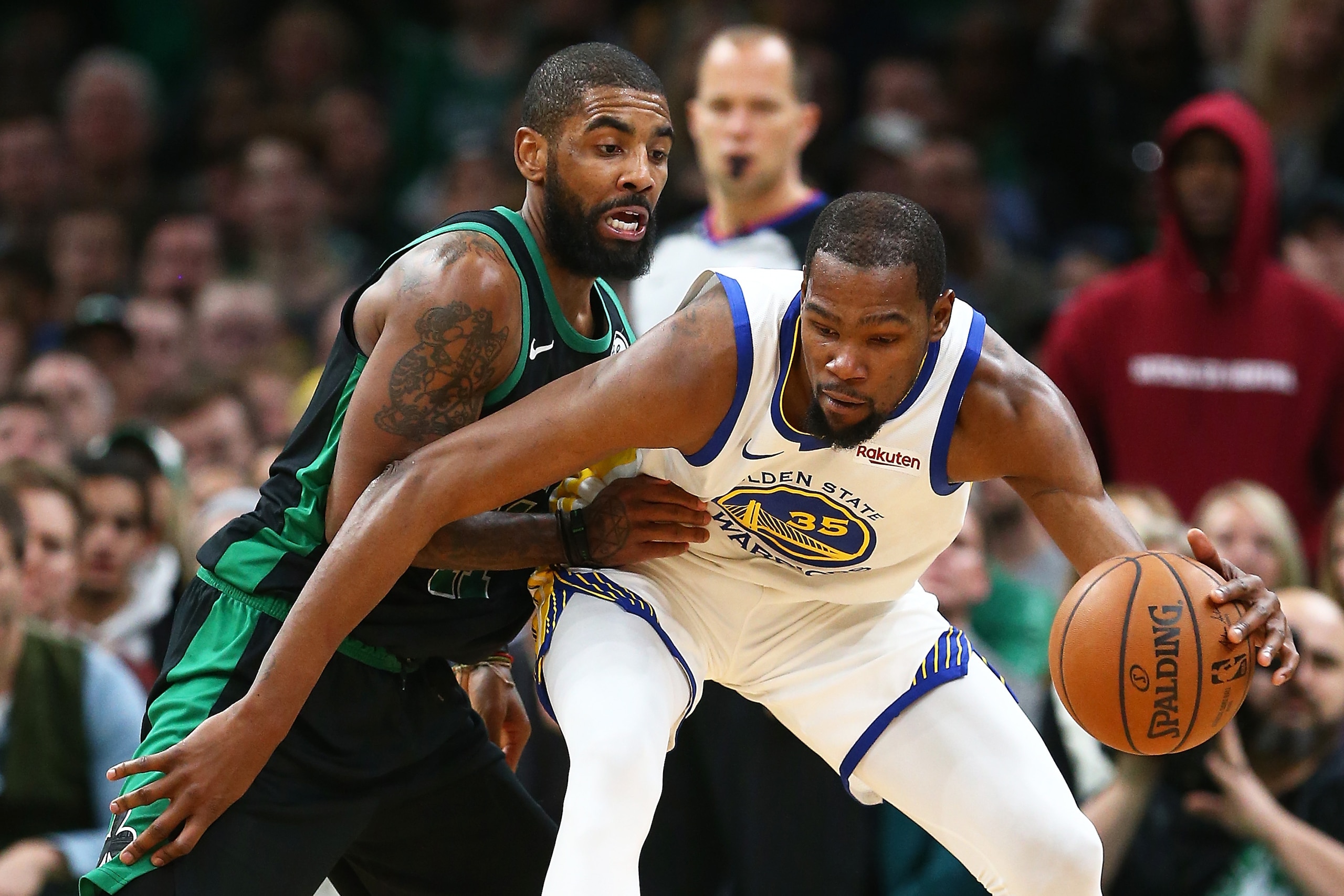
No. 3 Pick (Team LeBron): Kevin Durant, Golden State Warriors (16.6)
Update: Kevin Durant can still score the basketball.
He's averaging 27.5 points for the Golden State Warriors with a 62.1 true shooting percentage, so he's one of only eight qualified players in league history to hit those arbitrary but astronomical benchmarks:
- Adrian Dantley (five times)
- Kevin Durant (four)
- Charles Barkley (two)
- Stephen Curry (two)
- James Harden
- LeBron James
- Karl Malone
- Isaiah Thomas
But Durant is by no means just a scorer. He's also finding himself more involved in the Dubs' playmaking schemes than ever before, as his 26.3 assist percentage is the second-highest mark of his career, behind only his 2013-14 effort for the Thunder (26.7). Now, let's whittle down that previous list to see which players could also match this offensive sensation's passing numbers:
- Kevin Durant (twice)
- Stephen Curry
- James Harden
- LeBron James
- Isaiah Thomas
Durant is pretty good at this whole offense thing.
No. 4 Pick (Team Giannis): Kyrie Irving, Boston Celtics (16.2)
Let's not focus on Kyrie Irving's scoring, since we know he can keep the ball on a string and pull off a plethora of playground tricks that leave his adversaries grasping at empty space before they watch as he swishes the rock through nylon.
Last year, the narrative rang loud and clear: This Duke product had improved his facilitating and defensive chops during his first season under Boston Celtics head coach Brad Stevens. But the improvements were mostly marginal ones.
This year, however, he's taken major strides on each end of the floor, upping his assist percentage from 30.7 to 36.1 while boosting his DRPM from minus-1.35 to 0.85. The alleged leap the prior season had pushed those numbers from 29.7 and -2.30.
This is finally the MVP-caliber version of Irving for which the whole round Earth has been waiting—the one who can carry his troops on both ends of the floor, taking advantage of any cracks in the opposition's stratagems while functioning as Boston's unquestioned on-court leader.
5-6: Stephen Curry and Joel Embiid
3 of 8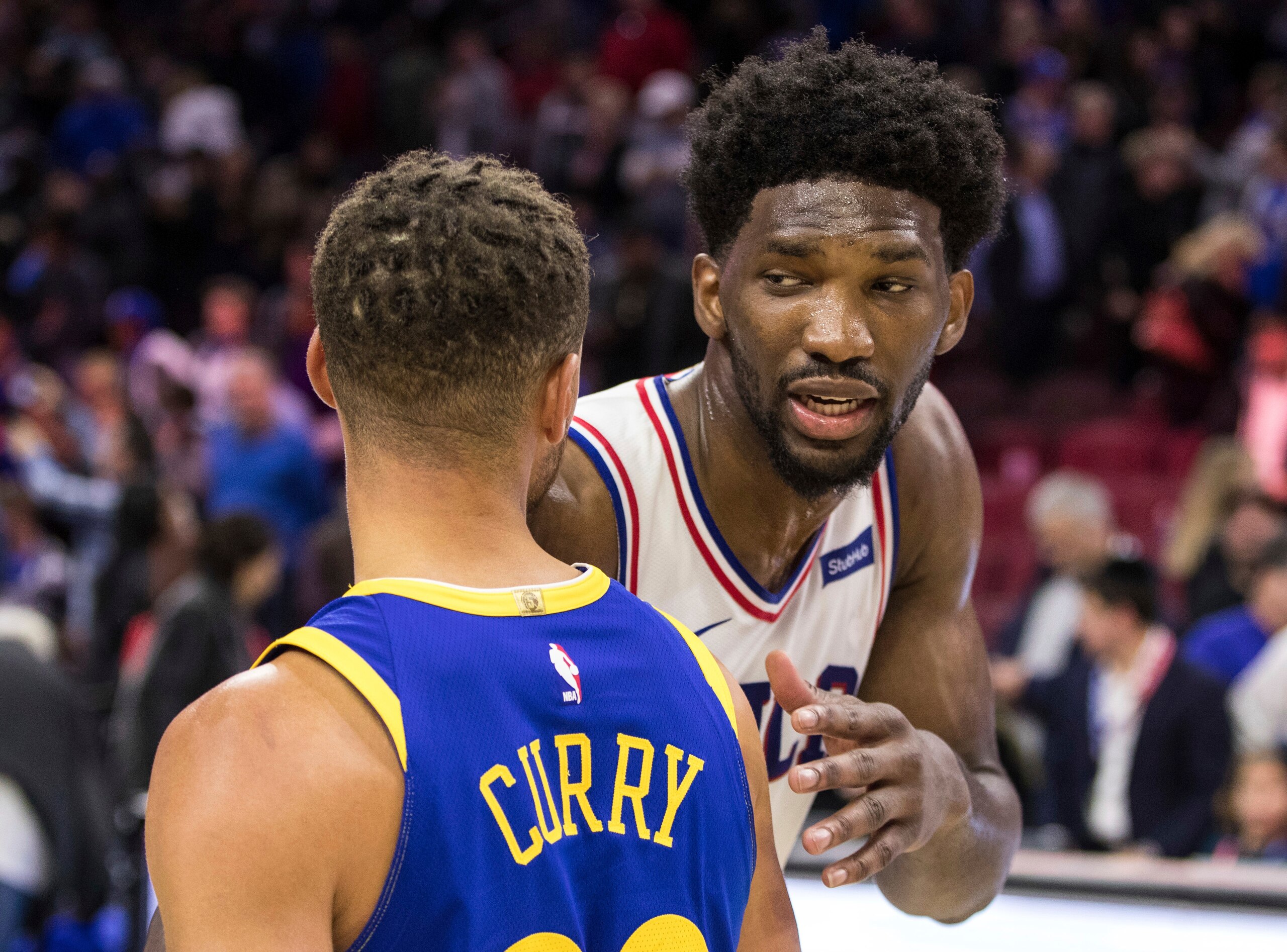
No. 5 Pick (Team LeBron): Stephen Curry, Golden State Warriors (16.1)
Though it may seem weird for Curry to come off the board after four other players (including Irving), keep in mind we're intentionally rewarding objective production during the 2018-19 campaign. Minutes played are a factor because availability matters, and that doesn't favor the Warriors floor general who's missed 11 games and ranks just 84th in the category.
That said, Curry has still been undeniably excellent when healthy, averaging 29.2 points, 5.1 rebounds and 5.3 assists while slashing 49.3/45.1/92.3.
But here's the fun part, potentially overshadowing the impressiveness of coming close to both the 30-points-per-game threshold and the 50/40/90 club: This point guard, already firmly established as the greatest distance shooter in NBA history, is having arguably his best season yet from beyond the rainbow. That 45.1 percent comes while he takes a mind-numbing 11.6 three-point attempts per game.
If Curry somehow got zero points for any shots he took inside the arc, he'd still be averaging 15.7 points per game—enough to rank 61st among qualified scorers.
No. 6 Pick (Team Giannis): Joel Embiid, Philadelphia 76ers (13.2)
Sure, Joel Embiid can handle the ball all over the half-court set. He can knock down the occasional spot-up triple from the top of the key, shoot over the top of an engaged defender with his devastating face-up game or torture foes in the post.
But the most terrifying element of his arsenal remains his defense.
Only All-Star snub Rudy Gobert, whose 19.0 score in our composite metric landed sixth overall, rivals Embiid as an interior defender. The Philadelphia 76ers big man is one of those players who doesn't just swat fruitless attempts and alter countless shots, but he also actively deters players from even thinking about testing him. Entertaining those thoughts is often closely followed by cold sweats.
Even though Philadelphia plays a switch-heavy style that leaves Embiid showing off his lateral quickness on the perimeter, not a single player is contesting more attempts per game at the rim than this center (7.8). Better still, he's holding opponents to 54.7 percent shooting in those situations, which means he is one of only 10 men to appear in 30 games, face at least four shots per contest and hold his opponents' field-goal percentage south of 55 percent.


7-8: Kawhi Leonard and Kemba Walker
4 of 8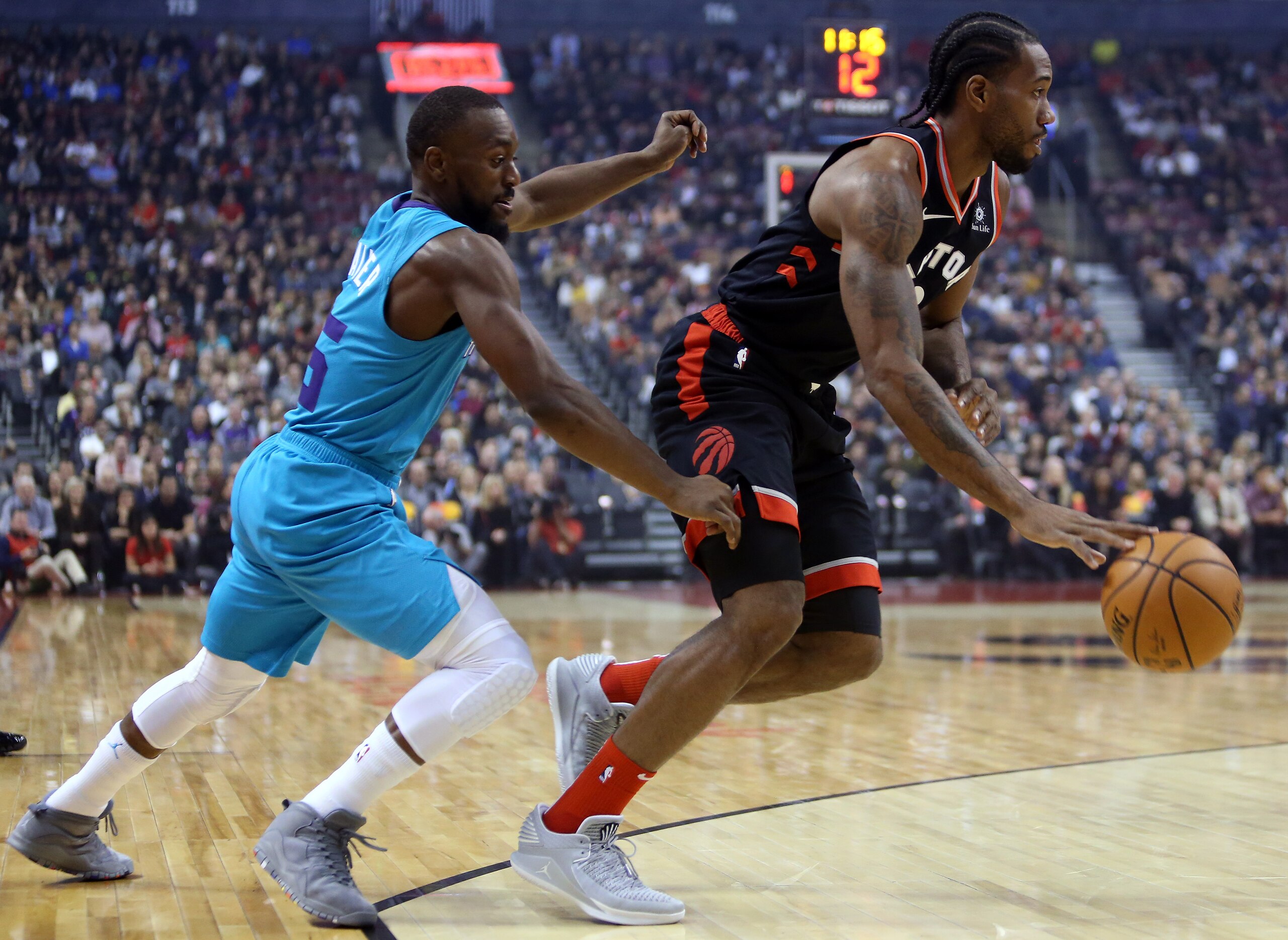
No. 7 Pick (Team LeBron): Kawhi Leonard, Toronto Raptors (12.6)
Kawhi Leonard is one of those players for whom the eye test and metrics don't agree.
Watch him play for the Toronto Raptors, and he's quite obviously an impactful defender who uses his quick instincts, fundamental understanding of point-preventing play and oversize hands to wreak havoc in any and all situations. But the numbers don't bear that out, perhaps because opponents actively avoid testing him and prefer to instead pick on weaker defenders.
Somehow, Leonard ranks just 42nd among small forwards in DRPM with a score of minus-0.07. Yes, that's a negative number. He also has a 0.9 defensive box plus/minus (marginally positive), and the Raptors allow 4.9 fewer points per 100 possessions when he isn't playing—the worst swing of any rotation member. Those metrics peg him as either a defensive detriment or a relative non-factor, even if that's obviously not an accurate snapshot of his skills on the less glamorous end.
In other words, consider this the floor for an objective evaluation of his game. Were he given proper credit for his defensive prowess, his score would only go up, potentially boosting him even higher in this selection process.
No. 8 Pick (Team Giannis): Kemba Walker, Charlotte Hornets (9.8)
Our numbers suggest Kemba Walker, despite his obvious importance to the Hornets, is a questionable All-Star inclusion who definitely shouldn't be among the first eight players off the board. His score of 9.8 in our composite metric placed him 29th overall, sandwiched between Montrezl Harrell, Marc Gasol, Tobias Harris and Luka Doncic.
But Walker has to be taken at No. 8 because he was voted in as a starter for the weaker East, and the starters must be selected before the reserves can join the two rosters.
Team Giannis has no choice.
Of course, we don't want to make it seem like Walker is having a bad season. He's not, even if his sub-standard 55.8 true shooting percentage makes him more of an inefficient gunner than an alpha-dog scorer in the Queen City. Given his takeover instincts for a franchise that needs a scoring punch, his playmaking for a relatively lackluster set of teammates and his underrated ability to defend without fouling (100th percentile relative to position in foul percentage, per Cleaning the Glass), he'd still be an asset to Antetokounmpo's squad.
9-12: Jokic, Davis, Lillard, Towns
5 of 8
No. 9 Pick (Team Giannis): Nikola Jokic, Denver Nuggets (20.9)
Note: Team Giannis gets the first pick of the second round.
Nikola Jokic, who boasts the best score in our composite metric of any player not named James Harden, has arrived—not just as a first-time All-Star who deserved the honor in previous seasons but also as a bona fide MVP candidate leading one of the West's deadliest teams while serving as a closer in crunch-time situations.
Accordingly, the MVP Award tracker, which is entirely objective and uses previous results to inform the model, places him third in the competition for the league's most prestigious accolade, behind only Antetokounmpo and Harden. That's what happens when Jokic's uber-efficient brand of offensive basketball, understated defensive solidity and knack for consistently elevating his teammates lead to both a sterling set of individual numbers and a veritable horde of victories in the Mile High City.
No. 10 Pick (Team LeBron): Anthony Davis, New Orleans Pelicans (20.4)
The balky index finger that's kept Anthony Davis sidelined since he logged 36 minutes in a Jan. 18 loss to the Blazers has also prevented the New Orleans Pelicans superstar (let's use that descriptor while it still applies) from earning an even higher score and jumping past George in the overall rankings. Jokic would remain the top reserve in either conference if we eliminated minutes played from our composite metric, but Davis would go from No. 5 to No. 4.
Either way, it's beyond obvious he's worthy of top billing.
Davis' contributions haven't necessarily made New Orleans a playoff squad (though it's worth noting the Pelicans have the league's 13th-best net rating and have been 7.6 points per 100 possessions better when he plays, which is indicative of underachievement), but they are massive and far-reaching. Name a facet of the game, and this unibrowed frontcourt standout can likely excel in it.
No. 11 Pick (Team Giannis): Damian Lillard, Portland Trail Blazers (15.67)
Damian Lillard remains a pull-up maestro.
Shooting 41.7 percent on his off-the-bounce field goals and 36.9 percent on the ones that come from beyond the arc, this Rip City floor general is taking 9.1 qualified shots per contest, which ranks behind only Harden (14.0), Durant (9.7), Walker (9.6) and Leonard (9.5). But thanks to the frequency with which he pulls up from outside the rainbow, he ranks third within the quintet in effective field-goal percentage.
In fact, Lillard is one of only 10 players to appear in at least 40 contests and maintain an effective pull-up field-goal percentage north of 51 while taking no fewer than five such shots per contest. This isn't an easy category for balancing volume and efficiency, but he's continuing to take and make the tough shots that spark the Portland offense.
No. 12 Pick (Team LeBron): Karl-Anthony Towns, Minnesota Timberwolves (15.66)
Particularly since the trade that sent Jimmy Butler to the 76ers and freed up Karl-Anthony Towns to operate, with regained confidence, as the No. 1 option for the Minnesota Timberwolves, this big man has continued to prove he's a generational offensive talent. Few players with his size can blend inside and outside scoring so seamlessly.
But somewhat quietly, Towns has started to turn his biggest weakness into a strength. Take a gander at his progression in DRPM:
- 2015-16: minus-0.22 (40th among 48 qualified centers)
- 2016-17: minus-1.41 (53rd among 53)
- 2017-18: 0.44 (50th among 62)
- 2018-19: 1.36 (36th among 67)
Towns might never become an imposing force who can anchor a top-flight defense, but eliminating a weakness has gone a long way for his overall profile.
13-18: Vucevic, Griffin, Simmons, Westbrook, Lowry, Aldridge
6 of 8
No. 13 Pick (Team Giannis): Nikola Vucevic, Orlando Magic (15.0)
Even if Nikola Vucevic doesn't have the glamorous game that might lend itself to higher placement in an All-Star draft, the numbers make it clear he's earned his celestial status during a breakout season for the Orlando Magic. The big man had reached this lofty level before (early in the 2017-18 campaign), but he's now sustaining it, tormenting foes with effective offense from all over the half-court set.
Somehow, Vucevic is hitting 37.8 percent of his triples, 44.4 percent of his two-pointers from at least 16 feet, 39.7 percent of his 10-16-foot jumpers, 52.3 percent of his 3-10-foot looks and 73.6 percent of his takes at the basket. There are just no weaknesses.
No. 14 Pick (Team LeBron): Blake Griffin, Detroit Pistons (12.4)
Russell Westbrook doesn't lead the NBA in touches per game. Neither does Harden. That honor belongs to Blake Griffin, who has meant everything to a struggling Detroit Pistons squad in need of a consistent rudder.
Watch the Motor City representatives for even a brief period, and you'll see for yourself. Griffin is more comfortable operating on the perimeter than ever before, showing off his through-the-legs dribbles while sizing up any and all defenders and cooly earning his own paint touches rather than waiting for entry passes from his lackluster backcourt. Not only does he pace the Pistons in scoring (9.6 more points per game than second-place Andre Drummond), but he's also leading the team in assists (1.0 more dime per game than second-place Reggie Jackson).
No. 15 Pick (Team Giannis): Ben Simmons, Philadelphia 76ers (11.9)
Ben Simmons can't shoot three-pointers. He's never made one during his two-year NBA career. He's also a struggling shooter from the stripe, hitting on only 58.7 percent of his 5.5 tries per game. But despite those glaring flaws, which lead to defenders sagging off and playing him a bit more aggressively on the interior, he's so damn good at finishing that he remains an efficient scorer.
Buoyed by his 71.8 percent shooting within three feet, an area from which he takes 57.2 percent of his field-goal attempts, Simmons scores his 16.9 points per game with a 59.1 true shooting percentage. He may not be a primary scorer, but only 19 qualified men are matching that combination of figures.
No. 16 Pick (Team LeBron): Russell Westbrook, Oklahoma City Thunder (10.7)
Simmons can't shoot, and he doesn't shoot. Westbrook can't shoot, but he keeps firing away with reckless abandon during a season in which he's slashing a putrid 41.8/25.0/64.4. That inaccuracy is keeping him from ascending back into the lofty territory he's occupied in previous seasons, but he's at least remaining valuable to the Thunder with his ability to contribute in all other areas.
His defensive aggression (sure, he's inconsistent on the less glamorous end), rebounding potency, remarkable passing volume and knack for finishing plays around the bucket all help this squad remain near the top of the West. Without him on the floor, OKC can muster only a minus-0.9 net rating—a far cry from the 7.8 rating posted when he's logging minutes.
No. 17 Pick (Team Giannis): Kyle Lowry, Toronto Raptors (10.5)
Kyle Lowry's per-game numbers don't jump off the page. He's averaging only 14.1 points, 4.5 rebounds and 9.2 assists while slashing 40.9/31.9/84.6. But it's all the little things he's done (and that lofty assist tally) that allow him to stand out during a season in which he's ceded top billing to Leonard while helping foster the breakout of should-be All-Star Pascal Siakam.
How about his meager 2.8 turnovers per game while functioning as a lead playmaker? What about his defensive determination, shown on a nightly basis while he takes more charges per game (among those with at least 20 appearances) than everyone but Griffin and Ersan Ilyasova? What about the 13.0-points-per-100-possessions swing when he enters a game, which is the second-biggest shift among all Toronto players?
Advice both now and forever: Don't just look at the points-per-game tally.
No. 18 Pick (Team LeBron): LaMarcus Aldridge, San Antonio Spurs (8.2)
LaMarcus Aldridge got off to a rough start in 2018-19, but he's posted All-Star numbers for a while now. Since the beginning of December, the Texas product has averaged 23.5 points, 7.8 rebounds, 2.7 assists, 0.7 steals and 1.2 blocks while turning the ball over just 1.9 times per outing, shooting 57.3 percent from the field, hitting 40.0 percent of his minimal three-point attempts and connecting on 86.9 percent of his freebies.
Maybe Aldridge's game doesn't lend itself to highlight-reel performances. Even his 56-point showing against the Thunder contained myriad routine plays and precious few House of Highlights entrants. But the production speaks for itself as the San Antonio Spurs remain in the playoff picture for roughly the 983rd consecutive season.
19-24: Beal, Russell, Middleton, Thompson, Wade, Nowitzki
7 of 8
No. 19 Pick (Team Giannis): Bradley Beal, Washington Wizards (8.0)
Bradley Beal has been nothing short of incredible when operating without John Wall. That's not a shot at the injured point guard, who never quite seemed himself before undergoing surgery, but instead a compliment highlighting the Washington 2-guard's ability to thrive as a solo star.
Beal has averaged a whopping 25.9 points, 5.1 rebounds and 5.8 assists per 36 minutes while shooting 51.7 percent from inside the arc and 36.8 percent from outside it when operating without the typical starter at the 1.
Important note: He won't be suiting up alongside Wall in New Orleans.
No. 20 Pick (Team LeBron): D'Angelo Russell, Brooklyn Nets (7.1)
Remember how Lillard's pull-up numbers (51.3 effective field-goal percentage on 9.1 attempts per game) were awfully impressive? Well, D'Angelo Russell, taking 9.0 pull-up jumpers per game and connecting frequently enough to earn a 51.5 effective field-goal percentage, is keeping pace with the veteran guard during his breakout season for the Brooklyn Nets.
Cliche as it may seem, the game seems to have slowed down for this 22-year-old, who's hitting more shots from all over the floor and becoming an efficient playmaker willing to take what's given to him. Last year, he earned a 35.7 assist percentage while turning the ball over on 16.8 percent of his possessions. Those numbers have shifted to 38.3 and 13.7.
No. 21 Pick (Team Giannis): Khris Middleton, Milwaukee Bucks (6.8)
Khris Middleton has always flashed a smooth pull-up jumper, one that he often used from mid-range zones to counter the idea that those aren't efficient shots. But in an offense granted more spacing under the supervision of head coach Mike Budenholzer, he's starting to create even more of his own offense. Compared to the 2017-18 campaign, his assisted two-pointers have decreased from 42.7 percent of his field goals inside the arc to 35.6, and his assisted triples have dropped from 84.2 percent to 61.2.
In fact, Middleton stands out as more than just one of the dozen qualified marksmen connecting on at least 38.0 percent of his treys while taking more than six per game (he's at 38.3 and 6.2). Along with Irving, he's one of just two to join the club while creating more than 35 percent of his deep makes off the bounce.
No. 22 Pick (Team LeBron): Klay Thompson, Golden State Warriors (2.2)
Yes, Klay Thompson has—by far—the worst score of the 24 All-Stars who were selected in typical fashion, which makes him the last pick of the second round in our objective analysis. Just keep in mind that his numbers are a bit misleading for two primary reasons.
As ESPN.com's Kevin Pelton once explained, defensive numbers tend to sell this Golden State Warrior short:
"The issue, instead, is the box score-stat component of RPM that helps stabilize it. Thompson's steal rate in particular is exceptionally poor, while his defensive rebounding has also been worse than the average shooting guard's. Players with box score defensive stats like Thompson's are typically poor defenders, so his defensive box plus-minus rating is far worse than league average. That rating is similar to the one RPM uses as a starting point to rate players, which means it's beginning with the assumption that the Golden State defense is succeeding in spite of Thompson rather than because of him.
"The lack of steals suggests that Thompson's defense is probably somewhat overrated, since these contributions tend to be undervalued in favor of one-on-one defense by most observers. Still, this isn't a case like Avery Bradley, in which elite individual defense doesn't seem to be translating at the team level. Thompson is clearly a very good defender, just in a way that's difficult to measure for a system designed to provide the best estimate for all players and not unusual cases like him."
Second, Thompson started the season in miserable fashion. But fear not. He's stabilized, to the point that he's hitting 48.1 percent of his 8.3 deep attempts per game during the 2019 portion of the campaign.
No. 23 Pick (Team LeBron): Dwyane Wade, Miami Heat (minus-1.5)
Note: Team LeBron gets the first pick of the final round.
While it's a fun legacy nod to include Dwyane Wade in the New Orleans festivities, he's not deserving of an All-Star selection. In fact, his score in our composite metric ranks 240th among the 383 players who have logged at least 200 minutes—among the likes of Shaun Livingston, Tyreke Evans, Quincy Pondexter and Rodney McGruder.
At least this works out so he gets to join his good friend and fearless captain, who may let him play a few minutes and get at least one defender up in the air with that enduringly effective pump-fake.
No. 24 Pick (Team Giannis): Dirk Nowitzki, Dallas Mavericks (minus-5.1)
The sentiments expressed for Wade also apply to Dirk Nowitzki, who's playing just 10.2 minutes per game for the Dallas Mavericks and slashing a miserable 34.4/29.8/81.8. Though he's been surprisingly adequate on the defensive end (perhaps thanks to sheer force of will and pride), his offensive game has dried up, as he earns the 353rd score in our composite metric.
Let's remember who he was on the court, not who he's become during his age-40 season.
The Teams
8 of 8
Team LeBron
Starters: Stephen Curry, Kevin Durant, James Harden, LeBron James, Kawhi Leonard
Reserves: LaMarcus Aldridge, Anthony Davis, Blake Griffin, D'Angelo Russell, Klay Thompson, Karl-Anthony Towns, Dwyane Wade, Russell Westbrook
Team Giannis
Starters: Giannis Antetokounmpo, Joel Embiid, Paul George, Kyrie Irving, Kemba Walker
Reserves: Bradley Beal, Nikola Jokic, Damian Lillard, Kyle Lowry, Khris Middleton, Dirk Nowitzki, Ben Simmons, Nikola Vucevic
Adam Fromal covers the NBA for Bleacher Report. Follow him on Twitter @fromal09.
Unless otherwise indicated, all stats accurate through Sunday and courtesy of Basketball Reference, NBA.com, PBPStats.com, NBA Math or ESPN.com.


.jpg?w=2560 "Trevon Diggs Cut by Seahawks")

.jpg?w=2560 "Grading SmackDown 🔠")