

The Russ Factor: Should Paul George Want to Spend His Prime with Westbrook?
Russell Westbrook is a natural. Phenomenon or disaster, at times, is the question. The general perception is that he is driven and demanding, a warp-speed steamroller who, once he has his mind made up and his top speed reached, will let nothing stop him.
That goes for teammates and opponents alike.
It's a dynamic that likely is dominating the thoughts of Thunder free-agent All-Star forward Paul George. Whether George knows it—or even cares—his decision on where to play next season will go a long way toward cementing or shifting the belief that for all of Westbrook's speed, strength and competitive fire, it is difficult to play with him. It's a narrative that started even before Kevin Durant left and won two championships with the Golden State Warriors, and it has only gathered momentum with Victor Oladipo blossoming into a bona fide star—and the 2018 Most Improved Player—for the Indiana Pacers.
TOP NEWS

Heat, Giannis were down by 20+ in each of their 3 losses
.jpg?w=2560 "NBA Gambling Charges")
Malik Beasley Negotiating Plea Deal (AP)

Power Ranking Every NBA Team's Starting Lineup 🔢
And, no, it's not abated by Carmelo Anthony opting into the final year of his contract, seeing as he had 28 million reasons beyond his feelings about Westbrook to stay.
That it's a challenge to play with Westbrook is something his current teammates readily admit.
"It's tough, man," Thunder center Steven Adams told B/R during the playoffs. "In transition, he's super fast and you get tired really quickly because he wants you to run with him.
"It was a big adjustment when I first came here. It was, 'Holy s--t!' He's just so fast because of the way he plays and how he is. And he expects you to be there. You can't let this guy down. But it's so f--king tough keeping up with this little motherf--ker."
Seeing the Thunder offense often stagnate, especially in the playoffs, despite the addition of two All-Star scorers in George and Anthony last season, only added to the idea that Westbrook is best suited as a one-man triple-double-averaging band.
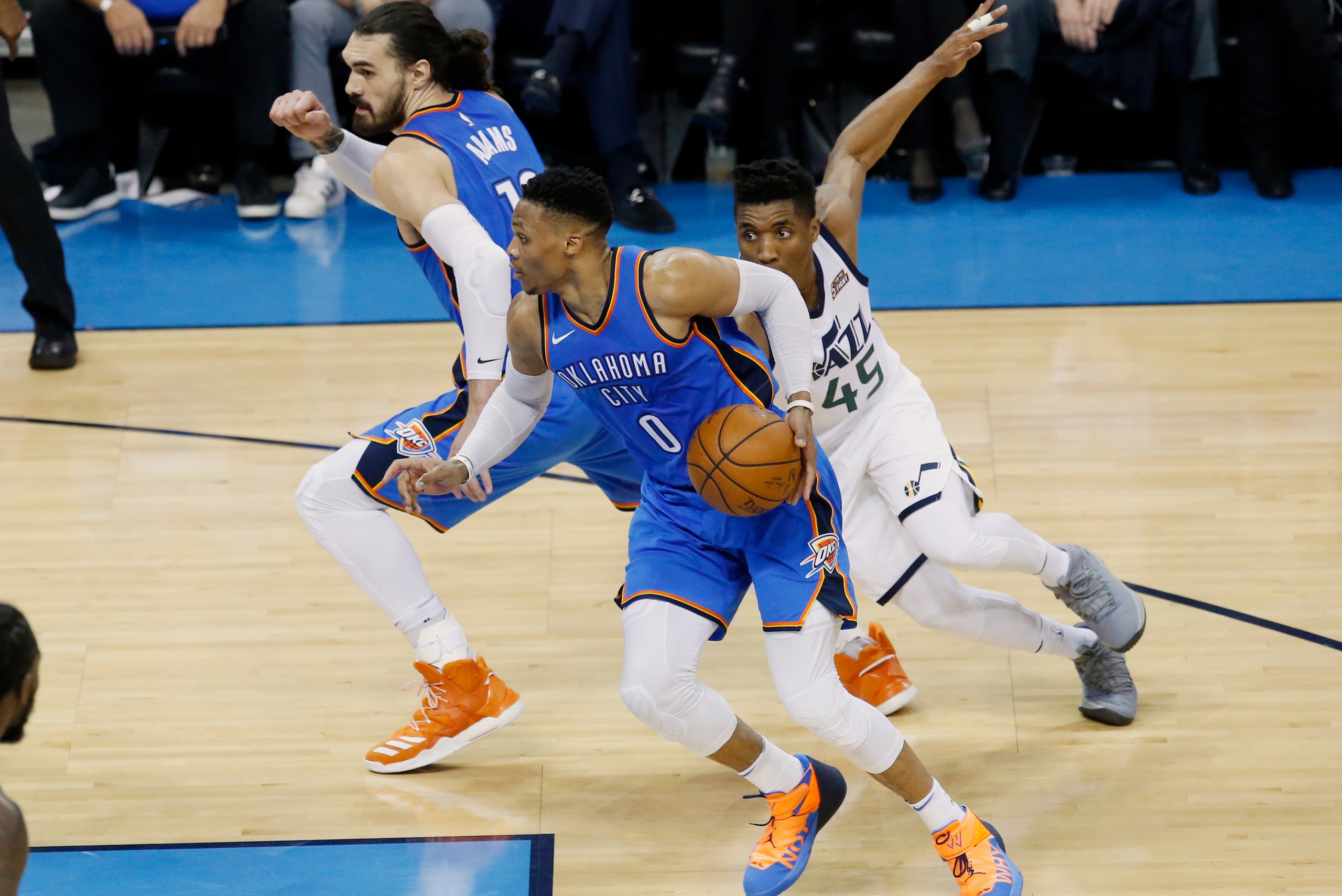
While George isn't tipping his hand, he doesn't agree with that last statement. "I know who I am as a player, I just want to help a team win," he said in Part II of the three-part documentary he's doing with ESPN on his free-agent decision. "And I feel comfortable doing that with Russ."
He didn't look that comfortable last spring, though, when the Thunder lost their first-round playoff series to the Utah Jazz in six games. In the final game, George missed 14 of 16 shot attempts for five points in 45 minutes. Anthony wasn't much better, contributing seven points on seven shots.
Westbrook, meanwhile, had 46 points on a whopping 43 shot attempts, including 19 threes. It nearly mirrored his performance in Game 5, a Thunder victory, when he had 45 points on 39 shots to lead a furious second-half comeback from a 25-point deficit.
Furious is a key word. Westbrook not only plays with maniacal energy, he generally has a maniacal look on his face, whether he's staring down the man guarding him, addressing a teammate who wasn't where he expected him to be or taking questions from the media.
Teammates insist that is not his persona all the time.
"He's intense on the floor," Adams said. "What you see on the floor, though, is different than when he's off the court. He doesn't hate you; he just has a very high standard."
Hence, though, the narrative—Westbrook pumps out glares and stats at a prodigious rate, but not always a winning one.
Thunder coach Billy Donovan insists it's not for lack of wanting to win or even to share the ball. In fact, his desire to win often causes him to flip the switch from feeding everyone to taking over with his one-against-the-world dominance. As anyone who has seen his fashion choices can attest, Westbrook does not do middle-of-the-road.
"Russell's mentality, with half the roster being different, was, 'I have to take care of everybody, this is my job,'" Donovan said this past spring. "And I think it was too much, because we weren't as good offensively when he was trying to keep everybody feeling like a part of the offense. He really feels a responsibility as a point guard to do that. But when he was trying to do that, it was, 'OK, let me run a play for Paul. Here, Paul, I'll get you a shot.' And Paul is like, 'Well, that's great, but what I like is to get my shots when it's free-flowing.' You want them, as pros with the level of experience they have, to work through it themselves. As a coach, once you have a body of work, then you can say here's the direction we need to go."
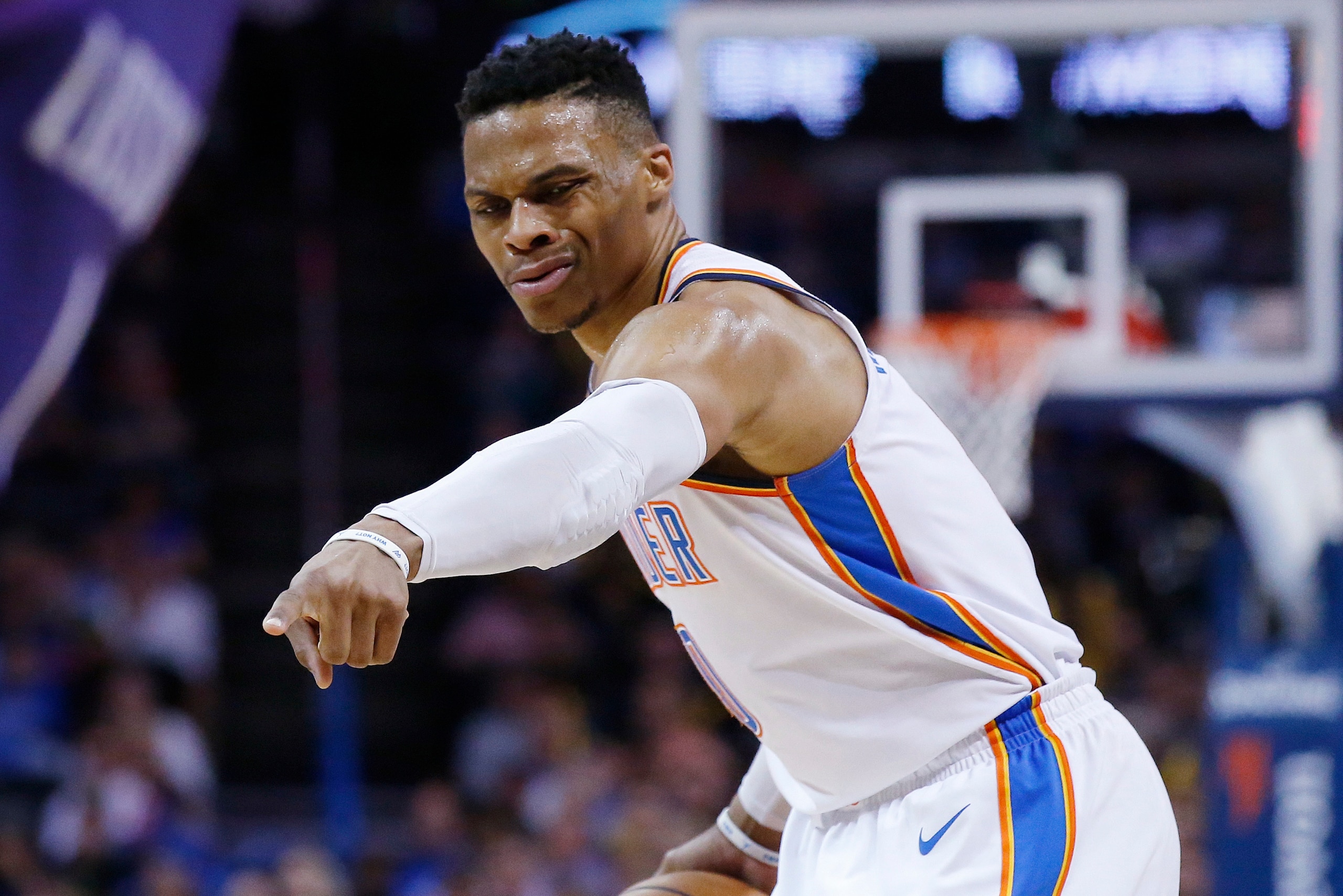
For anyone wondering if, this being Westbrook's 10th season, maybe blending his individual superiority with magnanimity simply is not something he'll ever master, Thunder swingman Corey Brewer believes the previous two seasons when Westbrook was a one-man band may have set him back.
"You've got to be able to turn it on and off," Brewer said. "He did it so much last year and the year before when he had to, now he's just got to figure out when he should do it and when he shouldn't do it. Steven sets great screens. You don't have to do it all yourself. Once Russ figures it all out, he'll start using Steven more and using the floor more."
George, too, remains convinced that there is a way to blend their talents into a winning formula—given time.
"Superstars in the league all have a way of controlling the game and playing at their pace," he said. "That's an area where we all have tried to grow—myself, Melo and Russ. We've got a guy who plays really fast, and Melo and I play with a slower tempo. I like to let the game develop and see what happens. All three of us are trying to find our place within one another. But that being said, Russ' energy and tempo give us a lot of easy opportunities. It's just trying to figure this thing out."
Donovan blamed the team's slow start last season (8-12 through the month of November) on allowing the players to see if they could integrate themselves. Part of that, he believes, was timing—Anthony was acquired from the New York Knicks the day before training camp, effectively trashing much of Donovan's offseason planning designed for binary stars Westbrook and George.
"What I didn't want to do is impose my vision or view on them without giving them an opportunity to work and play together and see how it filtered through," Donovan said. "Our challenge is, at different points of the game, they're all right. There are times we need to be attacking hard, times we need to be free flowing and moving and times we need to slow down and be surveying. It's getting them to see these things as a team, where there's a balance and they're still able to be who they are.
"What I noticed early on is they were saying to each other, 'Be who you are.' Not, 'My turn, your turn,' but 'Be who you are.' Well, if Russell is going to be who he is...that's when I tried to have conversations with them."
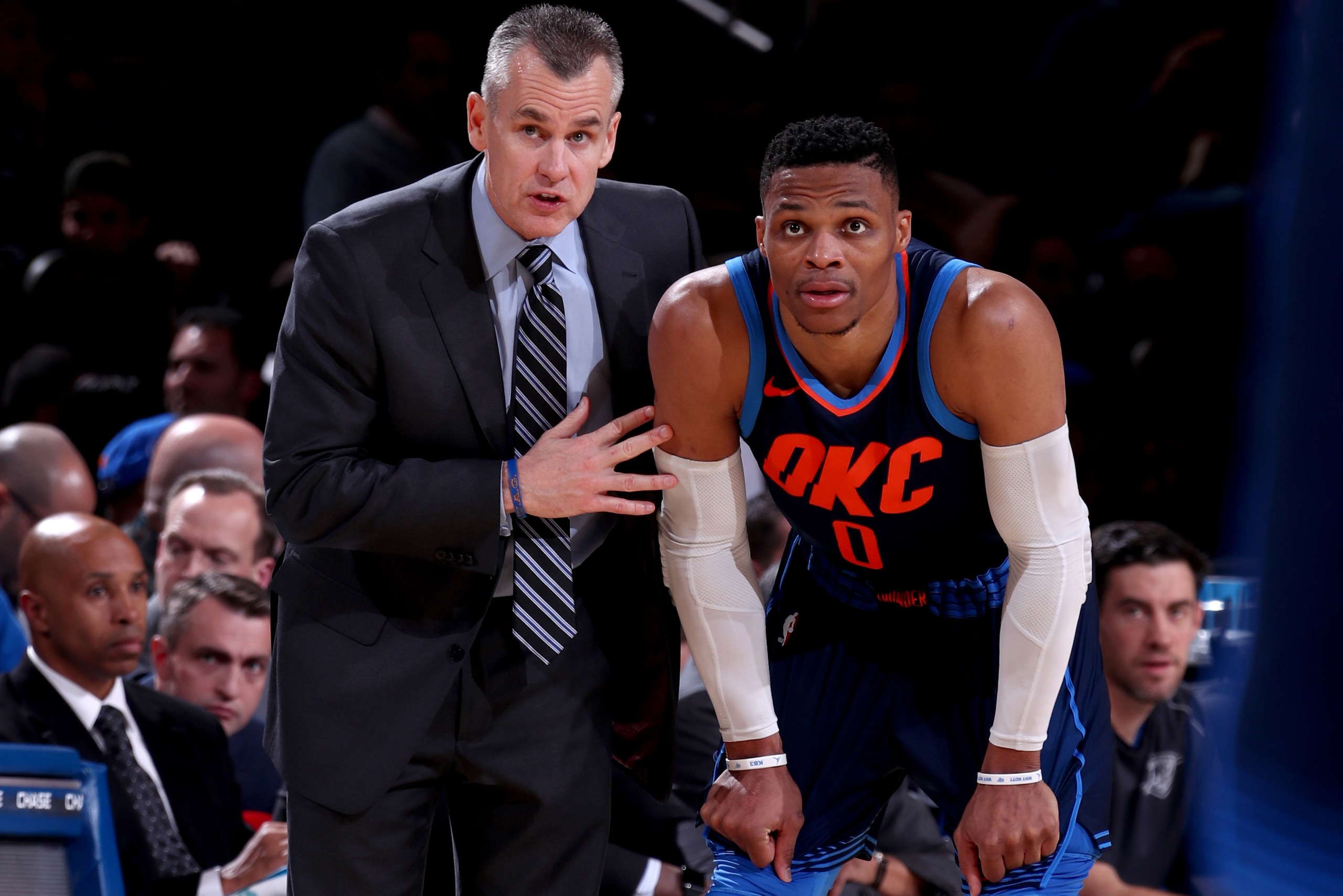
Brewer was a late addition to the roster last season and wound up starting the last month and all six playoff games. His playoff shooting percentages (52 percent overall, 45 percent from three) with the Thunder were vastly better than in his five previous postseasons with the Mavericks, Nuggets and Rockets.
It's not hard to see why: He knew how to take full advantage of playing alongside Westbrook. Having played in Denver with another speedy point guard, Ty Lawson, helped.
"I've played in so many different systems with so many different guys, it's easy to adjust," Brewer, an 11-year veteran, said. "You've got to play a little bit faster and give him space. You can't be on top of him. He's going to be coming down 100 miles an hour. Get to the corner and stay out of the way and be ready to shoot. When he's going to the hole and they're really packing it in, I have a lot of time to shoot the ball. I played with guards who can make the play but they don't create as much time for you, so defenders can get out and run you off the line. With Russ, you just need to rise up and make the shot."
George clearly benefitted from the same, shooting over 40 percent from three for only the second time in his career despite averaging an all-time high 7.7 attempts per game.
"It's running with him and making yourself available," George told B/R in May in the midst of the Thunder's playoff run. "That allows him to play in the open court and allows me to get one-on-one opportunities when the defense is loaded up on him. He kicks it out, I have a quick catch and shoot or a guy closing out on me. I don't necessarily run to one spot. I just try to make myself available and he does a really good job of finding us."
Anthony did not have quite the same success, hitting career lows in both scoring (16 PPG) and field-goal percentage (40.4). What Brewer and George were able to do that Melo could not is read and react off of Westbrook, rather than operate out of a set play as Anthony had done for most of his previous 14 seasons. Running the floor hard to get a trailing three-point shot, as opposed to having the offense wait for him to set up on the block or mid-post, was new as well.
Adams is not surprised that Anthony struggled in his first season with Westbrook.
"You have to play a long time with him, to be honest," Adams said. "It's making those reads. I don't look at him anymore. I just look at his man. If his man is slightly on his side or whatever, I'm good, I don't need to set a screen, he's going to go by him. If he does use the screen, I'll hold for a second and then catch up and get in front of the ball. With Russ you have to make a fast decision. With a slower guard, it gives you time to think or view what's going on, what they can see."
George, unlike Anthony, also doesn't hang his personal worth on his scoring average, despite being a 20-plus point scorer the last three seasons. While George has the trappings of a superstar—signature shoe, Gatorade commercial—he isn't greedy about his role in the offense.
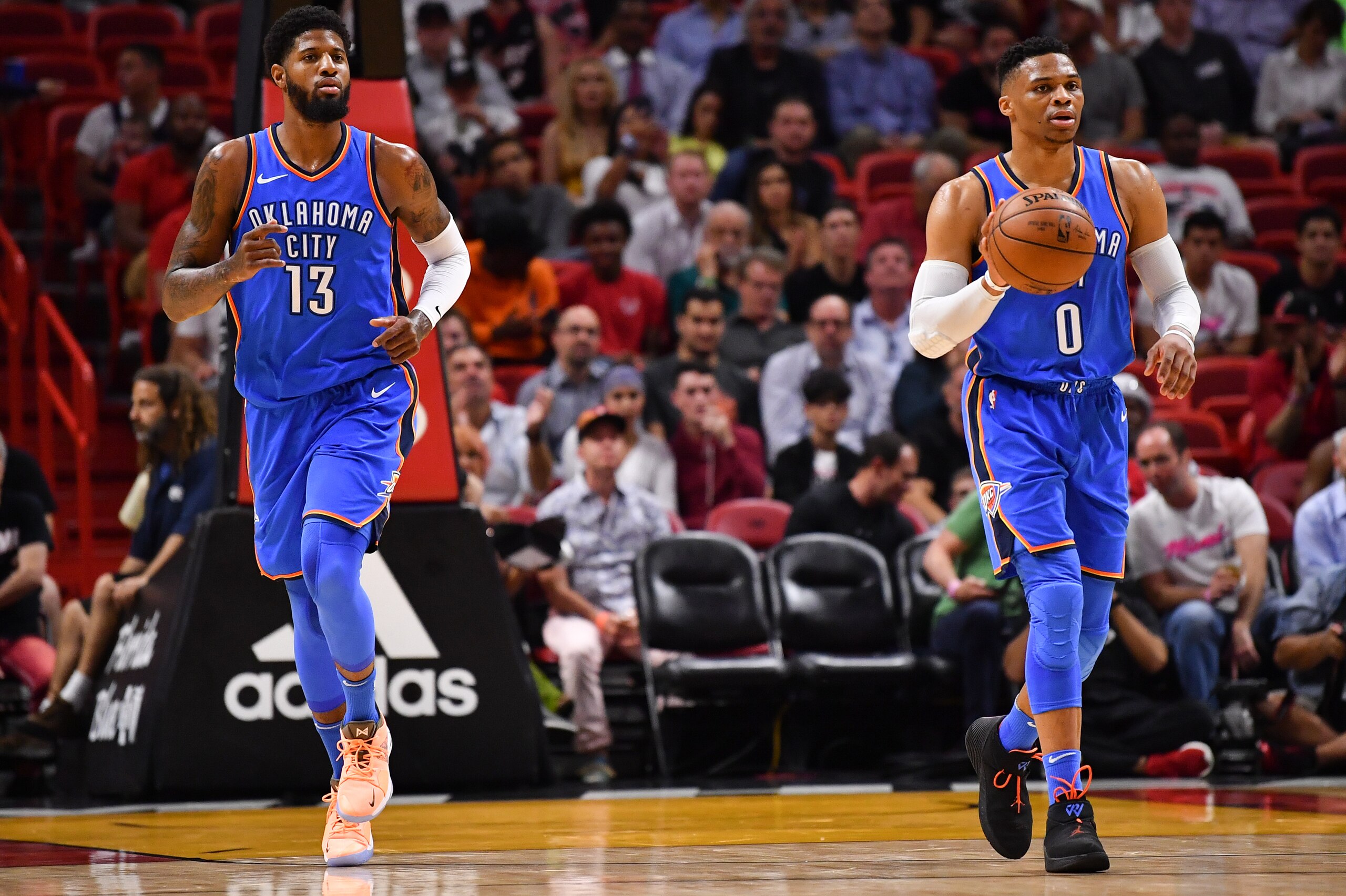
"The first couple of games, I ran things toward him," Donovan said. "He said, 'Coach, don't feel you have to run things for me to get me a shot. I'd rather have the ball in my hands where I can make a shot.' I've been around different scorers in college and NBA, and most of them will say, 'Get me one.' He really views himself as a defensive player first and then a player who feeds off of everybody else."
For his part, George wasn't so discouraged by last season's results that he can't imagine a sequel.
"It's an ongoing thing," he said. "This (was) our first year playing together. It's going to take a rough patch area of figuring out what's the best way of spreading the floor, making myself available, getting open, helping him out. It's Year 1 of trying to figure it out."
Sounds like a man willing to give it a Year 2. We're about to find out.
Ric Bucher covers the NBA for Bleacher Report. Follow him on Twitter: @RicBucher.



.png?w=2560 "Week 8 Winners & Losers 📊")
.jpg?w=2560 "Jonathan Taylor Landing Spots")