

How the Washington Redskins Can Shut Down TE Greg Olsen in Week 11
Cam Newton's dual-threat skills will be a headache. So will a Jonathan Stewart-led, power-based running game. But the Washington Redskins won't have a hope of upsetting the unbeaten Carolina Panthers in Week 11 unless they put a great big target on prolific tight end Greg Olsen.
Washington defense boss Joe Barry must design a game plan that reflects a full commitment to shutting down Newton's favorite receiver. It will mean targeting Olsen's regular routes, as well as using alignment and pressure to disrupt his release off the line.
By doing those things, the Burgundy and Gold can wreck the devastating chemistry between Olsen and Newton. It's a productive rapport best summed up by numbers provided by Joseph Person of the Charlotte Observer:
.jpg?w=2560 "Rams Raiders Football")

.jpg?w=2560 "Steelers Saints Football")
"Since Cam Newton entered the league as the No. 1 overall pick in 2011, the Panthers’ quarterback has completed nearly 1,300 passes.
Tight end Greg Olsen has been on the receiving end of nearly a quarter of them.
Olsen, who arrived in Carolina three months after Newton via a trade with Chicago, needs nine catches and 32 receiving yards Sunday against Washington to surpass Wesley Walls as the most prolific receiving tight end in Panthers history.
"
It's up to Barry's unit to make sure Olsen has the kind of day Peyton Manning had for the Denver Broncos in Week 10. Namely, he might set a record, but his general numbers will be meager, and the result will be a miserable one.
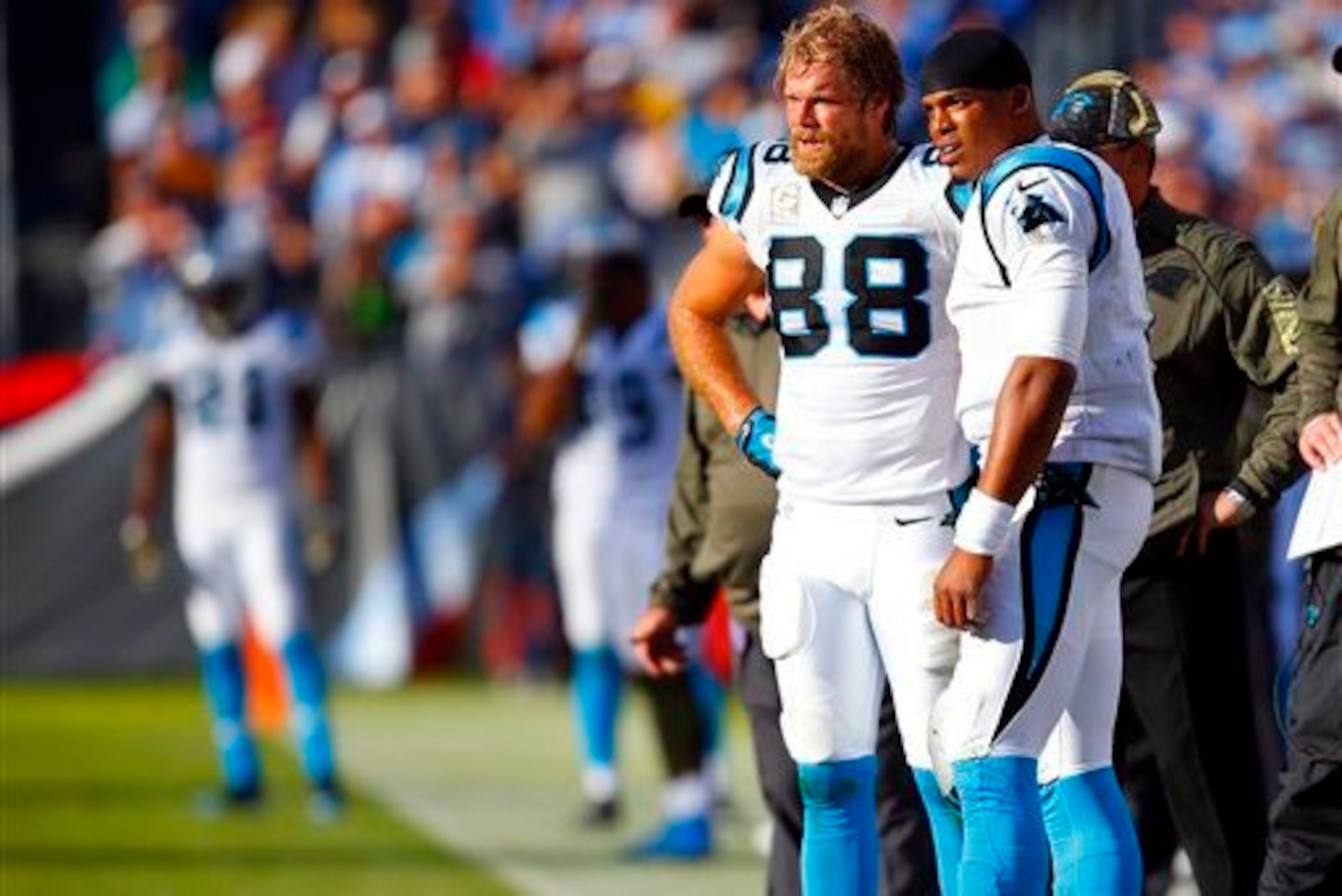
Ensuring a bleak outing for No. 88 will require taking away the routes he most commonly exploits.
Hooks, Curls and Circles
Clamping down on Olsen is all about eliminating the hooks, curls and circles. These in-breaking, intermediate-range routes are Olsen's favorite. He's become an expert at circling behind the linebacker level of zone coverage to exploit the soft middle.
Statistics from ESPN.com reveal how 22 of Olsen's 45 catches are off passes traveling one to 10 yards, while 14 more come from passes covering 11-20 yards. These are the common distances for hook and curl patterns. Teams that don't take them away pay a heavy price. The Tennessee Titans certainly did in Week 10.
During Carolina's 27-10 win, Olsen exploited the Titans for a trio of first-quarter grabs, all off curls and hooks. The first was a 20-yard catch on 1st-and-10 with the Panthers at midfield.
Olsen began aligned as an in-line "Y" tight end. He was facing ex-Redskins Pro Bowl outside linebacker Brian Orakpo:

The Titans gave Olsen a free release off the line, a cardinal sin against this talented a receiver. Notice how our old friend Orakpo made no contact with the tight end coming out of his break:
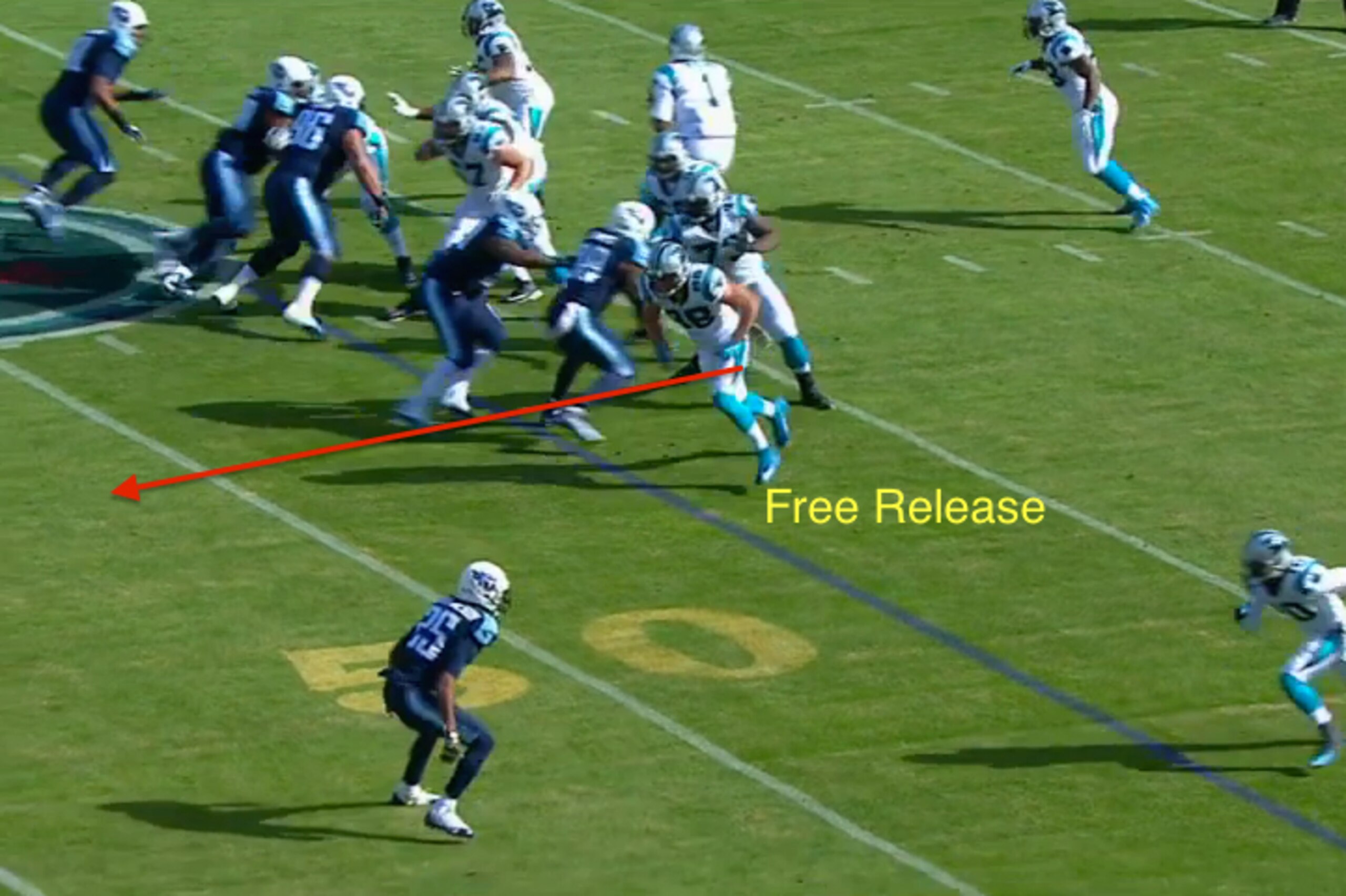
Even if they're playing run or simply on their way to the quarterback, edge defenders must at least bump Olsen as he releases. Orakpo didn't, and the dynamic playmaker had a free run into the middle of the zone.
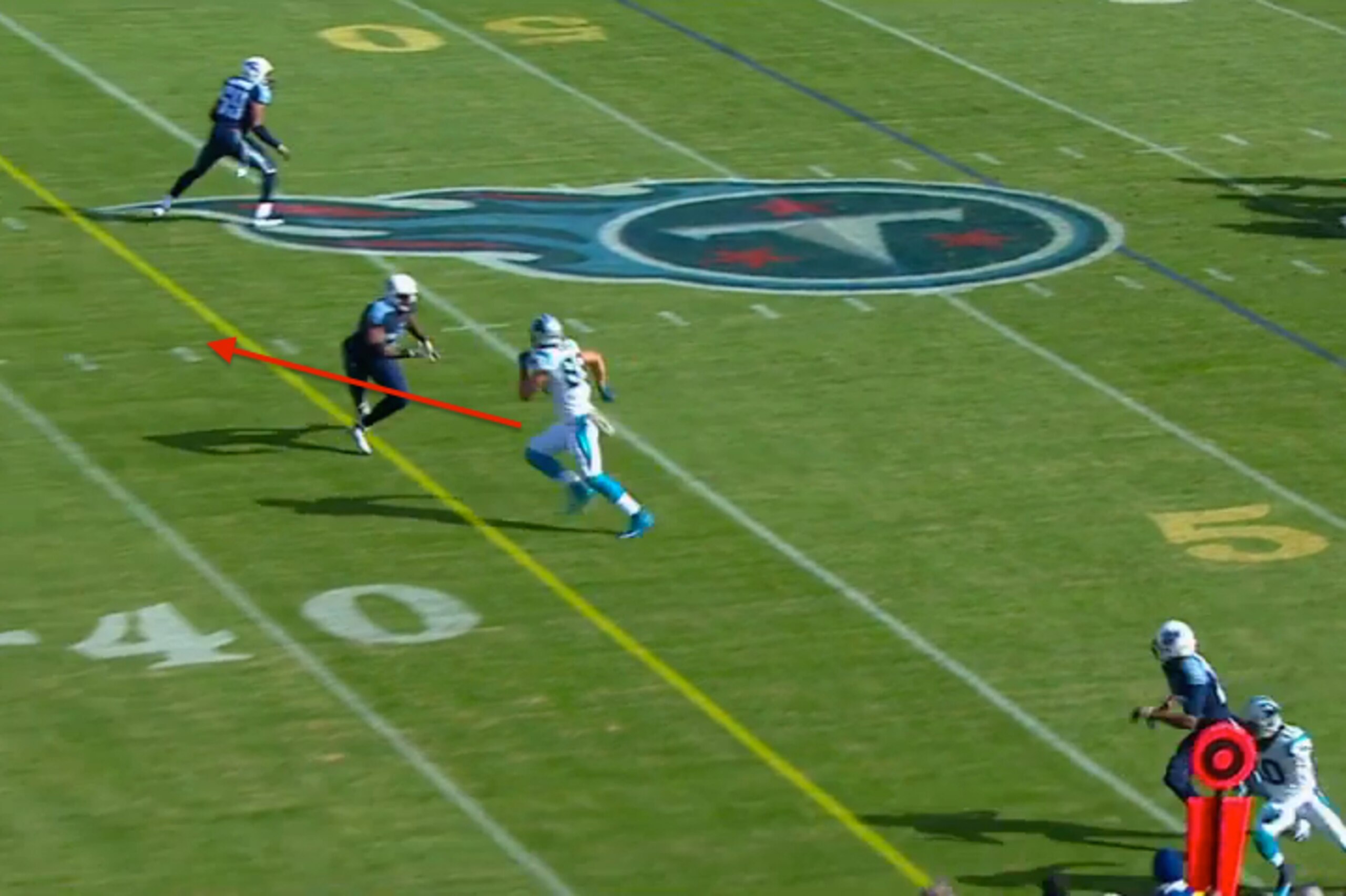
In trademark fashion, he began circling to get behind inside linebacker Avery Williamson and face his quarterback:
Olsen was now wide-open to make a big catch:
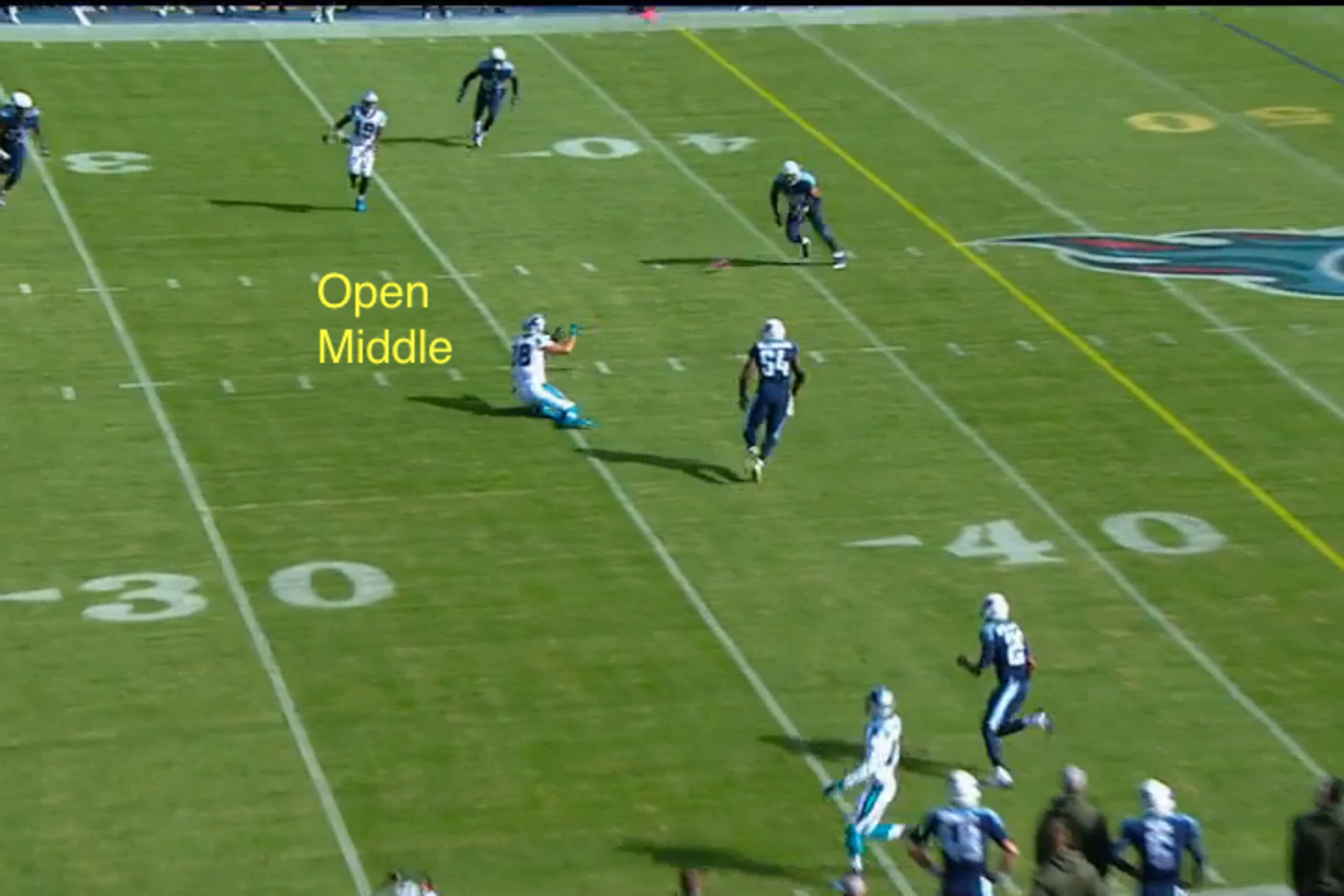
Williamson's position was actually not a bad one. He just received no help from his deep coverage. From the view of the coaches' film, you can see one half of Tennessee's two-deep safety shell hadn't rotated down to bracket Olsen:
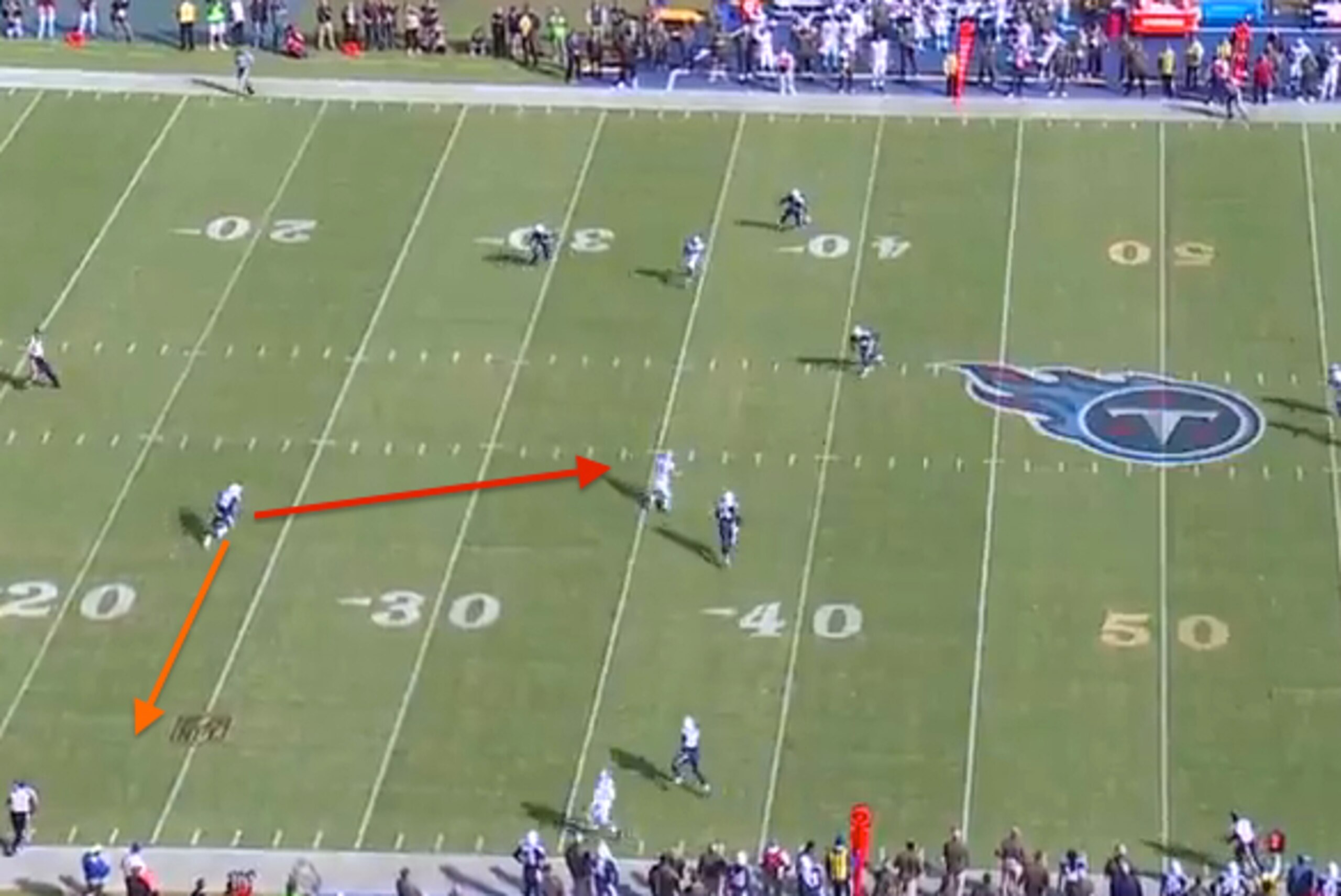
Instead, the safety was more concerned with hanging back to cover the deep half and track the vertical release of Carolina's outside wide receiver.
While this is essentially the right technique for playing Cover 2, it's the wrong way to shut down Olsen. Putting a target on Olsen demands risking leaving the cornerback one-on-one on the outside. It means rolling the dice that Newton will lock onto his favorite target and not look at his single-coverage matchup.
That's the chance a defense must take when it's committed to taking away an opponent's best weapon.
The Titans didn't follow that mantra, no matter where Olsen lined up. Later in the first period, he converted a 3rd-and-7 at the Tennessee 29. This time, he was flexed into the slot in front of outside 'backer Derrick Morgan:

Again, there was no hit on Olsen coming off the line. He was given another free release to run his typical curl route unopposed:

With the freedom of the middle, Olsen soon circled behind Morgan and turned to give Newton yet another easy target:
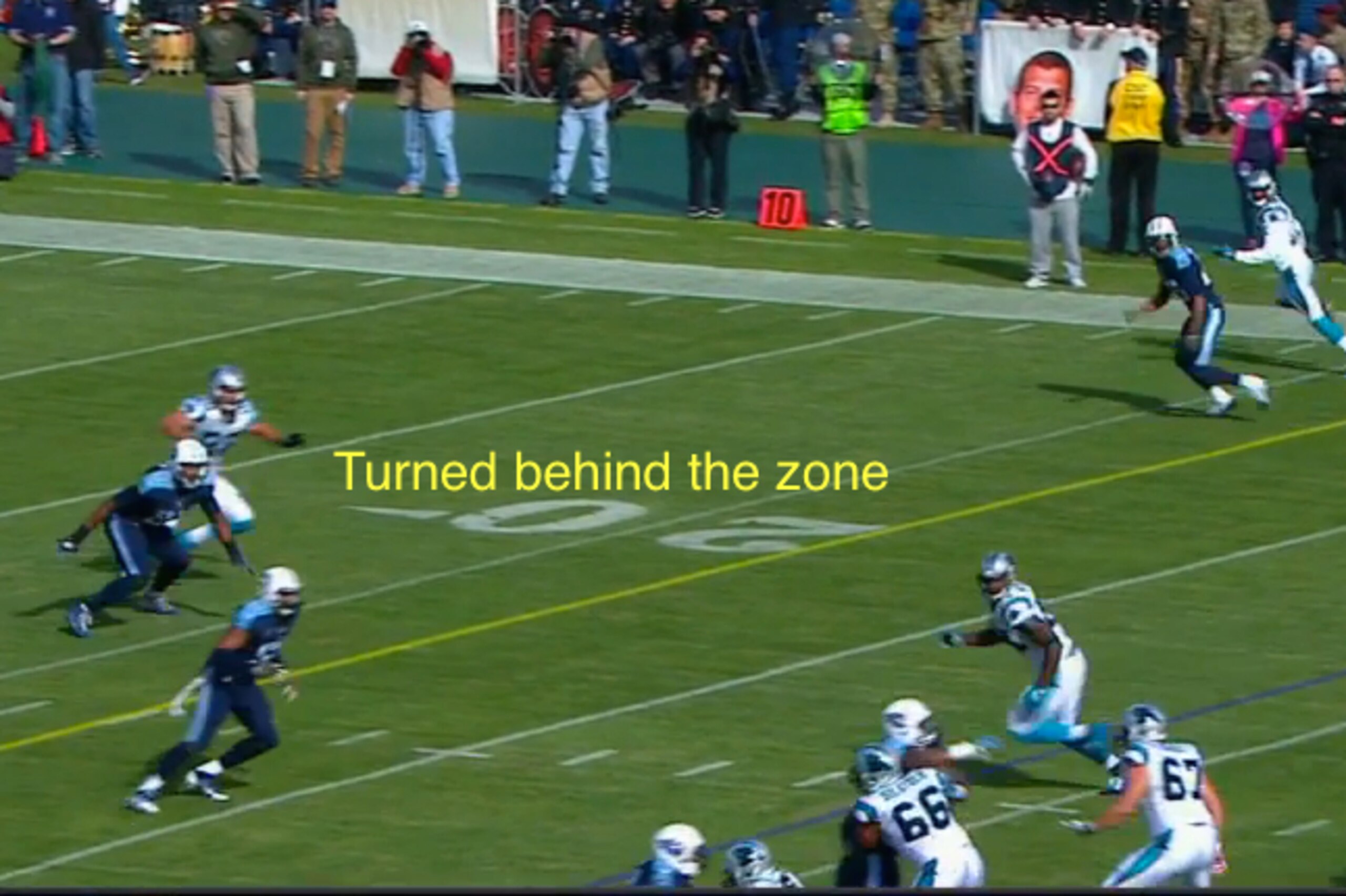
The catch was a simple one to move the chains:
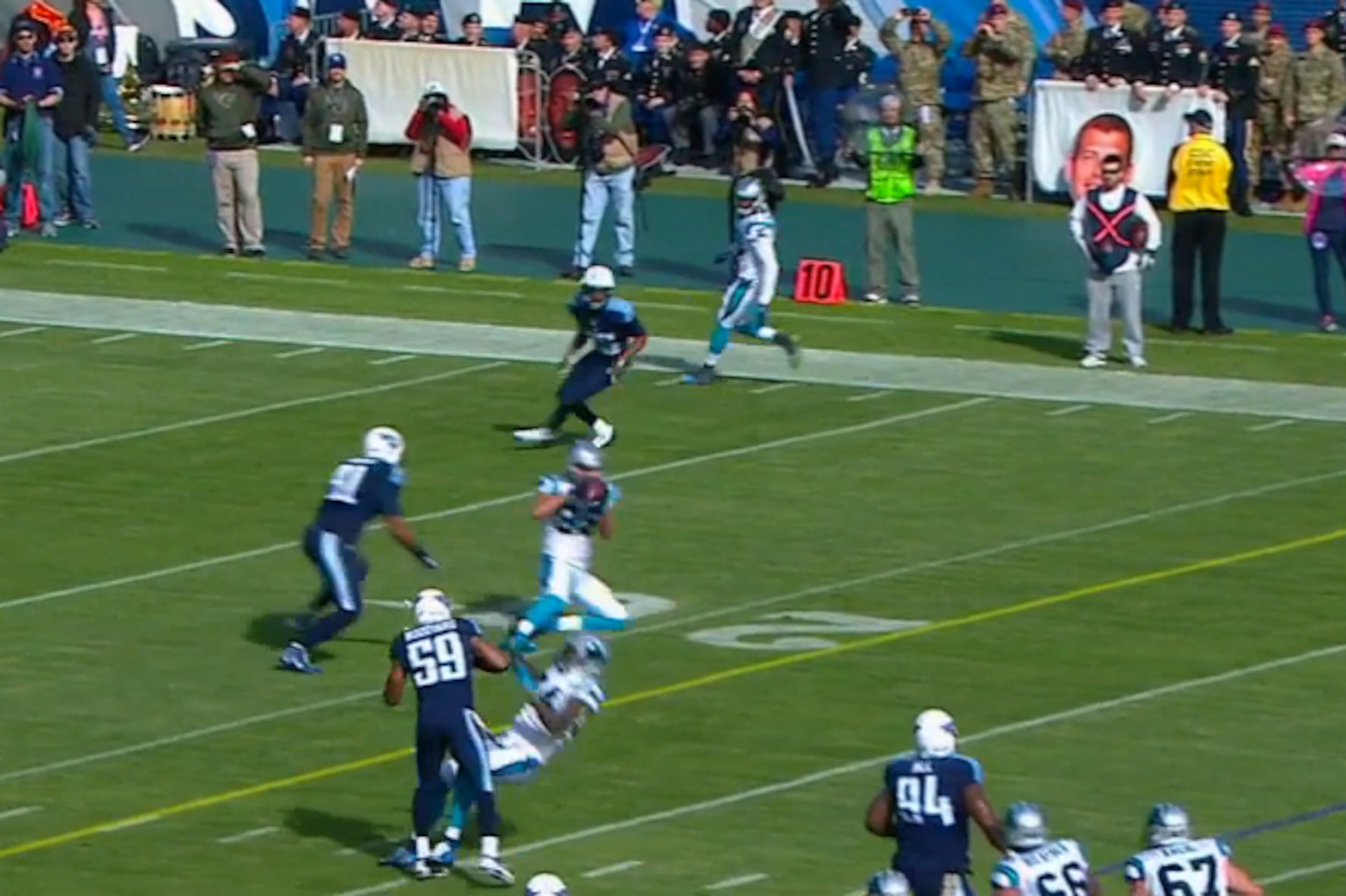
Tennessee hadn't learned its lesson from the earlier 20-yard gain. The Music City club didn't rotate one of its deep safeties down to the intermediate middle to bracket Olsen in the seams:

Just like on the previous play, the safety was maintaining his Cover 2 responsibility. But in a scheme designed to eliminate a particular player, coverage can't afford to be so rigid. A defense must give up what appears fundamentally sound in order to keep the real danger man quiet.
Even with Olsen back in his familiar "Y" position for another first-quarter play, the Titans still didn't apply this thinking. On 1st-and-10 at their own 20, the Panthers would target Olsen once more:

He was given another free release, utter madness against a pass-catcher this prolific. There was no hit from Orakpo:
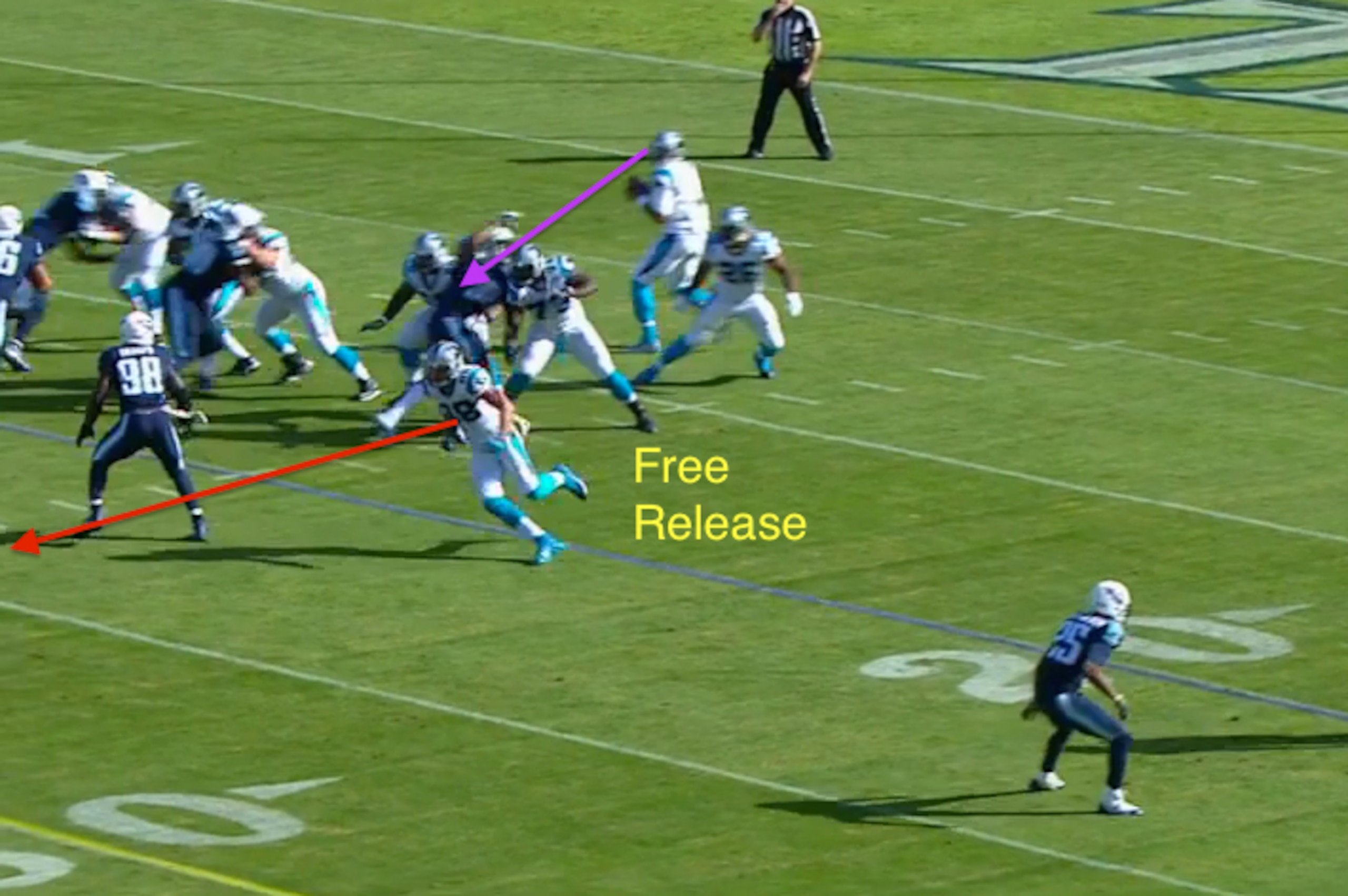
No wonder Newton immediately looked his favorite receiver's way. It's what he usually does.
Since the Titans weren't stopping it, Olsen reverted to his default move. He circled behind the front seven and into the open middle for an easy catch and 14-yard gain:
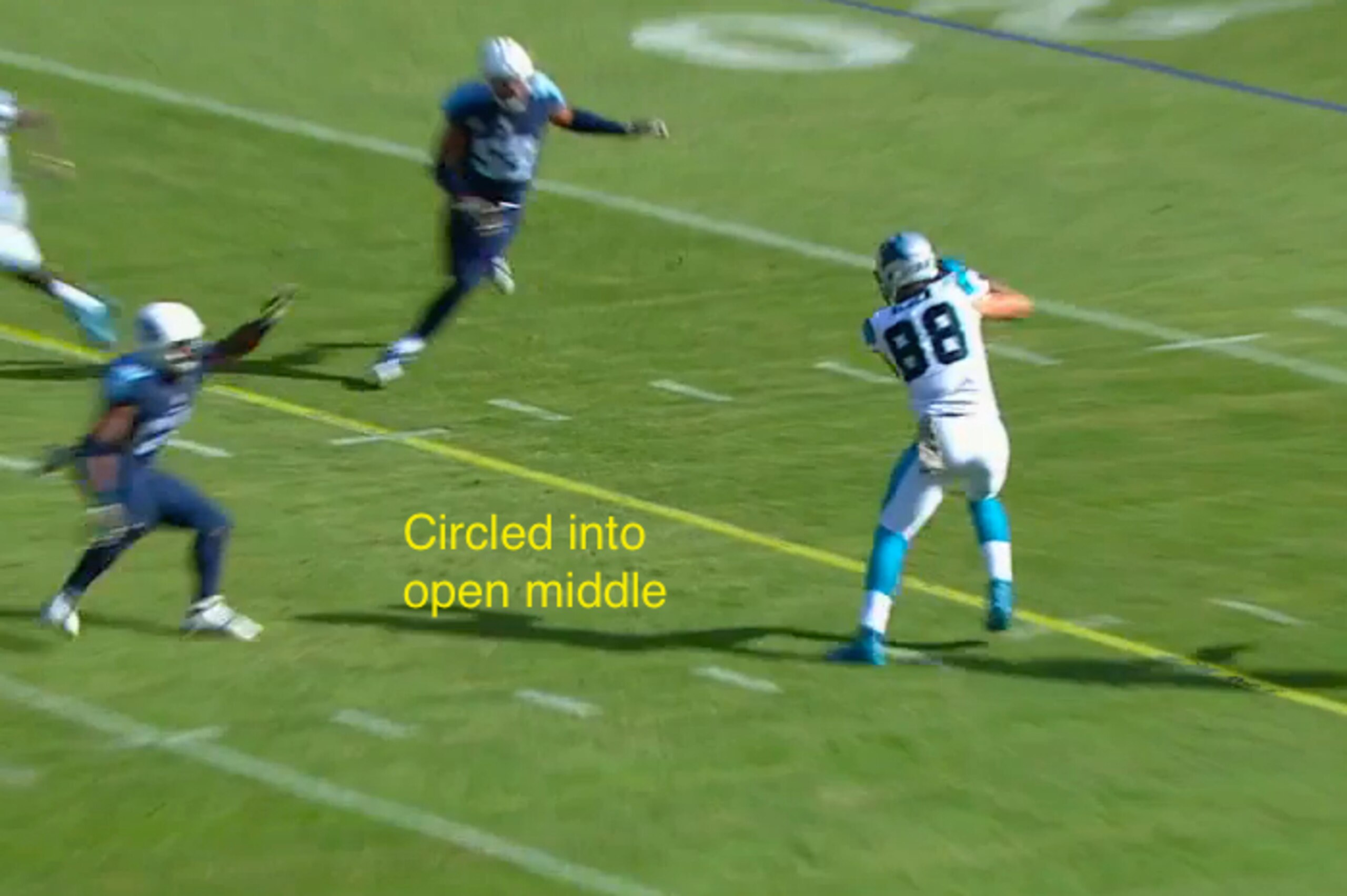
Once again, the Titans refused to double up in the seams—a very costly error:
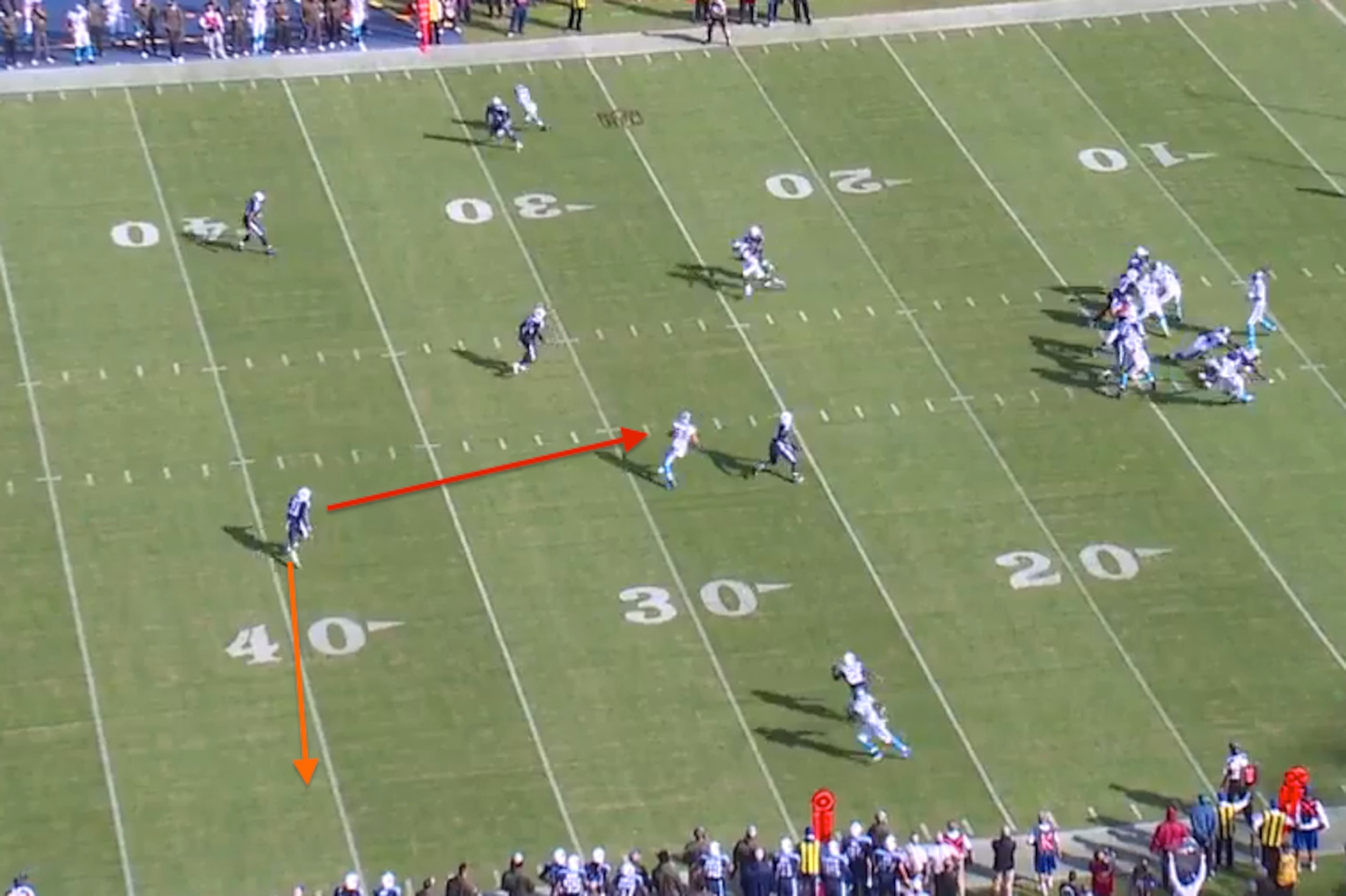
Give Olsen this kind of room, and Newton will happily connect with him all game. Barry has to view how the Titans played Olsen as a cautionary tale.
Barry must use his 3-4 personnel, both from base and sub-package sets, to regularly fill the inside throwing lanes with linebackers and safeties.
He must also ensure Olsen never gets a clean release off the line. Equally important will be showing the 30-year-old some form of double-team on every play.
For a practical demonstration, how about a journey back in time? Back to Week 1 of the 2010 NFL season when the Kansas City Chiefs hosted the San Diego Chargers and made it their mission to shut down Bolts tight end Antonio Gates.
Setting the Target
Kansas City's defense was directed by Romeo Crennel that season. He's a coordinator from the Bill Parcells and Bill Belichick coaching tree. Theirs is a philosophy based on taking away the other team's best weapons, no matter what.
Crennel rigorously applied that thinking to keeping Gates quiet. Barry can take a cue from the 68-year-old, particularly when it comes to using formation and shifting personnel to make someone a target.
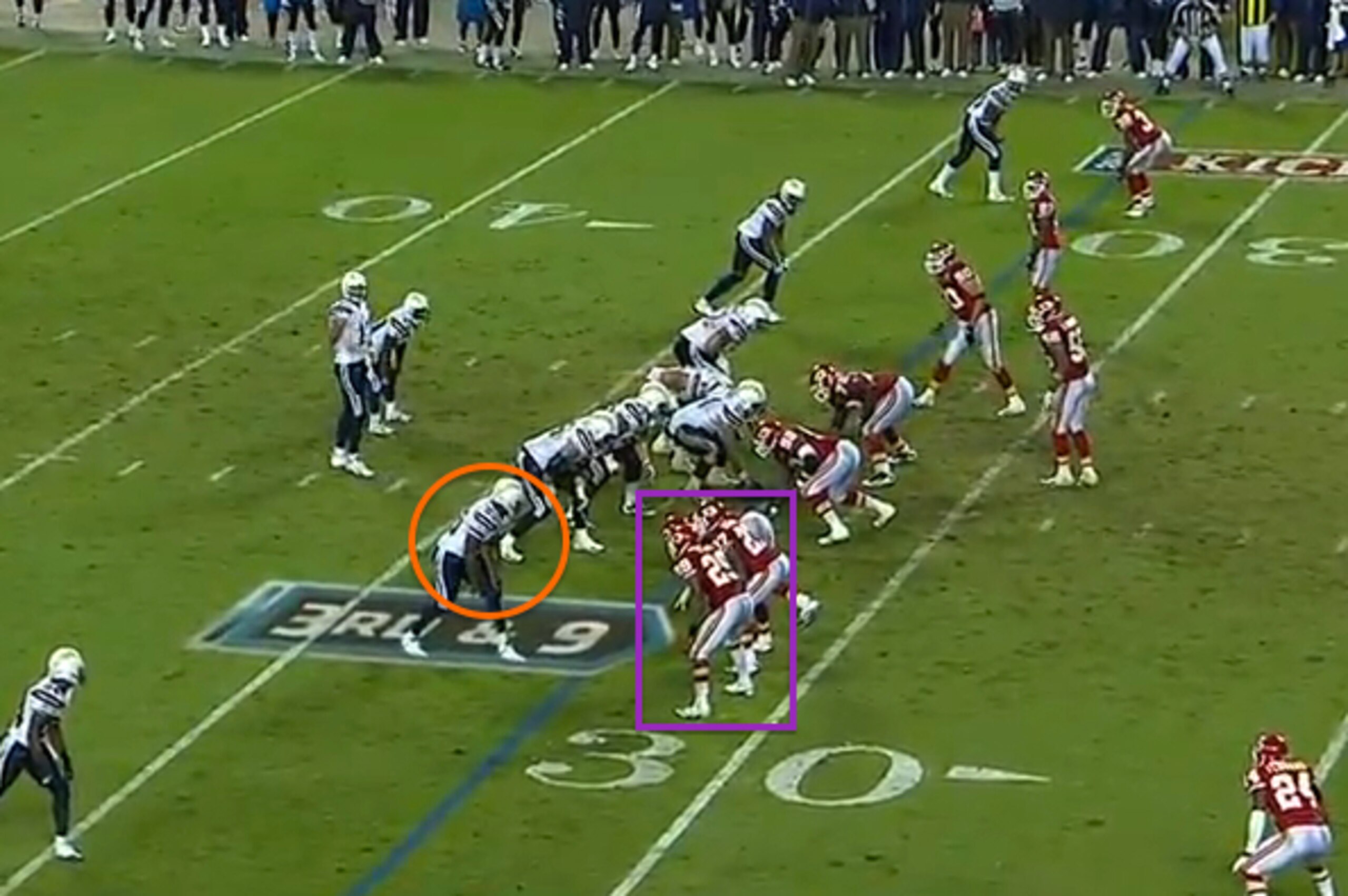
Here's how the Chiefs lined up against Gates on a 3rd-and-7 play in the third quarter. Notice how Gates was covered by two men, safeties Eric Berry and Donald Washington:
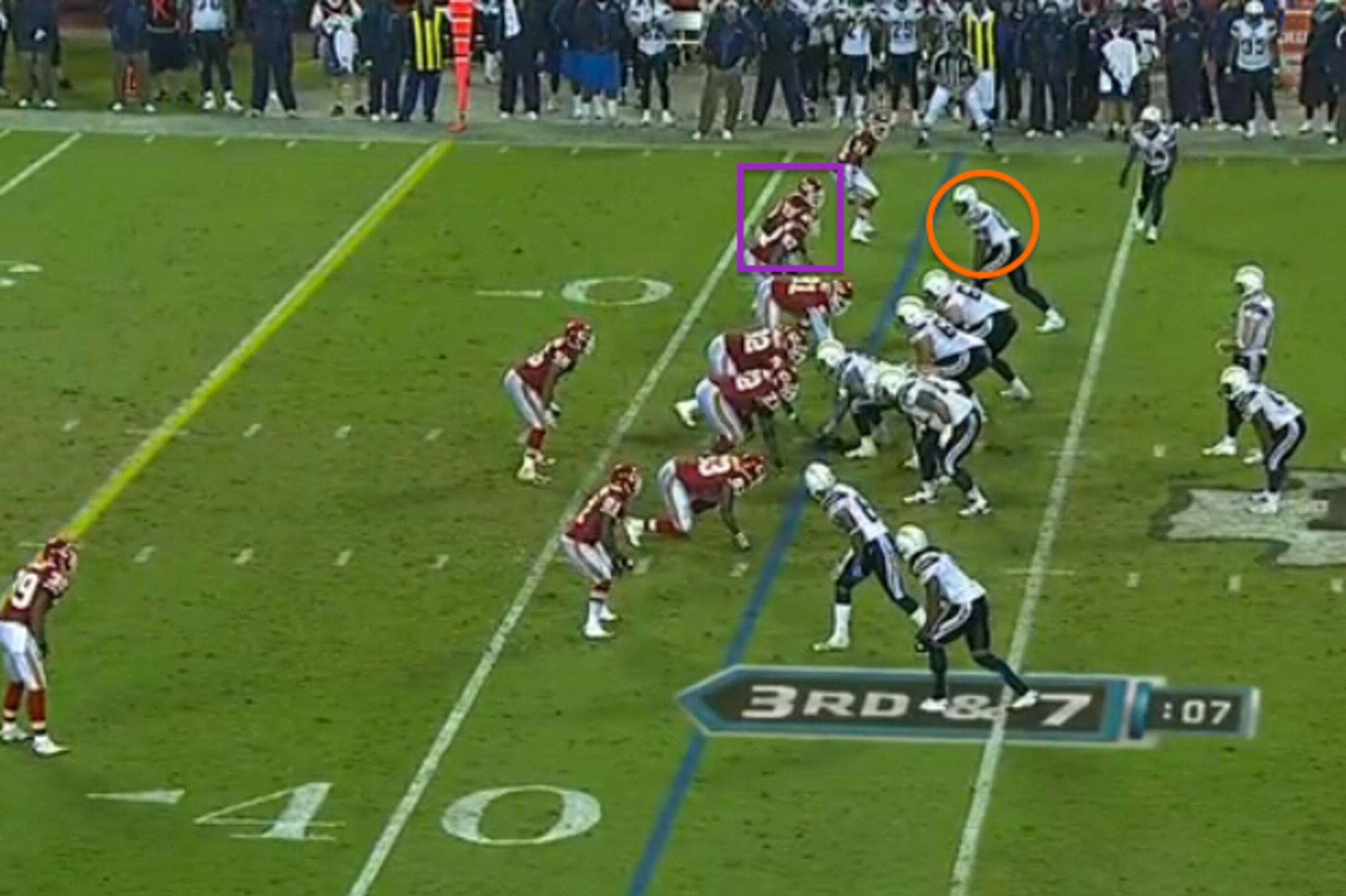
As pre-snap messages go, this one was blunt and to the point: San Diego quarterback Philip Rivers needn't waste his time looking Gates' way.
So it proved as both Berry and Washington clamped onto the tight end off the line:
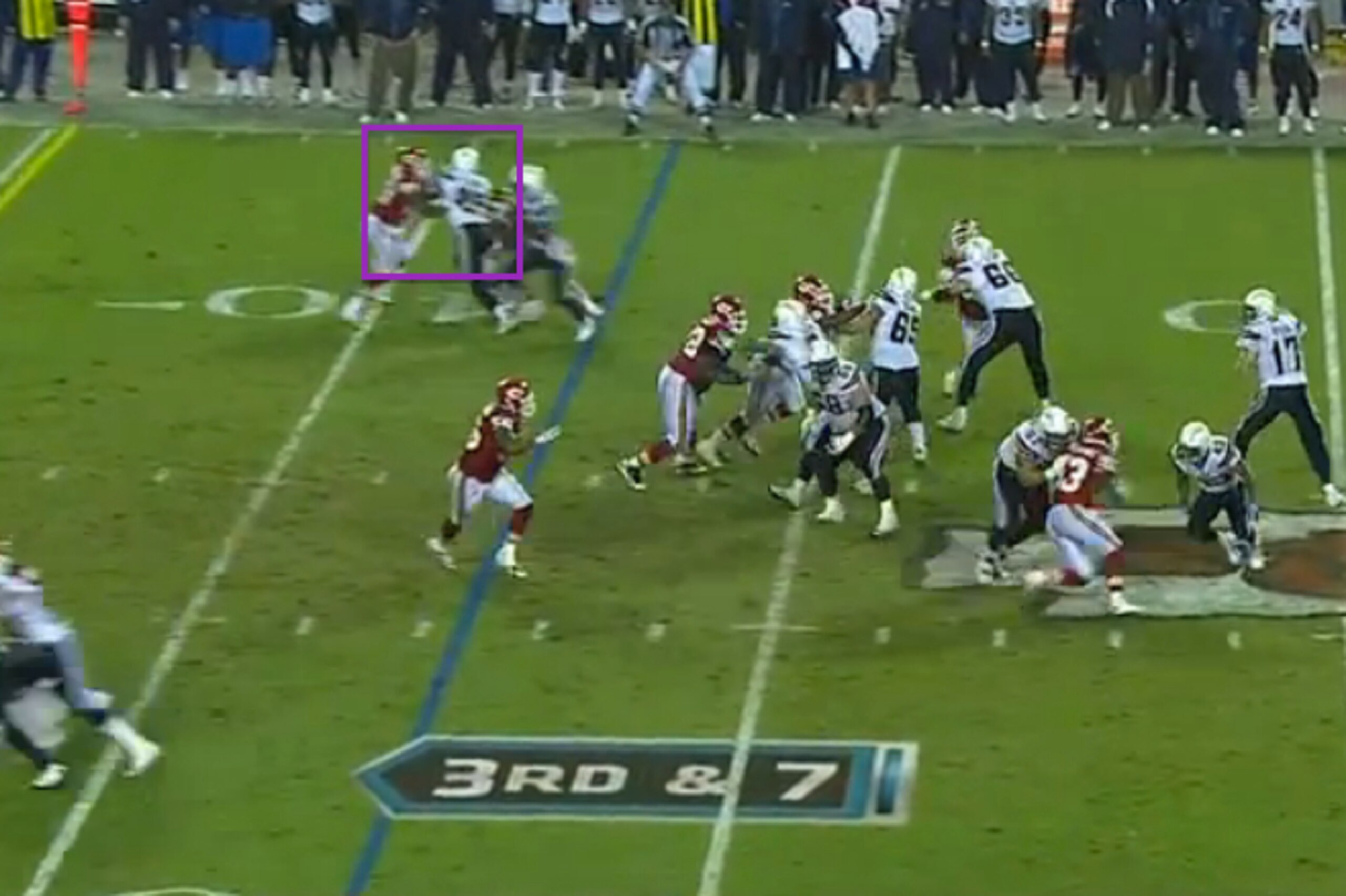
They maintained their vice-like bracket all the way through the play, forcing Rivers to look elsewhere:

His desperate throw to a less trusted receiver fell incomplete, and the Chargers had to punt.
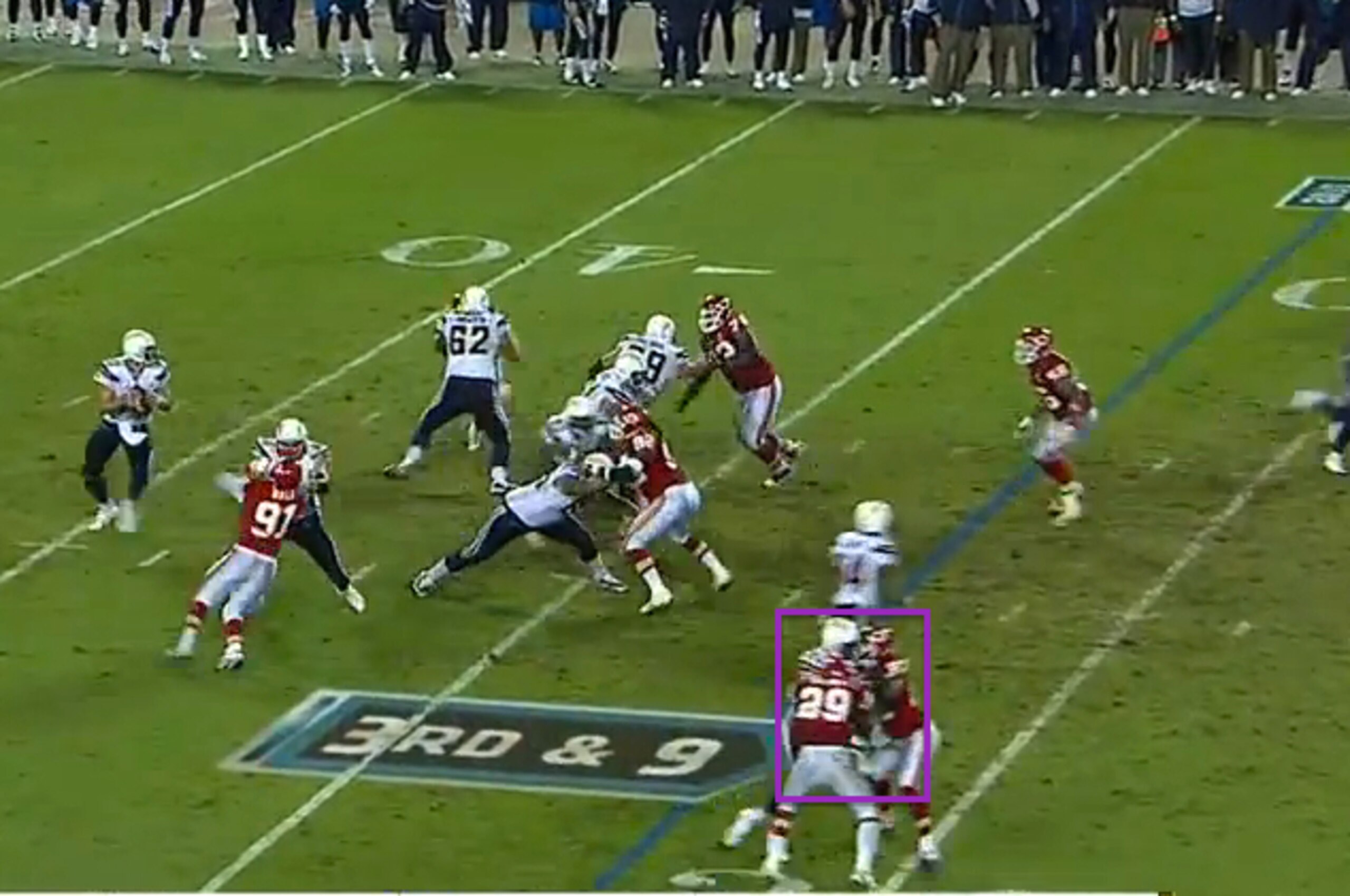
The Chiefs continued in this same vein all night. On 3rd-and-9 in the fourth quarter, Gates again saw Berry and Washington ready to double him off the line:
No. 85 was bottled up as soon as he made his move:
Things stayed that way until Rivers had again thrown incomplete on another pass aimed away from Gates:
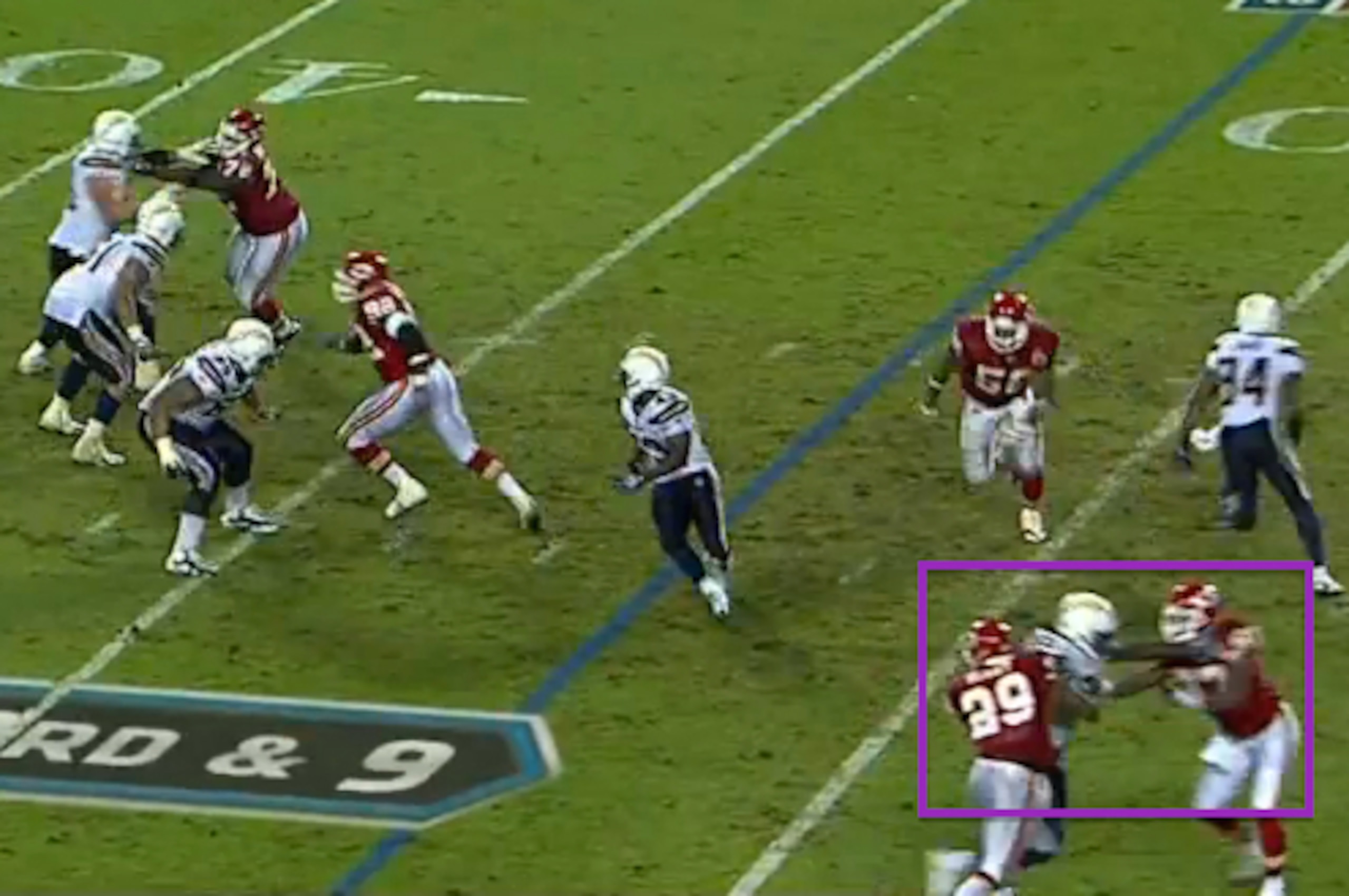
Whatever it took, the Chiefs did everything they could to disrupt Gates and take him away from Rivers. The following play was a brilliant example.
Knowing Rivers would still look his favorite receiver's way on a clutch fourth down, Crennel tweaked things slightly to provide a version of triple coverage on Gates:

It started with rush end Tamba Hali, then had Washington cover the short zone while Berry hovered over the top to prevent a vertical release up the seam.
Hali got things started by putting a hit on Gates as the tight end made his break:
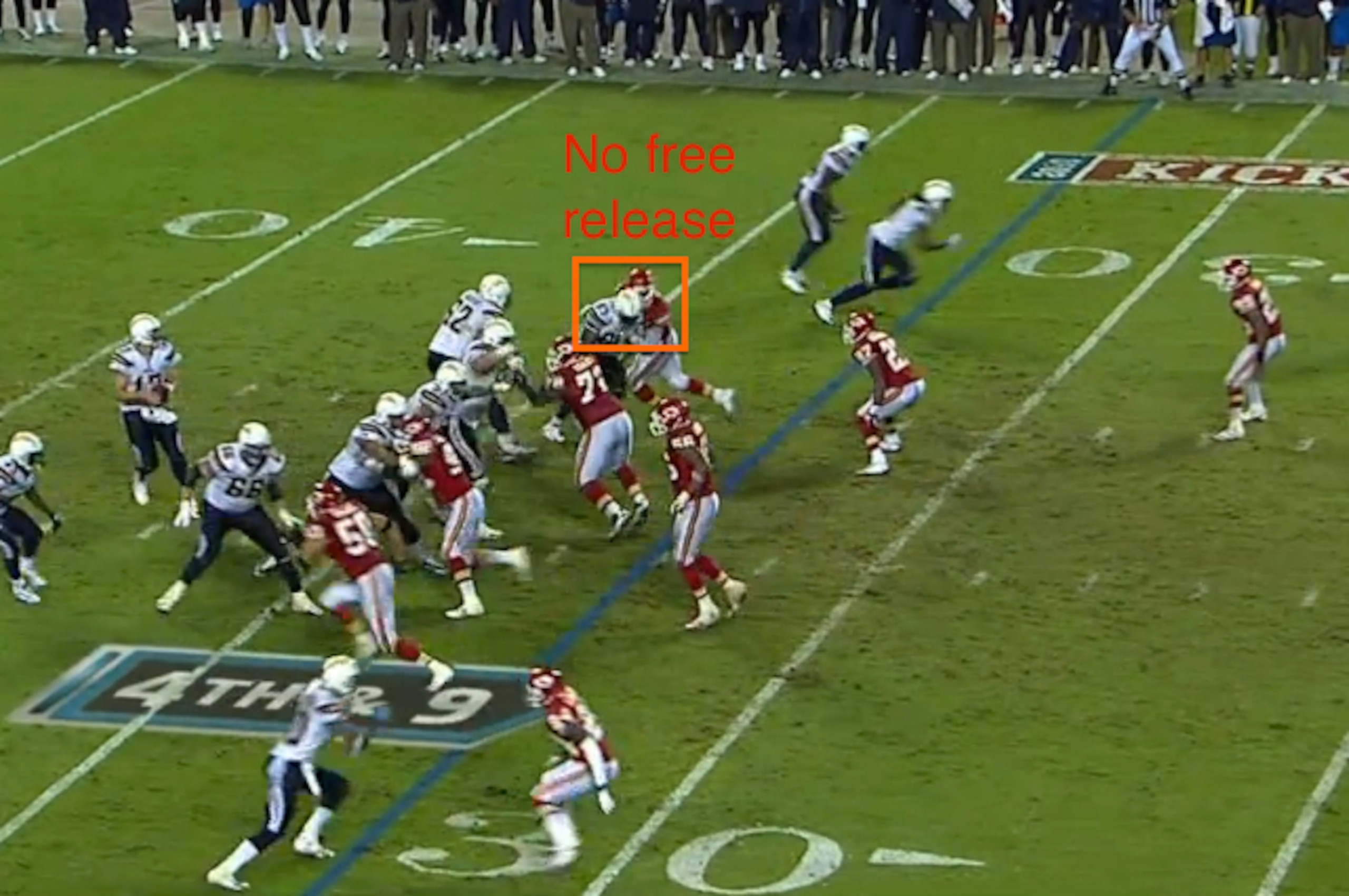
This disrupted the timing of his route and made Gates easy prey for Washington to lock up underneath:

Then it was time for Berry to help out and join Washington to keep Gates doubled up the field. There was no way Rivers could connect with his main man. His high throw underneath flopped to the ground, and the Chiefs got the ball back:
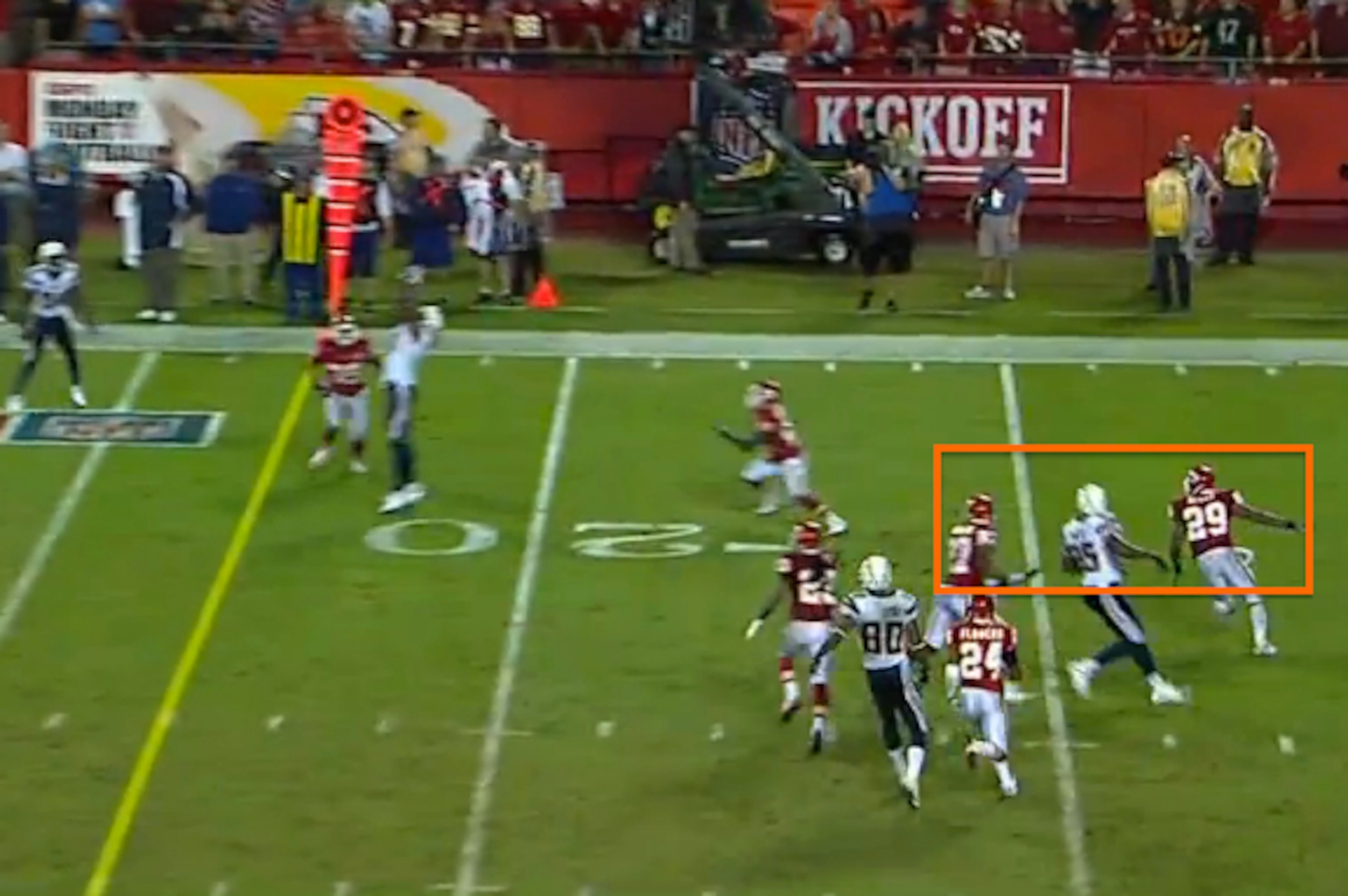
What stood out on this play was how Crennel didn't mind sacrificing his best pass-rusher and giving up some pressure on Rivers. Stopping Gates was the main focus.
That's the level of commitment Barry must show to keeping Olsen under wraps. He'll need some help.
Washington's Key Men in the Olsen Plan
Cornerbacks Chris Culliver and Bashaud Breeland need to bring their A-game to Charlotte. Barry has to be able to trust both to handle their receivers one-on-one, with no safety help, if Olsen is aligned on their side of the field.
It's the only way he can use the safeties with his linebackers to create a necessary bracket around Olsen's deadly inside routes.
Washington's edge-rushers must also sacrifice their rush on occasion if it means staying in to jam Olsen's initial release. He cannot be allowed a clean break on any play. So the onus is on Ryan Kerrigan, Trent Murphy and Preston Smith buckling their chin straps and putting some bruises on No. 88.
Finally, versatile rookie defensive back Kyshoen Jarrett will be a vital figure whenever Barry's defense goes into a sub-package set. As a safety with corner-like skills, he's a good matchup with Olsen in the slot.
In Week 9, Jarrett stood up well to the New England Patriots and Rob Gronkowski. He limited him to four catches for 47 yards—virtual silence for the Gronk.
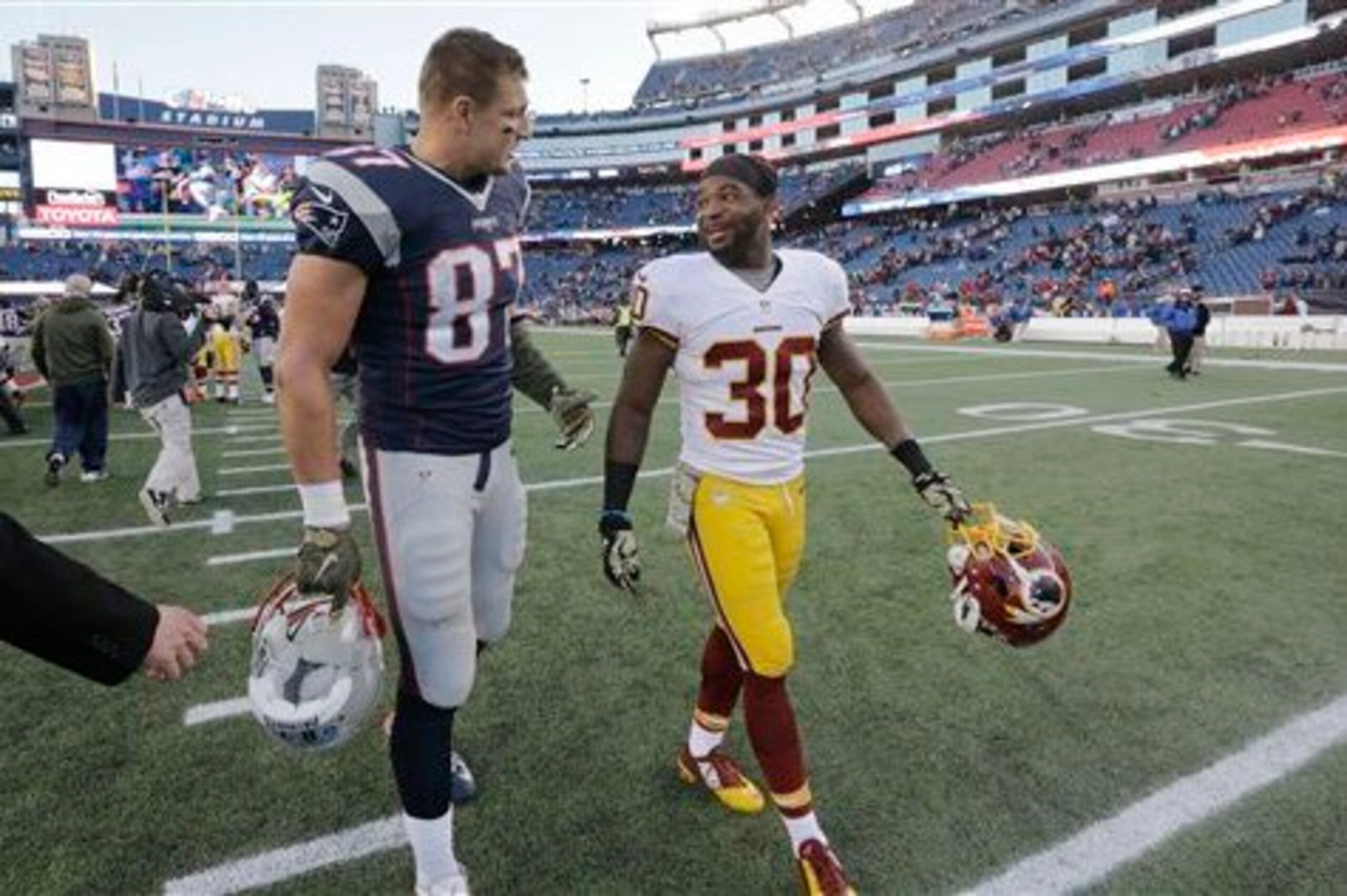
Jarrett can partner another safety to double Olsen at the line, the way the Chiefs did with Gates five years ago. He can also help limit the yards after the catch from a player who has tallied 234 of his 664 total yards after getting his hands on the ball, according to Sporting Charts.
Washington has to show a ruthless commitment to eliminating Olsen, even if it means surrendering a few big plays to others. Eventually, come crunch time, Newton will always look for Olsen. Taking him away will force the Panthers out of their comfort zone offensively.
It's the best way for Washington to steal an upset.
All screen shots via ESPN, Fox Sports and NFL.com Game Pass.
.jpg?w=2560 "Cowboys Packers Football")




.jpg?w=2560 "🚨 Week 8 AP Top 25 Poll")
.jpg?w=2560 "Fantasy Waiver Wire Stars 🤩")