Darrel Young Is Washington Redskins' Most Underrated Playmaker?
One day fullbacks will have a section at the NFL's Hall of Fame museum all to themselves. Somewhere between a great player from a bygone decade and a replica of the first Super Bowl trophy, there'll be a display dedicated to a forgotten position played by the relics of the past.
More than any other position, fullback has suffered the changing tides of progress. Modern offensive football's reliance on the downfield passing game, multiple-receiver and spread sets has rendered the blocking back largely meaningless.
It's no wonder then that Darrel Young is the most underrated playmaker on the Washington Redskins roster, despite being one of the best players in the league at his position.


.jpg?w=2560 "Seahawks Chiefs Football")
That he's used so little—just nine carries and 11 catches in 2014—is indicative of how his position is treated in today's game. But positional prestige aside, it makes no sense wasting a playmaker as talented as Young.
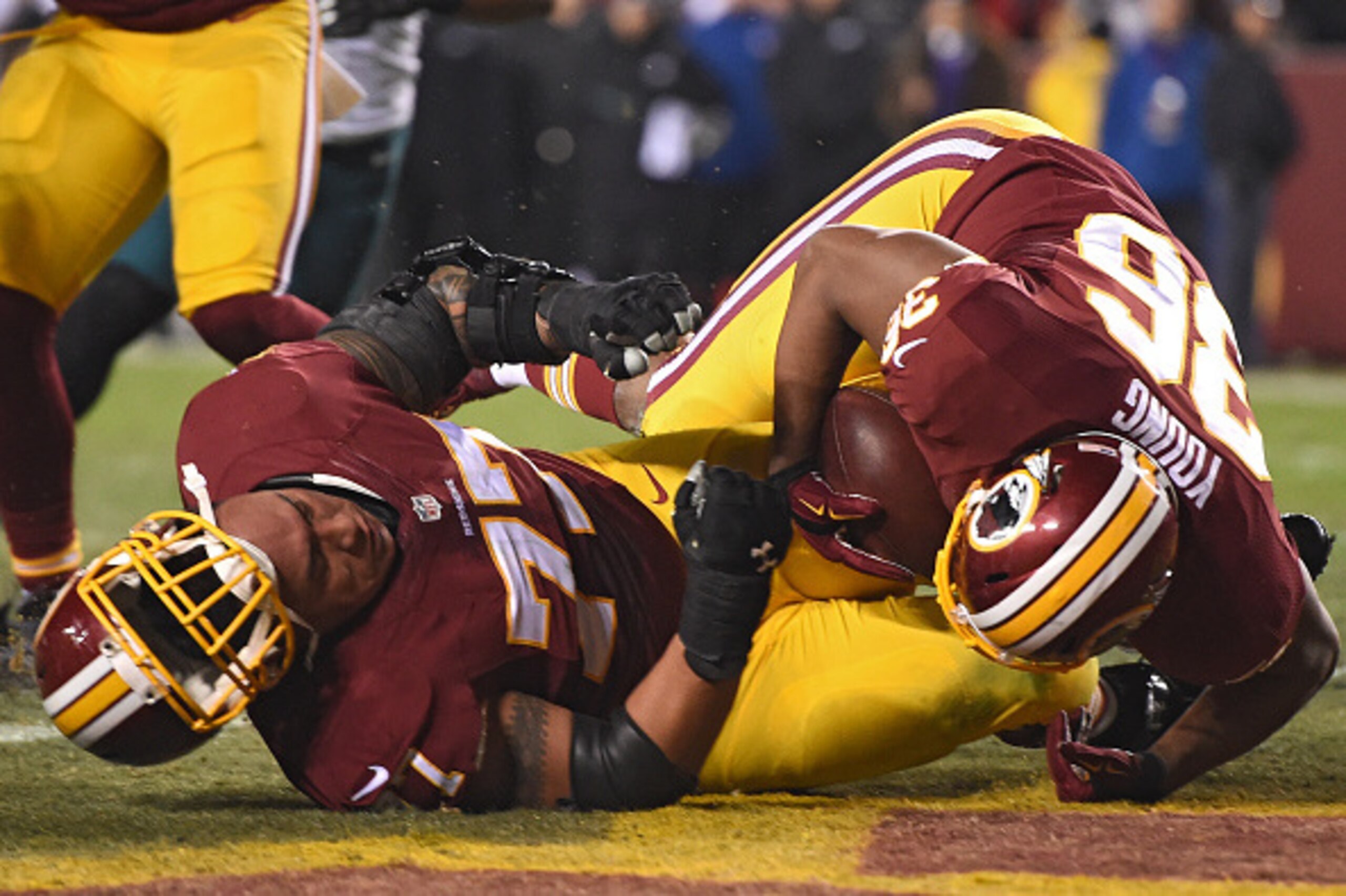
The five touchdowns his 20 total touches yielded last season should provide all the evidence needed of what kind of weapon the converted linebacker can be.
Here's a closer look at everything Young brings to Washington's offense, starting with his threat in the passing game.
Flexible Friend
All fullbacks have to have some skill as receivers. Since they naturally get so few carries, catching passes becomes the best way to get their hands on the ball.
Most of the time that translates to mere short-range receptions, usually in the flats. But Young is no middling target. In fact, he's flexible enough to be moved around formations to confuse defenses and create mismatches in coverage.
Take a look at this touchdown from Week 2's blowout win over the Jacksonville Jaguars for proof.
Young was motioned out of the backfield prior to the snap. He split out wide as the "Z" receiver:
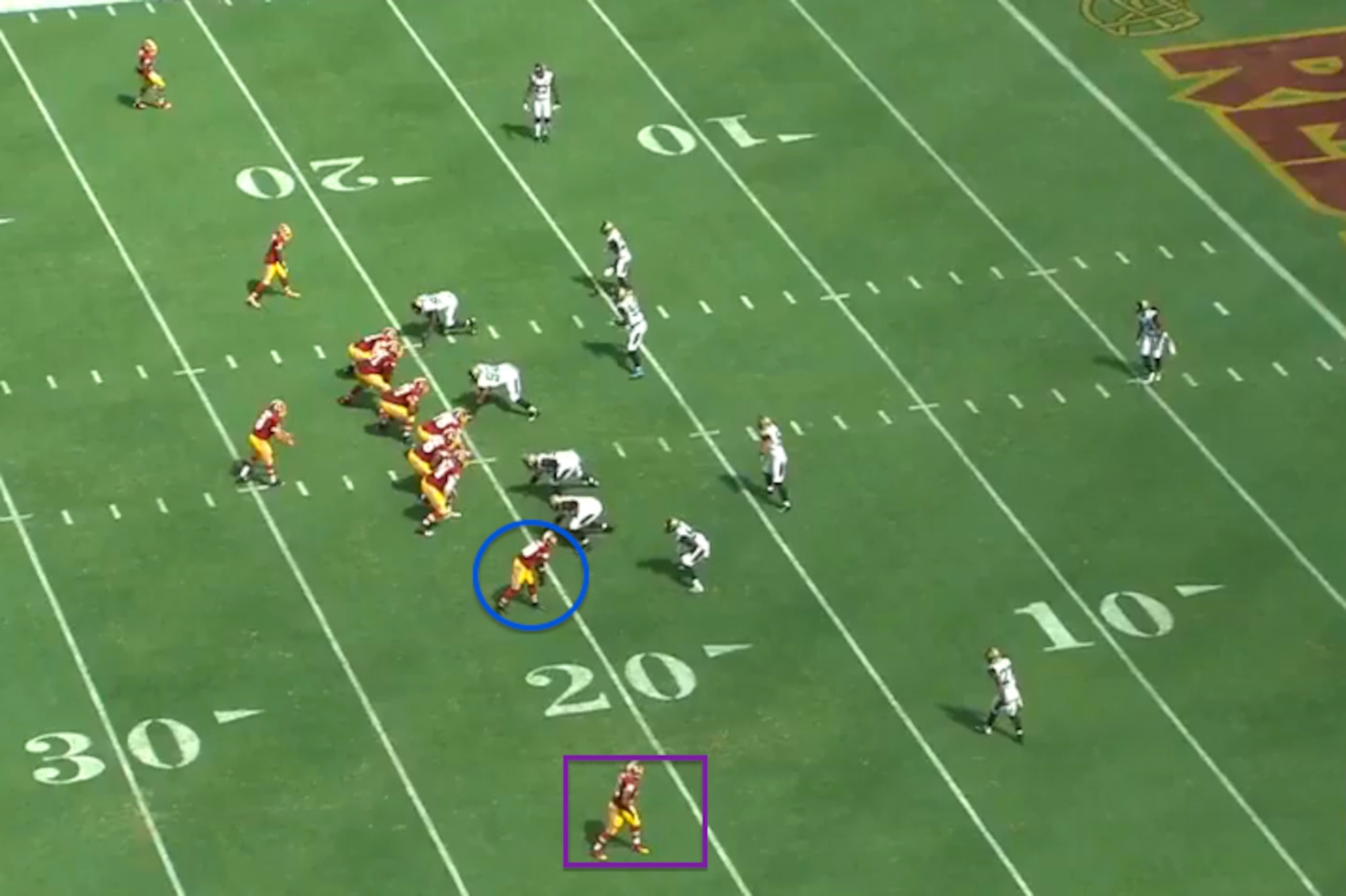
Notice how wideout Pierre Garcon tucked inside to the slot (blue circle). On the other side of the formation, halfback Alfred Morris was split out wide as the "X," while flanker DeSean Jackson aligned in the slot.
This really was an excellent design by head coach Jay Gruden and offensive coordinator Sean McVay (Yes, you read that right). They created an unusual formation that challenged Jacksonville's inside defenders, the nickelback and strong safety, to cover dynamic wide receivers, an obvious mismatch.
Wanting to avoid a matchup nightmare, the Jags would have preferred to match their outside corners against Jackson and Garcon, something that caused major confusion after the snap:

The inside defender on Young's side of the field tried to pass Garcon off to the outside corner. The cornerback looked inside to Garcon, leaving Young free to escape up the sideline uncovered.
He was left uncovered because the single-high safety was naturally more concerned with the threat from Jackson on the other side. Young soon spotted the opening and began to signal quarterback Kirk Cousins to get him the ball:
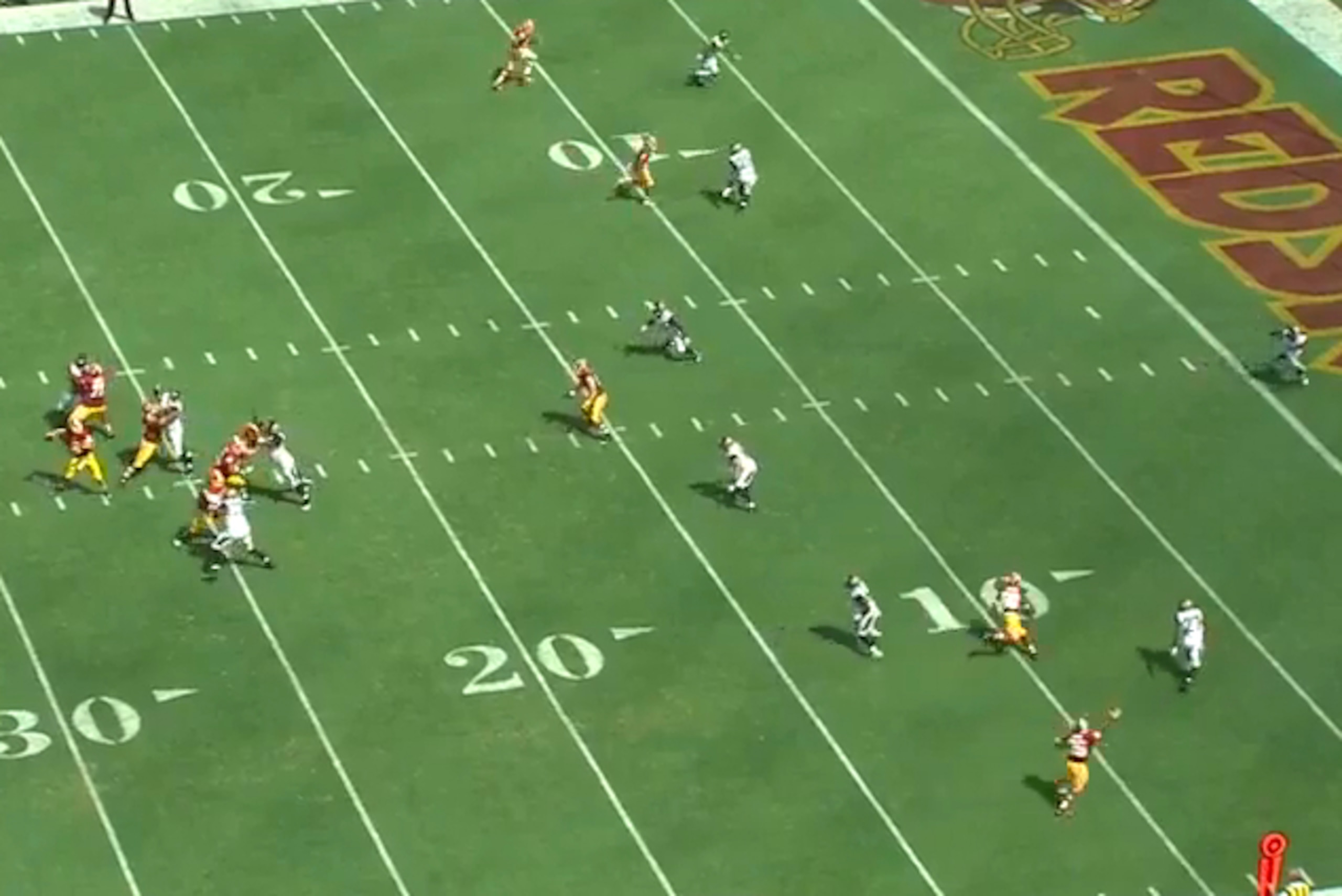
This coverage breakdown left Young wide-open to reel in an easy 20-yard scoring catch:

Although he'd been the beneficiary of a coverage breakdown from an inexperienced defense, Young had helped create the confusion by his alignment. Not many fullbacks would be trusted to split out wide and run a post to the end zone.
Yet Young offers that level of flexibility to the passing game. It's an element of his game that should be used more often, but isn't the only quality he offers as a receiver.
Call Him Mr. Clutch
Need a play in a clutch situation? Simply get the ball in Young's hands.
The 28-year-old has quietly (very quietly) established a niche for delivering crucial yards at key moments. Perhaps the most notable example from recent seasons came during Week 8's thrilling road win over old enemy the Dallas Cowboys.
Washington faced a 4th-and-1 in the final quarter and Gruden decided to go over it. With older brother and ESPN commentator Jon calling for a Morris run behind dominant left tackle Trent Williams, the younger Gruden instead dialed Young's number.
The play called for the fullback to release into the flat off play action:
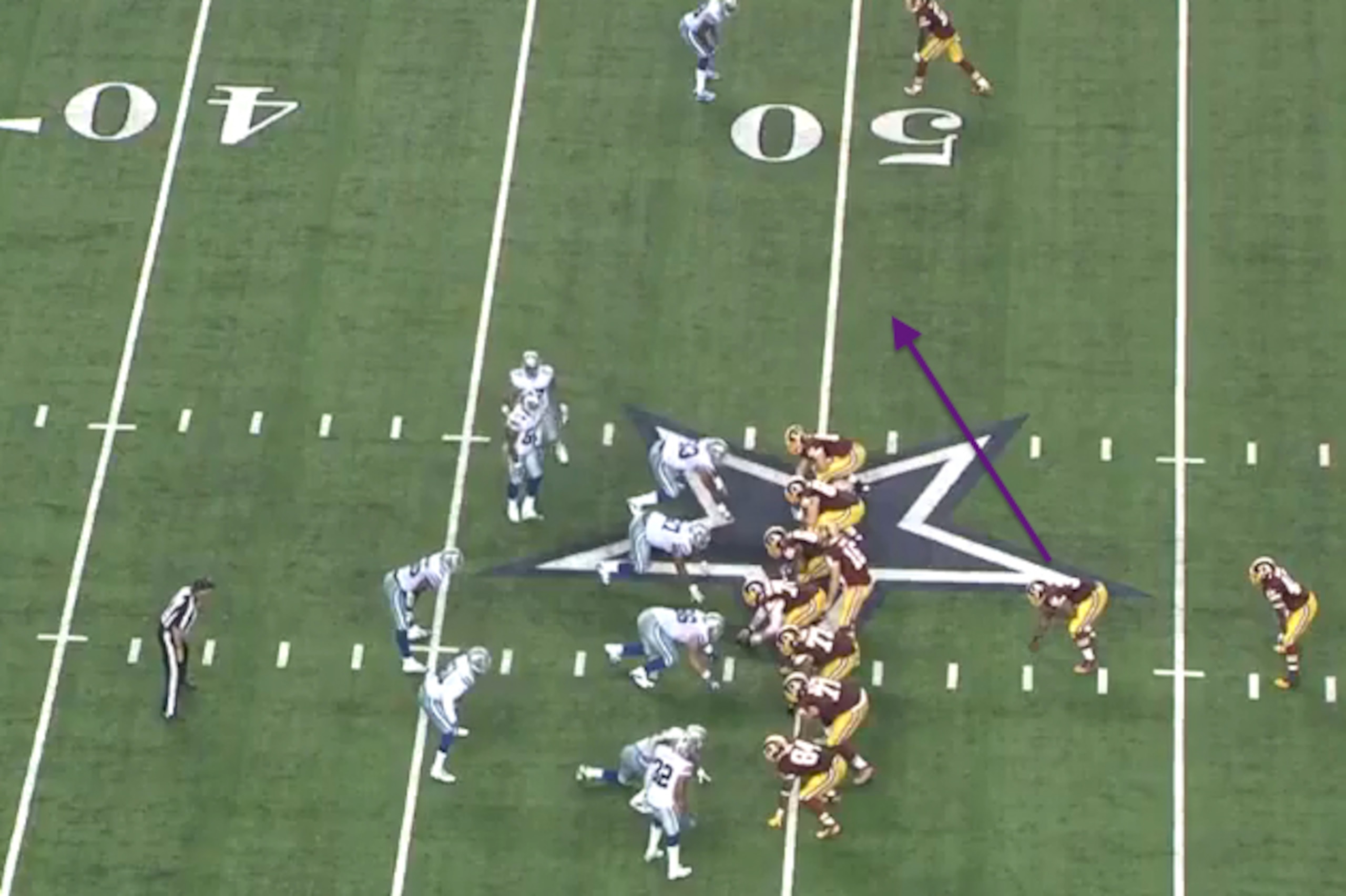
As quarterback Colt McCoy faked the handoff to Morris, Young crept off the line and into the flat. As he did, the receiver on the far side ran a slant pattern that occupied both the cornerback and deep safety:
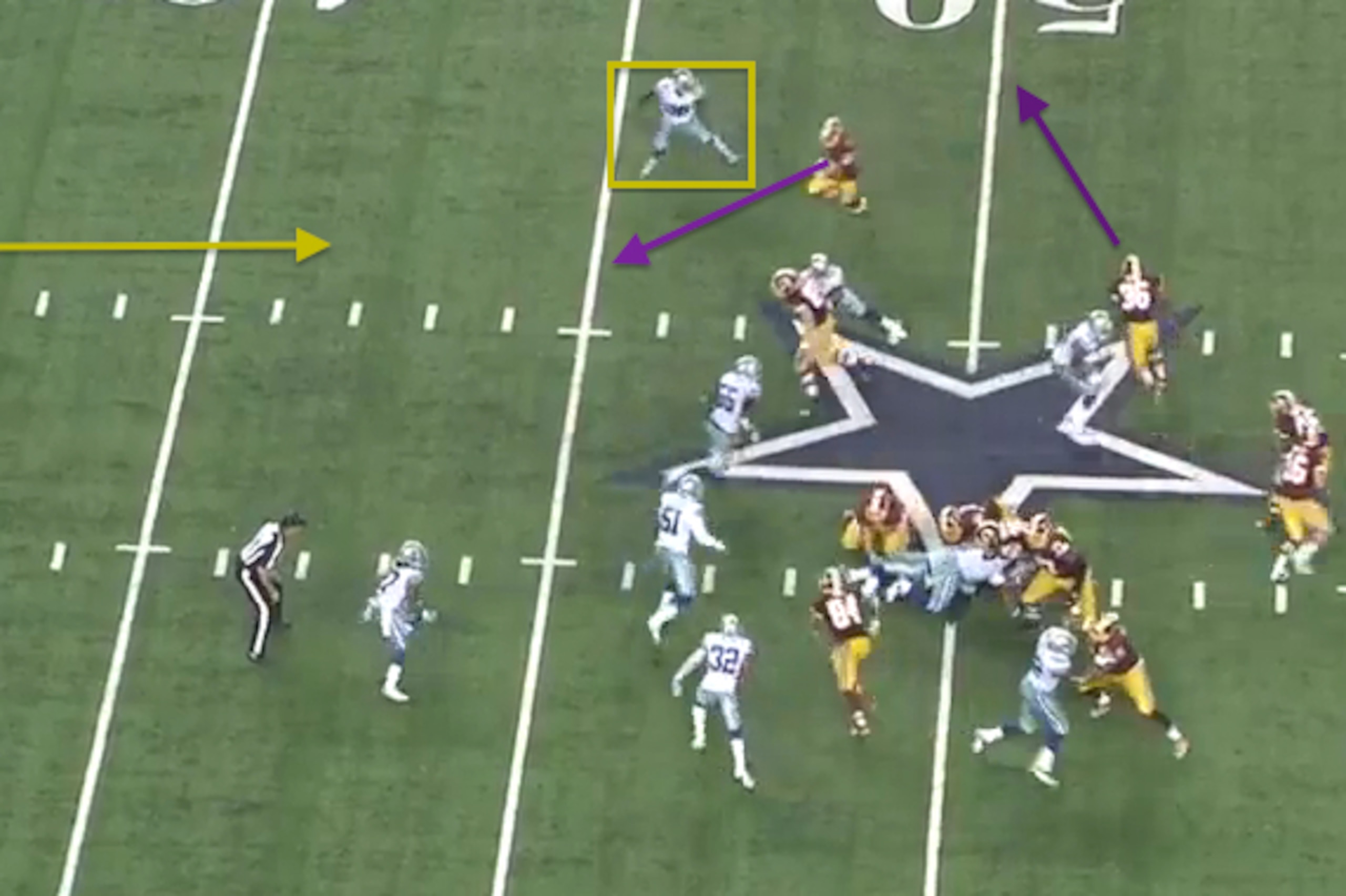
The fake to Morris immediately got rush end Anthony Spencer peeking into the backfield. So did the Cowboys linebackers. Spencer was oblivious to Young's release:

Ignored by the Dallas defense, Young was left wide-open in the flat Garcon had helped clear out. He snagged McCoy's dumpoff pass and turned it into 12 yards and a fresh set of downs:

A player coaches and teammates can trust when the pressure is on is invaluable to any roster. Young certainly belongs in that category.
So far, you've seen how he worked with both Cousins and McCoy. But what about his rapport with the man set to resume his starting role this season?
Helping Hands for Robert Griffin III
If Gruden and McVay are looking for some justification to get Young more involved, they should look no further than his rapport with Robert Griffin III. The fullback has proved he can be an invaluable outlet for a raw passer who still needs to improve significantly in multiple areas.
One of Young's best assets for Griffin is how he offers a helpful target whenever the dual-threat signal-caller breaks the pocket and uses his legs to escape pressure. When a quarterback is an equal, if not better runner than he is a passer, plays rarely unfold the way they were drawn up.
That's why teams with a mobile quarterback have to know what to do when he ad-libs. In common NFL parlance, it's known as the scramble drill.
Young is an expert, as he proved during a road loss to NFC East foe the Philadelphia Eagles in Week 11 of the 2013 season.
Initially, the play called for Young to release from the backfield and run a circle route to the flat. His was merely a safeguard pattern, a checkdown option:

The early moments of the play show Griffin is not even looking Young's way. Instead, he's naturally focused on his primary reads. But crucially, Young has not taken his eyes off Griffin:
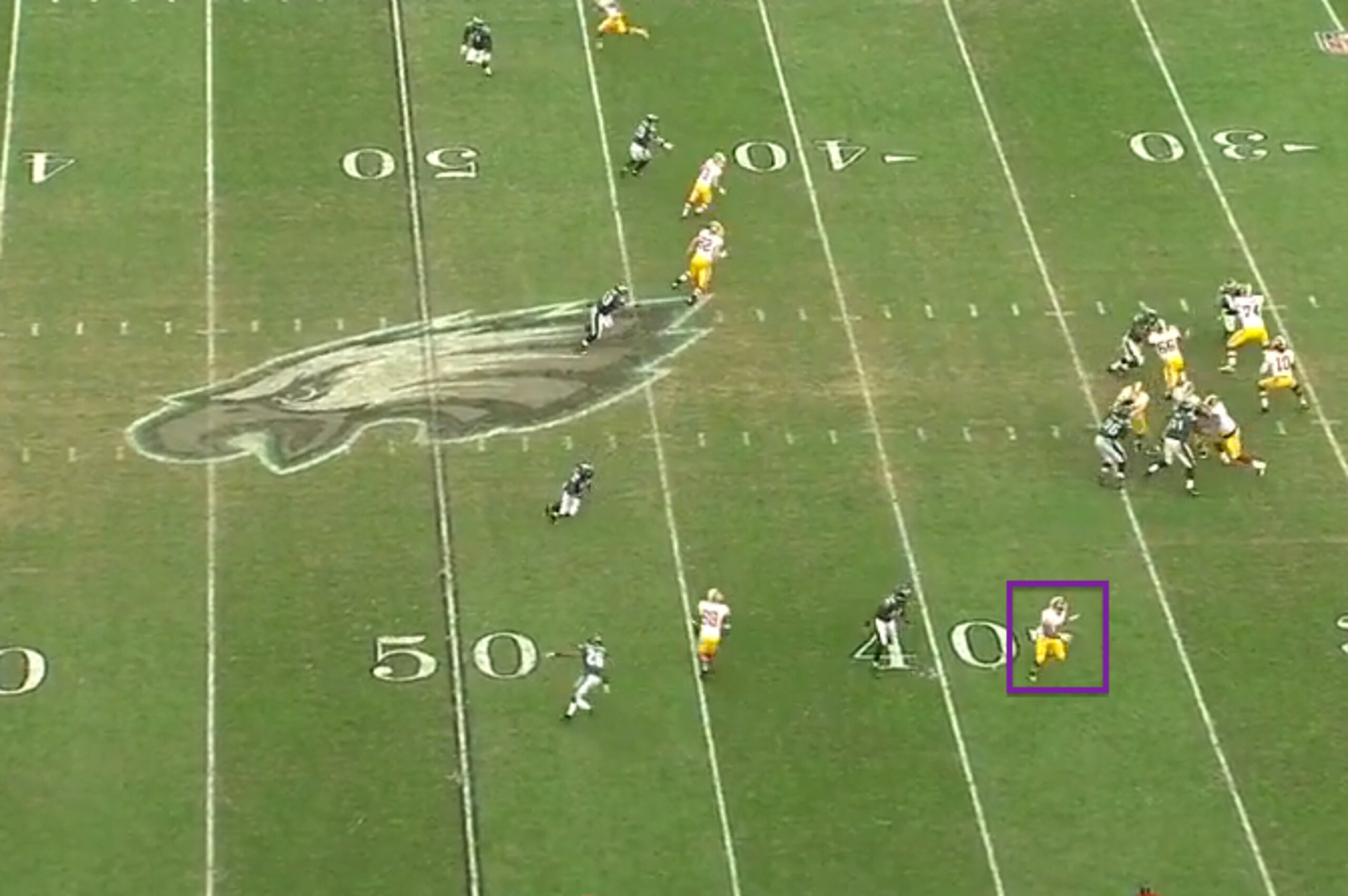
As soon as Griffin felt pressure and began to move, Young saw him flee the pocket. The instant he did, the fullback turned his route upfield, knowing his immediate coverage would be drawn to Griffin's run:
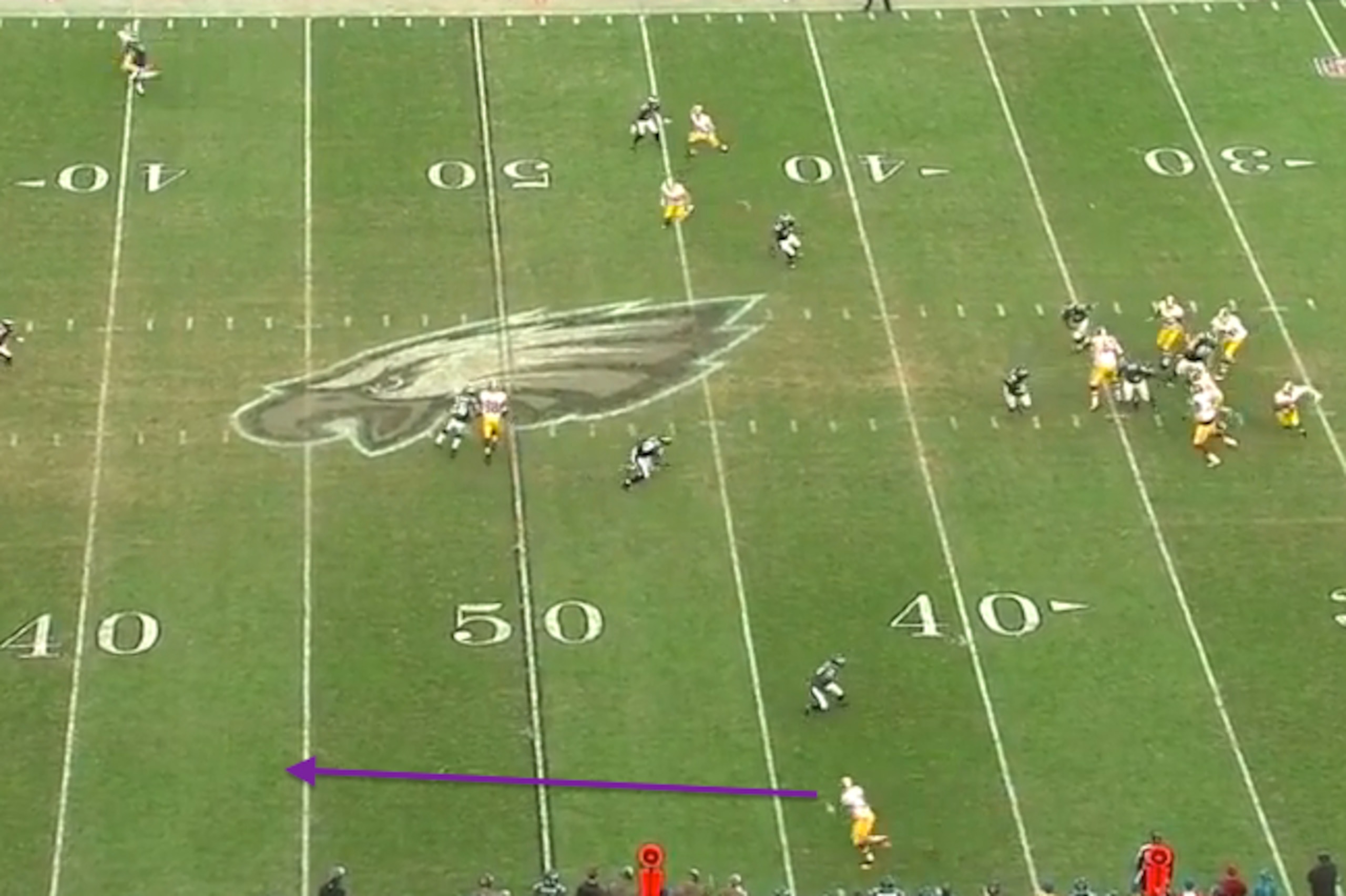
Young was now ideally positioned to offer an under-pressure Griffin an easy target to beat the rush. That's just what Griffin did, flipping the ball over the heads of closing defenders toward Young:
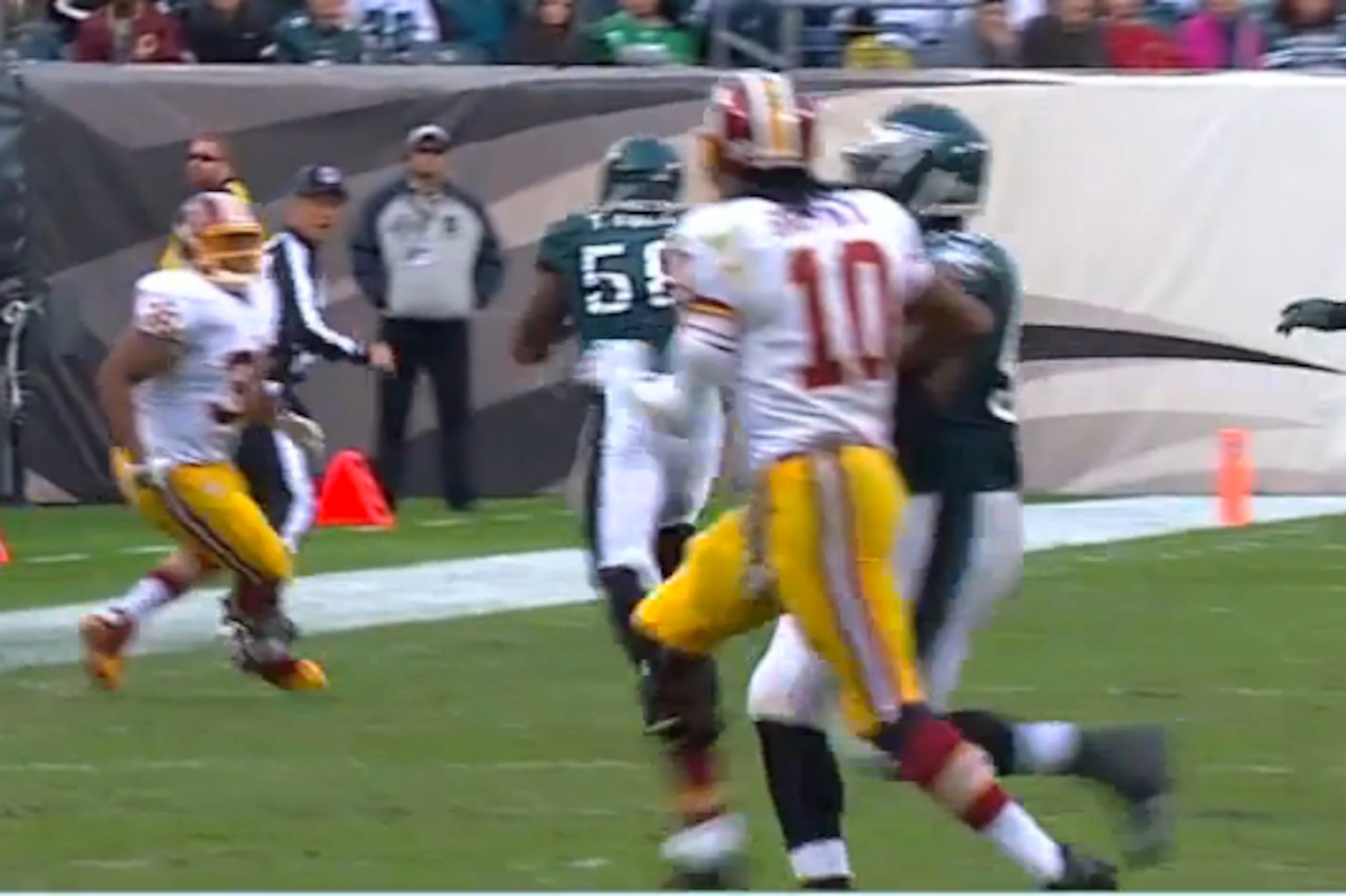
As he caught the pass, Young was aided by two Eagles players colliding with one another. The collision took both out of the play and allowed Young to escape and complete a 62-yard scoring catch-and-run:
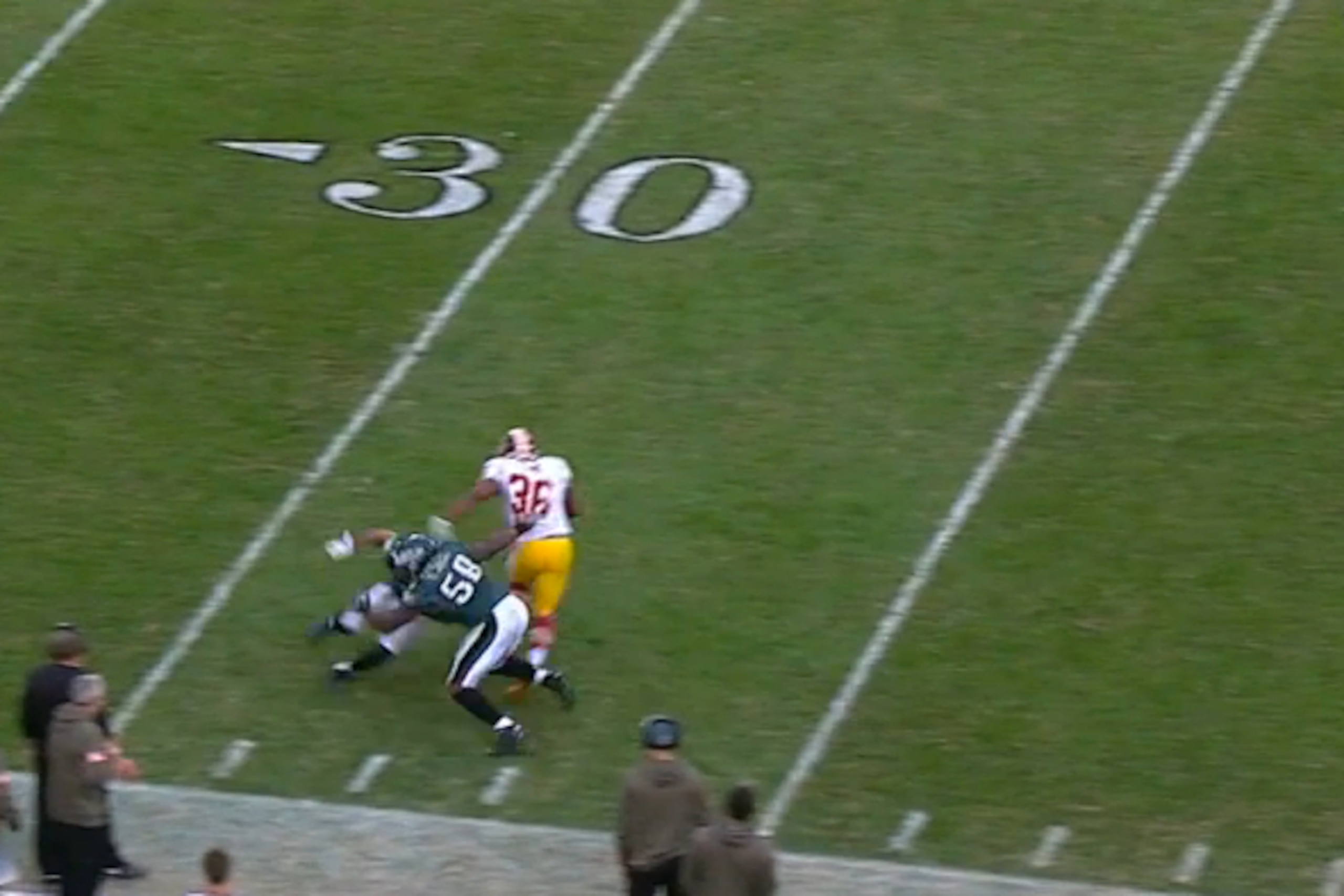
Although he'd again benefited from a defensive calamity, young had also shown excellent awareness for the scramble drill. He'd allowed Griffin to escape from pressure and turn a potential negative play into a big gain. That's a quality any mobile quarterback will cherish.
But it isn't the only way Young is an asset to Griffin.
Playing Captain Checkdown
Regularly targeting checkdown receivers often has negative connotations for quarterbacks. The implication is they can't make reads down the field or force the ball deep.
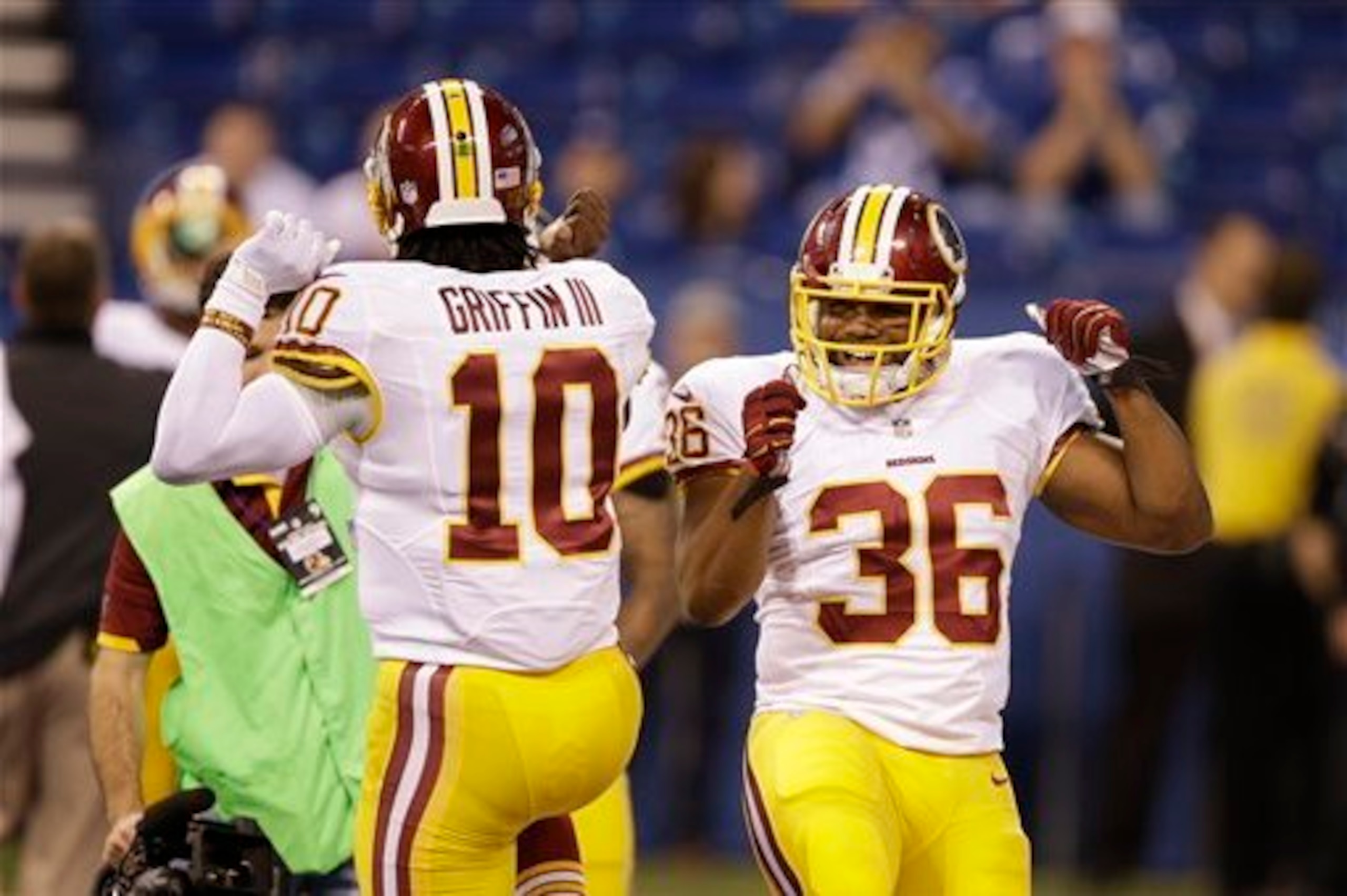
But dumping the ball off short is also a way of protecting it. It's something Griffin has never fully mastered, but it's also the necessary first step toward improving his accuracy and speeding up his release.
To achieve either of those things, Griffin needs a checkdown target he can rely on. Enter Young, currently the most effective backfield receiver on the team.
A play from a road win over the Tampa Bay Buccaneers in Week 4 of the 2012 season shows how this relationship works.
Young would release through the Tampa Bay line on a sort of hook pattern that would veer from the middle toward the sideline:

Once Griffin turned to fake a handoff to Morris, the entire Bucs front seven was playing run. Remember, this was 2012, when Griffin's mobility was top-notch, so it wasn't uncommon for receivers to be left running wide-open while virtually an entire defense played run:
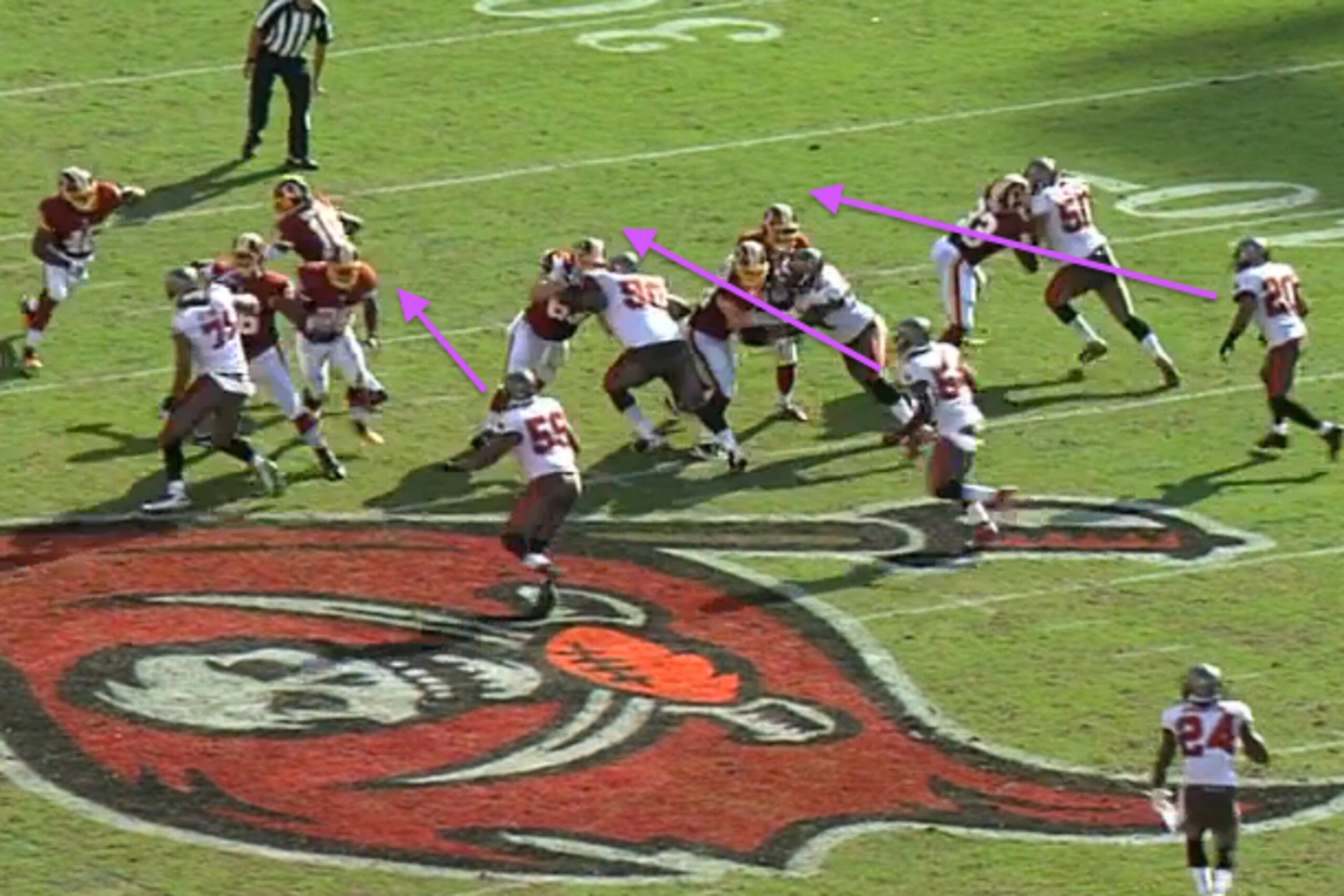
What was great here was how Young sold the fake by initially executing a lead block on the linebacker:

With the deception complete, Young broke off and drifted to the outside. Seeing Griffin get itchy feet and begin to move, he raised his arm in signal to give his quarterback an easy target and throw:

Having gotten Griffin's attention, Young received the ball in space and then beat the first would-be tackler. He executed a cut so deft no fullback should reasonably be able to make it:
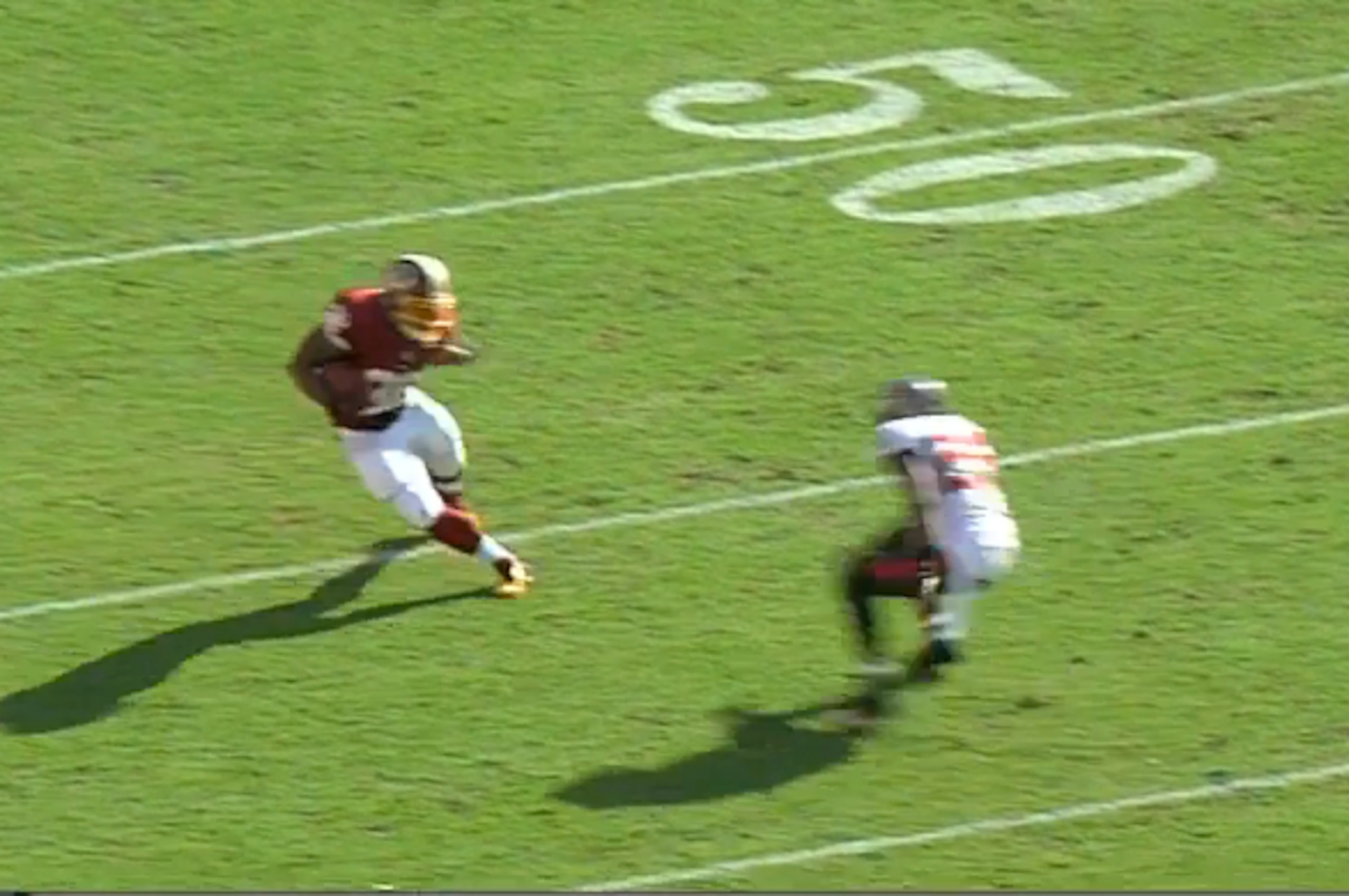
With the defender put on the ground by the nifty move, Young used a stiff arm to help him taste some turf before escaping to complete a 24-yard gain:
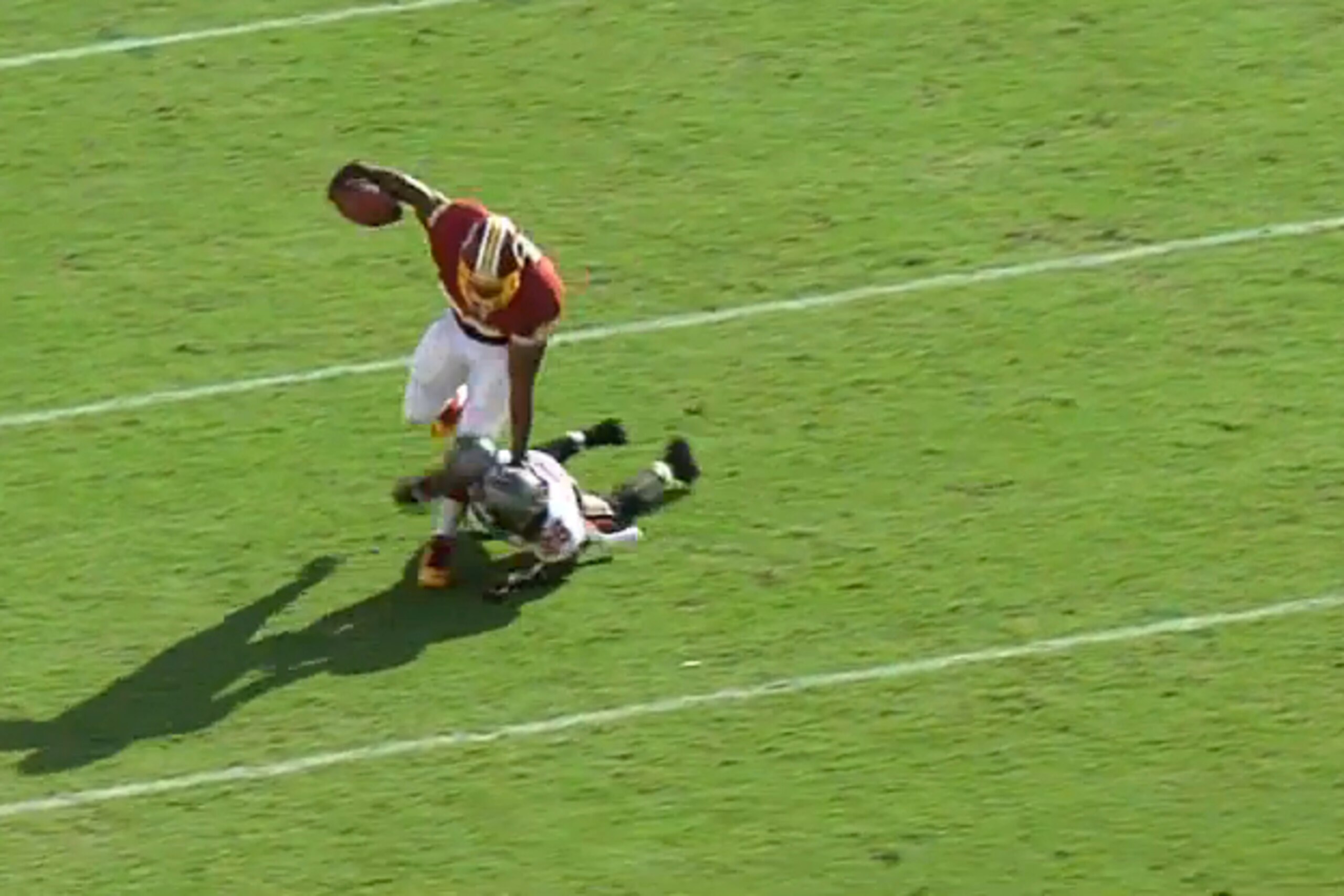
This play might have been a sack or just a short run from Griffin. But Young's awareness and smarts gave his quarterback an outlet.
One of the main criticisms of dual-threat quarterbacks is that they run too often when they should stay patient and find a pass. Running becomes a default escape mode, one that wastes gains in the passing game and can lead to injury, as Griffin knows only too well.
The best way to convince him to run less, is to consistently surround him with pass-catchers who make themselves easy targets. Griffin has to trust his checkdowns will be open, while the offense as a whole needs them to turn short passes into big gains.
With his surprising range of moves and initial power, Young has the skills to pile up yards after the catch.
He also has a talent for stretching the field.
Downfield Threat
How many fullbacks can consistently help their teams push the ball down the field? If you said not many, or even none at all, you're probably right.
Young may be the only fullback in the league who can offer a credible downfield threat. He's quick and decisive out of his breaks and runs his routes well.
Take a look at this great example from a win over the Baltimore Ravens in Week 14 of the 2012 season.
Young prepared to release through the middle off a play-action look from Griffin and Morris. His aim was to get to the void behind the linebackers and in front of the safeties:

Once again, the fake from Griffin naturally drew the attention of every member of the Ravens front seven. As it did, Young was able to sneak behind the linebacker level:
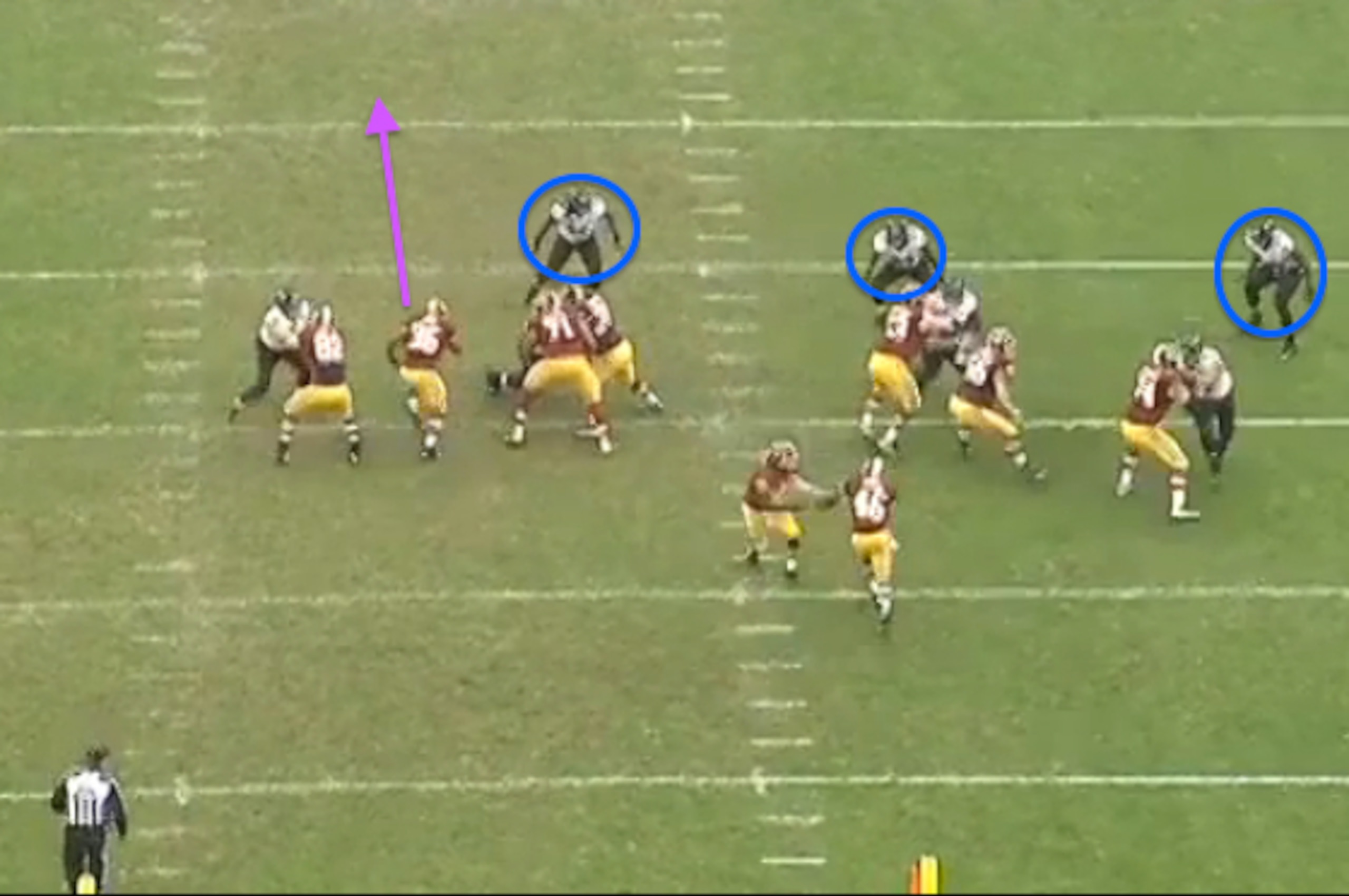
Here's an overview of the chasm of space he escaped into:

Notice how he smartly positioned himself behind the first and second levels of the defense and in front of the deep coverage. Young didn't overextend his route, even though he had the room to do so.
But that would have meant Griffin having to hold onto the ball longer while Young pushed further downfield. Instead, Young simply sat down in the void and gave his quarterback a quick and easy throw to make.
The result was a 28-yard gain:
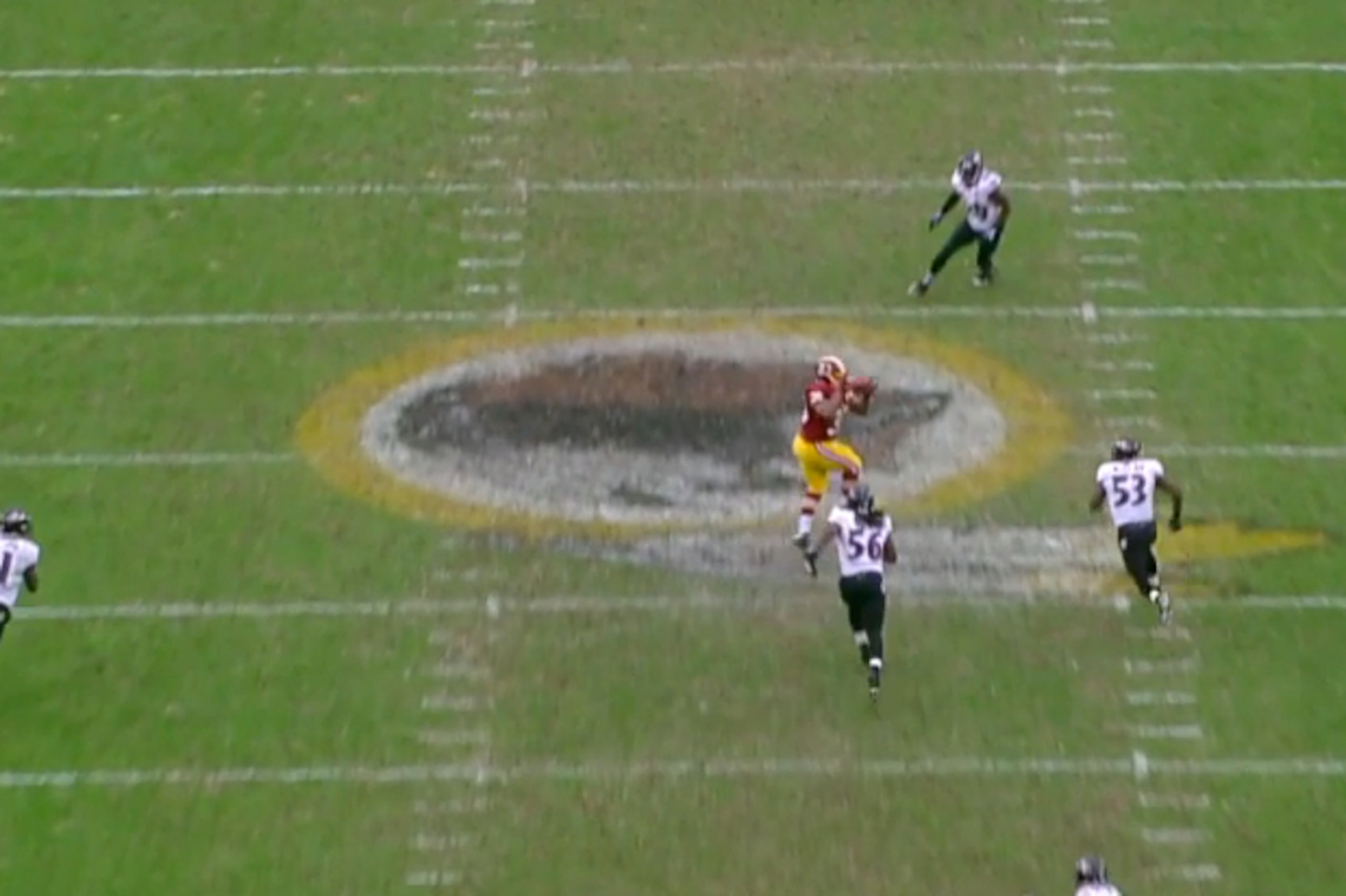
Being able to target a fullback for close to 30 yards has to be an X-factor for any offense. Really, what defense would honestly expect it?
Young gives Washington's passing game this kind of extra dimension. It's one of the many strings to his bow as a receiver.
Yet as much as he needs to be utilized more in the pass attack, Young is also woefully undervalued in the running game.
A Better Runner Than You Think
As runners, fullbacks are often designated for short-yardage work and little else. While Young excels in this area, he also boast skills that suggest he merits a few more carries.
Specifically, he displays quick feet, good vision and shifty moves. All three qualities were evident on one run from Week 7's win over the Tennessee Titans.
The Redskins had set up a counter-style trap play on 3rd-and-short. Young would initially plunge in the same direction as the blocking before cutting back against the grain:
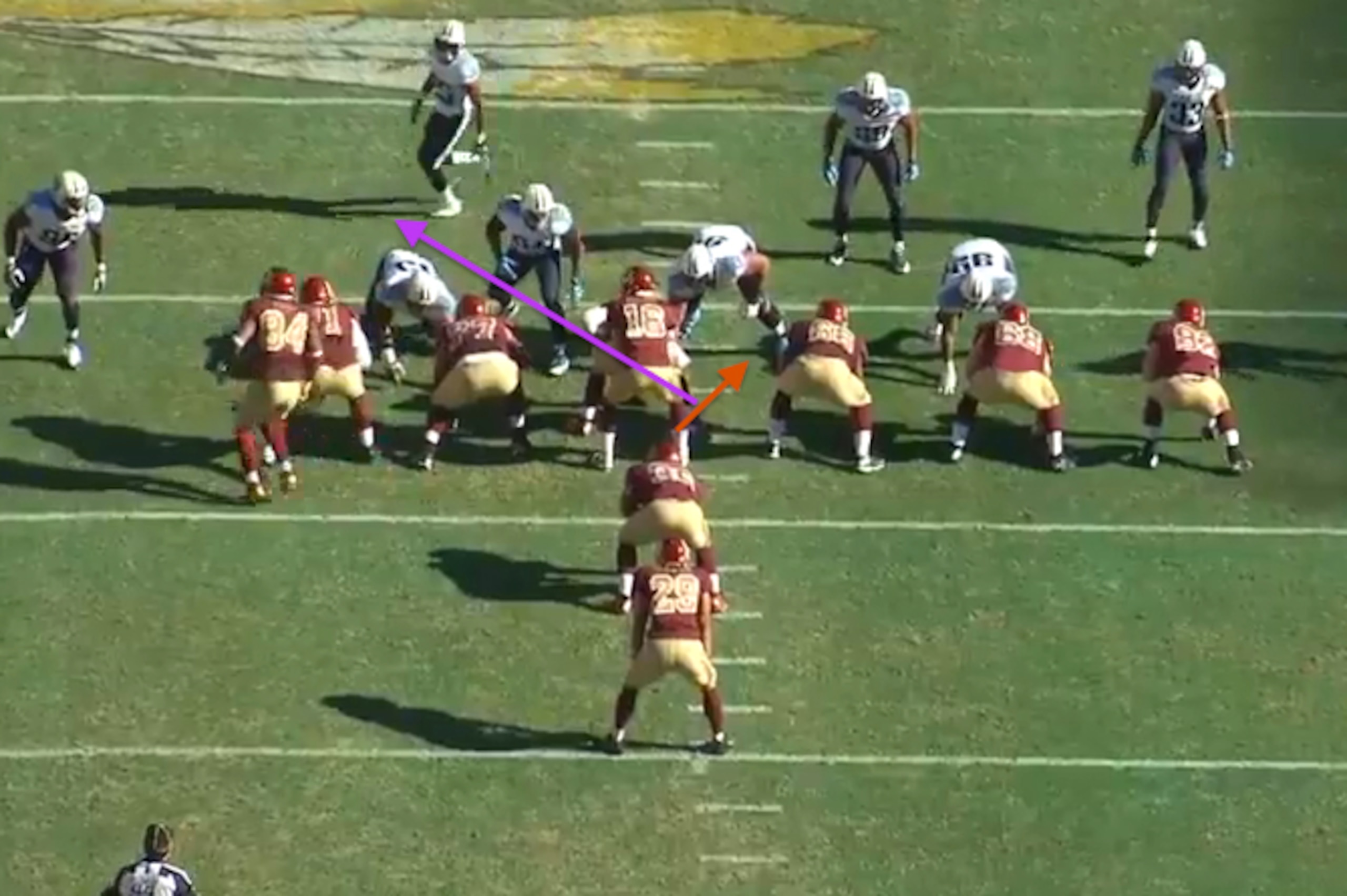
This design required a lot from the fullback. He had to quickly see the cutback lane, before just as quickly shifting his feet laterally to attack it.
Fortunately, Young expertly executed the play. Notice how his feet were perfectly set to execute a cut:
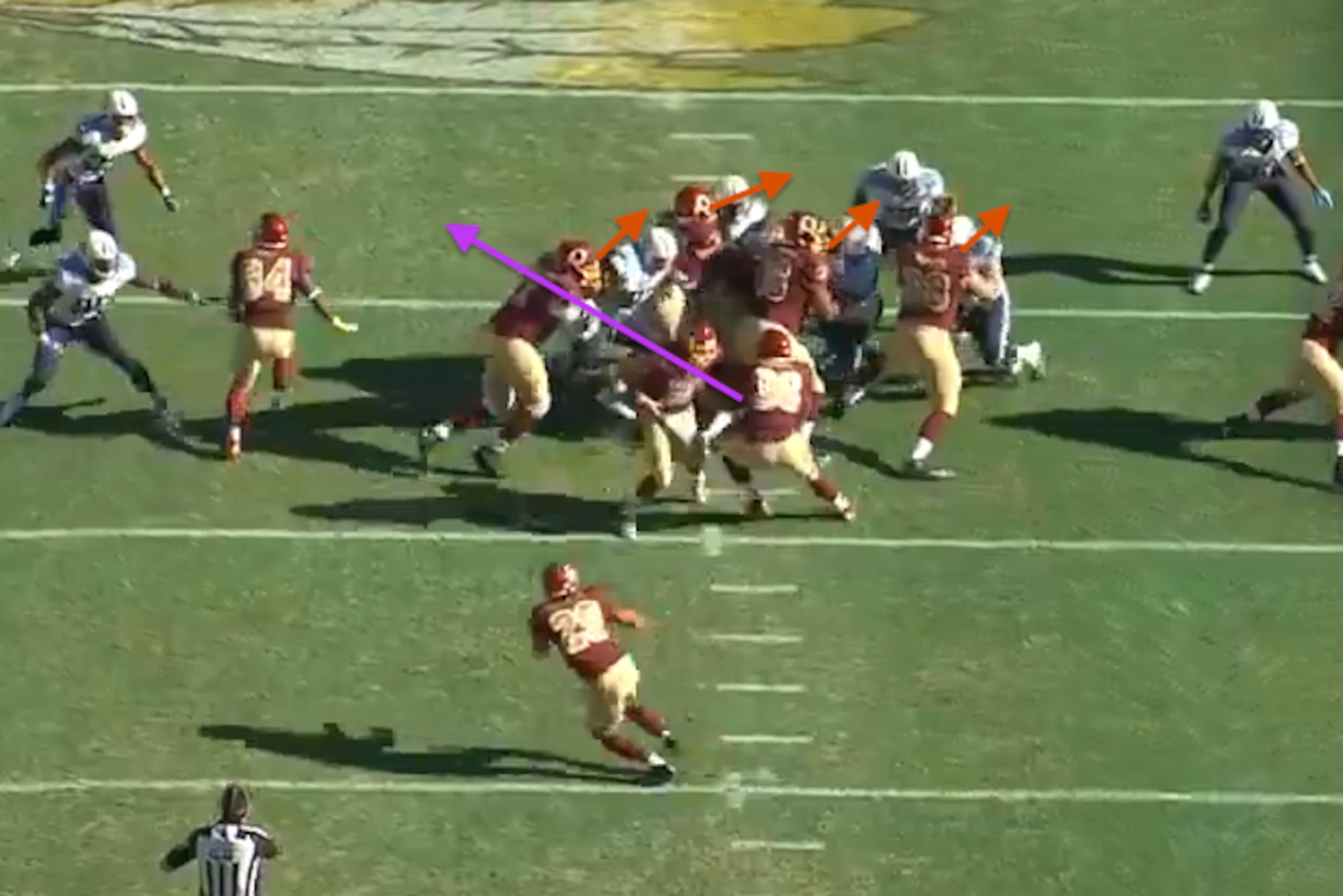
Almost standing on his toes, Young's body position was how a coach might draw it up for any one-cut-and-go run.
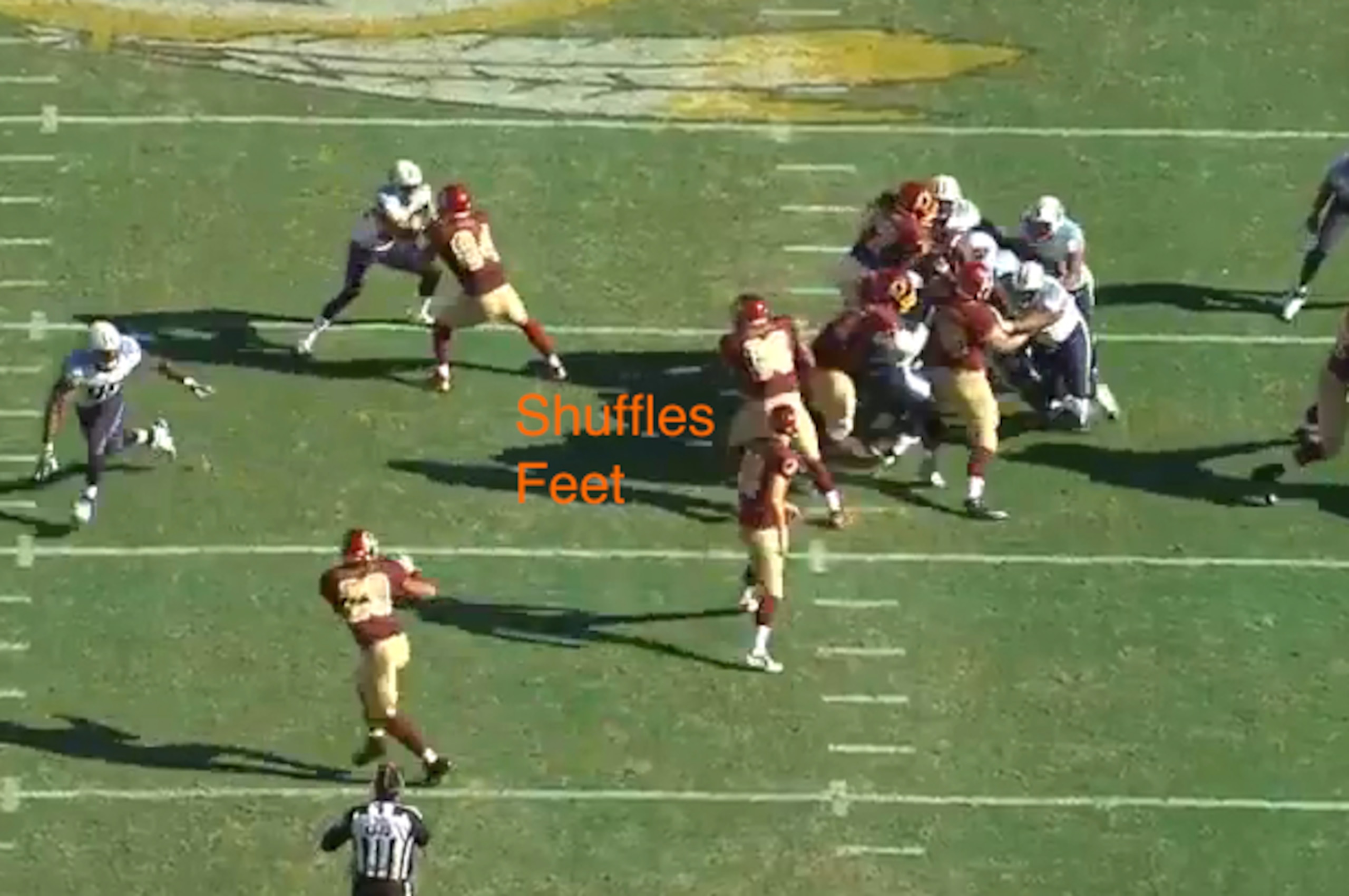
If McCoy wasn't blocking the view on this shot, you'd see Young then shuffle his feet across in lateral steps to set up his run to the outside:
Once he'd made his cut, Young decisively exploded through the backside gap and rambled his way for 14 yards:
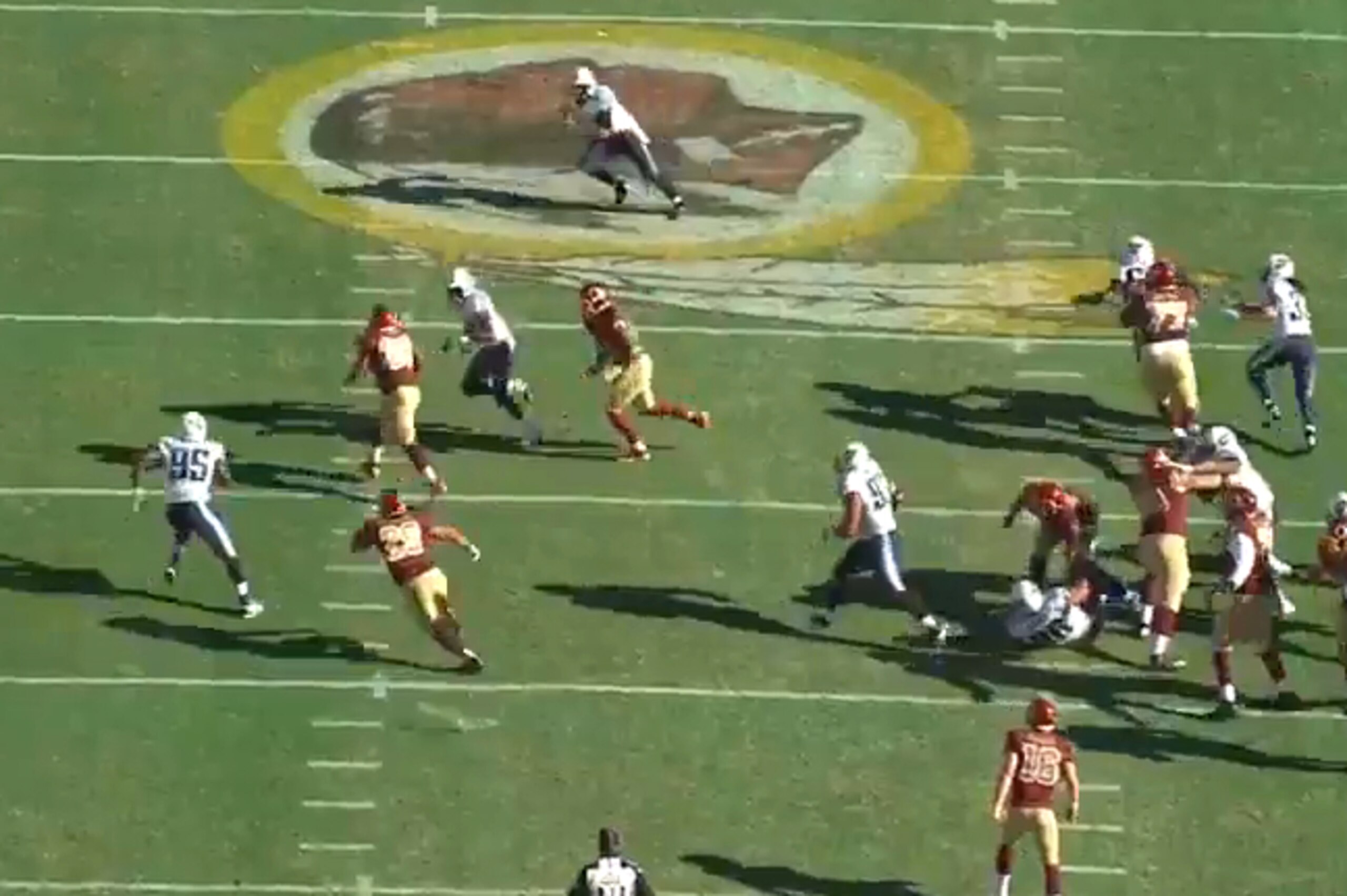
Few, if any fullbacks in the league can run like this. It says a lot that Young was often designated as a backup tailback during the 2012 season, a reflection of the confidence in his talent when lugging the rock.
It's a talent Gruden and McVay haven't really made the most of, despite this excellent play against the Titans. But predecessor Mike Shanahan wasn't quite as shy about turning loose a playmaker who runs with quick feet and formidable upper-body power.
Bringing the Pain, Smashmouth Style
With a head of steam and his shoulders square, Young takes some stopping. Combine that with a deceptively quick initial burst, and you have a runner who can really surprise defenses.
Young certainly caught divisional rival the New York Giants cold during a superb road win from Week 15 of the 2011 season.
The Redskins planned to mask Young's run with misdirection. This involved wide receiver Jabar Gaffney faking an end around one way, while tailback Roy Helu Jr. faked a sweep in the other direction:
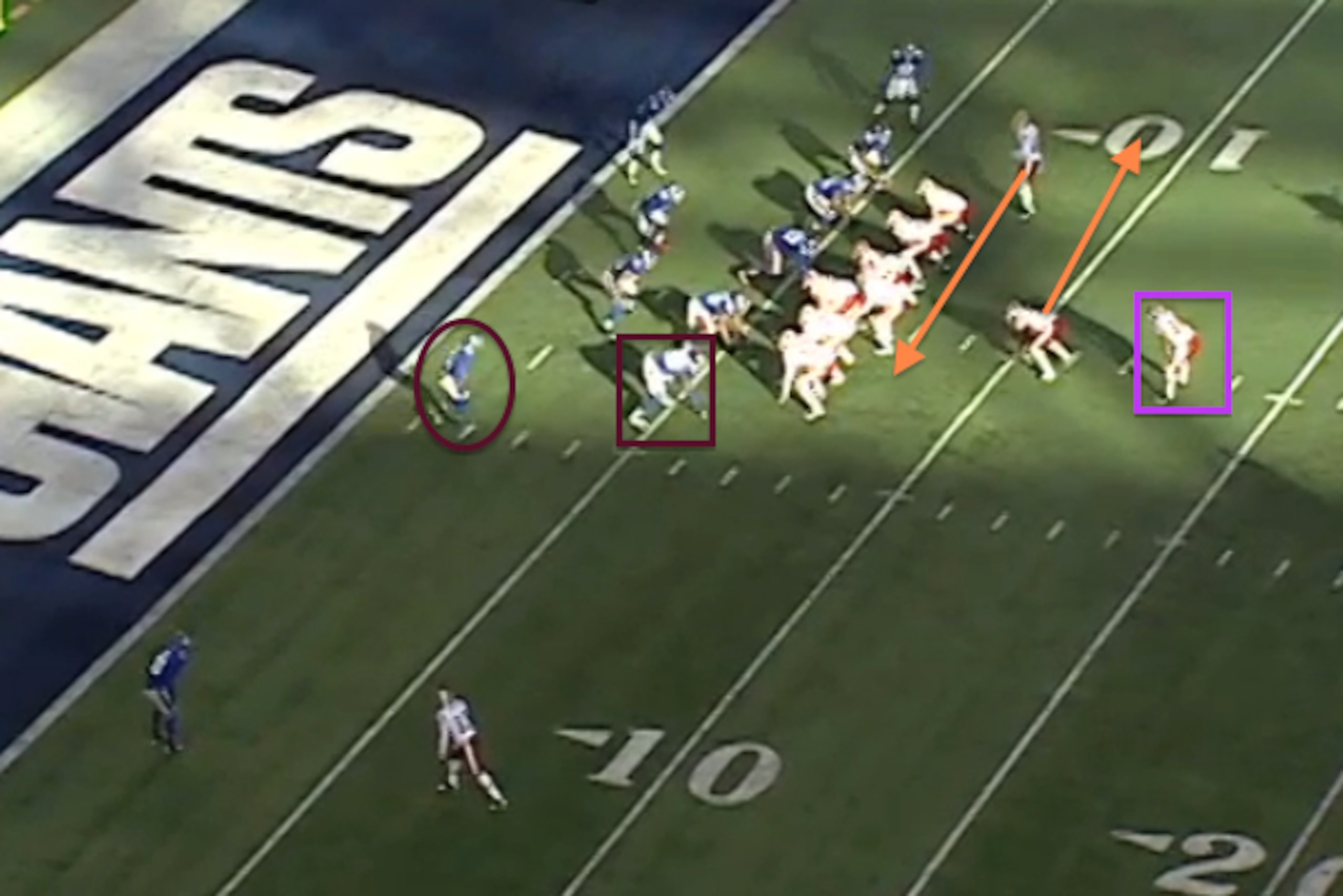
The main principle behind this design was to confuse two defenders, safety Antrel Rolle and defensive end Jason Pierre-Paul. Once the ball was snapped, it soon became clear how well the clever rouse worked.
Pierre-Paul watched as quarterback Rex Grossman faked one way and then the other, not realizing he had already slipped the ball to Young on a quick inside hitter:
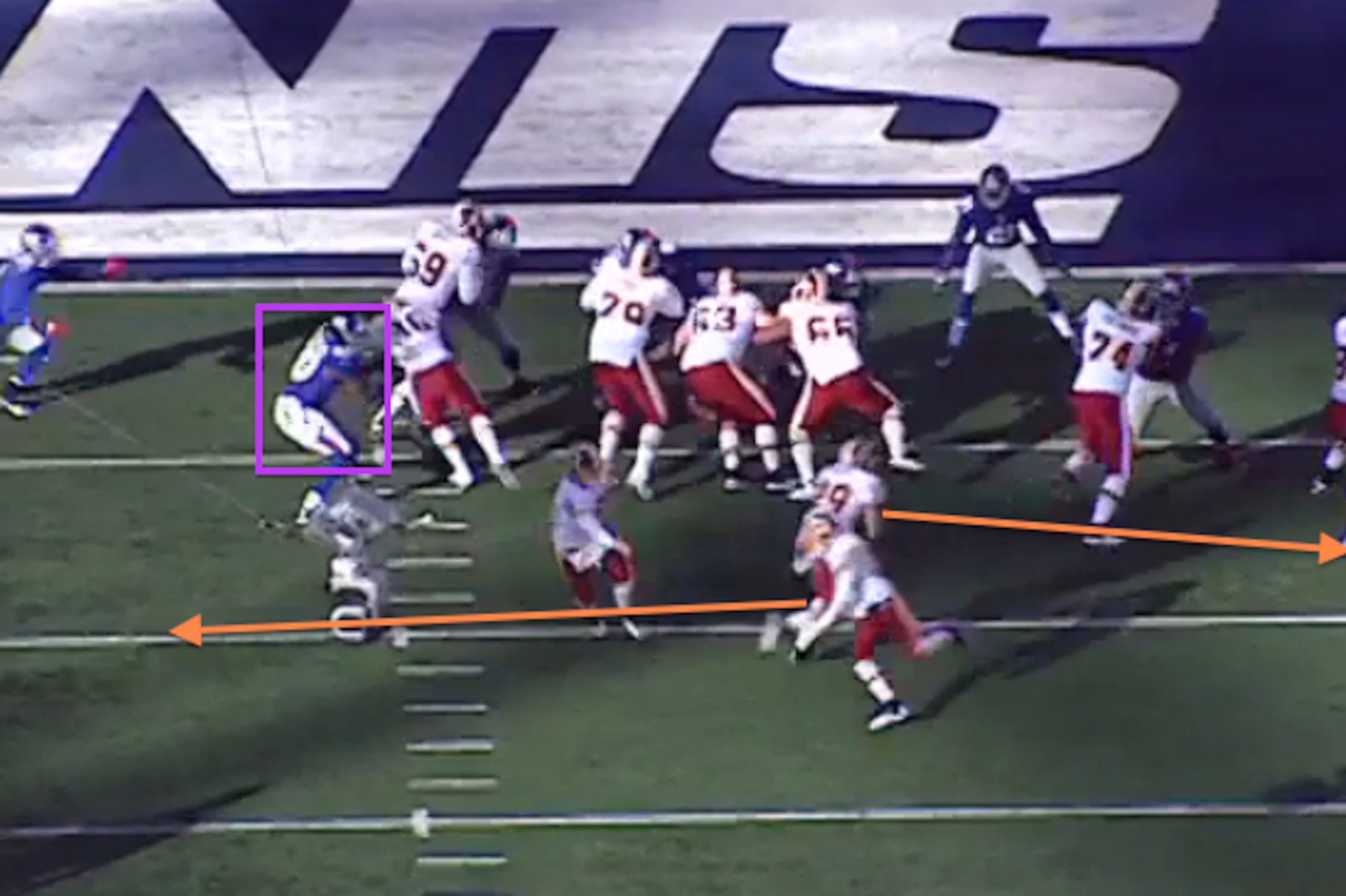
The fullback had already powered through Pierre-Paul's grasp and was plunging toward Rolle.
Even though Pierre-Paul had misread the play, the veteran safety had correctly diagnosed it. The problem was Rolle prove no match for Young's smashmouth brand of running.
Big Blue's defensive back slammed into Young, but was simply run over by the bruising ball-carrier:
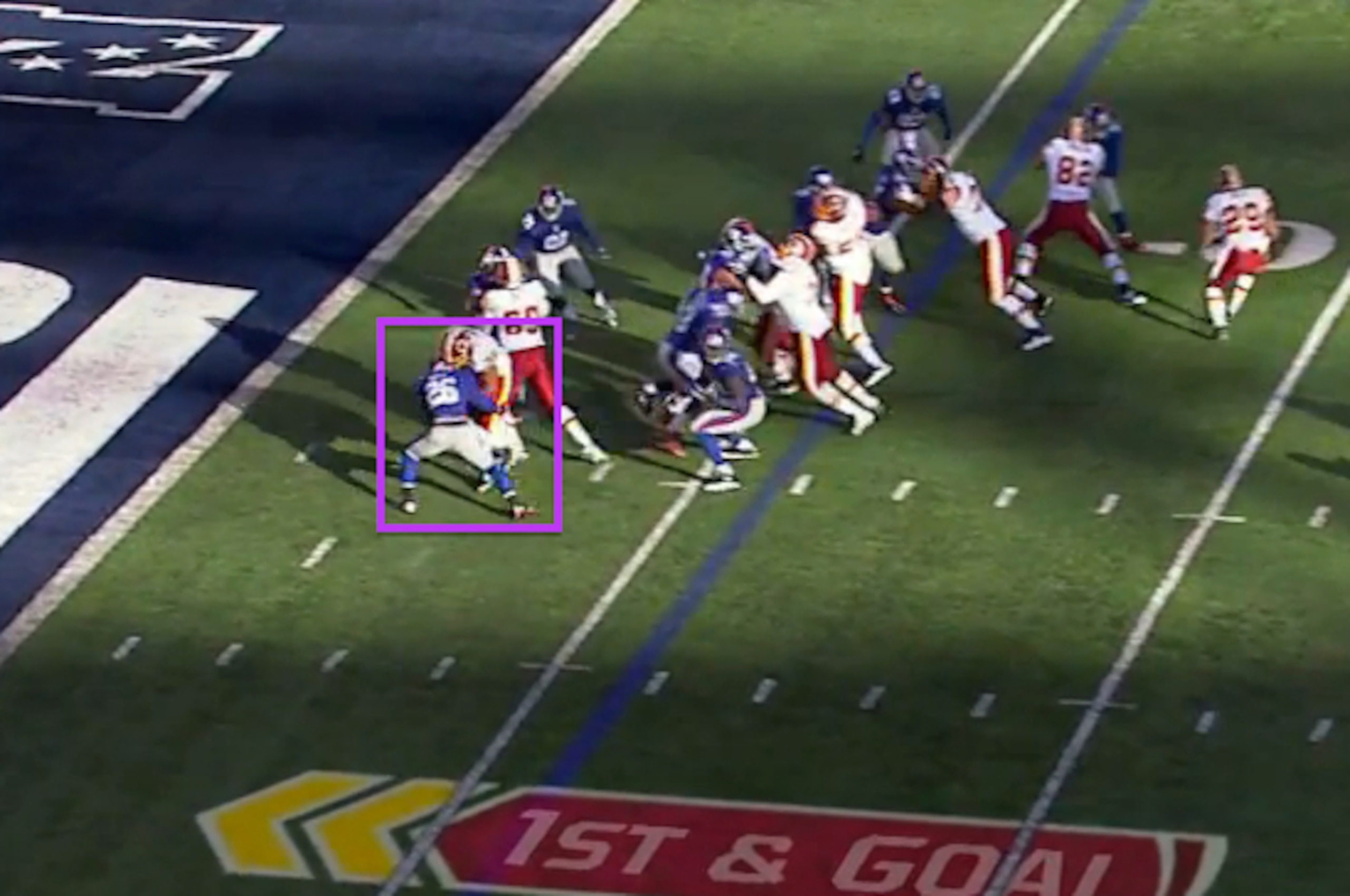
Young literally trampled over Rolle on his way to the end zone:
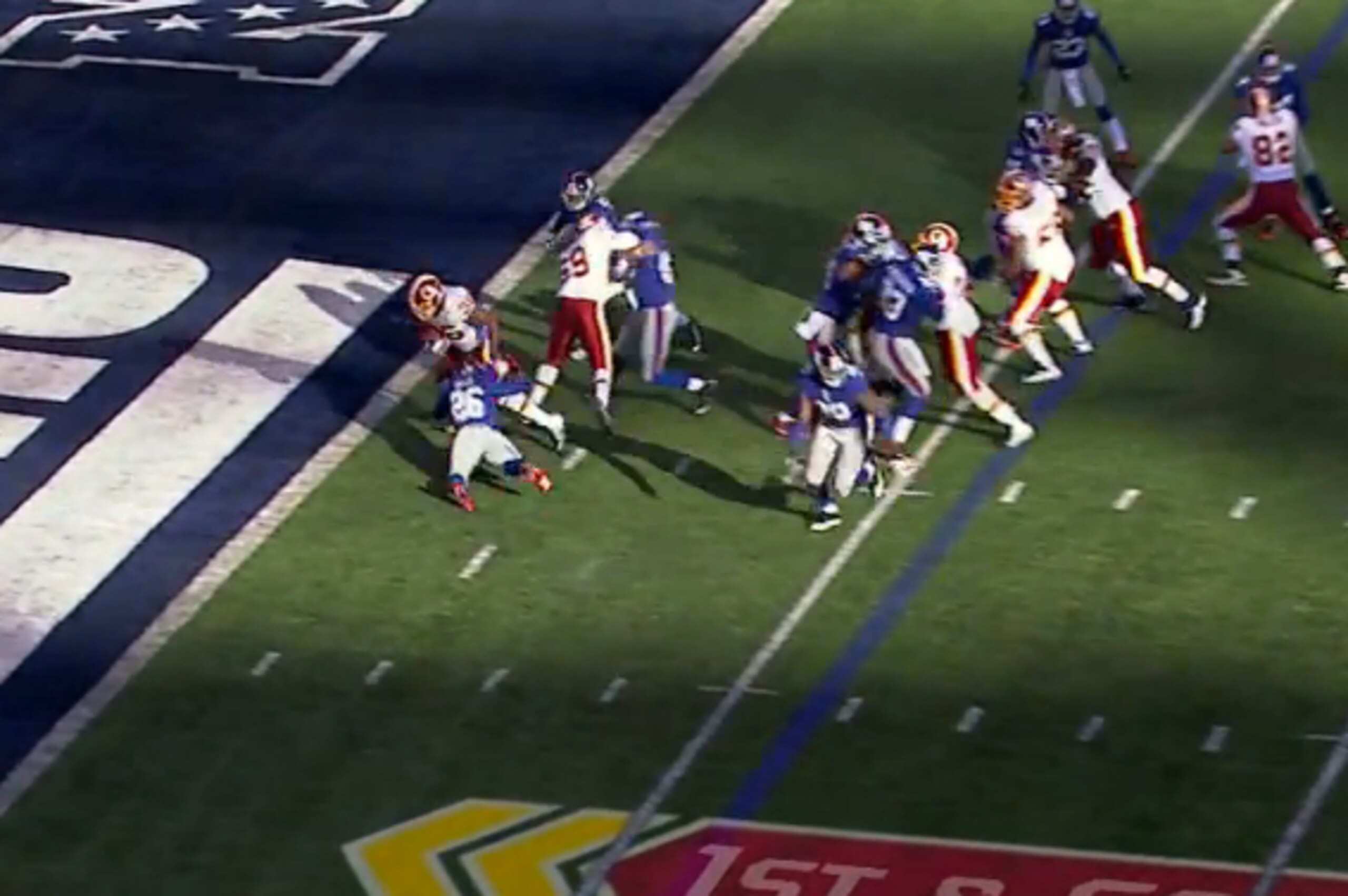
This kind of clever misdirection would have counted for naught if it weren't for Young's talent as a runner. His quick first step and excellent power, particularly whenever his shoulders are squared, are skills too valuable to waste, as the numbers prove.
In his ranking of the top 16 fullbacks in the NFL, B/R analyst Matt Miller commended Young's knack for finding the end zone: "Having a nose for the goal line, Young led all fullbacks with three rushing touchdowns this past season."
He also noted the player's proficiency in a vital area of the field, one Washington's offense has frequently struggled in during recent seasons: "Young excelled in the red zone this past season where he scored five times. If he can continue to make plays inside the 20, his playing time should increase next year."
But defenders don't just pay a high price when they try to tackle Young. The fullback hits for keeps when he lays the wood to create holes for Morris.
Putting Them on Skates
As part of his assessment of Young, Miller also noted a perceived lack of power when lead blocking: "He doesn’t posses the power to consistently clear out holes in the middle of the field or push defenders back off of their spots."
It's not an unreasonable critique when Young has spent most of his time in Washington leading the way on zone-style stretch runs that often target the edges of defenses. But when he's been given the chance to drive straight ahead, Young has rarely let his team down.
Consider this 16-yard run from the opening quarter of Week 12's road loss to the San Francisco 49ers as ample proof.
Young was positioned in front of Morris in an I-formation alignment. His target from this classic power look would be inside linebacker Chris Borland:
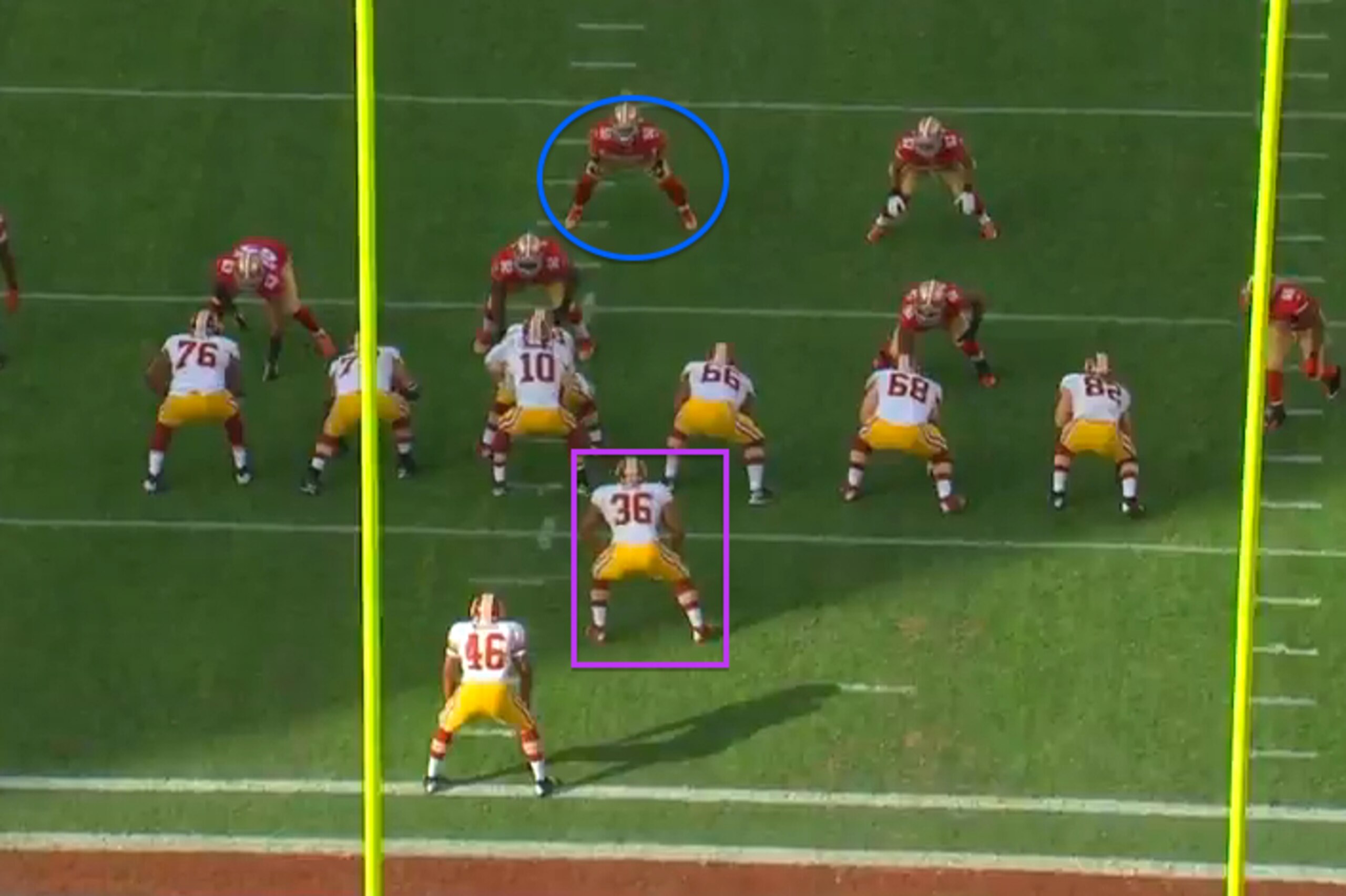
Young's initial contact certainly had Borland rocked and going backward:
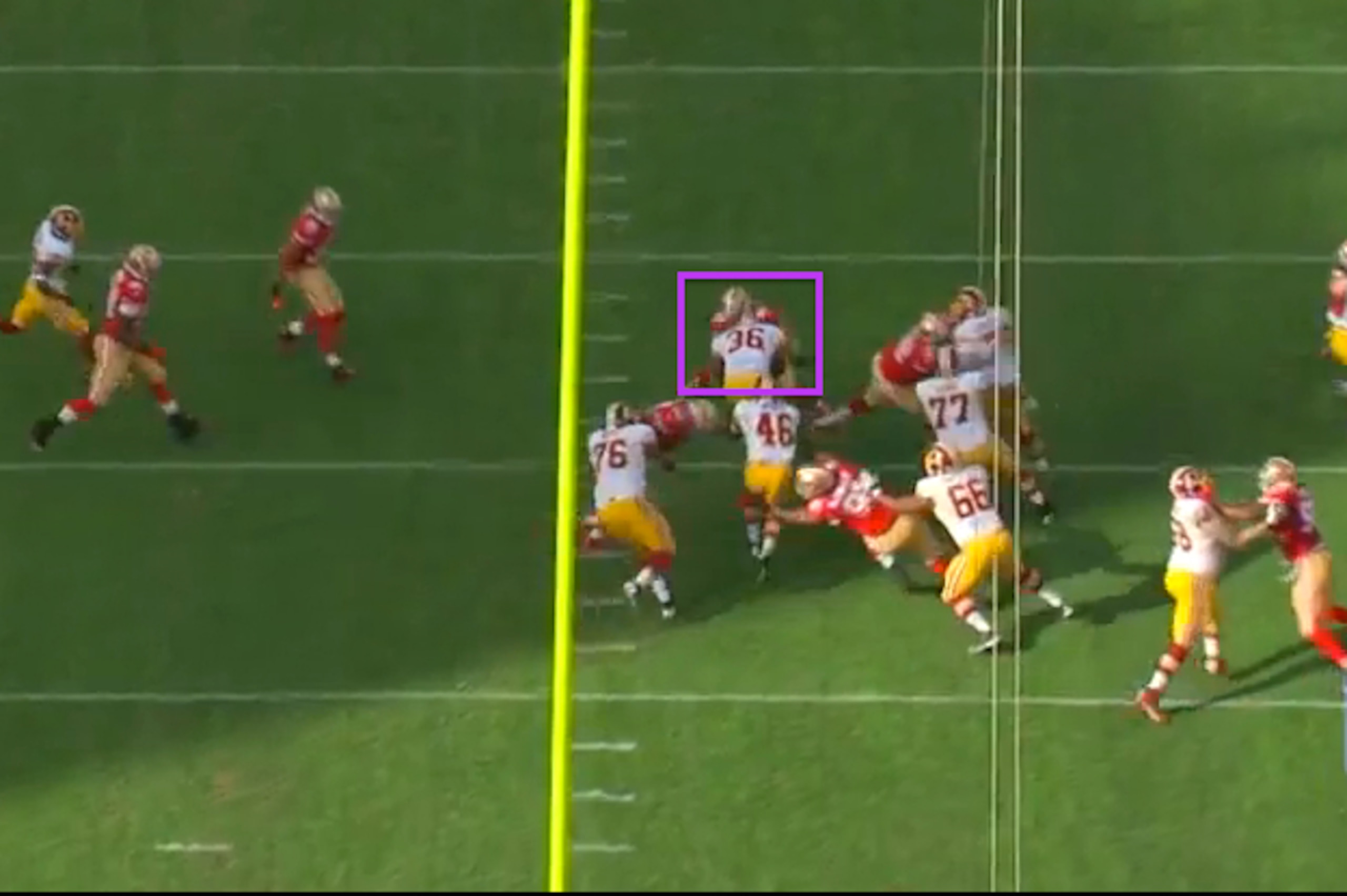
He was on skates by the time Young finished the block and cleared out the hole for Morris to escape to the second level:

He doesn't get to do it often, but Young is very adept at punishing defenders as a blocker on straight-ahead power plays.
During the Niners game, 106.7 The Fan host Grant Paulsen noted how much more effective Morris is when Young's in front of him:
Fortunately, that's something that should happen more often in 2015. Washington is adding more power principles to its ground game under the watchful eye of new offensive line coach Bill Callahan.
Morris has already indicated how that may mean more use of the I formation, per Tom Schad of The Washington Times: "I did all downhill in college with the Power I. Did a little inside zone, maybe a tad of outside zone, but mostly it was just downhill, so I feel like I’m better in downhill plays anyways."
More Power I means more Young, and that can only be a good thing for Washington. In fact, whatever the Redskins run, having Young lead the way more often will improve a ground attack that slumped to 19th in 2014.
Traffic Cop
Whether on runs up the middle or those targeting the outside, Young is an excellent traffic cop. He clears out a crowd and gives Morris obvious lanes to exploit.
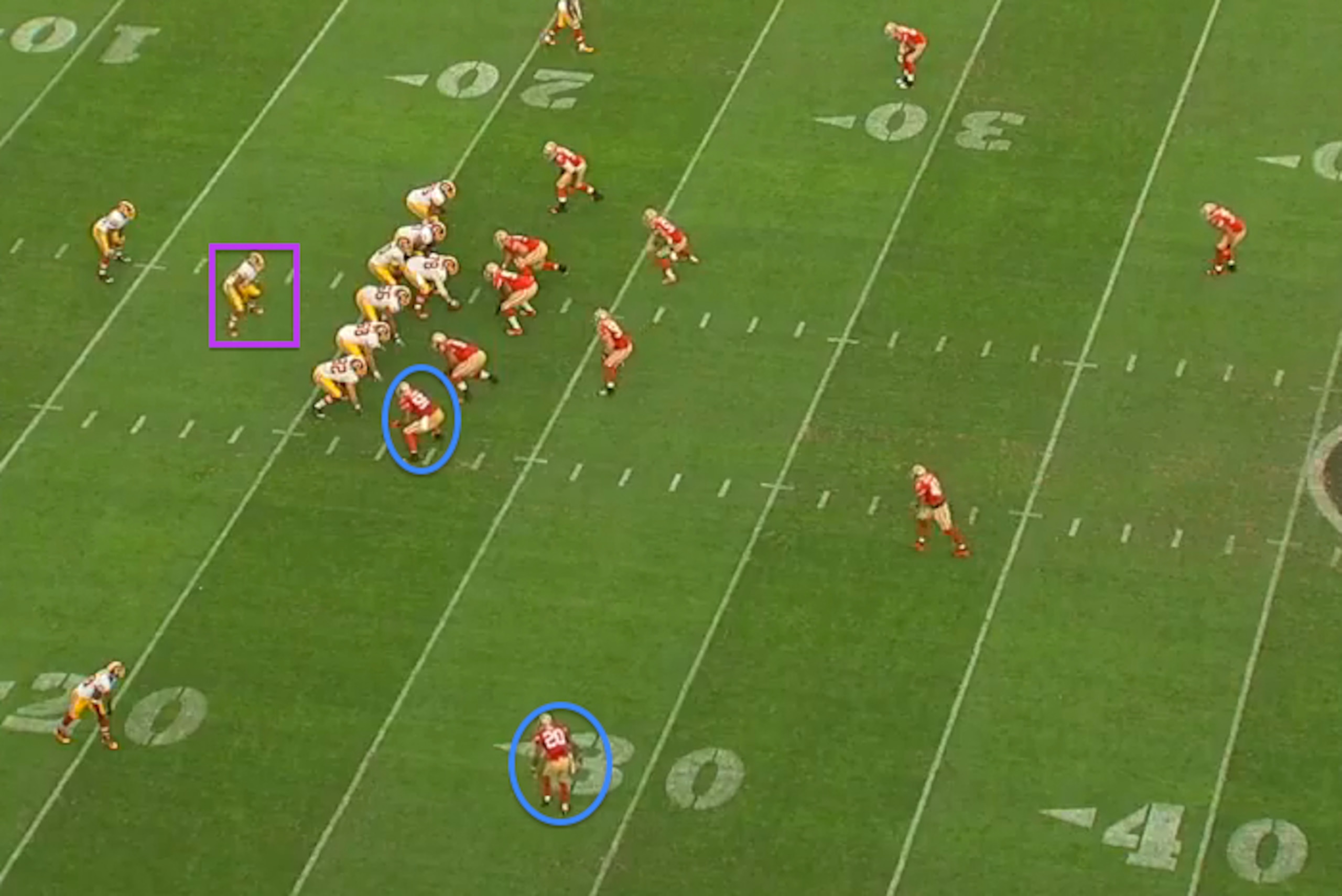
A 30-yard scamper from the third quarter of the game in San Francisco illustrates how Young clears the traffic.
Aligned in an offset I-formation look, Young's targets would-be rush end Ahmad Brooks and cornerback Perrish Cox:
After the snap, he made his way to the edge as part of Washington's staple zone-stretch run. On his way, Young chipped Brooks, helping tight end Logan Paulsen secure the block and neutralize the edge in the process:
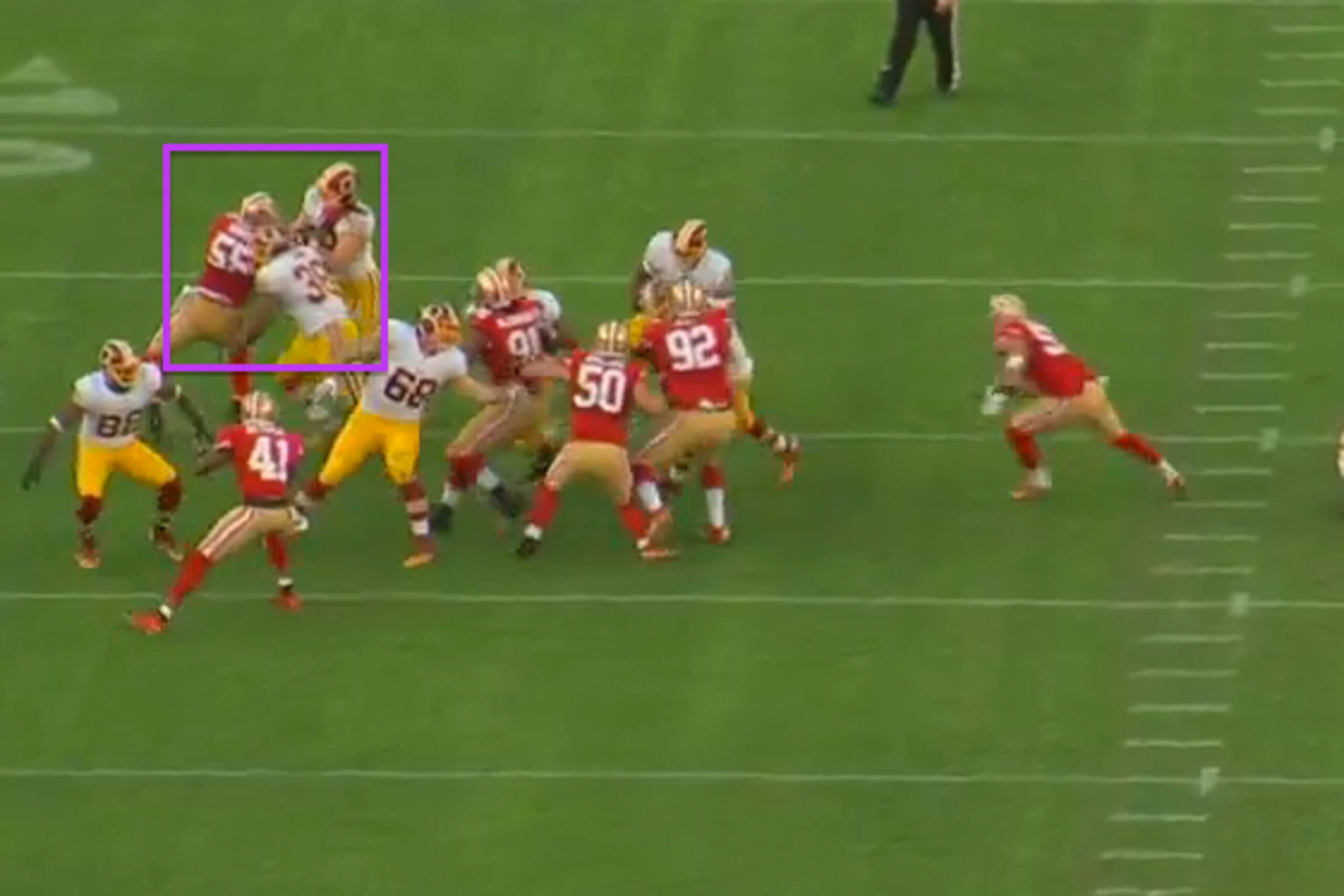
Then, in typical zone-blocking fashion, Young slid off the double-team and moved to the second level to absorb a defender in space. He quickly engaged Cox:
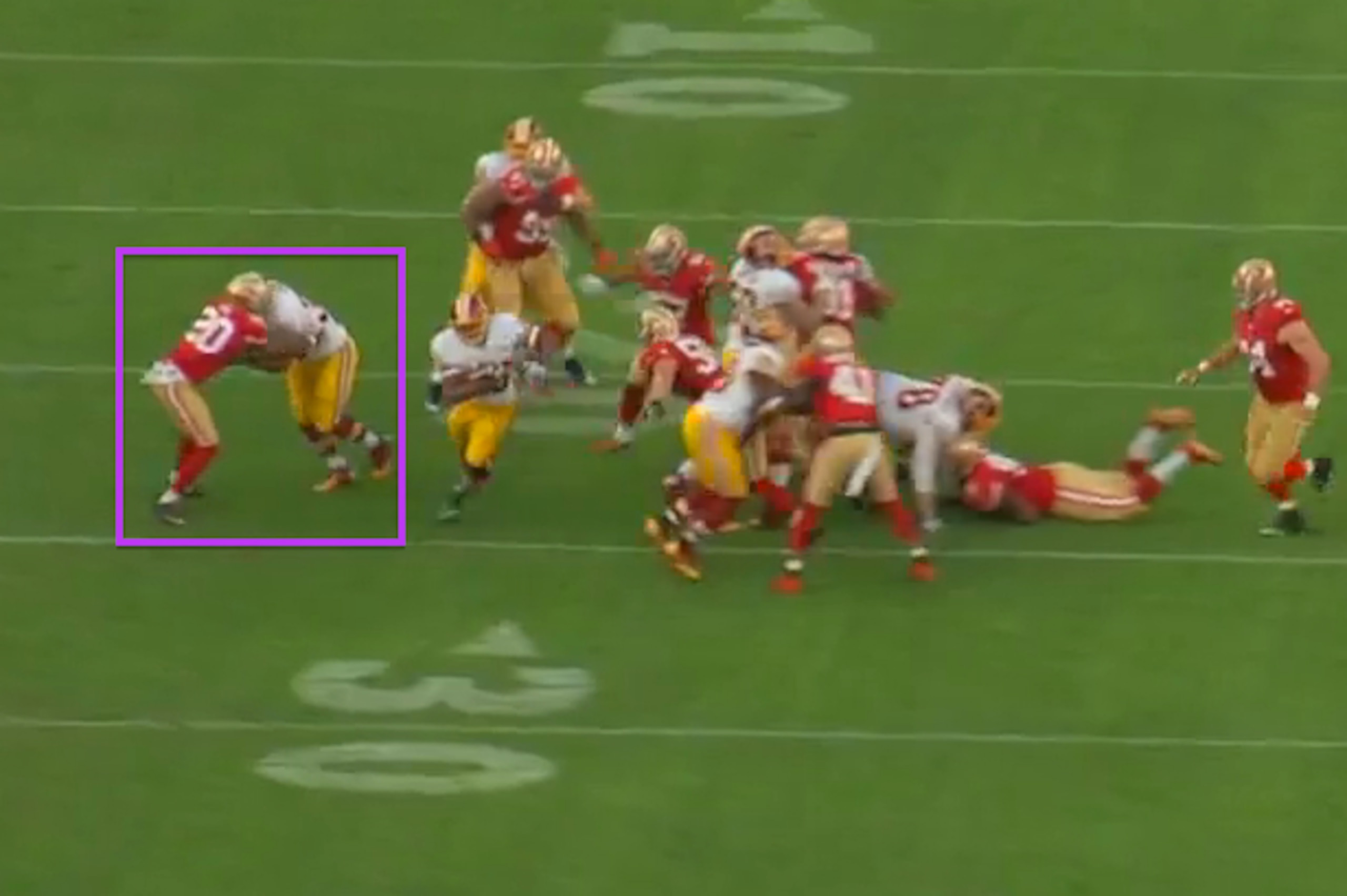
This block secured the edge and gave Morris an easy lane to thunder his way through.
Even with the extra power concepts added to this season's playbook, Gruden has already indicated elements of the zone scheme will be retained, according to Real Redskins blogger Rich Tandler.
Young has a vital role to play no matter what guise the ground game takes.
In fact, the fullback needs to be a feature of Washington's backfield in 2015, not a part-time passenger. Young is too good as a receiver, runner and blocker to leave out.
He offers Griffin an invaluable safety valve, while also acting as a highly effective and punishing convoy ahead of Morris. With the ball in his hands, Young is a real threat, both on the ground and in the air.
Why continue wasting a weapon this versatile and talented?
All screen shots via CBS Sports, ESPN, Fox Sports and NFL.com Game Pass.
All statistics and player information via NFL.com.



.jpg?w=2560 "Latest Peyton-Colts Rumors")