

Kyrie Irving Is the Biggest Factor Heading into the NBA Finals
Neither the King nor the Assassin will decide the fate of the NBA Finals. That honor belongs to Kyrie Irving, the biggest question mark heading into this year's final showdown between the Cleveland Cavaliers and Golden State Warriors.
LeBron James and Stephen Curry are undeniably the most important players in this series, but everyone knows they must deliver in order for their respective teams to win the title. They are the unquestioned leaders of their teams, the players everyone looks to in order to set the tone. They each know what must be done.
But one transcendent star has never been enough to win a title. LeBron, Kobe, Russell, Jordan, Magic, Bird, Shaq—they've all needed a co-star, someone to ease the crippling burden of carrying a team to a title.
TOP NEWS

J-Dub, Wallace May Miss Entire Season
Celtics at Fault for JT-JB Beef? 🤔
Melo's Quote on Confidence 😎
Curry has a deep, talented, versatile supporting cast. He has his brother in Splash, Klay Thompson. He has his two defensive hounds in Draymond Green and Andrew Bogut. He has the ever-improving Harrison Barnes and a plethora of talent ready to give their bodies for him off the bench.
James isn't as lucky with his friends. The Cavaliers possess talent but not on par with that of the Warriors.
They've lost Kevin Love. J.R. Smith is basketball's version of a box of chocolates. Iman Shumpert is still dealing with a nagging groin injury. Tristan Thompson is basketball's most tenacious rebounder, but his offensive game is limited. The bench is thin.
LeBron can't bring a title to Cleveland without Irving playing his best, but knee tendinitis has largely deprived Cleveland of the wizard capable of throwing up 57 points against the defending champion Spurs in San Antonio back in March:
Instead, the Cavs have gotten a mostly hobbled Irving, limited in both minutes and ability over his past several games.
In the East, an aggressive, determined LeBron and an efficient supporting cast were sufficient to carry Cleveland to the Finals. Against the Warriors, that won't be enough.
Irving deservedly gets second billing on this Cavs team, but if he is unable to play up to that distinction, Cleveland might suffer a fate similar to last season's LeBron-led Miami Heat.
Cleveland needs the 23-year-old Irving to be special. The question is, can he be?
Will the Knee Hold Up?
By the time the Cavaliers step onto the floor of Oracle Arena on Thursday night, they will have gone nearly eight full days between games.
Cleveland's sweep over the Atlanta Hawks in the Eastern Conference Finals was beneficial for a number of reasons, but perhaps the most crucial advantage gained from the Cavs' hasty dismissal of the East's No. 1 seed was the extended rest it granted Irving.
Irving re-aggravated his knee injury in the Cavaliers' Game 1 win over the Hawks, forcing him to sit out the next two games. He played Game 4 under a 25-minute restriction, but he was effective, scoring 16 points (6-11 FG), dishing five assists and turning the ball over only once in 22 minutes of play.
Despite the Cavaliers win and his efficient play, it was plain to see Irving still wasn't the same All-Star we had all become accustomed to. His quickness, explosiveness and leaping ability have all been severely hindered, limiting him on his typically spectacular forays to the rim.
Still, the fact that he was able to play is a good sign for the Cavaliers.
Cleveland.com's Nathaniel Cline spoke with Dr. Donald Goodfellow of University Hospital Case Medical Center in Cleveland in order to paint a clearer picture of the severity and nature of the ailment plaguing Irving:
"For Irving to have played in Game 4, Goodfellow said the point guard is most likely in a simple case of knee tendinitis where the tissue around the tendon could be inflamed and irritated. The best solution for someone from this is to rest and let the tendon regain strength.
"
Good news for Irving, as this long rest period has likely helped calm some of the inflammation and irritation around the knee.
That's not to say Irving is clear of the quicksand just yet. While this case isn't severe enough to keep him completely out of the series, it could inhibit his ability to play consecutive games, according to Dr. Goodfellow: "The key is will he [be] able to play three or four playoff games in a row? Or will he have to sit once or twice during that phase."
Game 1 is Thursday night, but Game 2 isn't until Sunday, giving Irving a bit of an extended recovery time. But questions still linger.
Will Irving be able to play big minutes, or will Cavaliers coach David Blatt have to carefully monitor the situation, keeping Irving around a specific minutes limit? Will he be able to effectively practice?
No talk has surfaced of any possible minute restrictions placed on Irving, but Blatt did indicate that his star point guard's progress has been slow, per ESPN's Dave McMenamin:
Will Irving Be a Defensive Liability?

The tendinitis has sapped Irving of at least some of his athleticism. Offensively, he's become more of a glorified spot-up shooter, waiting on the fringes for LeBron and others to create.
Losing Irving's unique creativity and scoring ability on offense is a huge blow, but his physical impediment might be an even bigger detriment on the defensive end.
Through his first 12 games, Irving actually hasn't been terrible defensively, at least according to the numbers. He's holding his opponents to just 42.5 percent shooting from the field, and players are actually shooting 0.3 percent worse than their overall shooting average when guarded by Irving.
As you might expect, those numbers are somewhat misleading.
In Irving's last three games, when the injury really started to plague him, he's allowed opponents to shoot 50 percent from the field, including 64.7 percent on two-point attempts.
Irving's limited mobility didn't exactly hurt the Cavaliers, as the Hawks never truly made them pay for having Irving out on the floor. Jeff Teague found success attacking Irving when guarded by him, but he never exploited it as much as he could have.
Golden State won't make that same mistake, not with the arsenal of weapons they have.
There's nowhere for Irving to hide on defense. He'll likely begin the game guarding Curry, but if Irving is the least bit compromised, there's no way he can keep up with Curry. Whether the MVP is running pick-and-rolls or sprinting around the court through unconventional sets with uniquely designed screens, Irving won't be able to take a single play off.
Irving is going to have to stick to Curry at all times, but the Warriors don't make it easy when they run plays like this:
It's not likely to go much better for Irving on Thompson or Barnes, both of whom are bigger, stronger and exceptional offensive talents, and both of whom can make exceptional plays inside and on the move:
Even the bench doesn't present any ideal options, as Andre Iguodala is 6'6" and Shaun Livingston is 6'7". Leandro Barbosa would be Irving's best bet, but their respective minutes are unlikely to overlap much throughout the course of the series.
Grantland's Zach Lowe believes defense could cause some serious problems for a physically compromised Irving:
"Even if the Cavs hide Irving on Barnes, Iguodala, and other back-end options, he will have to work on defense. The Warriors make everyone work; it’s kind of their thing under Kerr. They’ll play around with a funky Curry-Iguodala pick-and-roll if it puts Irving in the play — and perhaps forces Irving into switching back onto Curry.
"
Cleveland hasn't been terrible defensively with Irving on the court. The Cavs sport a 101.7 defensive rating with Irving on the floor—not elite, but serviceable.
But in the 256 minutes Irving has sat, Cleveland has posted a 93.0 defensive rating, which, for the sake of context, would have led the entire NBA during the regular season.
Defense has never been Irving's calling card, but he'll need to be, at the very least, functional if he wants to stay on the court.
Cleveland will likely alternate Shumpert, Smith and James onto Curry at various points of the game, while LeBron will take the defensive reins in late-game situations when necessary.
The first few possessions with Irving on Curry should serve as a litmus test for the rest of the game and possibly the rest of the series. Kerr will send his Warriors at Irving as much as possible to test that knee.
How Irving's left leg holds up could very well determine how much Blatt can afford to play him this series.
Will We See Uncle Drew?

The risk Cleveland takes with Irving on defense is worth it only because he is such a dynamic offensive talent.
He can make Curry and Thompson work on the defensive end every time down the floor. Irving's value comes not only from his shot-making ability, but from the fact that he'll force either Curry or Thompson to exert extraneous energy trying to stay in front of him.
Anytime you can slow either of the Splash Brothers down in the slightest, that's a win.
The question is, which Irving will we see this series?
Will it be the man capable of this:
With shot charts more in line with his Game 1 performance against Chicago (in which he also had nine free throw attempts):

Or will it be the Irving we saw in Game 4 of the Bulls series and Game 1 of the Hawks series, a shooter who could still knock down outside shots but wasn't nearly as aggressive or successful in attacking the rim and slithering through the heart of the defense:

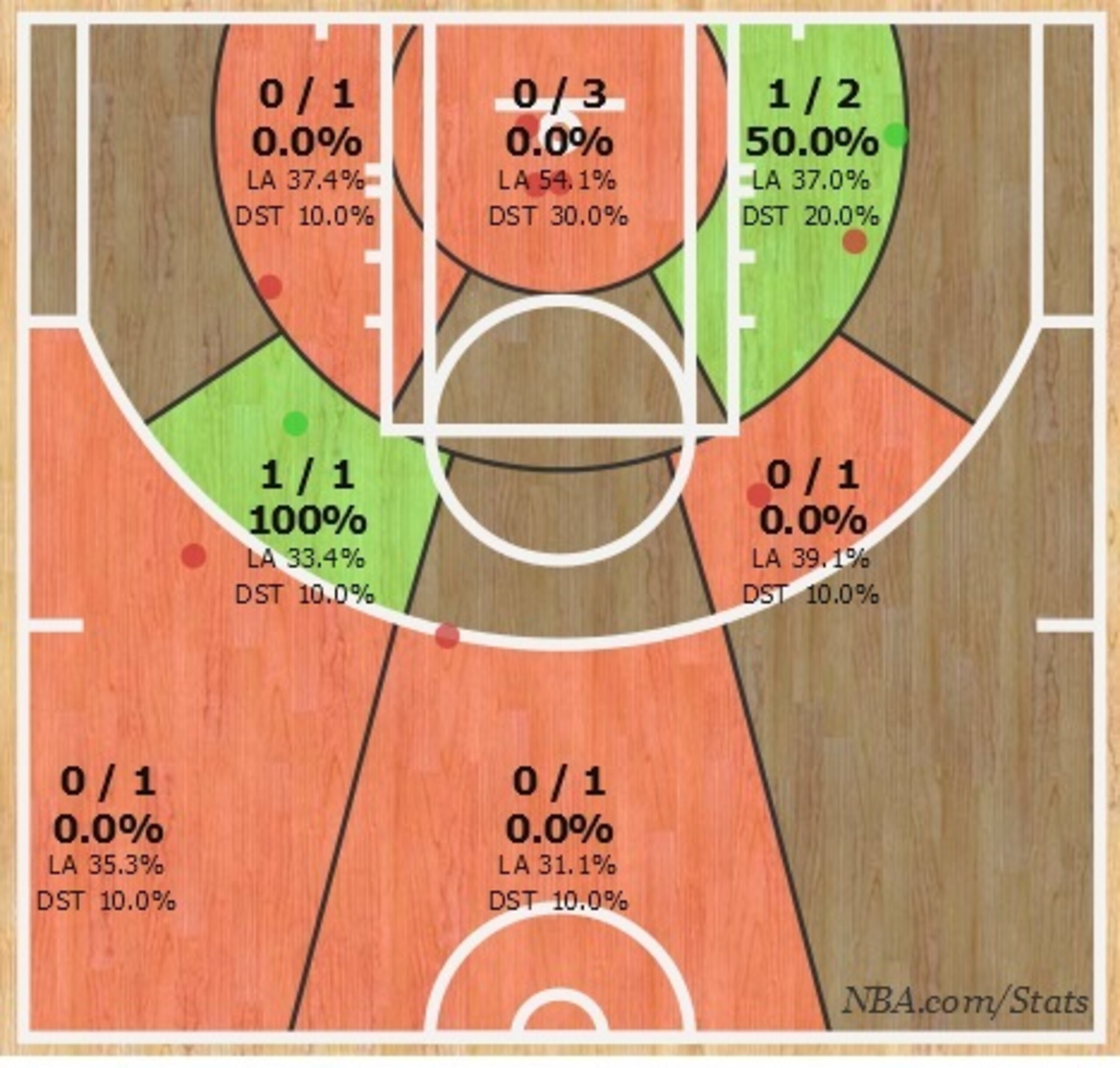
Irving was one of the most dangerous men with a basketball in his hand during the regular season; Cleveland needs that Kyrie Irving in this series.
Uncle Drew shook, shimmied and spun his way through defenders as if each NBA arena were his hometown playground. Irving averaged 9.4 drives per game during the regular season, producing seven points per game on (11.7 team points per game) on 48.6 percent shooting.
He clearly hasn't been that player lately, and the stats back it up.
In the postseason Irving is averaging 7.2 drives per game and producing just 5.4 points per game (8.6 team points per game) on 43.1 percent shooting.
It's not like Irving has been useless; he's still shooting 48.1 percent from three on 4.3 attempts per game. But Cleveland will need Irving to be far more than just a jump shooter in this series. Blatt needs Irving to break down the defense and create opportunities not just for himself but for others.
Blatt also needs to know Irving is functional enough to control the offense himself while LeBron gets some rest. The King won't sit much this series, but if Irving is able to hold the offense up on his own for extended periods of time that means James can get that much more rest. Every second counts in the Finals.
Still, against the Warriors vaunted defense, none of this will come easy, regardless of Irving's health status, as Bleacher Report's Grant Hughes explained:
"No team's defense was stingier during the regular season than Golden State's, and the Dubs' sheer versatility—they can play straight up and conservatively with Bogut or cause utter chaos with smaller, switch-happy units—makes them a monstrous defensive force.
When set, the Warriors defense is as good as it gets. The Cavaliers will rely on Irving to scramble things a bit.
"
Irving doesn't have Lebron-type pressure on him, but he's playing the role of Dwayne Wade and Scottie Pippen now. The star will take the glory or the blame; that's the nature of the game. But the sidekick will be the one whose play ultimately determines the fate of the series.
For better or worse, the Cleveland Cavaliers' championship hopes rest on the shoulders, or rather, the knee of Kyrie Irving.
Just remember, Youngblood, get buckets and don't reach.
.jpg?w=2560 "Chiefs, Steelers Eye WR Trades")





.jpg?w=2560 "Raiders Sticking with Cousins")