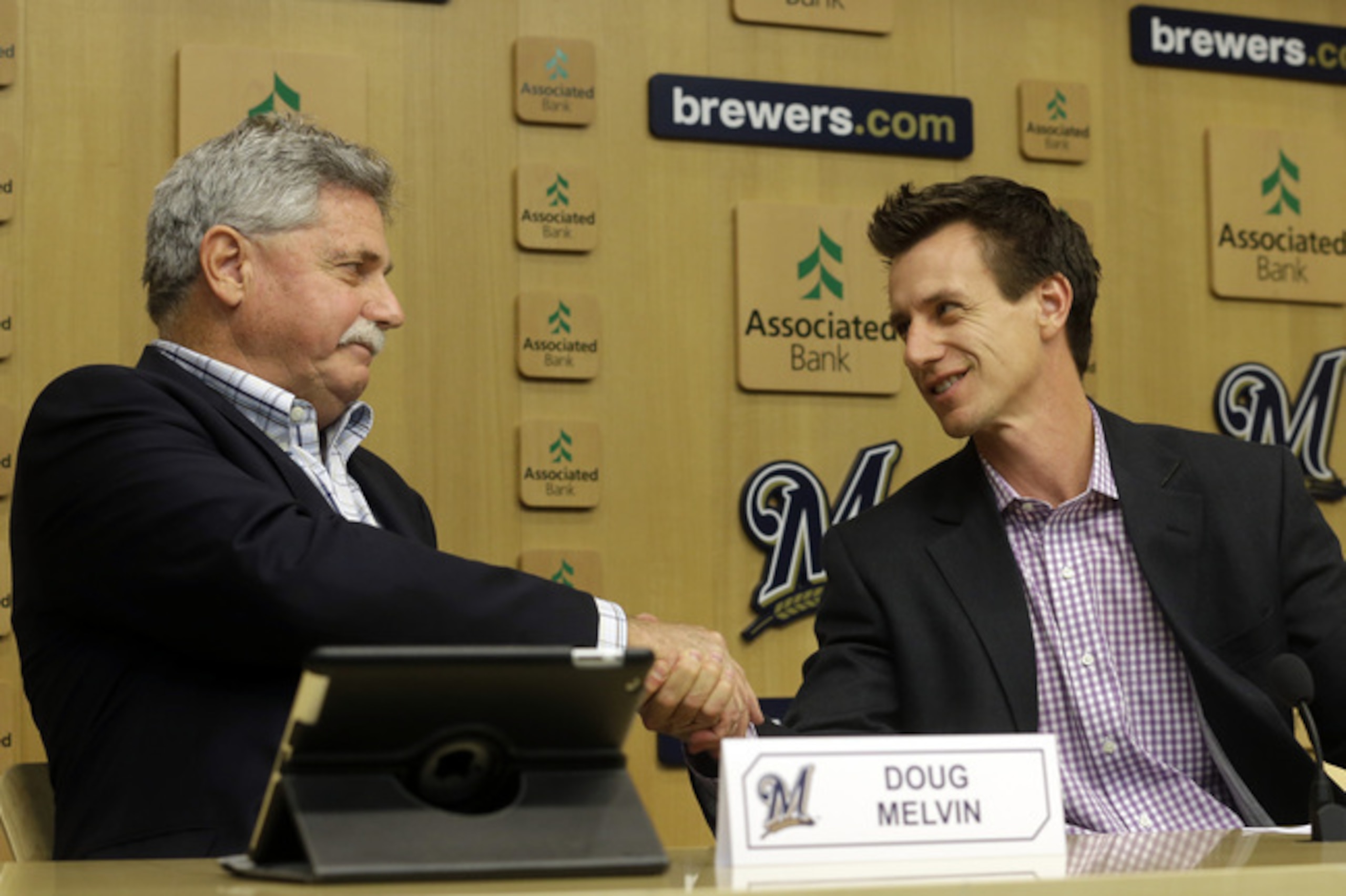

Grading Doug Melvin's Success Rate Drafting Top Pitching Prospects
Following early-season scares—including a 4-17 start that led to Ron Roenicke being fired—Milwaukee Brewers general manager Doug Melvin bought himself some security in placing blame elsewhere.
But as his job status remains a question mark for the remainder of the 2015 campaign, the brain trust in the Brewers’ front office will take a long look at the decisions made to build this team. Here, we’ll analyze the top pitching prospects chosen by Melvin and what sort of value is being brought to the team.
One must first analyze league-wide trends in order to collect an accurate understanding of Melvin’s performance. To begin, Matt Eddy of BaseballAmerica.com analyzed 22 MLB drafts from 1987 to 2008 and determined that only one-in-six players drafted actually play in the major leagues.
Numbers are then dramatically inflated for players drafted in earlier rounds. For example, Eddy notes that players drafted in the first round see the major leagues 73 percent of the time, while those drafted in the third to fifth rounds see a 35 percent chance.
Quite simply, early rounds demand top talent. And while the overall percentage of players drafted remains at 17.2 percent, it is fair to assume the rate for picks in the first five rounds averages closer to 50 percent.
The focus here will look only into pitchers selected within those first five rounds. Instead of digging through each selection by Melvin since his start in 2002, we’ll place emphasis on the top picks by Milwaukee—valuable picks hoping to project the next star player for your franchise.
For simplicity, we’ll combine draft classes into three-year periods and select the greatest pick and the biggest bust, along with the most peculiar story from each.
Draft Section No. 1: 2002-04
1 of 4
Draft Section No. 1: 2002-04
Five pitchers selected. Grade: B+
Top Talent: RHP Yovani Gallardo, Round 2 (2004)
We all know this story. By 2007, Gallardo was already pitching in the majors. Following a disappointing 2008 season because of a right knee ligament tear (24 innings), Gallardo grew to earn an All-Star appearance in 2010, followed by a seventh-place finish in Cy Young voting in 2011. With the eventual departure of CC Sabathia and Ben Sheets, Gallardo became the face of Milwaukee’s pitching rotation before finally being traded to the Texas Rangers prior to spring training this year.
Biggest Bust: RHP Eric Thomas, Round 3 (2002)
Thomas never made it higher than High-A ball, playing for the Brevard County Manatees in 2005. There, he sported an 0-2 record with an embarrassing 17.47 ERA. Thomas later bounced around several teams before finishing with the Sussex Skyhawks (independent) in 2008. Appearing in only one game for the Skyhawks, Thomas faced three batters and gave up two runs while registering one out for an ERA of 54.00.
Honorable Mention: RHP Mark Rogers, Round 1 (2004)
Rogers, 29, has jumped between Triple-A and independent ball the past three seasons. By 2006, Rogers was ranked the 44th prospect in the Brewers’ organization (per Baseball-Reference.com), but earned only a small presence in the majors in 2012. Appearing in seven games, Rogers pitched to a 3-1 record and 3.92 ERA. But two shoulder surgeries and injury setbacks prevented Rogers from reaching the next level of development.
Nicholas Zettel of DisciplesofUecker.com adds:
"It is difficult to call Rogers a “bust,” and leave it at that. First and foremost, Rogers made the big leagues, and produced some valuable innings for the club in 2012. One might scoff at that, but that’s certainly better than the eight players from his first round that failed to make the MLB. Oddly enough, according to Baseball-Reference, Rogers’ 1.1 WAR is good enough for 17th of the 33 players that made the MLB from his first round.
"
Analysis
Without the emergence of Gallardo in 2004, this draft section proves relatively weak. Melvin did not select a single pitcher in the first five rounds of the 2003 draft, leaving more pressure on the corresponding years. The apparent waste of a first-round pick on Rogers weighs heavy on this grade as well. Granted, hindsight is certainly 20/20, but pitchers picked after Melvin’s selection in the 2004 first round included the likes of Homer Bailey, Jered Weaver and Phil Hughes.
Draft Section No. 2: 2005-07
2 of 4
Draft Section No. 2: 2005-07
Four pitchers selected. Grade: D-
Top Talent: RHP Jeremy Jeffress, Round 1 (2006)
Jeffress was drafted with a flaming fastball and high expectations. But following three separate positive drug tests in 2006, 2007 and 2009, Jeffress was suspended for a total 150 games. Later a part of the Zack Greinke trade, Jeffress was sent to Kansas City in December 2010.
After not developing to the full potential other teams imagined, Jeffress moved from the Royals to the Toronto Blue Jays, before rejoining the Brewers again in 2014.
Todd Rosiak of the Milwaukee Journal Sentinel writes:
""He still has the plus arm that you can't find everywhere, so the opportunity to collect a player with this skill set is — especially with no acquisition fee — intriguing to us," assistant general manager Gord Ash said. "We have the history with him obviously; I think we know him better than most, so we know what his support system needs to be. We think it's a good risk.”
"
Biggest Bust: RHP Kevin Roberts, Round 5 (2005)
Roberts played a total of three seasons in the Milwaukee farm system. Roberts never saw past the High-A level and averaged a career ERA of 4.25. Later traded to Pittsburgh in an effort to bring in Salomon Torres in 2007, Roberts finished his baseball days following the 2008 season that ended in Double-A.
Honorable Mention: RHP William Inman, Round 3 (2005)
One year removed from being drafted in the third round, BaseballProspectus.com ranked Inman the No. 4 prospect in the Brewers system. With a solid curveball and fastball averaging velocity in the low 90s, scouts projected the best possible scenario for Inman would later be as a No. 3 or 4 starter.
Milwaukee never saw this development, trading Inman in 2007. Thrown together with a collection of pitchers, Inman was sent to the San Diego Padres in exchange for right-handed pitcher Scott Linebrink. Playing through the 2013 season, Inman's development reached only the Triple-A level.
Analysis
An embarrassing three-year stretch for Melvin. The greatest outcome arose from a bullpen performer Milwaukee is taking a second chance on. All other top prospect pitchers either became trade bait or diminished from major league contention.
Draft Section No. 3: 2008-10
3 of 4
Draft Section No. 3: 2008-10
Thirteen pitchers selected. Grade: A-
Top Talent: RHP Jake Odorizzi, Round 1 Compensation (2008)
Odorizzi, 25, has already been a part of two blockbuster trades. The first sent Odorizzi, Lorenzo Cain, Alcides Escobar and the aforementioned Jeffress to the Kansas City Royals in exchange for Zack Greinke. The Royals then sent Odorizzi and top prospect Wil Myers (among others) to the Tampa Bay Rays in exchange for a handful of pitchers, including James Shields.
With the departure of aces Shields and David Price, combined with injuries to Matt Moore and Drew Smyly, Odorizzi has become a major foundation in Tampa Bay’s rotation. In 47 innings pitched already in the 2015 campaign, Odorizzi sports a 2.09 ERA with a 3-2 record.
Top Talent: RHP Jimmy Nelson, Round 2 (2010)
With Gallardo’s departure, Nelson remains the only starting pitcher selected by Melvin in the first five rounds to remain with the ballclub. Able to survive throughout the minor leagues with a fastball and slider averaging in the low 90s, Nelson became a rare two-pitch starter in the majors. Luckily, the start of the new season arrived with a new pitch within Nelson’s repertoire, a curveball with speed in the low 80s (per FanGraphs.com). This has helped produce 35 strikeouts in 36 innings this season.
Biggest Bust: RHP Cody Adams, Round 2 (2008)
With high expectations after being drafted so high, Adams lasted for just two seasons. With the Wisconsin Timber Rattlers (Single-A), Adams appeared in 16 games with a record of 3-6 and an ERA of 5.93. Following this mediocre performance, Adams received a 50-game suspension due to a positive amphetamines test in 2009 and hasn’t toed the professional mound since.
Honorable Mention: RHP Tyler Thornburg, Round 3 (2010)
Thornburg is one of the few members of our list still on the Brewers' roster. Thornburg blew away competition at the Single-A level, sporting a 7-0 record with a 1.57 ERA. The success continued as he went 8-1 in 13 starts in Double-A. Eventually arriving with the pro club in 2012, Thornburg was eventually moved to the bullpen, where he currently remains.
Honorable Mention: LHP Josh Romanski, Round 4 (2008)
We're breaking the rules to add another honorable mention. First, because this list is in serious need of a lefty and, second, because this story is so strange.
After being drafted in 2008 by Milwaukee, Romanski needed Tommy John surgery in 2009, then had a slew of other setbacks. By 2011, Milwaukee decided Romanski wasn’t worth the trouble, so he later signed with the New York Yankees. After further struggles led to an eventual release from the Chicago White Sox in 2013, Romanski decided to make the switch to independent baseball to try out as a position player.
Abbey Mastracco of Fox Sports West writes, “He signed with the Gary Southshore Railcats of the American Association of Independent Professional Baseball—the second rookie contract of his career—and began training. It was far from a steep learning curve. Romaneski hit .311 with 60 RBI, seven home runs and stole 11 bases."
An odd case for sure. But it makes one wonder, how many other failed pitchers should have had opportunities batting?
Analysis
Undoubtedly Melvin’s most successful stretch drafting top pitching talent. Two looking to have great longevity within their respective starting rotations, while the other has experience coming out of the bullpen. Thornburg certainly has a long way to go in terms of creating his name in relief, but Milwaukee has seen some progress.

Draft Section No. 4: 2011-Present
4 of 4
Draft Section No. 4: 2011-Present
Thirteen pitchers selected. Grade: C+
Top Talent: RHP Taylor Jungmann, Round 1 (2011)
Coming out of the first round, the 25-year-old is playing at the Triple-A level. Jungmann recorded an 8-6 record last season and is already off to a 1-1 start in 2015. He was named the Brewers’ No. 3 prospect in 2012 and has held a 4.05 ERA for his minor league career.
Top Talent: RHP Tyler Wagner, Round 4 (2012)
Playing only as a closer in college, Milwaukee decided to move Wagner to a starting role, where he excelled to a 5-0 record in Double-A. The 24-year-old brings to the mound a fastball, changeup and slider.
Bernie Pleskoff of MLB.com adds, "The breaking ball might be the secret weapon for Wagner. He can set the hitter up with a sinking fastball and then throw the breaking ball to change the balance and eye level of the hitter. He also has the ability to elevate the higher velocity fastball to the eyes of the hitter, tempting swings at air."
Top Talent: RHP Taylor Williams, Round 4 (2013)
Last season for the Timber Rattlers, Williams delivered an 8-1 record.
Tom Haudricourt of the Milwaukee Journal Sentinel writes:
"Though smallish in stature (5-foot-11, 180), he has a big fastball that reaches the 94-95 mph range and sits at 92-93 mph, with a slider and curveball that torment right-handed hitters and an effective changeup that keeps lefties off his hard stuff.
A former infielder, Williams is athletic on the mound and aggressive in attacking hitters, constantly staying ahead in the count (45 walks in 174 2/3 innings in the minors).
"
Possibly most impressive was the attention Williams earned from Ryan Braun in spring training. “[Williams] might have the best stuff of any pitcher in camp,” Braun told Haudricourt.
Analysis
Due to the recent nature of this draft section, one can not yet determine a truly great pick from a bust. Players such as Jungmann, Wagner and Williams are certainly promising, but only time will tell if they see major league action, let alone with Milwaukee.
Overall, we can determine that Melvin’s judgement of top pitching talent in the draft has been subpar at best. Granted, organizational decisions to win in the present at the risk of trading away young prospects has absolutely created a halt in the development pipeline. But at the end of the day, since 2002 Melvin can really only point to Gallardo, Odorizzi, Nelson and Jeffress as those who have spent significant time in the majors.
Thirty-five pitchers total in the first five rounds, resulting in four positives, only two of which are still with the team. Those four equal an 11 percent success rate, far below the 17.2 percent of draft picks to make the majors, and dramatically behind the near 50 percent average of those from the first five rounds (per BaseballAmerica.com). Determining whether the scouting or development departments are at fault is a discussion for a later date. But either way, it is Melvin’s name taking the blame.



.jpg?w=2560 "Rodgers Iced Out on Plane 💎")
.jpg?w=2560 "Raiders Could Start Mendoza")
.jpg?w=2560 "Packers Safety Slams Refs 🤬")

.jpg?w=2560 "🚨 Week 8 AP Top 25 Poll")

