


Lost in the thrill of a few electrifying efforts from Austin Rivers and blowout victories over the Houston Rockets is something the Los Angeles Clippers can only rise above for so long: a supporting cast problem.
This is not a new, groundbreaking observation.
The Clippers' complementary talent spent a bulk of the regular season propagating criticism for its shallow, inconsistent play. The bench ranked 29th in offensive and defensive efficiency, according to HoopsStats.com, while the small forward position cycled between relative obscurity and beetling incompetence.
TOP NEWS

Embiid Out vs. Pistons
Luka 50 Piece in Win 🔥

Power Ranking Every NBA Team's Starting Lineup 🔢
Little has changed on that front during the playoffs. The Clippers' second unit still ranks in the bottom two of offensive and defensive efficiency, and Matt Barnes, the team's lone serviceable small forward, is clanging three-pointers off every part of the rim.
Somehow, though, perception has started to shift—especially in the second round, and especially with regard to the second unit.
"It's been great, it really has," Jamal Crawford said, per Clippers.com's Rowan Kavner. "The bench has taken a lot of criticism all year from everybody—in town, out of town, whatever. We're coming together at the right time, and I think it maybe caught some people off guard."
With Chris Paul watching from the sidelines in Game 1, Crawford tallied 21 points, five rebounds, four assists and two steals. Rivers pitched in 17 points. Barnes helped pace the starting lineup, exploding for 20 points, four steals and two blocks on 8-of-11 shooting
And the Clippers won 117-101, successfully navigating Paul's absence, jumping out to a 1-0 series lead that afforded them the opportunity to rest their floor general in Game 2.
Rivers went on to have the performance of his life in the Clippers' 124-99 Game 3 victory, using a 15-point third quarter to turn a close contest into a demonstrative drubbing. J.J. Redick pumped in 31 points, a postseason career high.
For a glorious, games-long stretch, the Clippers' puddle-deep stash of role players wasn't a punchline, or barely enough, or even merely enough.
As Bleacher Report's Adam Fromal underscored following Game 3, the team's accessories weren't a damning detriment, but booming leverage:
"The supporting cast is just more important than ever. And if it plays like it did on Friday night, the Clippers are going to be a serious threat to take down the Rockets and then work their way past either the Golden State Warriors or Memphis Grizzlies in the Western Conference Finals.
"
A fallow rotation did not keep the Clippers from upending the reigning champion San Antonio Spurs. It didn't force Paul into a situation where he needed to prematurely return from a hamstring injury. It didn't prevent them from establishing a 3-1 advantage over the Rockets.
It did, however, play a big part in disallowing the Clippers a chance to reach the Western Conference Finals in Game 5.
Blake Griffin and Paul combined to shoot 21-of-37 from the floor in Los Angeles' 124-103 loss. That's a 56.8 percent clip and, on most nights, good enough.
But everyone else went 17-of-54 (31.5 percent). The bench specifically shot 10-of-31 (32.3 percent) and was outscored 36-24 by Houston's second unit.
Redick admittedly won't shoot 25 percent from the floor and 12.5 percent from three forever. He's shooting 45.6 and 42.9 percent, respectively, for the playoffs, even after laying an egg during a potential series-clincher.
It's different for everyone else.
DeAndre Jordan converts point-blank looks at a high percentage, but he's a liability at the foul line. He shot 7-of-16 at the charity stripe in Game 5 and constantly forces head coach Doc Rivers to consider the defensive repercussions of taking him out for the offense's sake.
Other than a two-game stretch that bridged the gap between the Spurs and Rockets series, Barnes has been his usual, wild-card self. He's 5-of-26 from the field since his Game 1 explosion and having a negligible impact on the team's defense.

Crippling performances, meanwhile, remain standard for the bench. It's the recent success that's an anomaly.
The Clippers' second unit was outscored 299-156 through the first round. Though it has a decisive 169-136 advantage over the Rockets, the regular season and first round beg the question of whether this is sustainable.
Or even good enough.
History is on their side for now. Teams that get out to 3-1 leads in best-of-seven second rounds move on more than 94 percent of the time, according to WhoWins.com. A turbulent mix of surrounding talent won't spoil the Clippers' chance to advance.
But what happens in the Western Conference Finals, when the Clippers would square off against the Warriors or Grizzlies?
Will they enjoy the auxiliary talent from most of the second round? Or will they be met by the complementary pieces from the Spurs series, the ones that made a cameo in their most recent loss?
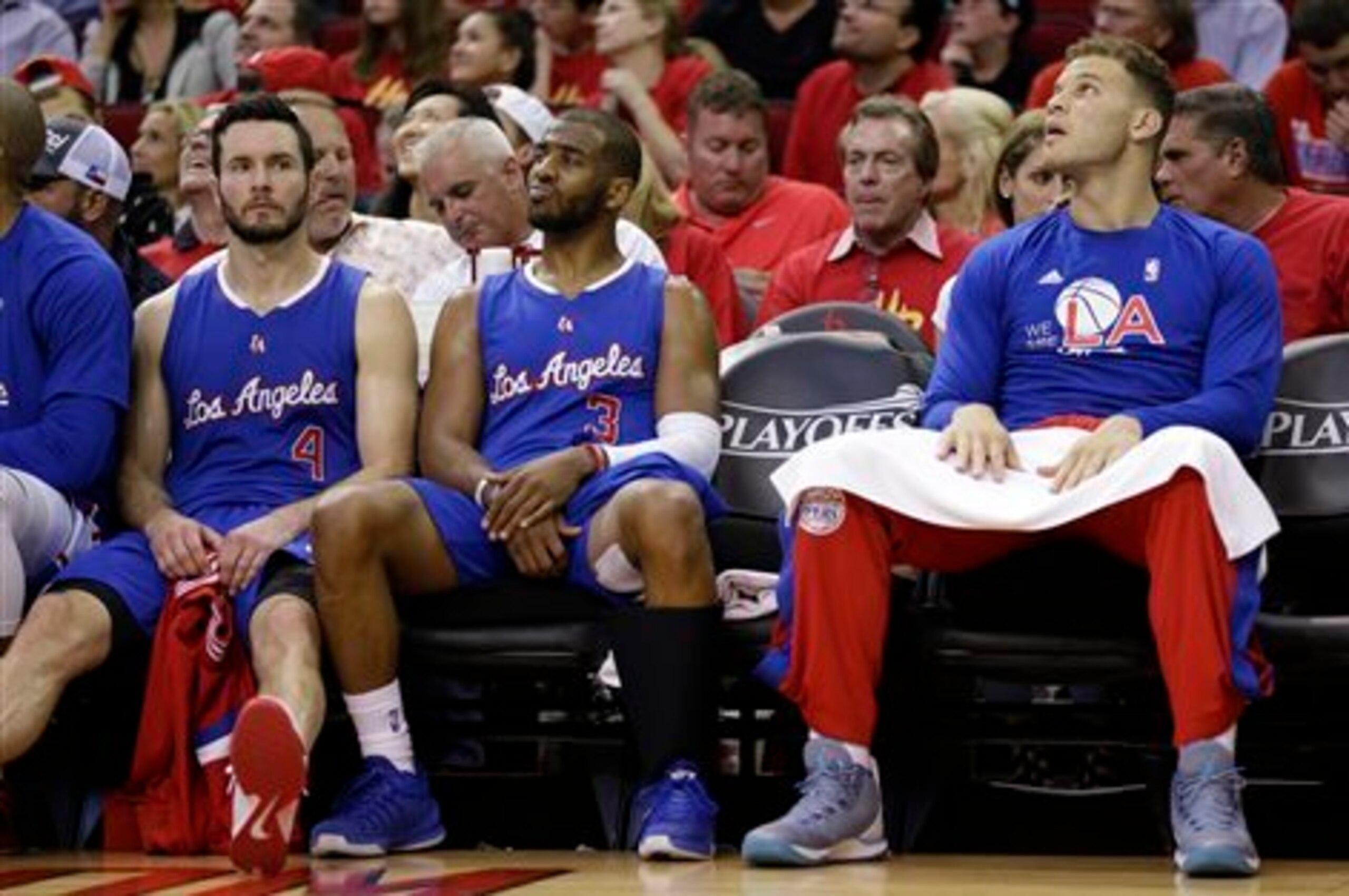
Relying solely upon Paul and Griffin or even the starting lineup in general can only carry the Clippers so far in the end. One-, two- and even three-man shows are dangerously unstable, because superior collectives can transcend the performance of a few.
That the Clippers have made it this far both in spite and because of their supporting cast is troubling to say the least. They need consistent contributors outside Paul, Griffin and even Redick.
If the second round is indicative of anything, though, it's that, on any given night, the Clippers have no idea which version of their role-player platoon will show up.
If the first round and regular season are stronger indications of what's to come, there are more Game 5s on the way.
And if more Game 5s are on the way, it's only a matter of time before the supporting cast stalls out once more, costing the Clippers a chance at their first-ever title before they even reach their first-ever NBA Finals.
Stats courtesy of Basketball-Reference.com and NBA.com unless otherwise cited.
Dan Favale covers the NBA for Bleacher Report. Follow him on Twitter: @danfavale.

.jpg?w=2560 "Rodgers Iced Out on Plane 💎")
.jpg?w=2560 "Raiders Could Start Mendoza")
.jpg?w=2560 "🚨 Week 8 AP Top 25 Poll")
.jpg?w=2560 "Mahomes Told Teammate to Leave Meeting")
.jpg?w=2560 "Lamar Being Out Shocked Ravens")

.jpg?w=2560 "Packers Safety Slams Refs 🤬")

