

Derrick Rose's Return May Not Require Much Adjusting from Chicago Bulls
In many ways, this might seem like this is just another year of waiting for the Chicago Bulls star Derrick Rose coming back from injury. But this return isn’t the same as previous returns, and these Bulls aren’t the same as the old Bulls.
The nature of Rose’s injury is different, the team is deeper and the reliance on Rose isn’t nearly as great. For these reasons, the reincorporation of Rose into the offense shouldn’t be much of an issue this time around.
A Different Procedure
TOP NEWS
Buzz: Knicks' KAT Offer Revealed

Surprise Dubs Trade Idea 💡

Projecting New-Look Lakers Rotation 🧐
This return from Rose is different both in terms of both how it will affect Rose's mental approach and how far he has to go to get to where he needs to be.
Most importantly, this is a completely different type of procedure that Rose is returning from. His previous returns are from repairs while this is a return from a removal. You can't reinjure what's not there.
First, that changes the entire mental approach to returning for both Rose and the team because there’s no risk of reinjuring the knee.
Rose took contact for the first time on March 30, just five weeks after the procedure. Afterward, coach Tom Thibodeau told the media, per K.C. Johnson of the Chicago Tribune:
"He was aggressive. He was a little winded, but we expected that. Overall, I thought it was good. He said he feels good physically. The big thing is going to be the wind and conditioning. He’s been out a long time.
This is the next step. We’ll know more as Derrick goes forward. Obviously, he needs some more practice time where he’s taking contact. But it will come. The more he does that, the faster it will come.
"
What’s not there in Thibodeau’s comments is as important as what is. There’s no concern about setbacks. When Rose addressed the media for the first time after the procedure, per Mike McGraw of the Daily Herald, he said:
"It's all about getting back on the court. It was something they had to take out. At the time, I didn't really care and wasn't really worried about the future. I'm not thinking that far ahead. I just wanted it out, and to walk right, get to rehab right away.
This was the only way, take it out, because it was blocking something in there.
"
That’s a different tone than the Rose coming back from his previous injuries, concerned about “muscle memory” or how he’d feel at his son’s graduation. The mentality is different because the injury is different.
Nor is the recovery time the same. He’s missing weeks—not months or years.
And he’s not as far removed from live action. He’s already played 46 games this year—more than half the season—and the most he’s played since his MVP year in 2010-11.
Per SportsCenter, Rose participated in full contact, five-on-five practices on March 31.
And Johnson is guessing a return in the second week of April. So this isn’t a will-he-or-won’t-he-return scenario like the last two years. It’s only about when he does.
A Different Team
The Bulls reached the Eastern Conference Finals in 2010-11, and there seems to be a general perception that this is the “same team.” But it’s really not. It’s not even the same core. In fact, only three players from the 2010-11 team are even on the current version: Rose, Joakim Noah and Taj Gibson.
Those three players account for 26.6 percent of the Bulls' minutes played this year. They accounted for 32.0 percent of the minutes played in 2010-11.
That year, per Basketball-Reference.com, Rose assisted on 1,409 of the Bulls’ points and scored 2,026, meaning he accounted for 43.0 percent of the points the Bulls scored in the 81 games he played. This year, he’s assisted on 523 points and scored 846, accounting for just 29.0 percent of the points in games he’s played.
In 2011, he was the leading scorer by a considerable margin. He averaged 25.0 points. Carlos Boozer had 17.5 and Luol Deng had 17.4. This year, he’s not even in the top two. Jimmy Butler, with 20.2, is the team leader. Pau Gasol, at 18.6, is second. Rose is third with 18.4.
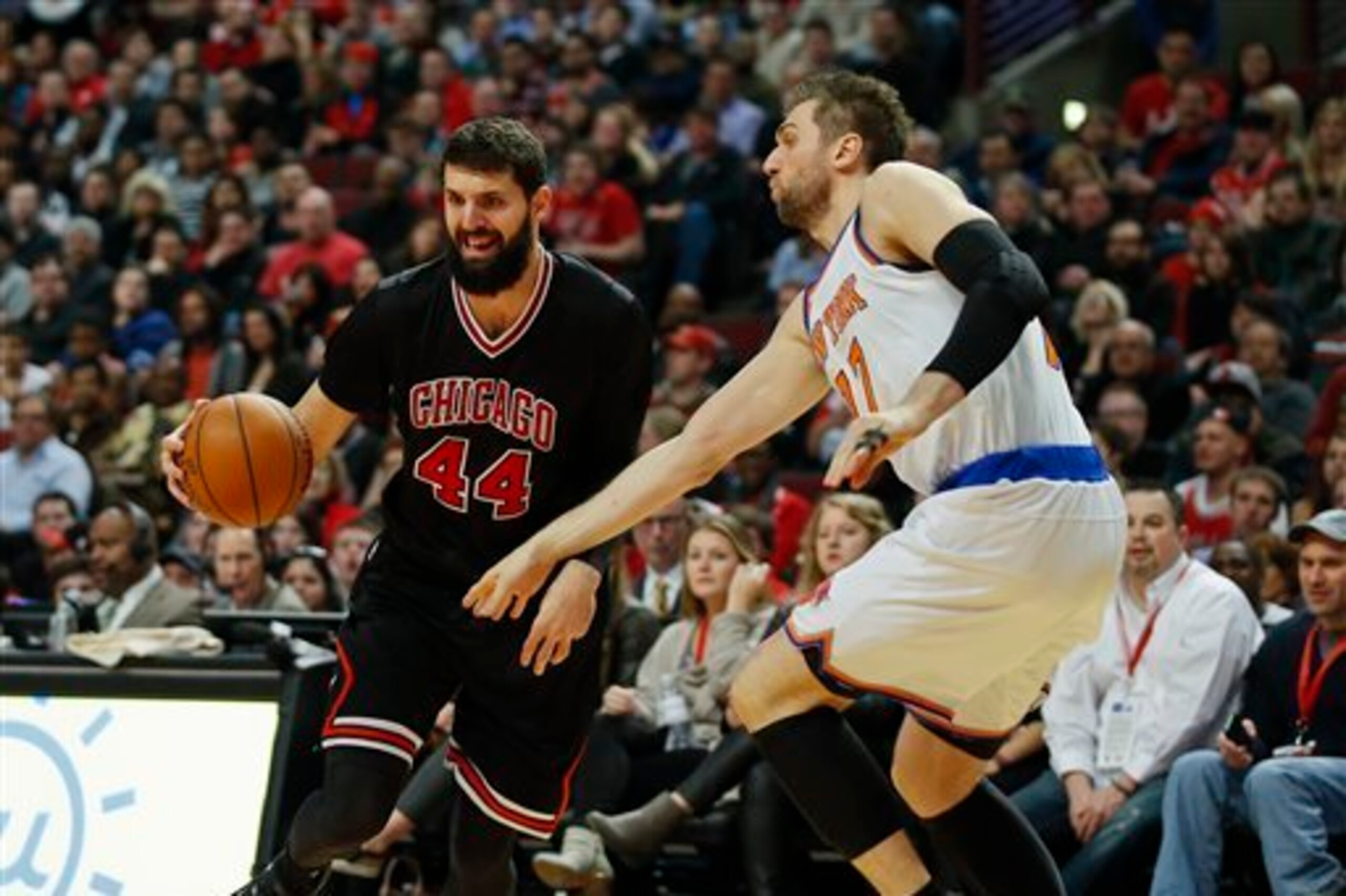
And now, Nikola Mirotic is coming on with his blistering March. He's averaging 20.7 points on 57.8 true shooting and 7.6 rebounds. According to NBA.com/Stats, he led the NBA in scoring off the bench, with 296, and was fourth in rebounds, with 102. His 136 fourth-quarter points also led the league that month.
Per NBA.com/Stats, in Rose's MVP year, the Bulls' offensive rating with him was 107.5 and without him it was 98.9. This year, it’s 105.7 with him on and 104.7 with him off.
In 2010-11, the Bulls had 118 games with players hitting the 20-point mark, but Rose had over half of them with 62. This year, the Bulls have totaled 115 such games, with only 20 of them coming from Rose and with 10 games left to play.
Point being: The Bulls are nowhere near as reliant on Rose as they were previously. The question that always seems to be asked is: “Can Rose return to his MVP level?” But the question that should be asked is: “Does he need to?”
John Hollinger devised a metric called Game Score, in which 10 represents an average game. The Bulls are 18-5 when Rose notches one of 11.0 or better. They’re 18-3 when his effective field-goal percentage is at least 50.0. The Bulls don’t need Rose to play like a superstar. They need him to play like a starter.
That’s not to undersell his importance. The Bulls aren't a better team without him, and if he’s thriving, the Bulls are almost unbeatable. When his Game Score is 14.9 or better, the Bulls are 11-2 and have won by an average of 10.1 points per game. That includes wins over the Houston Rockets, Cleveland Cavaliers and San Antonio Spurs.
If Rose can be solid with occasional spurts of magnificence, the Bulls are more than equipped to get to the Finals.
A Different Situation
This time around, Rose is no longer the sole focal point of the Bulls offense. He’s a key aspect, but not the only aspect. So the Bulls don’t have to hinge everything on him.
In fact, his health might not even be the most important factor. The Bulls are 29-12 when both their wings, Butler and Mike Dunleavy, are playing. They’re 16-17 when one or the other is missing. By comparison, they’re 29-17 with Rose and 16-12 without him. That indicates they can sustain his loss more easily than one of the wings.
Yes, while the Bulls have learned to play and win without him, that doesn’t mean he’s not still a part of the winning formula. He’s just not the only part.
And there are more areas the Bulls have to explore.
For example, Rose has played just 240 total minutes with Mirotic. Between Rose’s drive-and-kick game and Mirotic’s three-point shooting, the two are a natural fit.
Butler loves a Rose pass to the three-point line. He’s 18 of 37 on the season from deep when Rose is setting him up. He’s also 49 of 98 from two.
Rose, Butler and Mirotic, though, have only spent 129 minutes on the court together. While the trio is plus-4.0 in net rating, it seems it's only scratched the surface of what it can do together.
Not only do the Bulls have a deeper roster, but because of their various injuries, they’ve only started realizing what they can do together.
Conclusion
In essence, this return is different because Rose just needs to adapt to and enhance what his teammates are doing. They don’t have to change what they’re doing for him. And what they’re doing of late is impressive.
They’re getting healthy and positively crushing teams. In the three games they’ve played since Butler’s return, the Bulls have outscored their opponents by 56 points. Their offensive rating is 116.9 and their defensive rating is 98.2.
It’s little wonder that the team is feeling optimistic right now.
When Rose returns, it feels it can only get better. And when you’re playing this well, getting better certainly could bring home a banner.



.jpg?w=2560 "Love's Body Already 'Tired'")
.jpg?w=2560 "Tyreek Deal May Come Soon")

.jpg?w=2560 "Ward Nearly Walks Out of Presser ▶️")
