5 2014 Stats Miami Dolphins Must Improve Upon in 2015
This week, I took a break from draft predictions and speculations to take a post-mortem look at the Miami Dolphins' 2014 season by looking at statistics they must improve upon.
You'll find here that the suggested improvement could lead to more victories than eight wins, which the Dolphins have been stuck on the last two seasons.
The stats are on both sides of the ball, as they share almost equal blame in Miami's collapse down the stretch from a team that could've made possible playoff noise into a team that only made the wrong kind of postseason noise.
Here's a look at the stats the Dolphins must improve on in 2015 in order to push through to the next level.
Rushing Attempts Per Game
1 of 5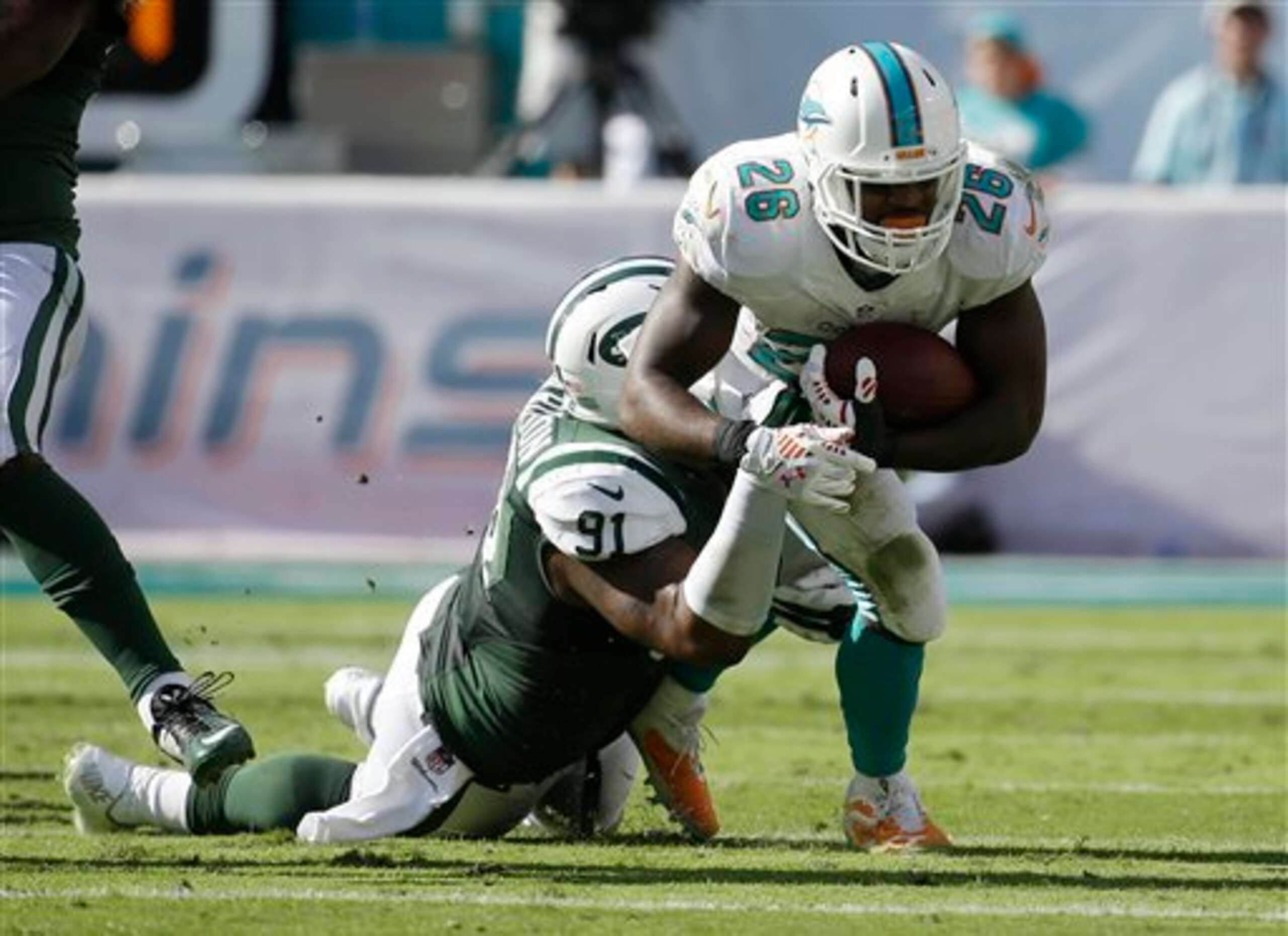
At first glance, nothing seems to be wrong with Miami's rushing attack.
The Dolphins finished the league 12th in rushing yards, running for 1,872 yards. When it came to yards per carry, the Dolphins were the second best team in the league with an average of 4.7 yards per carry.
Analytics support the Dolphins' case as a good rushing team, as well, as the team graded out at 9.4 when running the ball via Pro Football Focus, while Lamar Miller's final run grade was 11.0.
Now, let's try to make sense of something: How could a team that finished second in the league in yards per carry wind up only 12th overall in rushing yards?
They didn't run the ball enough, as they ranked 22nd in attempts with 399.
The best team in terms of average yards per carry was the Seattle Seahawks, with an average of 5.3 yards per carry. They also finished second in attempts at 525 and would wind up leading the league in overall rushing with 2,762 yards on the season.
Now, this isn't as simple as just running the ball more, as you can see why the Dolphins, despite the lofty average, didn't run the ball as much.
Reason No. 1 is their run blocking, which was atrocious analytically. As a team, the Dolphins graded out at minus-40 in run blocking, which could hinder any rushing attack.
The second reason is that they didn't have Marshawn Lynch.
Nothing can be done about the latter, as the best they could do would be to draft a more north-south running back to pair with Miller. Even that won't matter without improvements in the interior of their offensive line.
Once those improvements are made, the Dolphins should look at running the ball at least 420 times. If they retain their average from last season (a very difficult but possible goal), and get at least that many attempts, the Dolphins will have a top-10 rushing attack and greatly improve the offense.
Sacks Allowed
2 of 5
The main goal of the 2014 Miami Dolphins was to improve upon the 2013's offensive line that allowed 58 sacks.
They did that, allowing 46 sacks.
While 46 sacks allowed is better, you don't have to be a football expert to deduce that 46 sacks allowed in a season is still far from any semblance of good, as it was the 10th most sacks allowed in the league.
The problem isn't so much the sacks but the pressure from being sacked so much. It causes plays to get rushed, and when you're going for the big play, it can mess up the timing.
This means that while fans were infighting about whether to blame Mike Wallace or Ryan Tannehill for problems linking up, everyone missed the key factor of simply not having the time in the pocket to create anything.
Now onto the sacks themselves as problems: How many drives did these sacks kill?
I'd go so far as to say that there were at least two games this season that were lost partially due to the Dolphins taking a key sack late in the game.
This stat needs to be fixed even more. The good news is if the Dolphins can continue to decrease the number by 12 like they did last season, they'll be down to 34 sacks—below the league average of 37.9.
Yards Per Pass Attempt
3 of 5
The average NFL team's yards per pass attempt was 7.2.
The Dolphins were below average in that category, gaining 6.8 yards per pass attempt.
It doesn't seem like much since they're only 4/10ths of a yard away from the average, but how often have we seen 4/10ths of a yard be the difference between a first down and fourth down?
This isn't a Tannehill problem, it's a problem having to do with play-calling and the receivers.
I don't have too big of an issue with play-calling, except for the fact that the Dolphins run the ball an obscenely small amount, but that was covered two slides ago.
As for the receivers and their contributions to this statistic (low yards after the catch), that's already seeing a change.
Gone are Brian Hartline (3.5 YAC), Brandon Gibson (3.5 YAC) and Mike Wallace (a much more respectable 3.7 YAC).
In their place is Jordan Cameron (6.6 YAC), although Kenny Stills' 2.8 YAC is concerning to me.
The Dolphins should add another receiver in the draft, and the receivers expected to be available at 14 should improve on this.
As for Tannehill completing longer passes, a better offensive line and better timing, plus a better run game, should improve on this (see the last two slides).
.jpg?w=2560 "Chiefs Giants Football")
.jpg?w=2560 "Titans Colts Football")
.jpg?w=2560 "Colts Football")
Rushing Yards Allowed Per Game
4 of 5
I've picked on the offense enough in this piece, and despite how much those stats need to be fixed, I'll stick by my belief that it was the defense that prevented the Dolphins from prospering in 2014.
If you haven't drank enough good scotch (or aren't old enough to do so) to forget about their games against the Denver Broncos, the New England Patriots, the Baltimore Ravens and the New York Jets down the season's final stretch, then you know exactly what I'm talking about.
Those games all featured teams that could run the ball down the Dolphins' throat and did just that with impunity.
The Broncos beat the Dolphins by running for 277 yards. The Patriots did so by running for 108. And the Jets, who earlier that month almost pulled out a win over the Dolphins while running for 183 yards, got the win in the final game of the season behind 108 yards on the ground.
These rushing performances set up good passing performances by those teams, which was expected against the likes of Peyton Manning, Tom Brady and Joe Flacco, but it was insulting when Geno Smith got a perfect passer rating.
When you stop the run, the game becomes easier. Sure, teams will pass for more yards against you, but that also means more pass attempts, which isn't as efficient and leads to more turnovers.
At the start of the season, the Dolphins were one of the best teams at stopping the run, which explains why they were 7-5 with four games left and on their way to a playoff berth.
In the end, the Dolphins finished 24th in the league in run defense (but sixth in pass defense), allowing 1,973 yards and an average of 4.3 yards per carry and 123.3 yards per game.
How can they improve upon this? They took a big step earlier by signing Ndamukong Suh, whose Detroit Lions finished first in rushing yards allowed with 1,109 (an average of 3.2 yards per carry and 69.3 yards per game).
That's how the team did, but how did Suh do himself against the run? Per Pro Football Focus, Suh graded at 19.6 versus the run in 2014, a big upgrade over Jared Odrick (graded at 1.0) and Randy Starks (graded at minus-9.5).
All that's needed is for Earl Mitchell to improve upon his minus-3.8 grade, and you'll see a difference up front. Something tells me that having Suh next to him will help out a lot.
Point Differential
5 of 5
This is the second most important stat in the NFL and goes hand in hand with the most important stat—wins.
Miami had a point differential of 15 for the season, which ranked 15th in the league.
It was a related story to see the team finished 8-8.
How did the point differential reach such a low number?
Let's look at the offense first, which scored an average of 24.2 points per game. That's actually pretty good—11th in the NFL—and if you can score 24 points, you can win, usually. Would I like to see that average get bumped up to anywhere above 25? Yes, but this isn't the main issue.
Now on defense, you have a unit that allowed an average of 23.3 points per game. That was 20th in the league.
That's not so good.
The NFL average points allowed was 22.6, the worst scoring defense (Oakland Raiders) allowed 28.3 points per game, which is only five more points than the Dolphins.
In other words, this is a simple stat to improve: score more points and allow less.
Yes, that's it.
The question is, can the Dolphins do that? We shall see.
More improvements are needed on offense (guard and receivers) and on defense (cornerbacks). The draft is still a month away, and there are some decent free agent options available.
More work must be done, but it can be done. The question is, will it?
Statistics provided by pro-football-reference.com, unless otherwise noted.
.jpg?w=2560 "Steelers Buccaneers Football")
.jpg?w=2560 "Eagles Jaguars Football")