Making Sense of Adrian Peterson's Value and the Free-Agency RB Market
The Minnesota Vikings are caught in their will-they-won’t-they struggle with Adrian Peterson, and at the heart of it lies his inherent value. The “demise of the running back” has become almost a tired theme in NFL analysis, so much so that people may have over-corrected by arguing that running backs are worthless and easily replaceable.
But how much is Adrian Peterson really worth in the current NFL landscape? With new deals signed by top running backs, we have a chance to compare.
There are a number of factors involved, starting with the contracts of comparable running backs, but also age, scarcity and the importance of the running game in the NFL.
TOP NEWS
.jpg?w=3840 "Pro Bowl Football")
Watch: Jerry Rice Chases After Heckler
Most Improved NFL Defenses 📈
.jpg?w=3840 "SEMANA 10-PANORAMA")
Fantasy Football Busts You Need to Avoid
Free-Agency Contracts
Deals for Marshawn Lynch, LeSean McCoy and Frank Gore being reported (and for Gore and McCoy, technically not signed yet) may provide good refocusing on the running back market and what it means to be a high-level running back on the tail end of their career. The early returns are not favorable to Peterson’s contract situation with the Vikings.
After a misleading but technically correct report that LeSean McCoy would earn $16 million in his first year came out, valuation of his contract became a little off—Jason La Canfora reported that the fact that McCoy would be the highest-paid running back in the NFL means that Peterson’s contract wouldn’t be unpalatable to NFL teams, including the Vikings.
But the real cost of a running back to a team is in their cap hit, because cash taken home is not a concern to teams in the long run. Signing bonuses always increase take-home pay for a player in the first year, but the only thing that takes real resources away from a team is the cap hit consumed by that player. It’s the cap hit, not cash-in-hand, that prevents teams from signing as many free agents as possible.
In that context, LeSean McCoy’s contract devalues Adrian Peterson’s relative worth because his cap charge never exceeds $9.05 million over the life of the contract, and only does so in the final year—when the salary cap will be even higher than it is now.
In the first year, McCoy only counts against the cap by $5.5 million, nearly a third of Peterson’s hit, whose charge against the cap is $15 million for the Vikings and $13 million for any team he’s traded to. While McCoy’s average cap hit for the next five years is $8 million, Peterson’s is nearly double that for the Vikings for the next three years: $15.8 million. For teams he could be traded to, it’s $15 million, per OverTheCap.com.
McCoy is coming off of a poor season, but he also happens to be a younger player with less of an injury history. He may not match perfectly with Peterson, who is generally considered to be the cream of the crop, but it wasn’t long ago that McCoy not only claimed to dethrone Peterson as the NFL’s best running back, but had quite the supporting crew to back him up (even by those who want to shield themselves from criticism by using the word “best” and use “most exciting” instead). And he was even named the running back with the second-brightest future in the NFL (after Trent Richardson and ahead of Doug Martin and Marcus Lattimore).
As odd as that list is in retrospect, it’s an argument that LeSean McCoy, three years younger than Peterson, may be worth just as much money as him before taking age into account.
Frank Gore’s contract averages $5 million with over $7 million in guarantees for the first two years. Compared to McCoy’s average per year (APY) and Peterson’s APY, that’s quite low. There’s still an argument that it might be too much money for an aging back expected to carry the rock 200 times. Gore is going to finish the season just one year older than Peterson will, and the same age as Maurice Jones-Drew, who just retired. Gore is coming off yet another 1,000-yard season, but for the last two years, he has been running below his career yards-per-carry average of 4.5.
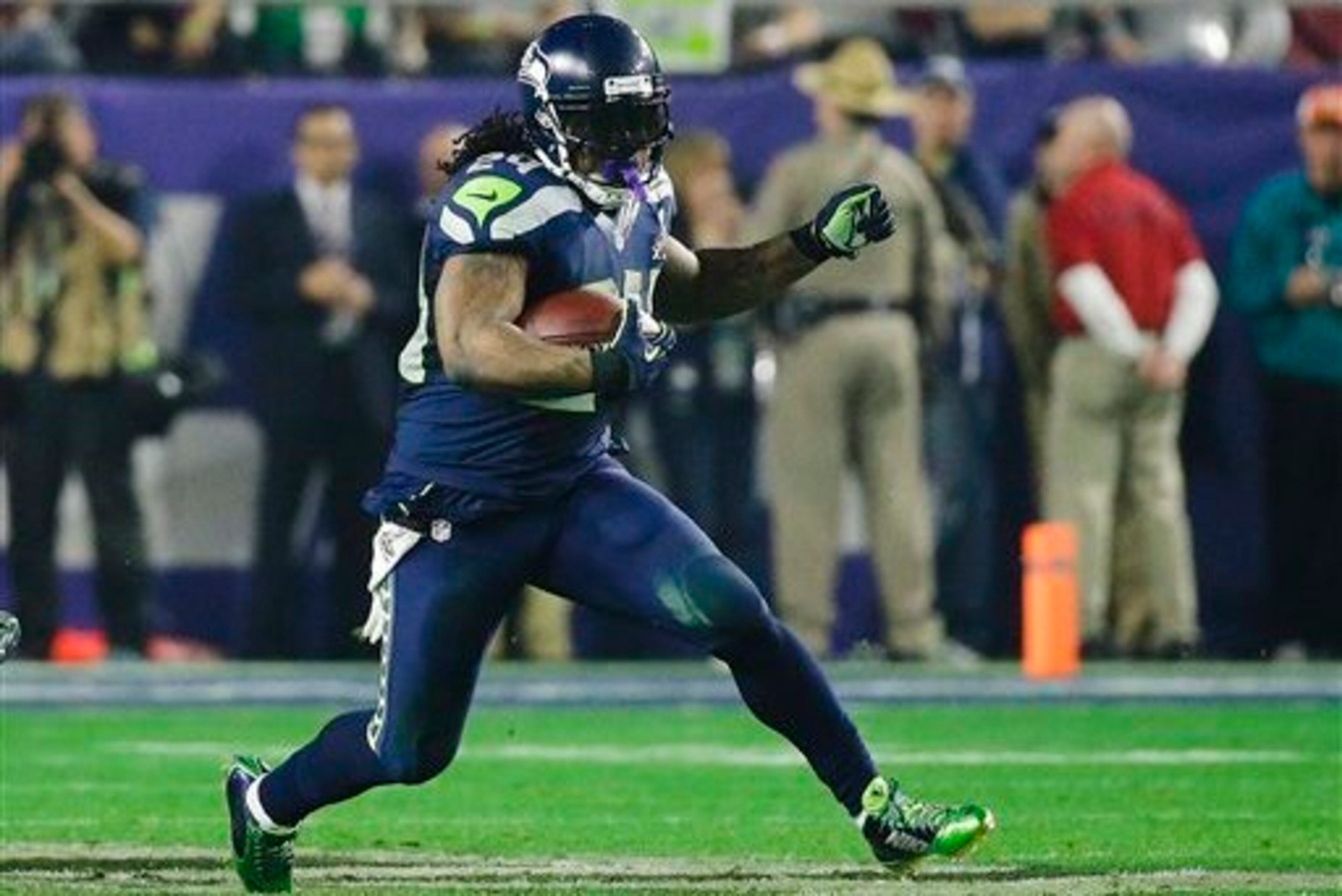
Marshawn Lynch’s contract is an extension and a pay raise. It gives him two more years with the Seahawks and has an APY of $12 million—also his average cap hit in 2016 and 2017, though the nature of signing bonuses has made it such that his cap hit in 2015 is only $8.5 million.
Lynch’s situation best matches Peterson’s, and also happens to best match his contract, but it remains the case that Peterson’s cap hit is still substantially higher—again, averaging $15.8 million over the next three years for the Vikings and $15 million for any team that trades for him (because they won’t be on the hook for his prorated signing bonus).
The comparison assumes that Lynch is being well valued by the Seahawks. Seattle, who relied on Lynch to get to the Super Bowl, know that he is important, but merely knowing a player is "important" doesn't tell us where the line is between overpaying and paying enough. After all, Lynch's average per year is $3.3 million more than Arian Foster, the third-highest-paid back on the market and $4 million more than McCoy is. Matt Forte and Jonathan Stewart average just above half that of Lynch at $7 million.
Lynch is good and important, but the question one would have to ask is if Lynch is so important that he commands 38 percent more APY than the next running back down the list. Probably not, but it seems as if Seattle was hit in a scarcity bind. That bind should not define if Peterson abstractly has value, especially in a scenario where he can be traded.
Age
Peterson is an extraordinary running back, but there are easily arguments to make that he’s not head-and-shoulders above the rest of his competition like he once was. His consistency in producing first downs has waned since his dominant 2007-2012 stretch, as his 2013 and brief 2014 showing have him averaging a first down on 21.5 percent of his carries, down from the previous 24.3 percent. His yards per carry dropped from 5.0 to 4.4, and his advanced stats follow that trend.
Using Pro Football Focus data from 2007-2012, we can see that his average yards after contact was 3.3 per carry. That dipped to 2.4 in the following two years.
That isn’t everything, however, and a more rigorous examination of the statistics would actually conclude that Peterson is not declining and has shown no evidence of decline. Whether or not that means there is no imminent future decline, however, is different. Both age and carries factor into a running back’s decline—a back with 1,200 carries will have “aged” just as much as one with 2,000 carries and one fewer year under his belt.
Historical data for Peterson would suggest that he has 623 carries left in his career, which amounts to two seasons (even after acknowledging he basically had a pass this year).
Approximating the data, and splitting the difference between the fact that he hasn't declined thus far (unusual for a running back and something that long-lasting back Tiki Barber did as well) and the fact that even backs who don't show signs of aging tend to fall off cliffs, would mean that Peterson likely has more than two seasons left. There's an argument for four, but not at the high levels that draw him acclaim or help win games. More likely, his performance will decline gradually until 33 or 34 and then fall off a cliff.
Peterson at 5.0 yards a carry (his career average) is an era-defining and foundational back. At 4.8 yards a carry, he's exciting, explosive and should help win games. At 4.6, he's pretty good.
Beyond that, there should be red flags. Jamaal Charles and LeSean McCoy are considered high-level backs and are much younger than Adrian Peterson. Their deals should last longer, and though McCoy is coming off a down year, both running backs have a high average and could provide as much value to a team from a success-rate standpoint and yards-per-carry standpoint very similar to Peterson, and for longer.
Their cap hits are much smaller, and the point about age may further emphasize that Marshawn Lynch's contract is not a good comparison for Adrian Peterson's true value.
Scarcity
Runners are not that easy to find. Between 2006 and 2011, 34 running backs were drafted in the first or second round of the NFL draft. Only six of them averaged more than 1,000 yards a season, and only nine of them have more than 5,000 total yards. Eleven of those running backs averaged fewer than 500 yards a season and seven have fewer than 1,000 career yards.
The idea that it’s easy to find those backs in the later rounds doesn’t really track well, either. Only one back drafted between the third and seventh rounds of the NFL draft in that time span (Jamaal Charles) has more than 5,000 career yards, out of 95 total running backs selected. Nineteen of them didn’t have a single NFL yard to their names, and 22 more have fewer than 100.
It may be the case that Arian Foster was an undrafted running back who made waves when he got a starting job, but 24 undrafted free-agent running backs made it to camps in that class. The next-most successful running back in that UDFA class was Isaac Redman, who had a career-high 479 yards in 2011, starting one game that year.
In the same year that Alfred Morris popped onto the scene as a sixth-round draft pick, Trent Richardson, Doug Martin and David Wilson were picked in the first round. In fact, from that entire draft, only one running back of the 19 ended up having a successful starting career—Morris. If running backs were as easy to find as is popularly asserted, not only would fewer running backs be selected (after all, no need to replace the ones you have), but the ones who would be selected would be successful far more often.
It is easier to find a number of other positions, like offensive lineman or receiver, than it is to find a running back. After all, looking at the first-round selections in the same period at either position produces a higher hit rate in terms of postseason awards or yards produced.
And, of course, finding a running back of Adrian Peterson’s quality happened once in the dataset: when the Vikings selected Adrian Peterson. One could make arguments, historically, for Marshawn Lynch (the Buffalo Bills would disagree), LeSean McCoy (Chip Kelly disagrees) or Jamaal Charles, but no running back has added as much value to their franchise per year as Peterson has—and that’s while including the year he missed due to suspension.
He is a particularly scarce back.
The Run Game
Given that we have a small index already for the value of the running game in the NFL (at least in terms of how teams view it, if not for winning), this doesn't matter much. We have an idea of how much teams will pay running backs who perform at a high level and are important to what they do. Rex Ryan and Doug Whaley value LeSean McCoy, Pete Carroll and John Schneider value Marshawn Lynch, and Chip Kelly values Frank Gore (but not LeSean McCoy, evidently).
The Vikings value Adrian Peterson, whether or not a trade is inevitable.
It also turns out that running the ball helps people win much more than people think. Run Success Rate is a measure that looks at how often running backs "do a good job" by getting enough yards to keep the offense on schedule. Not only does run success rate correlate well with pass success rate, but run success rate also correlates well with winning, especially when looking only at the first three quarters.
There are massive chicken-egg problems when looking at the data in that light, but it does indicate that total rushing yards or yards per carry may not be the best way to evaluate running games. Given that advanced statistics like DVOA and Advanced Football Analytics' predictive team ranking model use these kinds of metrics, the running game can actually help a team a lot, especially if they have a particular style that relies on running the football—like Seattle's ball-control approach, Philadelphia's tempo approach or Carolina's low-possession strategy.
While running the ball is not as important as passing it in terms of creating wins for teams, running has a clear impact on the success of the passing game and on providing wins for teams—making improvement at the running back position extremely important.
Beyond that, even if there was a massive disparity between running and passing in terms of value it provides to a team, a running back is much more likely to provide significant value to a team than any other position except quarterback. A running back has a greater impact on a game than a single receiver, if only because they tend to touch the ball three times as often.
It is true that the receiver will provide bigger gains for touching the ball, but the running back does it so often that it can overwhelm the contributions of a single skill player. Consider that one a single passing play, the best receivers will average just under 3.0 yards per route run (according to Pro Football Focus)—what is functionally an attempt to receive and advance the ball. The best running backs will advance the ball twice as far on an average rushing attempt.
This is in part because receivers contribute to incomplete passes (high catch rates are at 80 percent, and low ones are near 40 percent), but mostly because if a receiver fails on a particular play, there isn't a large impact because the quarterback can select another receiver. Sometimes that receiver is a running back.
If a running back fails on a particular play, the play is dead.
While it is true that an offensive line can produce the running game to a sufficient degree, it's also true that good offensive lines can be hampered by bad running backs. In fact, this last year, the best run-blocking line in football, per Pro Football Focus, was the Philadelphia Eagles. The eye test would confirm that for most people. Despite that, LeSean McCoy had a down year, averaging 4.2 yards a carry (and less than 4.0 yards a carry in the first 10 weeks of the season) and ranking 22nd in success rate by Football Outsiders.
Regardless, that would ignore the impact an offensive line has in the passing game, where a good one will increase the number of attempts for a quarterback (by reducing throwaways, sacks and scrambles) as well as increase the quality of those attempts (by reducing hits and hurries), enabling the passing game. After all, the average quarterback loses 20 percentage points in their completion rate while under pressure.
The best lines only allow one fifth of all dropbacks to lead to pressure, while the worst ones allow just under half of them to—meaning the difference between the best and worst line is about five percentage points of completion rate every game.

Conclusion
There are competing factors at play here when determining Peterson's value. He still carries the highest cap charge for a running back in the NFL despite the new salary cap opening up a round of negotiations for some of the top running backs in the league. The difference between his cap charge and the next closest back in terms of age and skill level (Marshawn Lynch) is about $4.5 million this year—52 percent more—and $4 million in the next two years, or 33 percent more.
Abstractly, paying running backs makes more sense than people are often led to believe. Paying Peterson this much may not be.
Peterson's average performance would be 5.0 yards a carry and a relatively OK success rate of 46 percent, and that would be better than every other running back's average performance thus far. But the amount by which it is better than other top backs is not worth 33-52 percent more, even after acknowledging that performance must be paid for logarithmically, not linearly (which is why Suh commands so much more money than the next best defensive tackle to grab a contract in free agency).
At other positions, the difference between the top contract and the next-best contract is smaller. At cornerback, where the contracts are expected to drop, the top contract is 14 percent higher than the second-largest APY. At 4-3 defensive end, the difference is eight percent. At quarterback, a position of greater scarcity and one where the marginal differences matter most, the difference is six percent.
A 33 percent increase over the next-best market price is nearly unheard of for any other position, and that devaluation assumes that Peterson performs at his career levels for the next three years. That also seems unlikely—and the best-case scenario is closer to an elite level commensurate with his high-level peers, not above them. While that may seem like a small distinction at first glance, it's the difference between $4 million; a team may have been able to grab the best defensive tackle in free agency instead of the second-best.
That 33 percent increase is over a 38 percent increase on the next-highest contract, too. Reasonable increase of eight percent over the third- and fourth-best contracts would dictate contracts of $9.4 million and $10.1 million, not $12 million and $15 million.
The best-case scenario for everyone involved would be for Peterson to restructure his contract, something he says he's willing to do for five other teams. The cap savings would be a good start for the Vikings in terms of gaining value, but overpaying a top player is better than not paying any player (in an imperfect market—which this is), so they would naturally want good compensation in a trade. With enough competition, they might be able to land a bit more than a second-rounder.
If teams can perfectly value Peterson (perhaps closer to $12.75 million in cap hit over the next three years instead of $15 million if Lynch's cap hit makes sense and closer to $11 million if it doesn't), then they should give in and deal for him, and deal relatively big. The draft is often an investment in a contract that provides four to five years with a less-than-desirable hit rate, especially at running back.
At the same time, the Vikings should be willing to either cut down his pay or move him. Though the Vikings aren't strapped for cap space, they would make very different moves in free agency if they had $13 million more to play with—perhaps in the market for a top player like Devin McCourty, even if that is outside of their modus operandi.
Hitting an elite running back is very difficult, and trade partners would be hard-pressed to find elite production, even for only two years, in the second round. Following that with two more years of good production would potentially mean more value than a second-round pick, but competition for the trade will matter more than the abstract value of a pick.
Partners who can restructure Peterson's contract will get a lot out of him. Given that Peterson seems reticent to restructure at home (after all, he feels disrespected as it is), moving him should satisfy everybody.
.jpg?w=3840 "Commanders Football")
.jpg?w=3840 "Commanders Football")
.png?w=3840 "Offseason Moves Sure To Backfire 💥")
_0.png?w=3840 "Summer League Takeaways ✍️")