

Breaking Down How Amar'e Stoudemire Is Fitting in with Dallas Mavericks
On the surface, the recent acquisition of Amar'e Stoudemire by the Dallas Mavericks doesn't make a ton of sense.
Stoudemire is a shoot-first, offensive-minded player who provides next to nothing as a defender. His effort level has never been in question, but he consistently struggles to protect the rim. This season with the New York Knicks, he gave up 1.132 points per possession in the post, according to Synergy Sports, which places him in the bottom 20 percent of the league.
Even offensively, Stoudemire isn't what he was four years ago due to multiple knee injuries. Part of what once made him the deadliest pick-and-roll big man in the league was his unpredictability. He could roll to the rim and finish with an explosive and vertical burst, finesse floaters over shot-blockers or step out on pick-and-pops for mid-range jumpers.
TOP NEWS

LeBron's Special Helicopter Deal

MJ Makes Record-Setting Donation 🙌

Shams: KAT, Hart Could Be Trade Names
Stoudemire is still capable of these things, but he no longer warrants the same defensive attention. He's not the same player athletically. His mid-range jumper has been supplanted by a post game that's sometimes effective but mostly inconsistent. His defense, which was never a strong point, is an even more glaring weakness.
That's why his signing with Dallas wasn't an earth-shattering move. He'll fill a bench role on a team already loaded with scorers and doesn't exactly bring much to the table on the defensive end.
So why did Dallas do it?
Ever since trading backup center Brandan Wright, the Mavericks have struggled to identify competent frontcourt combinations to spell Tyson Chandler and Dirk Nowitzki. When Wright was on the floor as a Maverick, his 115.2 offensive rating was the best on the team, according to NBA.com.
There are lots of factors besides a particular player's performance that impact offensive rating, but such strong efficiency over a 27-game span is at least somewhat indicative of his positive impact.
Since Wright's departure, none of Dallas' bigs has been able to solidly fill those shoes. Charlie Villanueva has a net rating of minus-0.3; Dwight Powell, who was acquired in the Rajon Rondo trade, is a rookie still finding his game. Greg Smith has not seen consistent minutes to make a lasting difference.
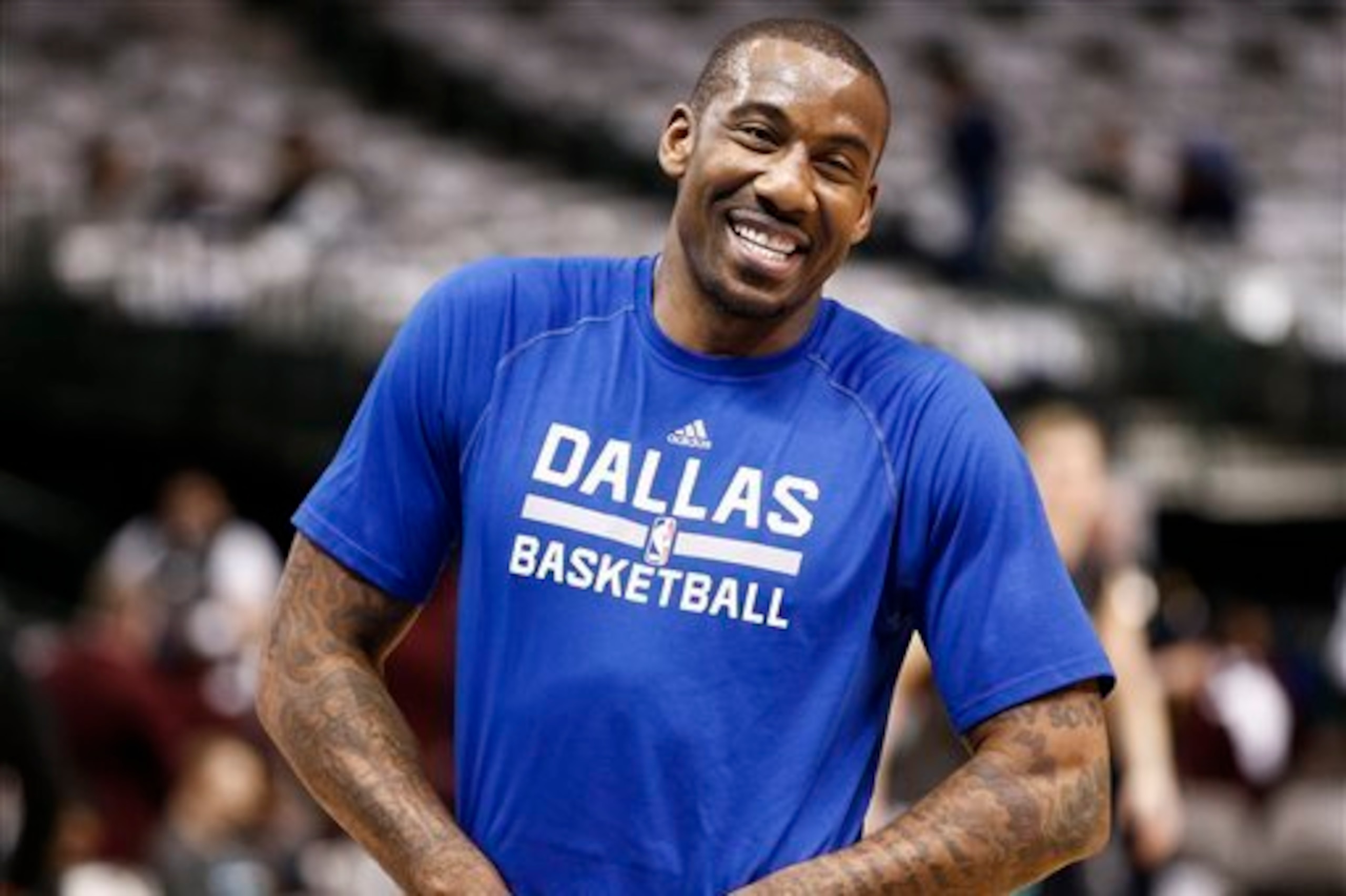
Head coach Rick Carlisle is struggling to find a lineup rhthym as well. Outside his starters—Rondo, Monta Ellis, Chandler Parsons, Dirk and Chandler—no five-man unit has seen more than 42 minutes together. And of those non-starter units, a majority feature small-ball groups with either Al-Farouq Aminu, Parsons or Richard Jefferson at power forward.
Part of what makes Dallas so dangerous offensively is its flexibility to match opposing bigs with Dirk and Chandler or downsize to run slower teams off the floor.
But Dirk and Chandler can't maintain heavy minutes over the course of an 82-game season—both started playing professionally as teenagers and have a combined 29 years of NBA experience. That's why they're averaging right around 30 minutes per contest and only share the floor for 18.2 minutes per game.
That leaves nearly 30 minutes each night with backup bigs or small-ball lineups on the floor. Carlisle mixes and matches these groupings according to situational needs, but the ultimate goal is to maintain winning basketball while limiting the burden on two of his better veterans.
Wright was that solution for the early part of the season because he mimicked Chandler's role on the floor. Both are athletic rollers on pick-and-rolls who suck in the defense and open up the floor for shooters. Neither require touches on the offensive end, and both are willing to do the dirty work, including screening, rebounding the basketball and finishing where appropriate.
Villanueva, however, is a pick-and-pop big who floats on the perimeter and shoots three-pointers. Powell will roll to the basket some, but his greatest strength is facing up opposing bigs and taking them off the bounce.
For Dallas' free-flowing, pass-first offense to function properly, spacing is crucial. Shooters must dot the three-point line at all times, and a big must operate out of the dunker spot—the baseline area six feet from the basket—or roll down the middle of the lane.
This puts pressure on perimeter defenders to make a difficult choice: pinch into the paint and help protect the rim or hug the three-point line and limit bombs from deep.
Wright and Chandler make this choice even more difficult because of their athletic finishing. On this pick-and-roll with Rondo against the Charlotte Hornets, Chandler catches the ball above the free-throw line and finishes with a dunk—all without even needing to dribble the basketball.

In the video below, we see Lance Stephenson lunge out toward Chandler in order to "tag" him—a technique in which a defensive player guarding a shooter bumps the roller to slow down his momentum and momentarily guard him until the defensive big in the pick-and-roll can recover. But he doesn't actually do it because Chandler's roll is so fast, which means Stephenson has to leave a shooter open.
Now let's flip the scenario, this time with Terrence Jones of the Houston Rockets fully rotating to tag Chandler. As the J.J. Barea-Chandler pick-and-roll unfolds, Jones slides down into Chandler's path to make contact on the roll.
Barea reads this defensive choice and properly kicks the ball out to Villanueva, who is lifting out of the corner both to create a better angle for a pass and to make Jones' closeout that much longer.
Chandler doesn't even need to make contact with Jones to cause him to collapse; all it takes is the threat of a Chandler finish at the rim to contract the Houston defense and open up the three-point line.
Stoudemire, though not the athlete that he once was, still has vertical explosion in spurts and is a dangerous roller to the rim. Even more than Wright and Chandler, Stoudemire is a capable finisher under pressure and does not necessarily need to dunk the ball with power.
In some ways, this makes him even more dangerous because it forces defenses to account for him even if he's not in a position to dunk the ball. If Chandler is not rumbling to the rim or hanging within a few feet of the restricted area, most teams will ignore him.
Stoudemire cannot be similarly disregarded. His 1.28 points per possession on shots in the restricted area (not including post-ups) puts him in the 89th percentile in the league, according to Synergy Sports, and it's not all dunks and clean layups.
Tim Cato of Mavs Moneyball sums up how Carlisle will add Stoudemire's skills around the rim to the Mavs' offense:
"Stoudemire is still a force around the rim, and that's all Carlisle requests from him. Sometimes, it'll be from the post. Sometimes, it'll be a roll down the lane as a Rajon Rondo bounce pass or Devin Harris lob floats his way. That's the nature of Dallas and their pick-and-roll heavy offense, as opposed to New York's triangle.
"
Stoudemire's prowess in the restricted area is much more a matter of skill than pure athleticism. Much of the time, he's using his power to create space and his underrated touch to finesse the ball over taller players.
Here against Brook Lopez of the Brooklyn Nets, Stoudemire is pinned behind the backboard, trying to gain control of the ball and facing two more defenders on the other side of the rim.
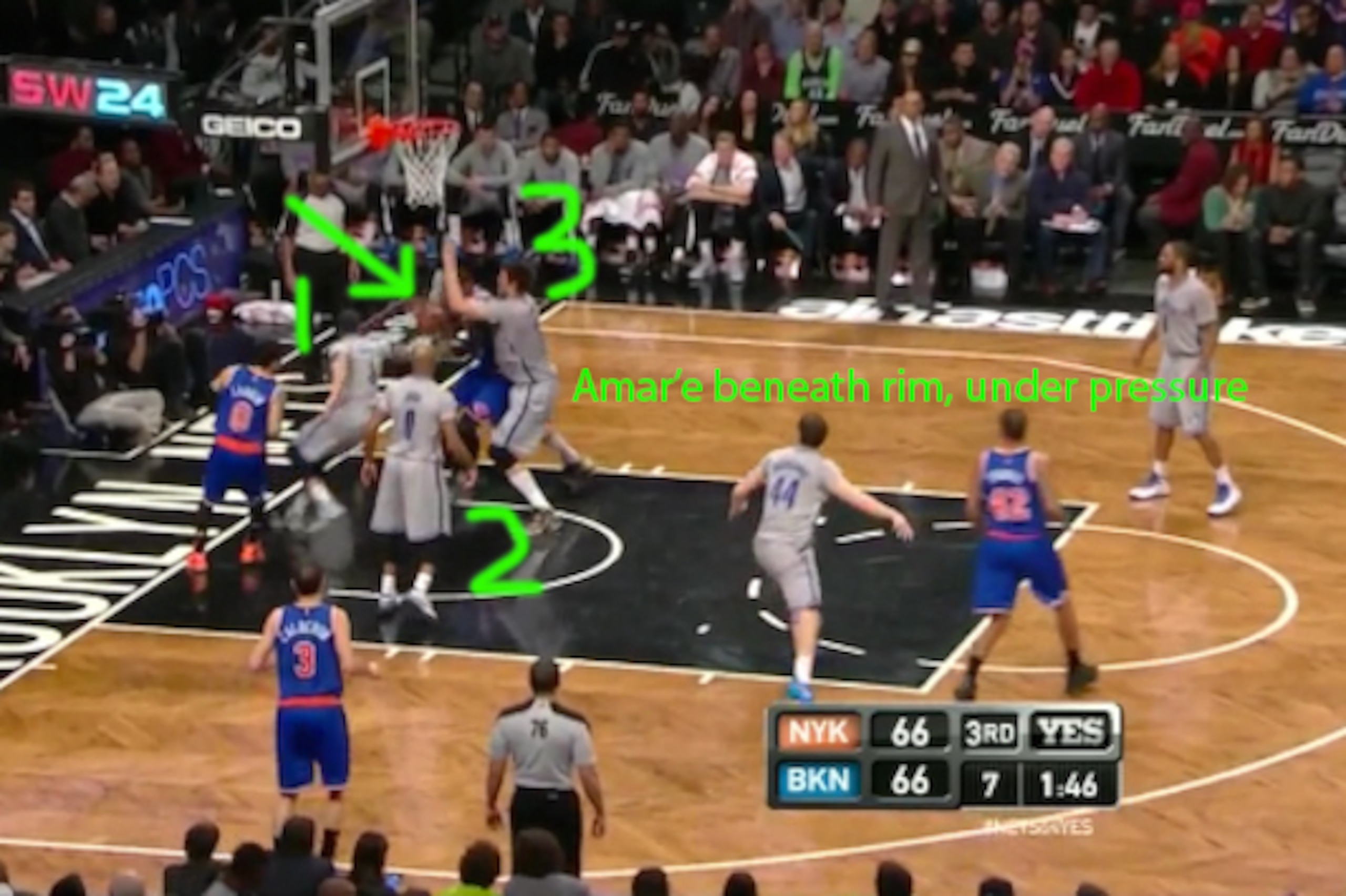
Still, he manages to rip the ball free from the quick hands of Deron Williams, muscle into Lopez, step through to the other side of the rim, power up through the verticality of Lopez's outstretched arm, double-clutch in midair and finish.
Not many bigs in the league are capable of such acrobatics while maintaining body control.
Stoudemire will also bring a legitimate post presence on the block for the Mavs, something they have not had all season outside of Dirk.
In New York, 46.4 percent of Stoudemire's possessions this season came from the post, by far his highest volume shot type (according to Synergy Sports). Ever since recurring knee injuries limited the reckless abandon with which he could play, Stoudemire has tweaked his offensive game to include more typical back-to-the-basket play.
To be clear, Stoudemire's work in the post cannot be a consistent or first-option source of offense for Dallas. But in the 15-18-minute role he's expected to play, it will be a nice change of pace for a second unit that has primarily relied on perimeter play.
Stoudemire, as has been the case for his entire career, is willing to accept whatever role he's given, as he told Dallas' 103.3 KESN-FM (h/t Dallas Morning News): "But with this team, we’re such a deep team to where it may not be necessarily needed for me to play those type of minutes, but we’ll see. If so, I’m available and I’m ready."
That's why the fit is ultimately a nice one for both Stoudemire and the Mavericks. He'll get plenty of touches with the second unit. His style of play is also a nice complement to the built-in pick-and-roll play of the Dallas offense, while his post game is a breath of fresh air.
Assuming he stays healthy, expect Stoudemire to be an important piece of Dallas' attempt at a championship run.

.jpg?w=2560 "Grading WWE Raw 🔠")

.jpg?w=2560 "Bijan's INSANE 1st Half 🤩")
.jpg?w=2560 "Viral Rams Coach Vid 🖕")
.jpg?w=2560 "Injury-stricken Seahawks signing veteran RB")

.jpg?w=2560 "2 NFL Officials Suspended")