

Did Houston Rockets Do Enough to Bolster Roster for the Playoffs?
The Houston Rockets have steadily rebuilt their bench throughout the season, consummating those efforts with the additions of Pablo Prigioni and K.J. McDaniels on deadline day, per Ramona Shelburne and Ian Begley of ESPN.com. Was that enough to give the Rockets a successful playoff run?
That question ties into the quality which is most intriguing about the Rockets: how surprising success can change expectations.
They were coming off a season where they were bounced in the first round of the playoffs because their suspect defense couldn’t stop Damian Lillard and the Portland Trail Blazers.
TOP NEWS

LeBron's Special Helicopter Deal

MJ Makes Record-Setting Donation 🙌
Shams: KAT, Hart Could Be Trade Names
In the offseason, the Rockets struck out in their quest to build a Big Three of their own by adding Chris Bosh or Carmelo Anthony. Instead, they had to settle for Trevor Ariza and an inexperienced bench.
Then, Houston faced a plethora of injuries as the season progressed. Of the Rockets' opening-night starters, Terrence Jones missed 43 games, Dwight Howard 23 and Patrick Beverley 10. While Donatas Motiejunas has improved remarkably, even as the season progressed, to help blunt that loss, it’s remarkable that the Rockets are even in the playoff hunt.
But here they are at 37-18, tied for the fourth-best record in the league and eyeing a deep postseason run. The point of this prolonged introduction is that the latest trades have to be evaluated in the context of the entire framework of their season, not just whether they can win the championship or not.
In light of the full picture, a “mere” trip to the Western Conference Finals or even a well-fought second-round series would be an improvement over last year. And with that coming in a season where they were considered to have regressed, it’s a success.
So, did the Rockets get what they needed to accomplish that in acquiring McDaniels and Prigioni?
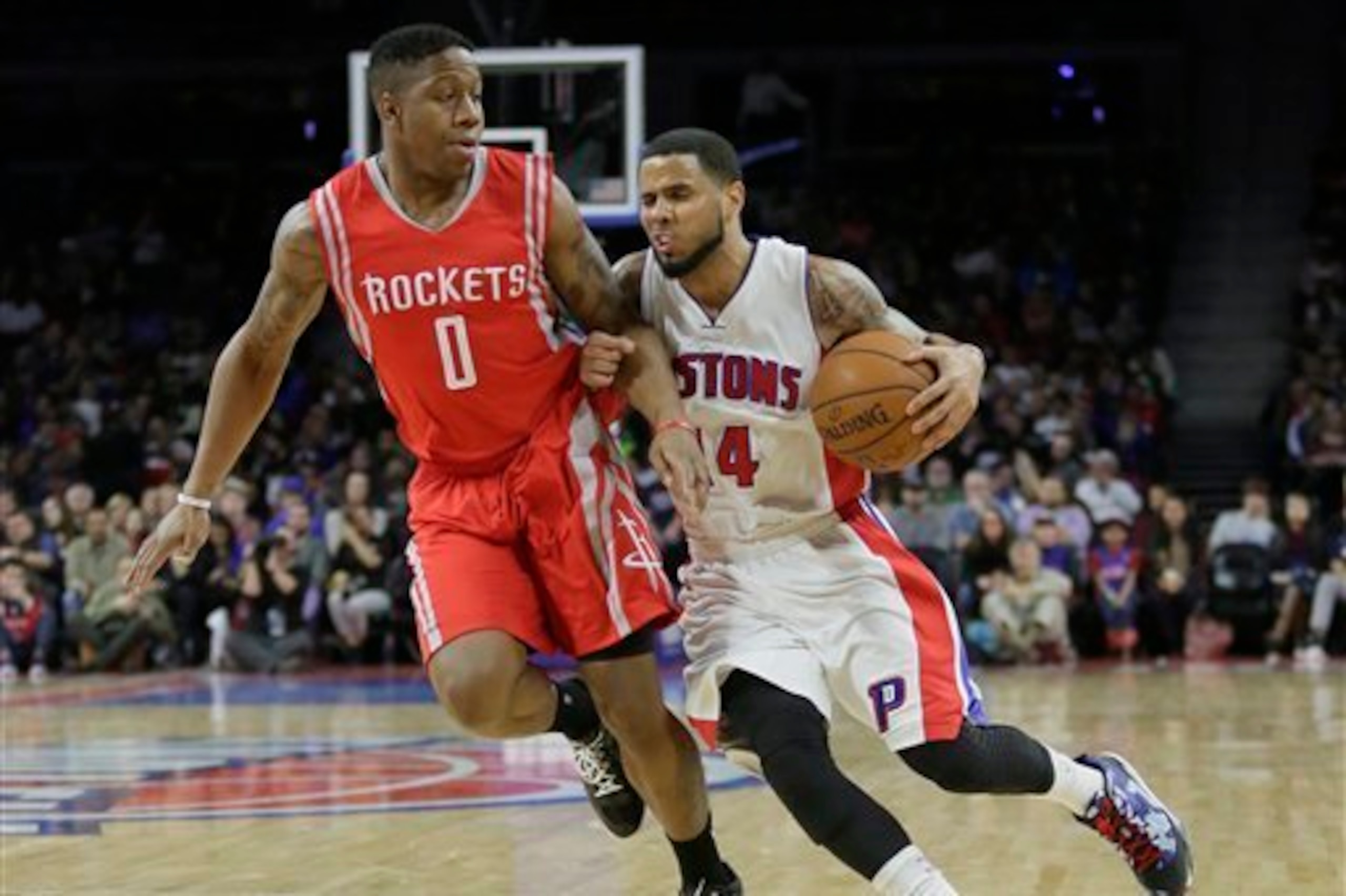
They gave up Isaiah Canaan and a couple of second-round picks for them. Canaan had a role early in the season. But after the Rockets acquired Josh Smith and Corey Brewer in December, he fell almost entirely out of the rotation, playing 60 total minutes after the “Headband Brothers” arrived.
So, the Rockets subtracted very little, but did they add what they needed?
As I’ve written previously, the biggest personnel problem the Rockets have had is an overreliance on James Harden to create scoring opportunities. A testament to this is that, per NBA.com, their offensive rating is 107.0 with him on the court and 92.0 when he’s not. That’s almost as bad as the Philadelphia 76ers, who own the worst offense in the league.
The additions of Brewer and Smith have helped some. Per the media version of NBA.com's advanced stats, since Smith made his move to the bench, the Rockets' offensive rating is up to 94.4 when Harden sits. That’s still woeful and overdependent, though. Can the new arrivals solve that problem?
McDaniels is in effect first-round talent who fell to the early second round because he didn’t impress in the combine. He was taken with the 32nd pick last season, which only means he’s less expensive. DraftExpress.com said of him: “K.J. McDaniels is one of those guys who looks more athletic on film than he tests in a combine setting. Freak in-game athlete.”
Because of that, he gambled on himself taking a one-year deal, which makes him a restricted free agent after this season, raising the question: Is he a long-term plan or a rental?
Per Jonathan Feigen of the Houston Chronicle, Rockets general manager Daryl Morey hints at the answer to that question:
"KJ McDaniels is a guy we tried to get since the draft, one of the highest potential young players in the league. Has elite athleticism and length, already playing at a strong level with Philly. He’s somebody we think will contribute down the road. With our veteran-laden team, it will be hard to break in right away.
"
Based on that response, the long-term future is more secure than the immediate future. McDaniels can only help in the playoff push if he can crack the rotation. That's not impossible.
In the brief time he spent with the 76ers, he proved he deserved better. Writing for BBallBreakdown in December, Jeff McMenamin compared McDaniels to a young Gerald Wallace:
"The NBA might just have found their new version of Wallace in this young 2014-15 season. Selected even later than Wallace at pick No. 32, Philadelphia rookie K.J. McDaniels has shown off his incredible leaping ability and defensive potential in his debut season for a very bad Sixers team. McDaniels averages 9.5 points, 3.8 rebounds, 0.9 steals and 1.6 blocks in 25.2 minutes for the Sixers.
"
And McDaniels is fourth on Scott Howard-Cooper’s Rookie Ladder in this year’s much-celebrated but disappointing rookie class. Howard-Cooper writes:
"He is still second in the class in blocks -- again, as a 6-foot-6 wing -- but McDaniels suddenly has a declining role. He is down to 19.8 minutes in the five games of February, after no less than 25 any of the previous three full months, and the encouraging early signs that three-point range could make him more than a defensive specialist have been replaced by 18.2 percent behind the arc in the same five games. McDaniels needs to find stable ground again.
"
McDaniels has that ability to be a two-way threat. Brewer and Smith, who also fit that description, are already developing some tremendous chemistry. The Rockets’ net rating is plus-9.6 when the pair is on the court together. With the same sort of explosiveness and athleticism, McDaniels can slide right in and provide what they need.
Can McDaniels create points? What do you think?
Per Basketball-Reference.com, McDaniels has 60 unassisted field goals this season, which is more than any perimeter player on the Rockets not named Harden. He’s also a beast at getting to the rim, as 44 of those self-manufactured field goals have been inside the restricted area.
That’s important as the Rockets emphasize “Morey-Ball,” a moniker derived from the GM's name and emphasis on the more efficient areas of the court: inside the little semicircle and outside the big one.
While the Rockets lead the league in three-pointers, both made and attempted, they are only 11th in points scored inside the restricted area, which is another area of concern. That problem manifests itself the most when their three-point shooters struggle. Apart from Harden (115), the most makes within three feet of any ball-handler on the Rockets is Smith (31).
Putting these two elements together—how McDaniels scores and where he does so—the Rockets have a guy who can create his own opportunities where they need him to the most—provided he gets the minutes.
While his defensive real plus-minus (DRPM) seems fairly neutral at minus-.10, per ESPN.com, that’s a pretty remarkable number, considering he’s a rookie coming from a horrid team. Then, factor in his 4.3 block percentage (h/t BBallBreakdown's Jesse Blanchard) is the highest ever by a player 6’6” or shorter, and he’s a defensive asset.
McDaniels’ efficiency seems problematic with a 44.8 effective field-goal percentage, but a large part of that is probably due to the fiasco of an offense he’s coming from. The Sixers shoot just 41 percent from the field as a team.
With the Rockets’ shooters to provide spacing, expect McDaniels’ shooting numbers to jump significantly. Consider Smith, who was in a similar situation in Detroit and has seen his effective field-goal percentage leap from 40.3 in the Motor City to 49.7 in Space City.
McDaniels isn’t enough to carry an offense by himself, but the triumvirate of Smith, Brewer and McDaniels should be enough to sustain it long enough to give Harden rest from time to time. A second unit with Jason Terry, McDaniels, Brewer, Smith and Jones should be able to put points on the board. In fact, that’s better than some teams’ starting five.
Prigioni may be the one who ends up getting to run with the starters. In many ways, he offers an ideal backcourt mate with Harden because he can supplement Harden's offense without dominating the ball.
And he’s a solid team defender, with a DRPM (plus-.33) actually superior to Patrick Beverley’s (minus-.92). He’s 41.4 percent in his career from deep. He averages 6.1 assists per 36 minutes.
Morey told Feigen:
"Pablo Prigioni is a top-end winner. We know him well. Very good shooter. More of a pure point guard. A guy who gives coach a different look when (Pat) Beverley is not playing at the one spot. He can make the passes he needs to make. A veteran leader and great locker room guy only focused on winning.
"
An alternative is to play Harden and McDaniels together. Harden is effectively the point guard anyway, and McDaniels’ ability to get to the rim would take pressure off Harden. McDaniels’ presence in the backcourt would be a defensive improvement as well.
So, in Prigioni, they have a guy who can create for others. In McDaniels, they have one who can create for himself. That meets the Rockets' two biggest needs.
While some would argue the backup 5 is essential, that's more a problem of Howard's absence. When Howard is healthy, Motiejunas, Jones and Joey Dorsey are sufficient to fill the void. The Rockets' current lack isn't that of a reserve center; it's not having a true starter.
When you look at the full scope of what the Rockets have done with player movement on the season, it’s impressive: This summer, they seemingly let Chandler Parsons walk and traded away their first-round pick, Jeremy Lin and Omer Asik. All they got back at the time was Trevor Ariza, the New Orleans Pelicans’ pick and a bunch of meaningless assets.
But in sum, they turned their late-20s pick, Lin and Asik into a lottery pick, Ariza, Terry, Brewer, McDaniels and Prigioni. Sitting on the biannual exception allowed them to land Josh Smith. For Houston, it’s not just about deadline day; it’s the whole picture.
At the outset of the season the question was: Can the Rockets make the playoffs? Now it's: Can they make a deep run?
That change alone almost makes the season a success, particularly if the latter query is answered in the affirmative. McDaniels and Prigioni aren’t the totality of the moves Houston made this season; they’re the consummation of them. And it’s just enough to make Houston a legitimate postseason threat.
Stats courtesy of Basketball-Reference.com and NBA.com unless otherwise noted.

.jpg?w=2560 "Grading WWE Raw 🔠")

.jpg?w=2560 "Viral Rams Coach Vid 🖕")
.jpg?w=2560 "Bijan's INSANE 1st Half 🤩")

.jpg?w=2560 "Injury-stricken Seahawks signing veteran RB")
.jpg?w=2560 "2 NFL Officials Suspended")