One flaw can derail an entire NBA team's season.
Contenders too?
Contenders too.
Imperfections are unavoidable in the NBA, even for the most dominant teams. Problems and shortcomings arise over the course of an 82-game season. That's life. But some defects aren't just minor roadblocks—they're fatal faults that cost wins.
Finding them takes a keen eye. Luckily, we all have 20/15 vision and are therefore equipped to find them. In doing so, we look for most major issues that have been plaguing squads over an extended period of time. These flaws could be anything—from defense to offense to health—though they're usually more specific.
Whatever they may be, they're a big deal as of now.
Identifying title contenders, of course, isn't as calculated. It's a mostly subjective process that demands we ask: Which teams are capable of coming out of their conference?
And on that note, hit the lights, lock the door and grab your lab coat. The NBA's best teams are about to go from the top of their pedestal to under our microscope.
Atlanta Hawks: Superstar-Less Success
1 of 13
Watching the Atlanta Hawks play is truly a treat—the kind with decadent, gooey-fudge filling.
Mike Budenholzer's crew is one of just two Eastern Conference teams (Chicago Bulls) to rank in the top 10 of offensive and defensive efficiency. They run a system nearly identical to that of the San Antonio Spurs, sharing the ball in excess—first in assist percentage, fifth in passing—while placing a premium on corner three-pointers.
Despite this progression, the Hawks lack a proven superstar. Paul Millsap is the only player on the roster to earn an All-Star selection since 2011, and only three in total (Elton Brand, Al Horford, Millsap) have made an appearance overall.
Superstars become especially valuable come playoff time, when lights are brighter and stakes higher. The Spurs parlayed a megastar-less system into a championship last season, but their dynamic is 15-plus years in the making. The Hawks are still new to conference supremacy and the title-contending conversation.
Jeff Teague, Kyle "Threezus" Korver, Horford and Millsap are all viable late-game options and big-stage performers. Even Dennis Schroder has had defense-slaying moments in the clutch. Victories over the Cleveland Cavaliers, Chicago Bulls, Houston Rockets, Dallas Mavericks, Portland Trail Blazers and Los Angeles Clippers are impossible to ignore as well.
Playoff basketball is merely a different animal—one the impressive, yet still new-to-the-discussion Hawks may or may not be fit to handle.
Chicago Bulls: Derrick Rose's Shot Selection
2 of 13
Deep breaths. Derrick Rose is still a superstar, and the Bulls remain Eastern Conference juggernauts. But the point guard's shot selection is not a good look for either party.
One-third of Rose's attempts are coming from beyond the arc, where he's a lifetime 30.5 percent shooter and banging in just 26.4 percent this season. He's also attempting more pull-up shots (6.5) per game than he is drives (6.3)—even though he's shooting just 33.7 percent on the former, compared to 52.2 percent on the latter.
Whether Rose is trying to adapt his game, consciously aware of past injuries or some combination of both doesn't matter. His shot selection does not align with his skill set, as Jay Patt wrote for Blog A Bull:
"I understand the desire to keep the defense honest, especially when the opponent is giving space and baiting Rose into shots. I also get him wanting to use his jumper to help preserve his body from wear-and-tear.
But there are ways to do this without continuously throwing up horrendous three-point attempts. We've seen it happen THIS season. Is it a coincidence that in his best three games of the year (POR, TOR, WAS), he took eight threes total? I think not.
"
Completely eliminating jump shots from his arsenal isn't the solution. But there's no way nearly 50 percent of his attempts should be coming outside eight feet when he's shooting 29.2 percent from said range.
If he's trying to attack less and/or hone his perimeter game, he should do so while working on his spot-up shooting—he's hitting just 31.6 percent of his catch-and-shoot opportunities—while hoisting fewer shots in general. He doesn't need to be the No. 1 option anymore, after all. Both Jimmy Butler and Pau Gasol provide relief he hasn't enjoyed before.
Indeed, the Bulls still rank sixth in points scored per 100 possessions, and their offense is even more potent with Rose on the floor. That plus-1.4 difference with and without Rose, though, is hardly impressive and stands to improve once his field-goal distribution does.
Plus, there's no comfort in knowing a title contender's best player—even if only by reputation at this point—isn't taking the right shots.
Cleveland Cavaliers: Rim Protection
3 of 13
Acquiring Iman Shumpert and J.R. Smith from the New York Knicks didn't solve the Cleveland Cavaliers' interior-protection problems. Trading for Timofey Mozgov might.
The Cavaliers are sending two first-round picks to the Denver Nuggets in exchange for the 28-year-old Mozgov in hopes of bolstering their flimsy paint protection.
Packed with perimeter players, the Cavaliers used their "biggest" trade asset in Dion Waiters to land more perimeter players. Meanwhile, they're still tied with the Minnesota Timberwolves for dead last in opponent field-goal percentage at the rim and rank 23rd in defensive efficiency overall.
Although Mozgov is an upgrade over what the Cavaliers already have—he allows opponents to shoot 48.7 percent at the rim—they don't yet know if the price is worth the prize. Kevin Love and Tristan Thompson are also still floor fixtures, and both are allowing rival scorers to shoot at least 57 percent inside six feet of the bucket.
Top championship contenders generally protect the basket. Nine of the league's most formative title-seekers rank in the top 11 of opponent field-goal percentage at the rim. If Mozgov and friends cannot find a way to address their point-blank shortcomings, they'll fall out of a discussion—this one—to which they barely even belong.

Dallas Mavericks: Perimeter and Transition Defense
4 of 13
Rajon Rondo's arrival has incited a defensive revolution in Dallas. The Mavericks rank third in points allowed per 100 possessions over the last nine games, and while said rise has come at the expense of historical offensive potency, they remain one of the league's most dangerous point-piling machines.
Once Rondo steps off the floor, though, everything changes. In the 142 minutes the Mavericks have played without him, they go from the league's best defensive team to the fifth worst.
Opponents are still putting in 37.6 percent of their long balls against the Mavericks defense as well, the Association's fourth-worst mark. That number has improved to 32.4 percent since Rondo's arrival, but this remains a small sample size. They're also tied for last in transition defense, allowing 15.9 fast-break points per contest, according to TeamRankings.com.
Landing the All-Star point guard has indeed helped change the defensive culture, but this isn't yet a Mavericks team that can be deemed a polished product. A 7-2 record and six-game win streak isn't enough to morph season-long weaknesses into cured strengths.
Until the Mavericks sustain this balanced brand of basketball past the All-Star Break and into the spring, their perimeter and transition defense remain potentially fatal, title-impeding flaws.
Houston Rockets: Point Guard Paucity
5 of 13
Josh Smith doesn't threaten to ruin the Houston Rockets. They've admittedly struggled since his arrival, going 3-4 in games he's played, but their already staunch defense is statistically better with him on the floor, and coach Kevin McHale always has the option of benching him.
Houston cannot, however, conjure a genuine floor general out of thin air or hopes and dreams.
James Harden has been the Rockets' primary playmaker thus far, and he's done a fine job. His usage rate is through the roof, the results of which are career highs in points (27.0), assists (6.5) and player efficiency rating (26.3).
Patrick Beverley and Trevor Ariza have also lent defensive helping hands. Opposing point men are registering a below-average PER of 12.4 against the Rockets' impregnable perimeter prevention, according to 82games.com.
But this previously potent offense has fallen to 19th in efficiency, and there are times when they lack structure, clearly missing the direction pass-first pilots bring. They turn the ball over 17.5 percent of the time, the second-worst mark in the league, and they're prone to fits of empty isolation basketball—issues an experienced offensive chief can help remedy.
Trading for another primary ball-handler, then, will prove paramount for these Rockets, lest their over-dependence on defense continues, their piddling offense lives on, and their championship chances suffer as a result.
Golden State Warriors: Center Position
6 of 13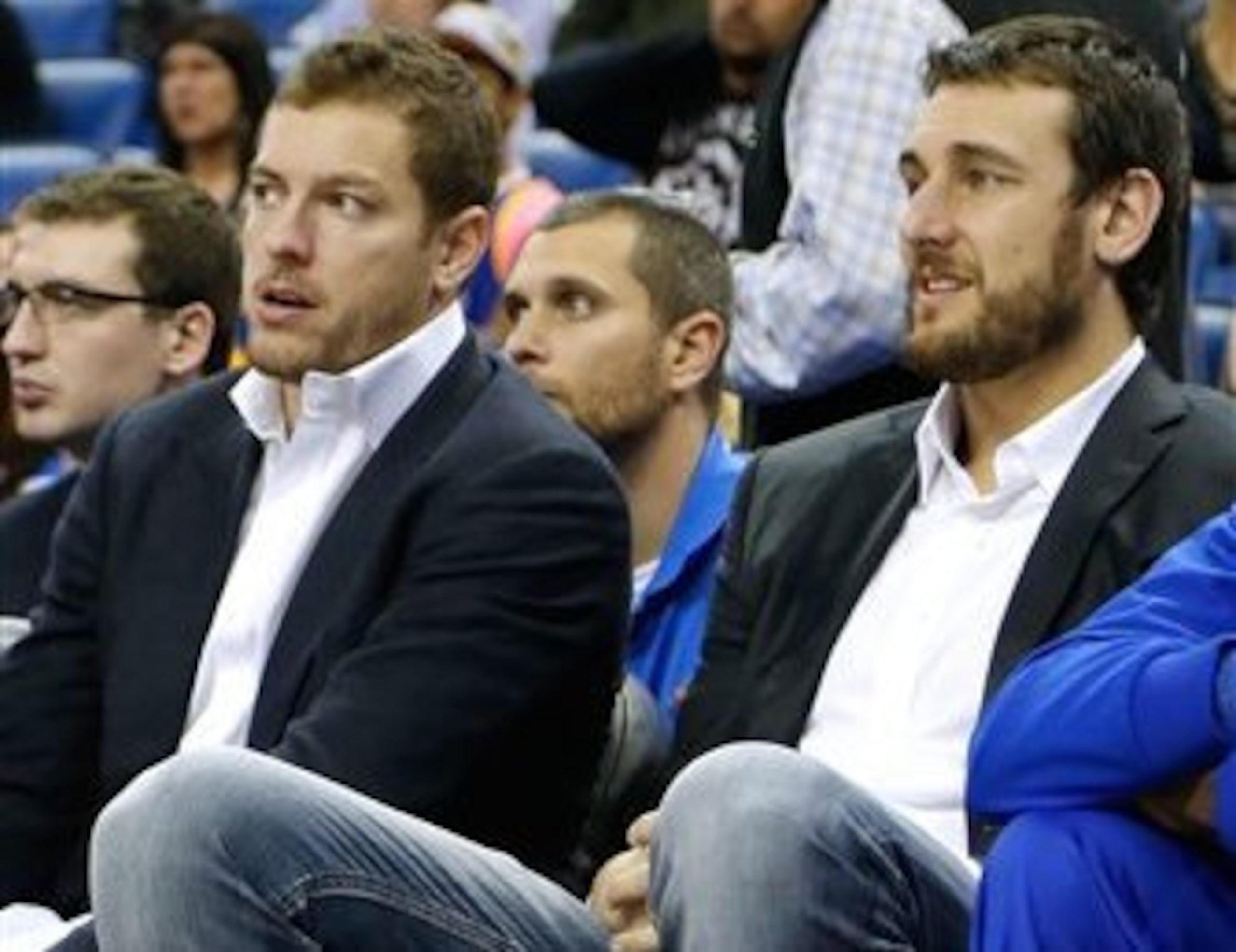
This, my nameless and faceless friends, is what nitpicking both looks and feels like.
Of all the NBA contenders, the Golden State Warriors stand alone, without a truly fatal, campaign-crushing flaw. But unlike Taylor Swift, we're not ones to riff about blank spaces. Thus, we have the Warriors' potential tumult at center.
Personnel-wise, the Warriors are fine. They have an elite paint-policer in Andrew Bogut, a feisty—albeit clumsy—tower in Festus Ezeli and an offensively apt power forward-center hybrid in David Lee.
Health is what gets in the way of this crew. The Warriors outscore opponents by a mind-melting 19.7 points per 100 possessions when Bogut is on the floor, but as of now, he isn't on the floor. He's out indefinitely with knee issues, a sadly typical state for the defensive linchpin who has missed at least 13 games in each of the last seven seasons.
Lee himself has only played eight games thus far, and while he's holding opponents to below-average shooting percentages, he's not a legitimate rim-protector. Ezeli, meanwhile, is battling an ankle injury and remains an offensive minus.
Bogut's extended absence could, in theory, cripple the Warriors long term. Yet here's the colossal caveat: They have the league's best offense and defense since he went down on Dec. 8, and their net rating (12.6) remains unchanged.
With so much going right for this incalculably balanced squadron, our analysis rests on the assumption that, no matter the evidence, it's better to be fully healthy than not.
Update: Bogut played 15 minutes versus the Pacers on Wednesday, finishing with four points and eight rebounds.
Los Angeles Clippers: Small Forward Woes
7 of 13
Across-the-board defensive declines have turned the Los Angeles Clippers into a fringe contender merely existing within the Western Conference's championship-chaser drove.
Last season the Clippers fielded a seventh-ranked defense under Doc Rivers; this season they're on pace to finish 16th. The biggest culprit behind their drop? Their depleted small forward corps.
Hedo Turkoglu and Matt Barnes are the only listed small forwards on the roster. Playing Reggie Bullock and Jamal Crawford out of position hasn't helped deepen the rotation either. Opposing small forwards are outperforming the Clippers' wings by 3.8 PER points, per 48 minutes, according to 82games.com, the team's worst position differential by far.
As for those hoping the Clippers bolster their small forward situation ahead of the Feb. 19 trade deadline, channel said optimism elsewhere. As Ken Berger of CBS Sports explained:
"The Clippers continue to shop for a starting small forward, but have told at least one inquiring team that they do not intend to move valuable sixth man Jamal Crawford in the process, sources say. The Clippers have one of the least productive benches in the league as it is, and that problem would become even more pronounced if they moved Crawford.
Coach and president Doc Rivers has few trade assets to work with, and the Clippers are hard-capped and thus don't have much flexibility to take on salary.
"
There is more to the Clippers' collective conundrum than the deficiencies at small forward. A second unit that ranks in the bottom five of minutes played and defensive efficiency, per HoopsStats.com, certainly isn't helping its championship case.
No position has been more complicit in its standings' plummet than small forward, though. That's the gaping hole the Clippers need to fill if they plan on finishing better than sixth in the brutal Western Conference.
Memphis Grizzlies: Three-Point Shooting
8 of 13
Hey, Memphis! Where are all the three-point shooters? The same place as last season: not in Memphis:
Bleacher Report's Adam Fromal will now grab the mic for a moment:
"The Memphis Grizzlies' core is identical this season, featuring Marc Gasol, Mike Conley, Zach Randolph and Tony Allen as well as a distinct defensive identity. And while Gasol is playing at ridiculous levels and Conley has improved significantly, the ceiling is still lowered by the team's lack of offensive versatility.
Basically, Memphis can't space the court.
"
Don't confuse any of this with the Grizzlies being an offensive eyesore. They have the NBA's eighth-most efficient offense and are still vying for alpha-dog status in the ultracompetitive Western Conference. But this doesn't excuse them from attempting only 15.8 bombs per game—fourth fewest in the league—while ranking a middling 13th in conversion rate.
Reliable three-point shooting has become an integral ingredient in building championship teams. Just look at how the last five title-toters have fared from behind the rainbow compared to these Grizzlies:
| 2009-10 | Lakers | 19.0 | 10 | 34.1 | 24 |
| 2010-11 | Mavericks | 21.6 | 5 | 36.5 | 11 |
| 2011-12 | Heat | 15.6 | 23 | 35.9 | 10 |
| 2012-13 | Heat | 22.1 | 6 | 39.6 | 2 |
| 2013-14 | Spurs | 21.4 | 17 | 39.7 | 1 |
| 2014-15 | Grizzlies | 15.8 | 27 | 35.8 | 13 |
Each of the last five champions has ranked in the top 10 of three-point attempts or three-point percentage. Each of the last four has finished in the top 11 of conversion rate.
After losing Mike Miller and seeing his replacement, Vince Carter, struggle from three-point range (31.4 percent), the Grizzlies aren't even close to there. In fact, if they won a title this season, they would be just the second team since 2003-04 to do so while attempting under 16 threes per game.
Here's hoping Courtney Lee, who is banging in 50-plus percent of his bombs, attempts between three and 27 more every night.
Oklahoma City Thunder: Seeding Sadness
9 of 13
Blame the Western Conference's powerhouse logjam and Oklahoma City's injury-bug infestation for this one.
The Thunder are finally whole again. Russell Westbrook and Kevin Durant are both back in the lineup, and the team is sporting a 9-3 record when the latter plays. Provided they remain healthy, the Thunder are playoff locks.
Eighth-place locks.
It's difficult to see the Thunder nabbing anything higher than the No. 8 seed, which they're three games back of heading into Jan. 7. Seventh place seems to be a possibility, with only a 3.5-game chasm between Oklahoma City and San Antonio. But come on: Who sees the Spurs dropping any further in the standings and then staying there?
Catching the sixth-place Clippers or fifth-place Rockets is an even more unrealistic goal. Six and 6.5 games, respectively, separate them from Oklahoma City. That leaves the Thunder to accept a harrowing reality: eighth place, and eighth place alone, is theirs for the taking.
Which is fine, right? Seeding doesn't matter in the contender-crammed West. If the Thunder sneak in at No. 8, they'll be the most dangerous eighth seed in NBA history. Memphis, Portland and Golden State, consider your teams warned.
That, though, doesn't change the facts. Only five No. 8 seeds have made it out of the first round in NBA history, per USA Today's Erik Brady. The 1998-99 New York Knicks remain the only eighth-place team to make an NBA Finals appearance.
If we're looking for the most detrimental piece of reality standing between the Thunder and a title, this is it.
Portland Trail Blazers: Depth
10 of 13
Insufficient depth has become the exhausted trope that's defined the rising Blazers over the last couple of seasons. And with their second unit having improved a great deal, it seems almost cruel to continue harping.
But a shallow rotation still threatens to sink this team. The Blazers' talent pool stretches seven impact players deep on a good night. Their second unit ranks middle of the road on both offense and defense, per HoopsStats.com, and the team's success remains tightly tethered to the health of a few.
That they rank third in points allowed per 100 possessions with Robin Lopez sidelined due to injury is incredible. That they're seventh in points scored per 100 possessions, despite Nicolas Batum having his worst statistical season since he was a rookie—career-low PER of 12.5—is also astonishing.
Credit Steve Blake and Chris Kaman with infusing veteran moxie into the bench, but the Blazers' backups remain tied for the fourth-fewest minutes played, implying an over-reliance on the starters. Though this model has yielded the West's second-best record to date, they run the risk of burning out pivotal players and regressing, much like last year.
And with the Blazers due to pour tens of millions of dollars into their core this summer—LaMarcus Aldridge, Damian Lillard (extension), Wesley Matthews and Lopez are eligible for new deals—that's no bueno.
San Antonio Spurs: Health
11 of 13
Something about the San Antonio Spurs' 2014-15 campaign feels off. Their defense ranks sixth in points allowed per 100 possessions, and the offense has climbed into the top 12, but their place in the West (seventh) doesn't feel right.
Late-game blunders against the Detroit Pistons, New Orleans Hornets, Mavericks and Blazers are uncharacteristic of this team. Are they suffering from a championship hangover? The clutch-moment yips?
While some combination of the above issues may come into play, injuries have harmed the Spurs more than anything or anyone else.
Patty Mills, Tony Parker, Tiago Splitter and NBA Finals MVP Kawhi Leonard have all missed significant time. Leonard isn't even back yet, and he isn't expected to return for at least another two weeks, according to Wojnarowski.
Coach Gregg Popovich has been forced to butcher his rotation in the meantime. Tim Duncan is averaging 31.7 minutes per game, his highest total since 2008-09. Manu Ginobili is in the same boat; he's logging north of 25 minutes a night for the first time since 2010-11. The Spurs have also played five overtime games already, and two of them have spanned three extra periods, putting unnecessary strain on players.
“I have to try to take care of that over time, so that we can be as energetic and fresh as we can possibly be,” Popovich said on Christmas Day, per Pro Basketball Talk's Dan Feldman. “And we haven’t even made the playoffs yet. Aren’t we like eighth or ninth or seventh or whatever we are? I don’t know. It’s not like we’re automatically in.”
“I worry about it every day, really,” Popovich would add of injuries.
Time and again, the Spurs have defied logic and age. And, just as it's been for years, their ability to win another championship rests with that continued defiance.
Toronto Raptors: Defense
12 of 13
Citing defense in general as the Toronto Raptors' fatal flaw isn't a cop-out. It's a sign of how much the Raptors need to fix defensively.
Smaller lineups, while offensively beneficial, have put the Raptors in a hole defensively. Find a defensive metric in which they don't rank near the bottom or in the middle, and I'll give you a cookie. They're 22nd in points allowed per 100 possessions, 26th in rebounding percentage, 19th in points allowed in the paint and 12th in three-point defense.
Many of their issues are systematic. There are the increased number of undersized lineups, sure, but the Raptors are also getting destroyed off screens. They neither fight through them nor switch, opting instead to double the ball-bearer, creating a maze of secondary rotations that leave them one pass away from giving up a wide-open three-pointer or layup lane.
DeMar DeRozan's return should help, as Bleacher Report's Grant Hughes outlined, but only slightly. The Raptors will still match up poorly against teams running stretch forwards, even when they field one of their own. They don't have the requisite meld of lateral quickness and athleticism to combat numerous floor-spacing wings.
No team since the 2000-01 Los Angeles Lakers has finished outside the top 10 of regular-season defensive efficiency and gone on to win a title, and the odds are against Toronto becoming the latest exception.
Playing in the Eastern Conference certainly helps mitigate the Raptors' defensive plunge now—they ranked ninth in efficiency last season—but their fellow contenders won't be as forgiving later.
Washington Wizards: Late-Game Execution
13 of 13
It's been tough sledding for the Washington Wizards late in games.
Fifteen of their contests have seen them ahead or behind by no more than three points in the final five minutes. They're an unimpressive 8-7 in those situations. Of the other 12 teams on this list, only the Spurs (9-10) and Thunder (7-11) have posted a lower winning percentage under similar circumstances.
Somewhat surprisingly, the Wizards' typically stellar defense has struggled. They're just 22nd in points allowed per 100 possessions during clutch situations overall (ahead or behind by five points) and only 14th when the margin is three points or fewer.
This, in addition to an offense that's still failing to climb past mediocrity. The Wizards' late-game play-calling is uninventive and overly dependent on Bradley Beal and John Wall—the latter of whom looks lost. As Bullets Forever's Umair Khan wrote:
"And this flows into yet another issue: Wall looks indecisive, almost like he's predetermining all of his reads and subsequently curling up into a ball when things go haywire.
His offensive rating drops nearly 20 points in the last five minutes of a ball game per NBA.com's stats page, which amounts to a net-rating of -21.7, and his assist ratio, which totals the number of assists a player averages per 100 possessions, drops from 31.6 to a pedestrian 18.1. All of this and still they're keeping the ball in his hands.
"
Close games are a reality of postseason play. If the Wizards are going to be legitimate Eastern Conference threats, they'll need to look more at home during crunch time. Wall himself—whose usage rate increases from 25.5 to 37.9 in the clutch—needs to ensure the ball doesn't stick.
Plenty of players on this roster have the ability to knock down crucial shots, after all. From Beal and Paul Pierce, to Marcin Gortat and Nene, the Wizards have enough talent and experience. They just need to play smarter.
*Stats courtesy of Basketball-Reference.com and NBA.com unless otherwise cited and are accurate as of games played Jan. 6, 2015.
.jpg?w=2560 "Chiefs, Steelers Eye WR Trades")