
The NBA's Stars of Tomorrow at Every Position
Tomorrow's NBA stars matter too.
Today's NBA dignitaries dominate discussion and headlines. But there will soon be other players joining their exclusive club—prospects who will soon become household names.
Let's channel our inner seer and find them.
Possible choices will be limited to players who have been in the Association no longer than three years. Current superstars will also be excluded, which is a compliment, so Damian Lillard and Anthony Davis needn't fret over the absence of invitations.
Selections will boil down to statistics, career progress, future outlook or, in some instances, a lack of upcoming star power. How good are these players now? How good can they be later?
Finally, it's important to remember these are predictions, not inflexible edicts. Each of the following players does, however, have a legitimate shot at positional stardom.
Saddle up, folks. The time to stargaze into tomorrow is now.
Point Guard: Dennis Schroder, Atlanta Hawks
1 of 5
Considering the NBA is currently enjoying the golden age of point guards, the next era of floor generals looks stunningly shallow. Still, there is hope for the NBA's newest offensive pilots yet—much of it lying within Dennis Schroder.
After a rather unimpressive rookie campaign in which the Atlanta Hawks used him sparingly, Schroder is now one of this season's most pleasantly surprising players. Coach Mike Budenholzer has increased his playing time by more than five minutes per game and shown a willingness to play him late in games over the more seasoned Jeff Teague.
Schroder has responded in resplendent fashion, averaging 8.5 points and 3.3 assists on 45 percent shooting. He's also assisting on 30.1 percent of Atlanta's made baskets when on the floor, which ranks 22nd among all players (minimum 10 games) who are logging at least 18 minutes a night. That's pretty incredible given only he, Manu Ginobili and Beno Udrih qualify while having started fewer than five times.
Statistically, the Hawks are both better offensively and defensively when Schroder is off the floor. The sophomore point guard is also hitting just 30 percent of his shots outside the paint and allowing opponents to shoot 4.3 percentage points above their season average on defense.
But Atlanta is also 10-0 when Schroder plays at least 20 minutes. The comparison to Rajon Rondo lives on as well. And, in many ways, Schroder is exceeding expectations there:
| 29.9 | 12.7 | 6.1 | 28.2 | 15.6 | |
| 18.3 | 16.7 | 6.5 | 30.1 | 14.7 |
At the very least, a healthy Rondo remains a fitting comparison. At best—and equally possible—comparing Schroder to Rondo doesn't do his potential justice.
Shooting Guard: Giannis Antetokounmpo, Milwaukee Bucks
2 of 5
Certain NBA players are prematurely crowned phenoms, swiftly reaching a point where status and trajectory belie proof and practicality. Giannis Antetokounmpo used to be one of these players. He is not anymore.
Antetokounmpo has made subtle yet serious strides under head coach Jason Kidd. His usage rate has increased by more than 25 percent compared to 2013-14, and he's nearly doubled his points-per-game average. His field-goal percentage is hovering close to 50 percent, more than nine points higher than his rookie showing.
Credit Kidd with catering to his strengths. He's been unafraid to feature Antetokounmpo as both a ball-dominating playmaker and scorer, running more sets that specifically call for him to attack the rim and create his own shots.
Accepting that Antetokounmpo isn't yet a reliable jump-shooter has helped as well. Roughly half of his shots came outside the paint last season, of which he hit just 24.6 percent. This season, while enjoying greater offensive freedom, more than 74 percent of his shots come from inside the paint or restricted area, where he's shooting a combined 57.8 percent.
There is still work to be done, of course. The Bucks' 23rd-ranked offense is even worse with Antetokounmpo on the floor—as is their 11th-place defense—and he has a harrowing lack of range for a shooting guard. Even so, the physical tools are there. Next to Anthony Davis, he's the NBA's most immeasurable youngster.
"You either sell winning or you sell hope," general manager John Hammond told Grantland's Zach Lowe, "and we’re selling hope."
Hope in the form of a burgeoning star who will one day enable Milwaukee to sell winning.
Small Forward: Andrew Wiggins, Minnesota Timberwolves
3 of 5
Despite initial claims to the contrary leading into the 2014 NBA draft, Andrew Wiggins is not the second coming of LeBron James. (He's also not technically a small forward; most of his minutes have come at shooting guard. At 6'8", though, the move is inevitable.)
When James was a rookie, there was no Rookie of the Year debate. He was a dominant and aggressive specimen who became a superstar upon putting foot to hardwood. So, we repeat: Andrew Wiggins is not LeBron James.
Yet, as ESPN insider (subscription required) David Thorpe writes, Wiggins the product has not disappointed:
"If Wiggins begins to play more ambitiously night after night, and then trains in the offseason as if he wants to be the best player to ever play—as Kobe [Bryant] has done for nearly two decades—the Timberwolves forward can be a great team's best player on offense and defense for many seasons. As Paul George has been for a few seasons in Indiana.
Wiggins can be better than Kawhi Leonard, the reigning Finals MVP, or another Finals MVP, Paul Pierce. But the key is Wiggins can be, not necessarily will be. He needs help from his franchise and coaches, and from teammates and good fortune, to be at the level of those guys, much less be better.
"
Caution still needs to be preached at this stage. Nikola Mirotic looks like a better Rookie of the Year candidate, and Wiggins hasn't lifted the five-win Minnesota Timberwolves to new heights. That he's shooting 39.9 percent from the floor and registering a 9.8 player efficiency rating is concerning too.
Injuries have forced him to the forefront of Minnesota's rebuild a lot quicker than head coach Flip Saunders intended, though. Wiggins spends most of his time guarding the opposition's top scorer, he's one of only two rookies clearing double-figure point totals per game, and there are moments in which he's looked the part of a future alpha dog.
Athletically, Wiggins remains well worth the hype. His jumper needs work—he's shooting 33.5 percent outside eight feet—and he removes himself from the offensive picture much too often. But once more, he's not LeBron James. He's a rookie learning the ropes, navigating a trial by fire, the results of which are convincing enough to see stars in his future.



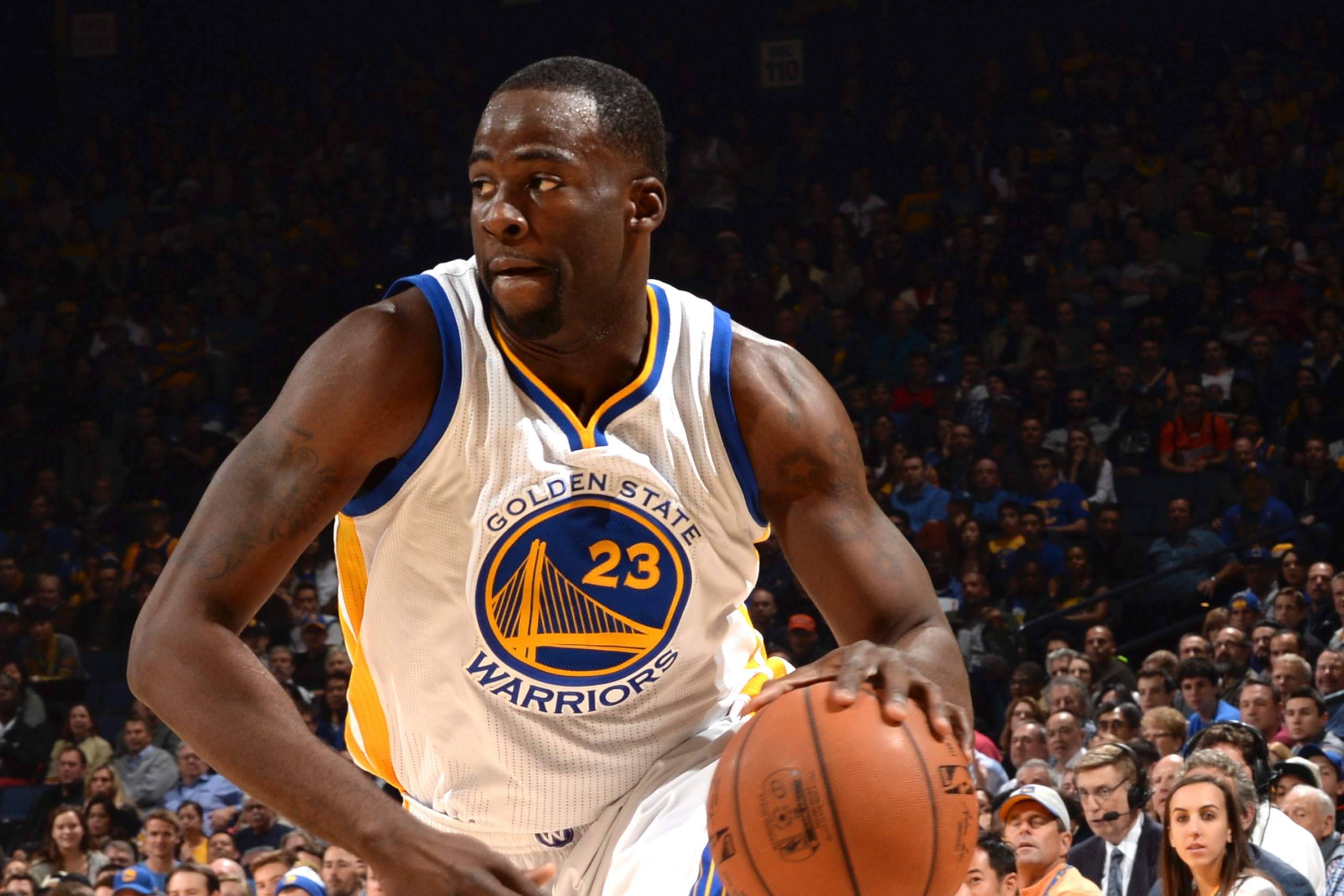
Power Forward: Draymond Green, Golden State Warriors
4 of 5
Breaking into this conversation can be difficult—nigh impossible—when playing beside so many impact players. Draymond Green is an exception.
Green plays within a starting five that, when healthy, relegates him to the fourth or fifth offensive option on any given night. But he's thrived within Steve Kerr's system, averaging career highs in minutes (33.1), points (12.1), rebounds (8.0), assists (3.4), steals (1.4), blocks (1.4), field-goal percentage (44.3) and PER (15.1).
Spending most of his time at power forward has helped. Green is difficult for traditional 4s to guard because he slides inside and outside the paint, orbiting around the three-point line if line need be. While his 33.9 percent clip from deep won't turn heads, this is the same guy who drilled just 20.9 percent as a rookie in 2011-12.
Plus, he's even better off the catch; he bangs in 35.3 percent of his bombs as a spot-up shooter. Moreover, he's existing within an offense that calls for more movement, excelling as a secondary playmaker who sends out that one extra pass or finds slashing wings.
Playing power forward hasn't hurt him on defense either. Opponents are shooting 4.3 percentage points below their season average against him, and rival power forwards are registering a PER of 12.3 when he's on the floor, according to 82games.com.
Coining him a future star might feel ambitious, even amid this breakout season. But stretch forwards are all the rage for teams that understand the importance of spacing—so, not the New York Knicks or Los Angeles Lakers—and Green is fast adapting to meet those contemporary demands.
And when July rolls around, he will hit the open market at only 25 years old with room to improve, having (likely) already joined Tim Duncan and Marc Gasol as the only players to average at least 12 points, eight rebounds, three assists and one block in 2014-15
Dollar signs and star status, then, are en route.
Center: Joel Embiid, Philadelphia 76ers
5 of 5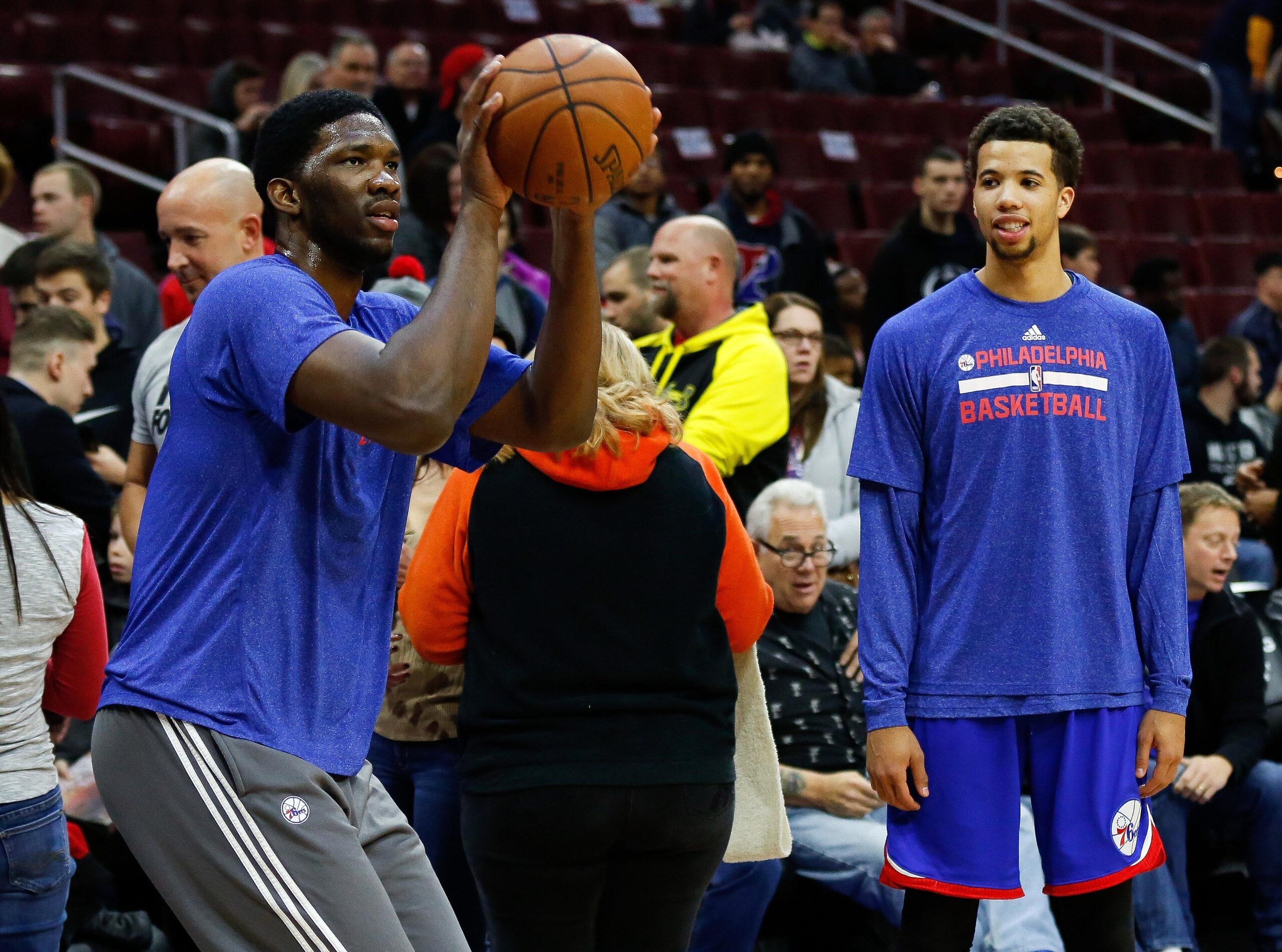
One pot-stirrer coming right up.
Lots of different things go into this selection, chief among them being the fact these are predictions. Then we have the current landscape at the center position.
Andre Drummond is the runner-up here. He's the closest thing to the next generation's Dwight Howard, but he's struggling as Stan Van Gundy tries making him into a prominent scorer—this is to say, his post-ups are still klutzy. He's also limited defensively, actively seeking blocks at the expense of other areas; opponents are shooting 58.8 percent inside six feet of the bucket against him.
Steven Adams and Gorgui Dieng fall into the next tier. But the Oklahoma City Thunder have too much firepower in Kevin Durant, Russell Westbrook and Serge Ibaka to ever fully develop Adams' offensive game, and Dieng's ceiling looks to be that of an everyday starter and nothing more.
That brings us to Joel Embiid, who likely won't play this season as he rehabilitates a broken foot.
Durability and developmental concerns make this a high-risk, high-reward gambit, but the Philadelphia 76ers have one of the decade's most versatile center prospects on their hands. Embiid, assuming health, projects as a premier defender as well as someone who dominates the post and drains jumpers Hakeem Olajuwon-style.
The Sixers, in fact, have already started grooming him to be a big of that ilk.
"We’ve been showing him tape of Al Jefferson, Tim Duncan," coach Brett Brown told ESPN.com's Henry Abbott (via Philly.com's Michael Kaskey-Blomain), "some of the great post players, getting him familiar with the rules, and working on his shot."
True, Embiid has yet to play. But whenever Tim Duncan comparisons are involved—stylistic or otherwise—predictions like these are well worth the risk.
*Stats courtesy of Basketball-Reference.com and NBA.com and are accurate as of games played on Dec. 28, 2014.
.jpg?w=2560 "OBJ Calls Out Giants After Release")



.jpg?w=2560 "Saquon Out for Game")