The Indiana Pacers never would have joined the ranks of NBA contenders without their toughness, tenacity and unwavering confidence.
But that same sense of self-belief and never-surrender attitude could prevent the Pacers from taking the necessary steps to eventually rejoin the championship hunt.
Indiana has to accept fate and realize that the window for this current core is closed. It must abandon hope of salvaging the present in order to build something substantial for the future.
TOP NEWS
.jpg?w=2560 "NBA Gambling Charges")
Malik Beasley Negotiating Plea Deal (AP)

Yaxel: Luka Not MJ 🗣️
Knicks, Spurs On Wrong Side of History
Luckily, the current NBA climate is more than conducive to a fire sale. Buyers aren't always easily found at this time of year, but Yahoo Sports' Adrian Wojnarowski observed recently that a number of teams are already working the phone lines:
The good news for the Circle City is that Wojnarowski listed the Pacers among his "most active teams."
The problem is that Indiana has found itself on the wrong end of these discussions. Rather than scrap its expensive, aging veterans for future assets, the Pacers have been searching for immediate assistance, per Steve Kyler of Basketball Insiders:
It's a puzzling stance to say the least, though not a really surprising one.
Remember, Indiana's offseason nearly fit the requirements of cruel and unusual punishment.
Mere months removed from a 56-win campaign and their second consecutive Eastern Conference Finals appearance, the Pacers lost both Lance Stephenson to free agency and Paul George to a broken leg. The stat sheet processed that as the offensively challenged club having lost 35.5 points and 8.1 assists per night.
Indiana tried to combat the Stephenson's exit with the arrivals of sharpshooter C.J. Miles and scoring guard Rodney Stuckey. But there was no way to plan for or recover from George's horrific injury.

Even with the odds stacked against them, the Pacers weren't interested in the white flags many were already waving on their behalf.
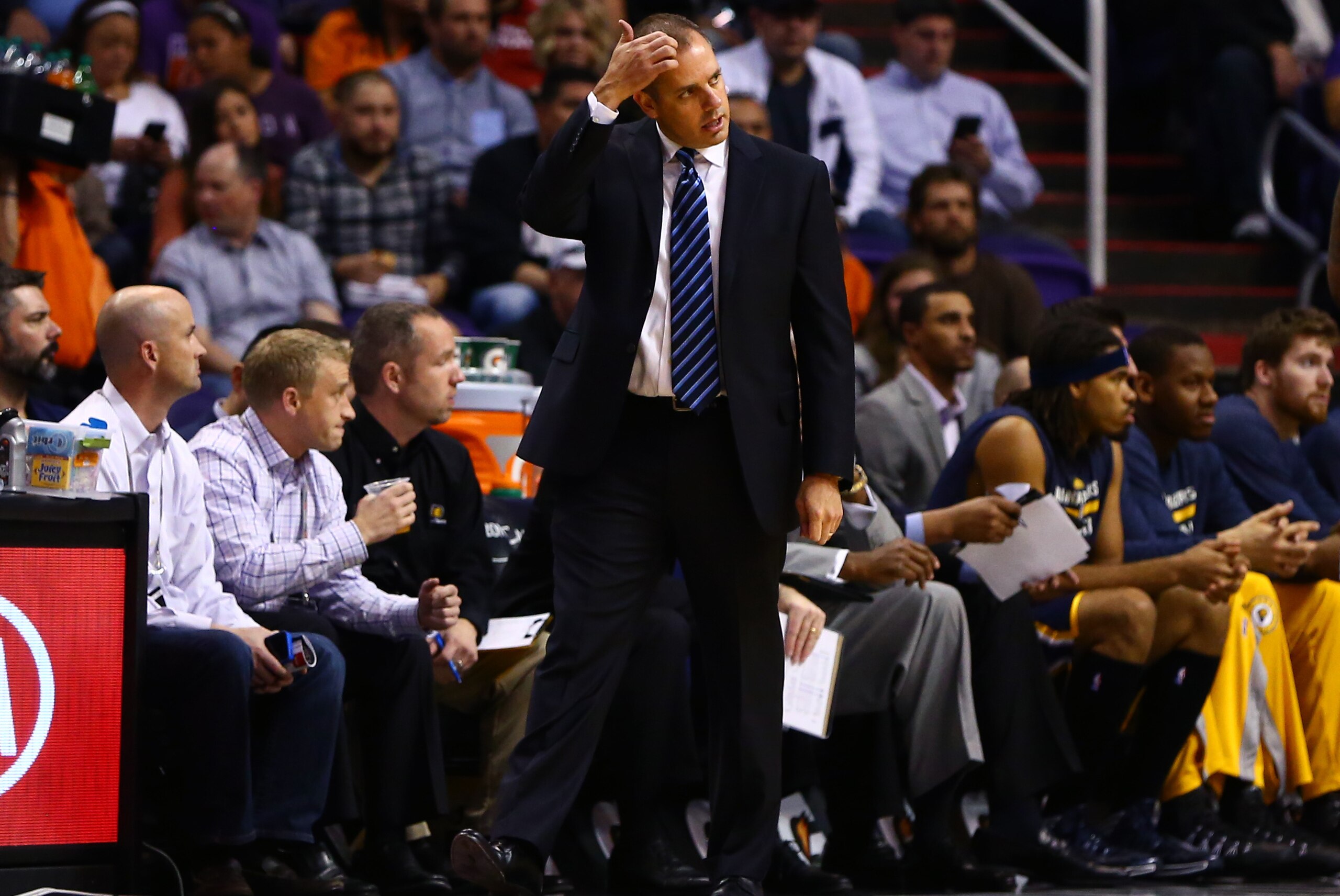
"It's accurate to say we're going to be different," coach Frank Vogel said before the season, per ESPN.com's Brian Windhorst. "But it doesn't mean we're not going to be just as good."
There was something inspiring about Vogel's words, but there wasn't much meaning beyond the inspiration. Reality was never going to come close to matching the team's internal expectations.
"Obviously you lose your best player, things change," Pacers forward and longtime truth-teller David West told Reuters' Mark Lamport-Stokes recently.
The Pacers are different than before and not in a good way.
After winning more than 60 percent of their games each of the past three seasons, they currently own a .321 winning percentage. The Pacers have single-digit defeats of the lowly Minnesota Timberwolves and Los Angeles Lakers along with 10 losses to show for their last 12 games.
Indiana's defense has gone from elite (first in efficiency last season) to above average (ninth). The offense, which was tough to watch last season (22nd), has now become unbearable (29th). There are 88 different players in the league averaging at least 13 points a night—none of whom play for the Pacers.
"What we’re witnessing is one of the most dreadful crashes of a contender in the last decade," NBA.com's Shaun Powell wrote earlier this season. "So many things have happened, and all of them bad. Injuries, poor play, more injuries, defections and, well, the avalanche that buried the Pacers since last March is still building and adding layers."

There is no easy way out of this mess.
Is there a conceivable way the Pacers force their way back into the playoff race? Sure. It's hard to rule anyone (except for the blatantly tanking Philadelphia 76ers) out of a conference race in which two postseason spots are currently held by clubs with a losing record. Heck, as bad as the Pacers have been, they are only three games back of the No. 8 seed.
But there is no reward in being a first-round casualty. Is it really worth chasing a bottom-rung playoff spot when all it really does is worsen this club's draft position? Of course not.
Yet the Pacers are subscribing to the flawed theory that mediocrity is worth pursuing. That's why Pacers owner Herb Simon left the door open to a possible reunion with Stephenson, according to the Indy Star's Candace Buckner, though Indiana's players reportedly put the kibosh on that idea, per ESPN.com's Marc Stein:
Indiana should be active on the trade market, but it needs to go about this in the completely opposite direction. Whatever it can give up today that may help tomorrow is a sacrifice that needs to be made.
That means seeing what the market might bear for the 34-year-old West, who holds a $12.6 million player option for 2015-16, according to HoopsHype. One glance at his per-game marks of 12.8 points and 6.5 rebounds shows it won't be much, but a low-level prospect or a middling draft pick is far more valuable than a past-his-prime player.
The Pacers need to gauge the value of Roy Hibbert, even if shipping out a 7'2" center with a 43.8 field-goal percentage means selling low. It's hard to justify keeping his $15.5 million player option for next season on the books, especially when his ability to protect the rim could make him a moderately coveted asset for a win-now contender.
"With just one season after this the Pacers may be looking for that new direction," Bulls.com's Sam Smith wrote of Hibbert.
Indiana doesn't quite need to put an "Everything Must Go!" sign on the front of Bankers Life Fieldhouse, but it should be doing something close to that. Outside of George and 23-year-old swingman Solomon Hill, there just isn't much worth saving for a team that could be years away from contention.
The NBA looks awfully crowded at the top. There are 12 teams with a winning percentage above .600, a group that doesn't include the battle-tested Oklahoma City Thunder or playoff-hungry clubs like the New Orleans Pelicans, Phoenix Suns and Sacramento Kings.
With such little separation between the league's top teams, anyone hoping to strengthen its playoff position should be searching for that final piece to push it over the top.
And despite the Pacers' struggles, they have plenty to offer potential buyers.
Teams short on shooters might be interested in Miles, C.J. Watson and Chris Copeland. The savvy Luis Scola might be attractive to those light on post scorers, while Lavoy Allen and Ian Mahinmi could be options for clubs searching for size. Stuckey can provide some off-the-bounce creativity, while Donald Sloan could add experience to a team's point guard crop.
Indiana won't get the world in return for any of these players—Hibbert included. If the Pacers could ask for a king's ransom, they wouldn't be floating so low in the conference standings.
But the Pacers already have their superstar in George. This is about finding certain pieces that complement his game and help maximize his impact once he is ready to return.

George is both a dominant defender and top-tier scorer, so the franchise has options with how it chooses to proceed. Indiana isn't restricted to a specific style. A team led by George might have a defensive slant, but he's athletic enough to play with pace and has a high enough basketball IQ to thrive at a more controlled tempo.
The Pacers just need to construct a vision for their future. Holding onto an aging core while running its collective NBA odometer even higher simply is not a viable option.
This is going to require an organizational change and approach, a willingness to set aside that confidence and realize things need to change.
It might not be the Pacers' way, but that's kind of the point. Once a plan has run its course, it's time to develop a new one. Without it, Indiana will be stuck chasing past successes with a present that can't repeat them at the expense of the future.
There's no sense trying to force open a championship window that has already been bolted shot. The Pacers' focus must shift to starting construction on a new one.
Unless otherwise noted, statistics used courtesy of Basketball-Reference.com and NBA.com.


.jpg?w=2560 "Jonathan Taylor Landing Spots")

.jpg?w=2560 "Aikman Blasts Cowboys WR 🫣")