

Building the NBA's All-Efficiency Team
Efficiency is the name of the game in today's NBA, and there are some astonishingly streamlined stat machines roaming the court in 2014-15.
If you were to put together a team comprised of the most efficient players at each position, who would make the cut?
There isn't one all-encompassing statistic that indicates who generates the most positive production with the least amount of waste. However, there are some key metrics that give a good illustration.
To form our team, we took a look at several different efficiency statistics. They include player efficiency rating (PER), efficiency rating per 48 minutes (EFF), true shooting percentage (TS%) and traditional statistics such as turnovers and fouls.
For some positions, we focused more on certain production areas than others (for example, assist-to-turnover ratios for point guards and defensive efficiency for big men).
Who are the most systematically productive players in the Association? Check out our eye-popping All-Efficiency rotation.
*Includes players who have played in at least 15 games.
Starting Point Guard: Chris Paul, Los Angeles Clippers
1 of 7
Positional Emphasis: Passing/shooting
Paul's Key Stats: +34.6 EFF, 25.6 PER, 4.5 A/TO ratio
Stephen Curry has a higher overall efficiency rating than Chris Paul, and the Golden State Warriors star is perhaps the hottest guard in the league.
While the Dubs' sharpshooter might be a more efficient player, the Los Angeles Clippers leader is the more efficient point guard.
CP3's assist-to-turnover ratio is so much better than any other high-volume passer, and his superiority in that category ultimately tipped the scales in his favor. He's notching 9.5 assists and 2.1 turnovers per game (4.5 ratio), whereas Curry is posting 7.7 assists, 3.4 turnovers and a weaker 2.3 ratio.
"When it comes to making plays and protecting the ball, it seems Paul’s getting better with age," wrote Rowan Kavner of Clippers.com.
Although the Clips' standing in the West isn't where they'd like it, Paul remains a quintessential star quarterback. Not only is he a razor-sharp distributor who makes truckloads of mistake-free plays, he also shoots incredibly efficiently.
Just take a glance at this marvelous shot chart. His effective field-goal percentage on catch-and-shoot attempts is 62.7, and it's a clean 52.7 on pull-up shots.
Factor in his cagey defense and knack for forcing opponent turnovers, and you've got a floor general who truly commands the game.
Starting Shooting Guard: Klay Thompson, Golden State Warriors
2 of 7
Positional Emphasis: Shooting/scoring
Thompson's Key Stats: 26.1 EFF, 19.6 PER, 57.7 TS%, 43% 3PT, 102 D-rating
With apologies to box-score stuffer James Harden and two-way monster Jimmy Butler, the most efficient shooting guard in the NBA is Golden State Warriors wing Klay Thompson.
He's not as prolific a scorer as Harden, and he's not quite as strong as Butler. But he's a cleaner mix of the two, and by far the best three-point shooter of the bunch. In an era when the triple is more utilized and valued than ever, Thompson's accuracy from the wing is undeniable.
The taller half of the Splash Brothers duo is hitting 43 percent of his threes this season, including 51.4 effective field-goal percent on pull-up attempts. His ability to find and smoothly convert perimeter opportunities is exceptional.
Thompson's efficiency goes beyond shooting the rock, however. He explained some critical areas of success with ESPN.com's Ethan Sherwood Straus.
"I honestly think my ball-handling and my plays out of the pick-and-roll," Thompson told Straus. "…I did it a lot better than people give me credit for. I think people underestimate my first step too…I might not be the best vertical athlete, but I think I'm quicker than people give me credit for."
With his pick-and-roll prowess and foot speed, he's able to supplement his shooting with productive passing and consistent defense. His increasingly multidimensional efforts are a huge reason why Golden State has risen to the top of the heap.
Starting Small Forward: LeBron James, Cleveland Cavaliers
3 of 7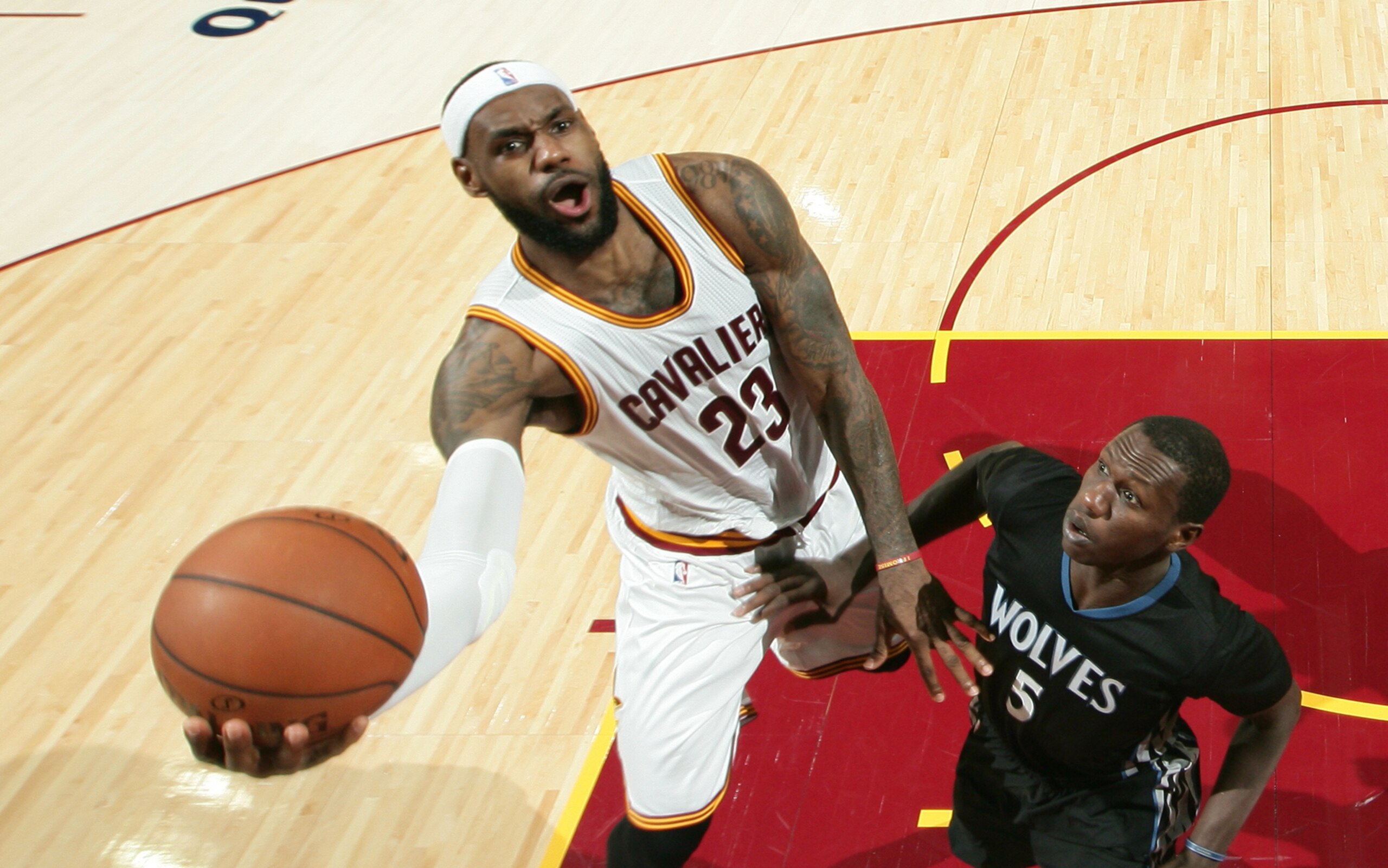
Positional Emphasis: Versatility
James' Key Stats: +32.2 EFF, 25.4 PER, 59.0 TS%, 7.6 APG, 1.7 fouls per game
LeBron James isn't the same player he was during his time in South Beach. He's not as dominant physically, he's not as imposing defensively and he's still trying to mold the new-look Cleveland Cavaliers.
However, he remains our clear-cut most efficient small forward in the league, especially considering the injuries to stars like Paul George and Kevin Durant.
He influences the game offensively in so many ways. James can create and set up teammates whether he's operating from the top of the key or driving to the basket. When he's in scoring mode, he can shoot efficiently on drives, post-ups and perimeter tosses.
Although his rebounding numbers have dipped to more modest levels, James has taken his point-forward abilities up a notch this year. He's enjoying his best assists-per-minute pace since 2009-10, and he's creating 22.1 points off assists per 48 minutes, which is the type of number only point guards post.
As a stopper, his effort and athletic prowess are noticeably weaker than they were just a couple of years ago. However, he's still a strong, quick defender who plays smart within team concepts and keeps the fouls to a minimum—James is averaging just 1.6 fouls per 36 minutes.
He's essentially playing with a brand new supporting cast, so his efficiency has been impressive during the Cavs' turbulent start to 2014-15.
.jpg?w=2560 "NBA Gambling Charges")

Starting Power Forward: Anthony Davis, New Orleans Pelicans
4 of 7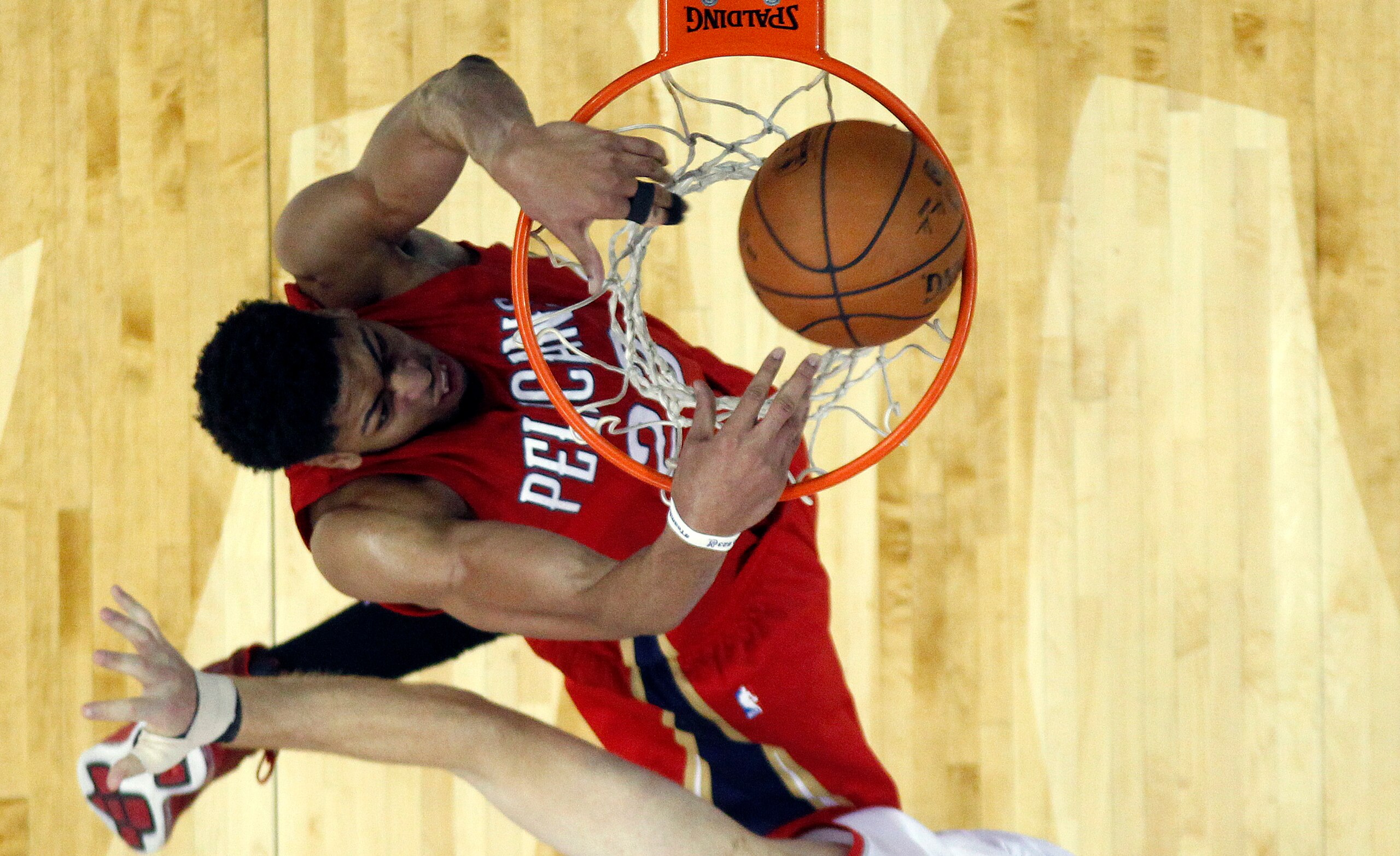
Positional Emphasis: Field-goal efficiency, rim protection, versatility
Davis' Key Stats: +42.3 EFF, 32.8 PER, 62.2 TS%, 2.9 BPG
Most 21-year-olds are either trying to break into the league or still searching for their role. Anthony Davis is already the king of frontcourt efficiency.
He's able to influence so many areas of the game without any wasted movement, and the result is a high-production, low-mistake brand of basketball. He attacks the hoop and finds favorable opportunities almost effortlessly; Davis makes astounding putbacks look easy, and he can drive to the rim from the perimeter with just one dribble.
Even his outside jumper—which doesn't yet extend to three-point range—is utilized at an impressively efficient rate. According to 82games.com, his effective field-goal percentage on all jumpers is .519. Davis' shot chart vividly illustrates that he routinely cashes in on his mid-range chances.
The Brow is also massively productive and economical on the defensive side, where he cleans up the boards and protects the basket. He's blocking 2.9 shots per game while committing just 2.0 fouls.
To be fair to both Davis and his predecessors, we've never seen a player quite like him. And unfortunately for the rest of the Association, he'll become more efficient and more dominant as he continues to refine his skills.
Starting Center: Marc Gasol, Memphis Grizzlies
5 of 7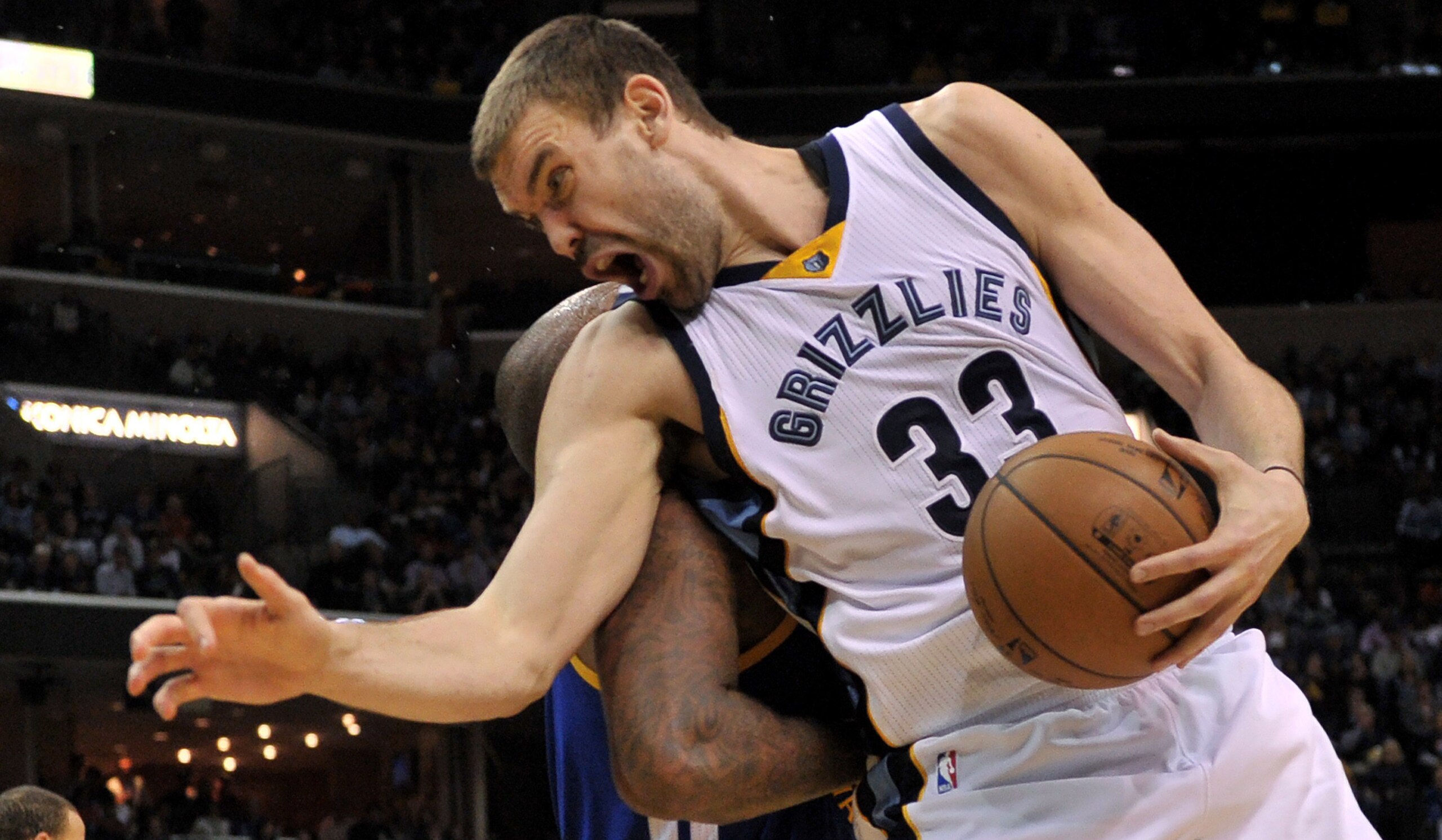
Positional Emphasis: Two-way efficiency, including foul rate
Gasol's Key Stats: +32.3 EFF, 23.2 PER, 82.8 FT%, 2.6 fouls per game
He doesn't gobble up the most rebounds (8.2 per game) of any center, nor does his true shooting percentage (57.3) tower above other big men.
But when you consider Marc Gasol's multidimensional offensive contributions with minimal turnovers, along with his defensive stinginess without fouling frequently, he's the most efficient pivot man in the league.
His usage rate is extremely high for a 5-man (26.2 percent), and he's scoring 19.9 points while dishing 3.8 assists per game. Despite this high usage and volume, he's still shooting over 50 percent from the field and committing just 2.6 turnovers per 36 minutes (compared to someone like DeMarcus Cousins, who's turning it over 4.0 times).
One of his most overlooked qualities among casual fans is his ability to play formidable defense without fouling. Gasol is locking up opponents and notching just 2.6 fouls per game (2.7 per 36 minutes).
"There's basically nothing that the younger Gasol does poorly, especially now that he's become a decent rebounder and a significant scoring threat for the surging Memphis Grizzlies," wrote Bleacher Report's Adam Fromal in his positional rankings. "He's always been a distributing maestro and a defensive mastermind, and now his game has become more complete than ever while helping a pretty dominant squad."
One of the biggest reasons Memphis can enforce its blue-collar style and still win is Gasol's combination of versatility and efficiency.
Sixth Man: Stephen Curry, Golden State Warriors
6 of 7
Curry's Key Stats: +36.9 EFF, 26.3 PER, 61.8 TS%
The first stud off our All-Efficiency bench is dynamic combo guard Stephen Curry. He's a modern marvel when it comes to playmaking, shot-creating and shooting accuracy.
He's been assisted on just 36.8 percent of his field goals, yet he churns out a ridiculous 61.8 percent true-shooting mark because he can connect with precision from any spot and every angle. If he wasn't dangerous enough through the 2013-14 season, he's becoming even more adept at slicing up opposing defenses this year.
"In addition to becoming more efficient on two-pointers, Curry is getting to the line more frequently and assisting at a similarly high rate to last season," noted Jason Patt of SB Nation.
Speaking of two-pointers, Curry is shooting 68 percent on shots within five feet of the rim, a phenomenal number for someone short in stature. The speedy, crafty guard times his drives perfectly, as he knows when to attack and finish with a floater or banker.
Aside from creating a boatload of his own buckets, he does a ton of work as a table-setter. He generates 25.2 points off assists per 48 minutes.
And his defense has also been solid; Curry is posting a defensive rating of 99 while swiping 2.1 steals and committing just 2.1 fouls per contest.
Key Bench Players
7 of 7
In addition to our sixth man, Stephen Curry, here are our most efficient players to fill roles off the bench:
Shooting Specialist—Kyle Korver, Atlanta Hawks: +23.7 EFF, 74.5 TS%, 54% 3PT, 132 O-rating
We had to include the NBA's ultimate role-playing marksman on our squad. Korver doesn't impact every area of the game, but when it comes to stretching the floor he's brilliant.
He posts superb shooting numbers every season, but this year he's even more lethal than usual. Korver is sinking 51.6 percent of his field goals (including a blistering 53.9 percent from three-point range), and he's also sinking 95.3 percent of his free throws.
Two-Way Wing—Jimmy Butler, Chicago Bulls: +27.5 EFF, 22.1 PER, 60.2 TS%, 1.9 fouls per game
Chi-Town's latest sports star has gone from "key role player" to one of the most efficient two-way weapons in the league.
His true shooting percentage is greater than both Klay Thompson's and James Harden's, as he works hard to convert drives and mid-range post-ups. Butler is also getting to the free-throw line 7.2 times per 36 minutes, and he's committing just 1.3 turnovers and 1.7 fouls in that time span.
No wonder Tom Thibodeau can rely on him for 40 minutes a night.
Backup Big—Tim Duncan, San Antonio Spurs: +34.1 EFF, 22.5 PER, 19.2 REB%, 5.2 BLK%
Timmy is just too good in every area to leave off our squad.
Compared to the other power forwards not named Anthony Davis, he stands out in the rebounding and shot-blocking departments. He's also maintaining highly productive assists numbers (3.5 per 36 minutes), and he's taking 6.2 free throws per 36 minutes.
His command of the game has become stunningly sharp; he plays with such good habits that he can't help but operate efficiently.
End of the Bench—Dirk Nowitzki (+29.7 EFF, 21.2 PER, 57.1 TS%), Damian Lillard (+30.7 EFF, 23.3 PER, 60.1 TS%), Tyson Chandler (+34.6 EFF, 22.4 PER, 71.2 TS%)
All statistics gathered from NBA.com, Basketball-Reference.com and 82games.com.



.jpg?w=2560 "Jonathan Taylor Landing Spots")

.jpg?w=2560 "Aikman Blasts Cowboys WR 🫣")
