Quin Snyder Slowly, but Surely Helping Utah Jazz Grow Up
It's been an odd career for Quin Snyder.
The current coach of the Utah Jazz has bounced around about as much as any other coach in the league.
He started off in the 1990s as a Duke assistant under Mike Krzyzewski. In 1999, he became head coach at the University of Missouri, where he worked for seven years. But his reputation took a hit as the team continued to lose, and he started to pinball around the basketball world.
TOP NEWS

Pic of LeBron's Helicopter Commute 🚁

Duren Calls Out 'False' Rumors

NBA Power Rankings Entering Preseason 🔢
Three years in the D-League. A year in player development with the Philadelphia 76ers in 2010-11. Then, a year as an assistant with the Los Angeles Lakers. Then, a year overseas coaching for CSKA Moscow followed by another assistant job, this time with the Atlanta Hawks. Finally, he settled into his first head coaching job since his college days with the Utah Jazz before this season.
It's always difficult to evaluate coaching prowess through just over a quarter of a season, but it seems like Snyder is leading Utah in the right direction.
The 7-19 Jazz, recent owners of a nine-game losing streak, may not be winning many ballgames, but they're playing with a renewed sense of purpose, almost as if someone just led them in a group recital of "Eye of the Tiger." (If you click on one link today, click that one.) Granted, Snyder had a low bar to start with after replacing the much-maligned Tyrone Corbin, who was the coach in Utah for four years and just stepped into the same title with the Sacramento Kings this week.
Ultimately, Snyder is a de facto San Antonio Spurs guy, and ironically, that nine-game streak was snapped against Gregg Popovich's gang.
He coached the Austin Toros, the Spurs D-League affiliate, from 2007 to 2010. He assisted at CSKA Moscow for legendary international coach Ettore Messina, now an assistant in San Antonio. He was an assistant with the Atlanta Hawks, basically Spurs Southeast (complete with an ex-Popovich assistant for a coach and an ex-R.C. Buford front office worker for a GM). Now he has the Jazz trying to play like the Spurs.
That doesn't necessarily mean they execute like San Antonio. Of course, 7-19 is hardly Spurs-like. (If you want to watch the Spurs outside of their usual black and white jerseys, head to Atlanta to appreciate an 18-7 team which just dismantled the Cleveland Cavaliers by 29 on the road.) But, like plenty of teams around the league, Utah is implementing some "Spursiness" into its game on both sides of the floor.
Defense

The Utah defense under Corbin was totally discombobulated.
There was, however, an argument to back his team's struggles: Young players don't communicate well, which—if we have to use the most general basketball statements—has some truth to it. But that doesn't mean all defenses with youthful cores receive bad enough grades to repeat Communication 101.
The Jazz struggled running through screens and seemed to have inconsistent strategy against pick-and-rolls under Corbin. Grantland's Zach Lowe wrote about the now-Kings coach's defense in March of 2013:
"There are no clear, consistent rules to Utah’s defense. Sometimes the big men drop back. Sometimes they stick to the screener, allowing the point guard to blow by them, a stance that indicates they expect help to come from behind them. But there are possessions on which that notion appears to make little sense. Here’s a Mario Chalmers pick-and-roll in which Jefferson decides to stick to the screener (Udonis Haslem), allowing Chalmers to get into the lane.
"
Under Snyder, the defense has been ineffective, ranking third to last in points allowed per possession, but at least we're seeing some scheme consistency from a team that desperately lacks natural defenders on the perimeter.
Utah actually has a similar pick-and-roll strategy to that of the Spurs. They mostly sag back on ball screens to entice mid-range jumpers and cut off a lane to the rim. What's commonly referred to as "zoning up" the screen-and-roll is one of the more popular coverages in the league. When it's going well, it looks like this, courtesy of Trevor Booker:

One of the main issues with the Utah defense is the inability of the guards and wings to fight through screens. As a defender, you either want to go over or under a pick, depending on who is the potential shooter. The Jazz defenders have a bad habit of running straight into them—or at least changing their paths too late as they're about to clank into a screener.
Still, what we're seeing from the bigs has some promise.
Derrick Favors, Enes Kanter, Rudy Gobert and Booker sag. But, they will actually switch up coverages if a big man with range is setting the ball screen. In that case, the Jazz defender will hedge and turn his body sideways to cut off or slow down the dribbler. It's a way to stay closer to a potential pick-and-pop threat, like in this instance when Kanter's assignment is Matt Bonner:
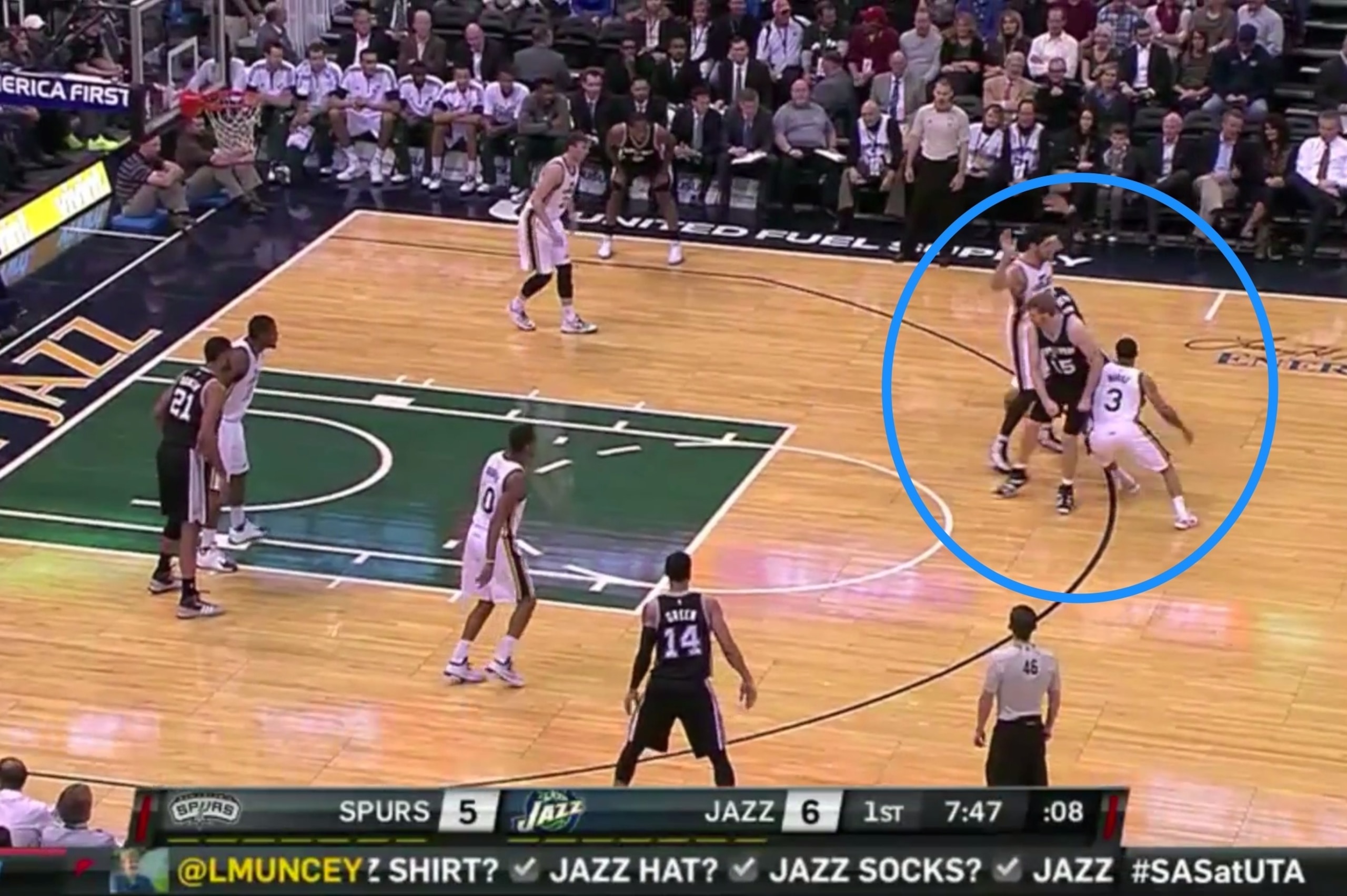
The Jazz haven't necessarily guarded ball-handlers as well in these instances. In this case, Cory Joseph finds an open lane, Favors helps late and the Spurs end up with a relatively easy shot, even if Joseph does miss it. Here's what the above picture looks like in real time:

Execution is still a long way off from decency—like here, when Trey Burke gets caught up on the screen and Favors stayed glued to Duncan for too long—but at least we're seeing some consistency. There's a general understanding of defensive concepts and assignments that didn't exist in past years.
That Lowe piece is from 2013, when Utah's big men were Al Jefferson and Paul Millsap. But even after those two left Utah before last season, when Favors and Kanter were a year younger, those same issues of confusion occurred.
Now, we're seeing mistakes young players would make, but we're also seeing growth (i.e. moments when a guard is about to go to the wrong spot until Favors directs him otherwise, part of his trek to becoming a legitimate defensive anchor). And on the offensive end, we're seeing the bigs learn how to play off each other.
Offense

"Spursiness" transfers to the offensive side of the ball, as well, where the Jazz rank a respectable 14th in points per possession, up from 25th a season ago.
Corbin's offense relied on a bunch of pounding. Whether it was Gordon Hayward dribbling around the perimeter for extended periods or Favors killing clock with long post-ups, the Jazz spent more energy smashing the ball into the floor than they did swishing it through the net.
Snyder's Jazz are running more ball-screen action; There's decisive movement.
Hayward, the team's best playmaker who re-signed on a four-year, max deal over the summer, is getting more opportunities to facilitate, limiting some of Burke's responsibilities and, thus, improving team efficiency.
Limiting Burke's role has caused major improvement within the Utah attack. Per NBAsavant.com, the second-year point guard averaged 3.9 dribbles and 4.0 seconds per touch a season ago. Those numbers are vastly down to 2.2 and 2.9, respectively, this year.
Utah is putting a premium on more efficient shots, releasing a notably higher percentage of its attempts from inside the restricted area and from three. It's scheming for these but, of course, aging and improved personnel helps. And Kanter's improved range is a major part of that.
Fluid Decision-Making
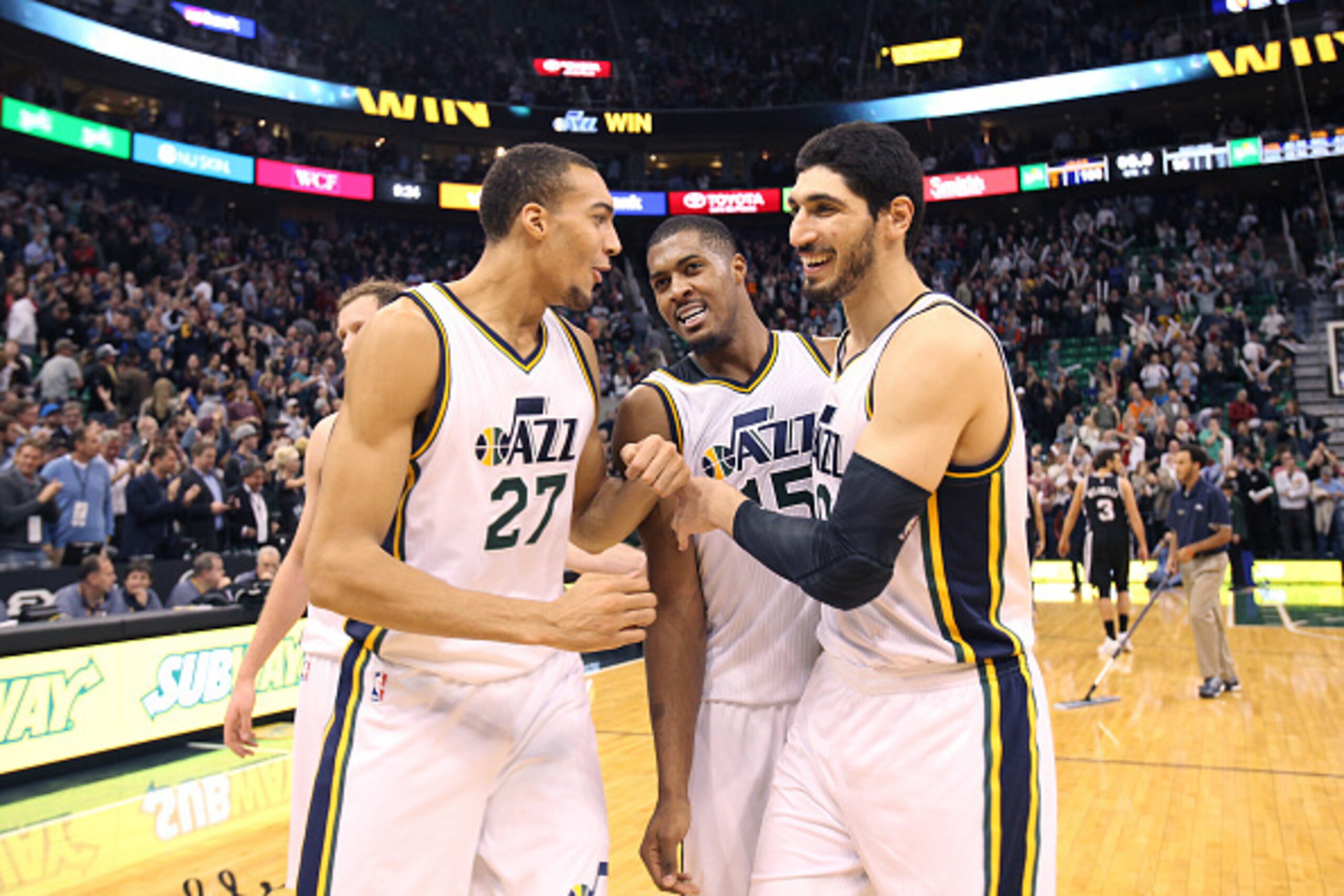
Favors is a classic roll man. Now it looks more and more like Kanter—who is sinking an above-league-average 43 percent of his mid-range jumpers as he tries to work his game out to the three-point line—will be someone to pop next to him.
Big men need to complement each other on the offensive end. An inside threat works best next to one who can space the floor, and Kanter is working steadily toward that. The pick-and-roll game isn't just working because of those two, either.
Gobert can jump and, with that NBA-best 9'7" standing reach, already has a head start on anyone guarding him. Burke is most comfortable dribbling around ball screens. Dante Exum, meanwhile, is in the process of developing a changeup to complement his all-world speed.
Utah is loading up on young, pick-and-roll personnel, and for the first time in their professional careers, they're not giving up after one failed ball screen. Take a look at the play below, which includes a stymied Burke-Favors screen-and-roll and a successful Hayward-Kanter one:

Last year's Jazz may have given up after the first failed pick-and-roll with Favors. They may have moved into Burke isolation or turned hopeful for Hayward's last-second, shot-clock heroics. This year, they just continued their offense unfazed.
When people talk about Spurs-like movement, they're not only speaking of ball movement. It's also player shuffling and the constant flow within the offense.
The Spurs find success scoring the ball partly because, when an initial play doesn't work, they're instinctive enough to move onto another shorter play which can yield points. Essentially, they don't regress into emergency isolation or post-up offense easily.
Still, it's hard to find continuity within an attack, especially on an inexperienced team with a first-year coach. Even with all the improvement from last year, the Jazz are no exception to this.
Utah still gets into moments when the offense stalls, highlighted by Kanter or Burke waiting around for a play to develop even though it's apparent the defense has already stymied it. Such bouts often lead to a big man uncomfortably holding the ball for seconds at a time 25 feet from the rim. Or you'll see a guy like Alec Burks or Trey Burke going into isolation at the end of the clock.
These issues, though, can solve themselves with time, chemistry and maturity. And Utah has eight players in its regular rotation who are 24 years old or younger: Gobert, Burke, Favors, Kanter, Hayward, Burks, Exum and Rodney Hood.
Snyder's schemes work best—as do pretty much all—with shooters sprinkled around the perimeter.
At the moment, the Jazz aren't running guys off screens for three-point shots often. That's the next move. But for now, a ball-screen heavy offense has carried them to a far more impressive spot than last year's "Imma do me" approach.
The Jazz aren't executing anywhere near the rate of the more successful teams in the league, but they're learning. They're showing signs of doing so. Once their young players grow more comfortable in the molds Snyder has constructed for them, the organization can start to make its return to relevance in the Western Conference.
Unless otherwise noted, all statistics are current as of Dec. 18 and are courtesy of Basketball-Reference and NBA.com.
Fred Katz averaged almost one point per game in fifth grade but maintains that his per-36-minute numbers were astonishing. Find more of his work at WashingtonPost.com or on ESPN's TrueHoop Network at ClipperBlog.com. Follow him on Twitter at @FredKatz.
.jpg?w=2560 "OBJ Calls Out Giants After Release")



.jpg?w=2560 "NFL investigating referee after viral exchange with player")