Comparing NY Knicks' Season to Phil Jackson's Inaugural Year with Chicago Bulls
If the New York Knicks' early season play has proven anything, it's that Phil Jackson's triangle offense brings with it a steep learning curve. The organization certainly knew this heading into the 2014-15 campaign, but a 4-14 record couldn't have been in the plans.
Head coach Derek Fisher's job certainly isn't easy, especially with a roster mixed with future assets and holdovers from the prior regime. Eighteen games in, the Jackson disciple is still trying to find the right rotation, while the system is very much a work in progress. Coming after a season under Mike Woodson where there weren't many offensive principles at all, the adjustment period has been understandably prolonged.
TOP NEWS
.jpg?w=2560 "NBA Gambling Charges")
Malik Beasley Negotiating Plea Deal (AP)

Yaxel: Luka Not MJ 🗣️
Knicks, Spurs On Wrong Side of History
It's worth noting, too, that while Jackson is overlooking the Knicks' triangle, it'll be the first time he's doing so without Tex Winter, the triangle's innovator, within arm's reach. The 92-year-old was as assistant to Jackson from 1995-2008 in Chicago and LA, and despite New York's bench being littered with Phil's triangle disciples—Fisher, Kurt Rambis, Jim Cleamons—the only triangle teams that have thrive without Winter on the bench were the Lakers during Jackson's final seasons at the helm.
The rarity of the transition makes it especially difficult to put into perspective. The triangle, as overseen directly by Jackson, has only been implemented twice: with the Chicago Bulls in 1989 and the Los Angeles Lakers in 1999. With that Lakers team essentially having a championship-ready roster from the get-go—not to mention bringing in ex-Bulls who already were familiar with the system—Jackson's first Chicago squad provides the better comparison of the two.
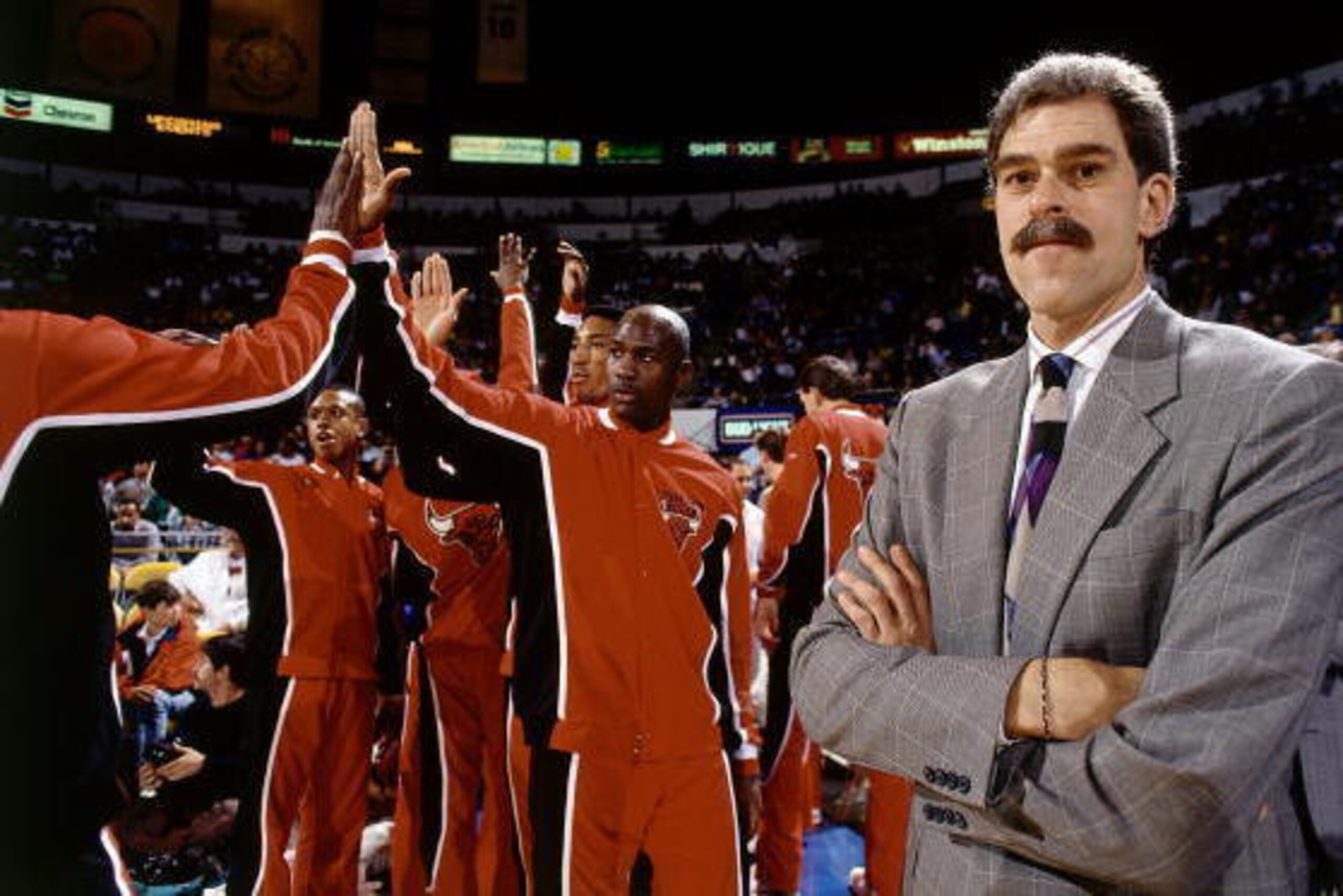
Let's be very clear before we get into comparisons: In terms of talent, the 1990 Bulls and this year's Knicks do not compare. Obviously, it's not even close. Chicago started a 26-year-old Michael Jordan and a 24-year-old Scottie Pippen in all 82 games that season, while the Knicks are bound for the lottery in 2015.
The purpose isn't to compare the two teams' successes in their first year under Jackson. Rather, looking back at Chicago's blueprint for success in the early stages of the Zen Master's tenure there could provide some insight as to how New York plans on developing moving forward.
The Focal Point
The glaring similarity lies in both teams' centerpieces. Like Michael Jordan, Carmelo Anthony's dominance in isolation makes him a natural fit in the triangle. And though it took Anthony twice as long in his career to find the system (this is Anthony's 12th season, while Jackson took over Chicago in Jordan's sixth year), with the right roster, it should have lifesaving effects on his performance.
Red Kerr, former coach and Bulls broadcaster during Jackson's tenure with the Bulls, spoke in 1992 about the triangle's impact on Jordan's career. According to an article found in an April 1992 edition of the Sarasota Herald-Tribune:
""When Michael came into the league, every coach Chicago hired tired to get him the ball and get out of the way," Kerr said. "The last couple of years, the team has gone to the triangle that spreads the offense and makes Michael a better player."
The system is designed to avoid double-teaming and to open up passing and cutting lanes. It has taken the pressure off Jordan and given other Bulls more shots.
"They were all longing for the right system," Kerr said.
And they found it when they found the right coach.
"
If the first part of that quote doesn't hit home for Knicks fans, it certainly does for the players—J.R. Smith practically screamed it out loud after a Nov. 3 win against the Charlotte Hornets:
And while Anthony didn't expect any more scoring titles in his future entering this season, the Wall Street Journal's Chris Herring wrote in October about why that may be misguided:
"A look back at Phil Jackson’s successes with the triangle in Chicago and Los Angeles reveals that Michael Jordan and Kobe Bryant each took more shots, not fewer, in the season after Jackson began coaching their respective teams with his beloved triangle. Scorers are going to look to score, no matter the system.
Despite the triangle’s reputation for forcing stars to give up the ball more than they want, Jordan and Bryant each took three more shots per 100 possessions and scored three more points per 100 possessions in their first triangle seasons, according to Basketball-Reference. And they managed that while playing alongside teammates who were much better than Anthony’s fellow Knicks (Scottie Pippen in Chicago, Shaquille O’Neal in Los Angeles), so it isn’t a stretch to predict that Anthony could end up getting more shots this year.
"
Interestingly, Anthony's shooting is down a bit through 16 games: 28.9 attempts per 100 possessions, compared to 29.3 last season.
A primary reason his raw points-per-game average is down from 27.4 to 23.7 has to do with playing time. Unlike Woodson, who had Anthony logging a league-leading 38.7 minutes a night, Fisher has his star on the floor for a much more reasonable 35 minutes on average.
Within the offense, according to NBA.com player tracking data via SportVu, Anthony is moving the ball more willingly than in years past. In 2014-15 thus far, he's registering about 2.45 seconds per touch, down from 3.16 seconds per touch last year. He's also passing about the same number of times per game (about 41) while playing almost four less minutes on average.
As a result of the more well-rounded offensive philosophy, Melo is shooting over 47 percent—more than 20 points higher than his 2013-14 clip. Once the team is able to surround him with more viable teammates this summer—and defenses have other threats to key in on—Anthony's output could increase.
Roster Turnover
One difference between the two regimes is how the roster was handled in the years that followed Jackson's hiring.
With the Bulls, Jackson was an assistant coach for two seasons under Doug Collins before being promoted to head coach, so he was familiar with most of the personnel by 1989. That isn't the case in New York, where several expensive pieces are set to come off the books this summer, giving the Knicks an immediate chance to take a new shape in 2015-16.
For the most part, those Bulls teams remained intact through the entire championship era. A reason why—which the Knicks can't relate to now—was the abundance of triangle fits throughout the roster. Over Jackson's first three years with Chicago, the Bulls used a total of six different starting lineups, according to Basketball-Reference.com. Generally, Jordan, Pippen, John Paxson, Horace Grant and Bill Cartwright were the ones with their names announced first.
In this transitional period for New York, Fisher has already ran out nine different starting fives.
Outside of Anthony, Jose Calderon and possibly Iman Shumpert, it's difficult to pinpoint a Knick who fills a need within the triangle. With so much salary coming off the books this summer and Jackson set on providing "change throughout the franchise," it's safe to assume that next year's roster will look very different than the one Fisher is managing now.
A Different Undertaking
While Jackson is working to instill his same triangle principles into this Knicks core—despite some similarities—this is a vastly different responsibility than taking over as head coach of a 47-win Bulls team.
Instead of sliding into a leadership role on a pre-made contender, it's now Jackson's own duty to construct the contender from the ground up. And unlike those Bulls teams that exemplified consistency through the early portion of his coaching tenure, even Phil has conceded this will be a lengthy process.
From a September Q&A with the New York Post's Steve Serby:
"Q: Is Step B, 2015 let’s say, is that championship contender stage?
A: I don’t know. I wish I had an answer to that one. We don’t know what’s gonna happen on the process. We have our eye on the target and the goal. That’s what’s important, and we know how to get there.Q: The target and the goal is to win a championship. Not this year. That’s unrealistic.
"
A: We would love to do it this year. When I went from retirement the last time to the Lakers in ’99-2000, I believed that I could win a championship in the first year. We had the personnel to do that. When I took the job in Chicago in ’90, I thought we could win a championship. … This team hasn’t taken the subsequent steps to get to the place where you vault yourself from not in the playoffs to a championship. So we have to go through some of those steps.
The Knicks need to go through all the steps, and Jackson is the one responsible. The first order of business comes this summer, when the team can finally surround Anthony with suitable pieces to contend.
At that point, the Knicks will be in the position Chicago was in 1989 and Los Angeles was a decade later. Then comes the period of time it will take for the new-look Knicks to adapt and become fluent with the triangle.
The results won't come as immediately as they did elsewhere, but Jackson is hoping he can build something that lasts just as long.



.jpg?w=2560 "Aikman Blasts Cowboys WR 🫣")
.jpg?w=2560 "Jonathan Taylor Landing Spots")