Locker-Room Dynamics That Matter in the NFL
Every NFL team seeks to discover the secret ingredient for long-term success on a football field. Anytime you have 53 grown men both working together and competing for a common goal, the dynamics of team chemistry almost certainly come into play.
Does the key to success lie within a loose, fun atmosphere? Is it critical for teammates to like each other?
Having been a member of several NFL locker rooms, both successful and otherwise, I've gathered some firsthand insight into locker-room dynamics that may be of some value to those wondering what really matters behind those closed doors.
TOP NEWS
Bears' Santos Wanted to Kick 58-Yarder
Picking Each NFL Division Winner 🔮
.jpg?w=2560 "Chargers Chiefs Football")
Reported Details of Seahawks-K9 Split ⛓️💥
With a red-hot spotlight shining down on the 49ers organization, every loss it endures becomes just another example of a fractured relationship between players and coach.
What seems all but concluded out of San Francisco, at this point, is numerous players within that locker room are becoming fed up with head coach Jim Harbaugh's methods.
Even the best 49er of all time, Hall of Fame wide receiver Jerry Rice, told Sports Illustrated he doesn't believe Harbaugh will be the coach next year. He went on to add:
"The team, they try to say, 'Well, we're not affected by it.' But you are, because (the coach and GM) have to make very crucial decisions that are really going to benefit the team. There's a lot going on with that organization right now and I think it's starting to hurt the players down there in the locker room.
"
This assertion by Rice here plays right to the heart of what we're trying to figure out in this article. At what point do the locker-room dynamics start to hurt the product on the field?
Harbaugh is in the fourth season of a five-year, $25 million contract he signed after leaving Stanford. The 49ers' disappointing 4-4 record is their worst at a season's midway point under his leadership, and rumors about he and general manager Trent Baalke not getting along have been swirling around for a while now.
Seth Wickersham of ESPN The Magazine does a nice job providing interesting details into the psychology of Harbaugh as it pertains to this developing situation. But what remains unknown is how much this distraction has contributed to the team's struggles.
The issues surrounding the 49ers coach and his team seem to vary, depending on the source, from a lack of trust among his players to being tired of his college-style coaching approach.
If the major complaint among the players is the latter, I have serious doubts as to the validity of this being something that has hampered the team's success more than it has created it—assuming, of course, that we even know the difference between a college coach and a professional one.
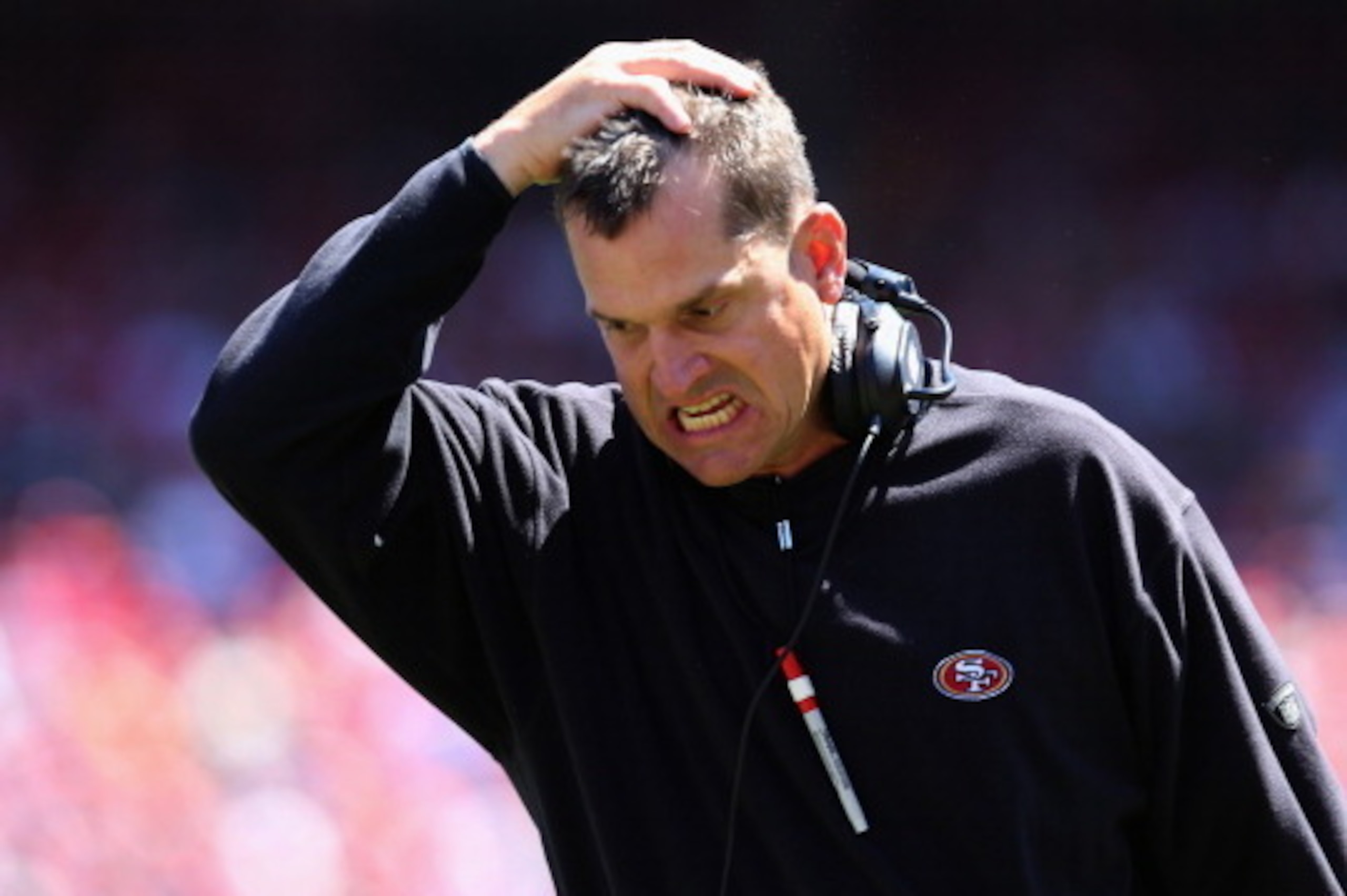
To me, college-style coaching infers that the coach runs a tight ship and has certain rules that his players find to be unnecessary or overbearing.
But if we consider the contrast between him and former coach Mike Singletary—who Harbaugh replaced as head coach—it would seem the Harbaugh version took on a more positive approach.
After almost four years, we've learned Harbaugh was at least better than Singletary at getting his players to play tough (something Singletary tried to implement using his own tactics), but he was also better at showing his team he was a down-to-earth, blue-collar worker in the same way he expects the players to be.
After the team's dramatic comeback victory over the Eagles in his first season as coach, Harbaugh gave up his first-class seat on the team charter to center Jonathan Goodwin and hung back with the players for the five-hour flight home, sending a resounding message that the team heard loud and clear.
Back then, there was nothing but praise and admiration from both his players and the media for the turnaround of a perpetual loser.
Harbaugh, like many NFL coaches, can be demanding of his team even to a point of ticking the players off. But this is a necessary evil in the process of pushing guys to places not even they believed they could go—or in other words, turning a losing atmosphere into a winning one.
A former college teammate of mine who ended up playing for the Patriots under Bill Belichick would tell me about how much of an [expletive] he is to everyone. In fact, when I asked my friend why he gave up on professional football so soon, Belichick's hard-nosed methods were a primary reason given.
Liking the coach is a nice perk and certainly can play dividends on a season's success, but a coach's job is not about being liked, but rather, to bring out the absolute best from each one of his players.
There are several ways to attain this delicate feat, including likability, but it must be made clear that being liked by your players is not a prerequisite for success, and as Rex Ryan has proved, it's not a guarantee for success, either.
So what is?
"Fun" and "playful" locker rooms can have benefits to the team but only to a certain degree.
The interactions inside a locker room can be perceived quite differently if a team is losing or winning. Naturally, winning brightens the mood of the players and the atmosphere around the locker room just as losing can drape a dark cloud over the entire organization from top to bottom.

Imagine if we got wind of the Oakland Raiders having random pillow fights in the locker room like the Detroit Lions? Casual observation may make the association that a relaxed and fun locker room breeds winning while tension and stress will result in losing. This could be a case of confusing causation with correlation.
How do we know that winning isn't responsible for the fun rather than the other way around?
From my time observing both winning and losing locker rooms, the reality seems to fall in the middle.
A relaxed team able to avoid complacency should incubate players who are at least slightly more prepared for winning than a tense team or a complacent one. Achieving this balance is a constant battle for the coaching staff and leaders of the team, and the outcome will forever ebb and flow in and out of the ideal, like trying to balance a Coke can on the corner brim.
Two things that every successful locker room must have in abundance among the players and the coaches are respect and trust.
Each of these elements go hand-in-hand and are absolutely vital in order for a team to thrive. Remove one from a football team, and it will fall apart faster than a soggy taco shell.
Respect is mandatory in a locker room because it allows for individuals to build and maintain trust as they work for months trying to execute seamlessly and cohesively as a piece to a larger system.
When players don't trust each other in a locker room, this certainly bleeds into performance on the field. Guys begin to overcompensate and try to do too much when they've lost trust in the players next to them. This leads to being out of position. Players also stop communicating with each other during the game when trust is absent.
What good is a receiver who has lost the trust of his quarterback? What good is a safety if the cornerback can't assume he will be in proper position?
A self-centered player who puts his needs above the interest of the team is also someone who will eventually not be trusted.
Was this what happened with players like DeSean Jackson and Percy Harvin?
From the perspective of those in charge of personnel, it would seem to be applicable in both situations.
These recent examples serve to illustrate just how important trust can be for an organization. A player who cannot be trusted is like a cancer that must be surgically removed early before it spreads throughout the entire locker room—even when they are as gifted as the names mentioned.
Trust and respect must also be present in the relationship between player and coach.
If we look at the 49ers through this lens, has the team lost its ability to trust and/or respect Harbaugh? If so, why?
Maybe they just don't trust his desire to be a part of the organization, like Jerry Rice and so many others have alluded to. This could give the players the perception that his decision-making is either no longer being done in the best interest of the team or he is so distracted with his future plans that it has cannibalized his ability to focus on the job at hand.
Neither of those scenarios seems likely. What does seem likely, however, is the rumbling we hear from the 49ers locker room is primarily born from players who are unhappy with their roles on the team, unhappy with the way they are being treated and unhappy with the level of demands being placed on them.
Though the aforementioned things may cause some players not to like their coach, it is far less likely to result in a substantial loss of trust or respect for him.
I hesitate to conclude that the 49ers are struggling because of some rift between Harbaugh and his players. Until further evidence emerges, I think the team has struggled mostly because of the absence of key contributors coupled with a loss of identity on offense.
I also doubt the Lions are having success because they're having more fun. Fun is mostly the byproduct of success rather than the other way around. Detroit is having success because the players work together extremely well on defense and play as a cohesive unit in the secondary as good as any team in the league right now.
In order to build a winning franchise, you better spend more time building a foundation for respect and trust rather than fun and getting along.
Ryan Riddle is a former NFL player and currently writes for Bleacher Report.
.jpg?w=2560)
.jpg?w=2560 "Texans Jaguars Football")