What Can Stop These Scorching Houston Rockets?
Grab a high-pressure hose. Grab the nearest fire extinguisher. Grab something, anything. The undefeated Houston Rockets are ablaze, torching defenses, melting opponents, setting fire to the Western Conference and any and all projections that asserted the offseason padlocked their title window.
They need to be stopped.
They must be stopped.
TOP NEWS
Giannis' Warning to NBA ⚠️

NBA Power Rankings Entering Preseason 🔢
Wizards Guard Admits Tanking 😨
Can they be stopped?
No NBA team is infallible, so the answer is an obvious, albeit cautious, yes. But stopping them isn't a mindless matter. Throwing water all over their incandescent tear through the league consists of more than hoping that James Harden misses extra shots, or that Terrence Jones stops playing well, or that Dwight Howard comes into contact with a shrink ray.
Serious, thoughtful game plans must be put into practice. Then, and only then, will there be a puncher's chance of stifling these scorching Rockets.
Impede the Long-Range Assault
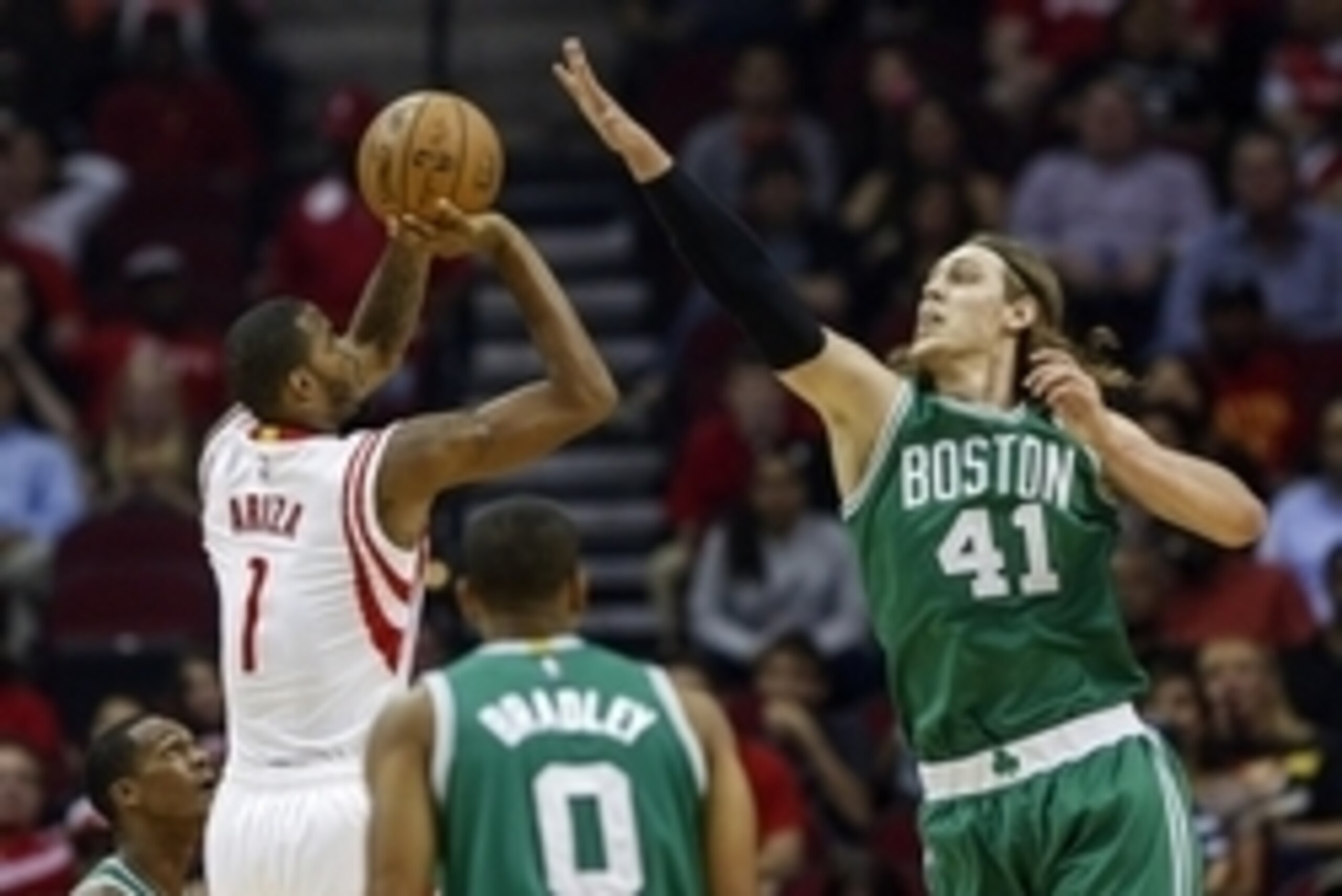
Contesting the shots of high-powered offenses—Houston ranks fourth in points scored per 100 possessions—is always a good place to start. But as the Rockets showed in their 98-81 drubbing of the shorthanded San Antonio Spurs on Thursday night, it's not always enough.
Roughly 66.7 percent of Houston's field-goal attempts were contested by the Spurs. The Rockets proceeded to shoot 56.3 percent in those situations. The hands in their face didn't matter, the mid-shot adjustments didn't rattle them.
More effective defensive measures must be taken, and that starts with manipulating the kinds of shots they're attempting.
The Rockets are averaging 31.3 three-point tries a night through six games. Not only does that lead the Association by a 3.9-shot margin but it puts them on pace to jack between 2,566 and 2,567 treys by season's end. That, in turn, puts them on pace to shatter and obliterate, then liquidate, the record for most three-point attempts over a single season. The New York Knicks sit atop the long-ball ranks after gunning 2,371 threes in 2012-13; Houston has also attempted at least 2,179 in each of the last two seasons.
Important still, the Rockets are converting 43.1 percent of their three-pointers, which also leads the league. Five of their players are bombing away at least three times per game while shooting better than 38 percent: Harden (38.9 percent), Isaiah Canaan (47.8), Patrick Beverley (53.8), Jason Terry (54.2) and Trevor Ariza (55).
Ariza has been particularly fantastic from deep. His 55 percent clip comes on nearly seven attempts a night. Only two other players since 1985 have attempted at least 40 threes through their first six games and drilled 55 percent of them: Paul Pierce (2001-02) and O.J. Mayo (2012-13). Both of them would go on to shoot better than 40 percent from deep during those respective seasons.
Special thanks is owed to Rockets coach Kevin McHale here. The 1980s star has embraced the modern-day three-point trend despite playing during an era in which they weren't popular shots. Between 1980 and 1993, when the 6'10" McHale played, not one team averaged more than 14 threes per game. His Rockets are more than doubling that number.
Conventional wisdom suggests they will have to cool off eventually. Harden hasn't shot better than 37 percent from behind the arc since 2011-12. Only one qualified player (Tim Legler) in league history, meanwhile, has connected on 50 percent of his deep balls after attempting three or more per game. That doesn't bode well for Ariza, Terry or Beverley.
Still, McHale has wisely allowed the three-point shot to become an integral part of Houston's offense by running one-in, four-out—sometimes zero-in, five-out—lineups. Banking on history to take care of the team's hot shooting will only do so much. Defenses need to figure out how to deter those shots altogether.

"We have the most dominant big man in the league (Dwight Howard) rolling down the lane,” Harden said, per the Houston Chronicle's Jonathan Feigen. “Somebody has to take him. And then, we have tremendous shooters on the wing. It’s pretty hard to guard."
Sending help—as teams have done—on Howard is of little value in those situations with the Rockets shooting so well from deep. They rank 22nd in points scored in the paint, per TeamRankings.com. It's better to defend Howard one-on-one, then foul him if need be. Let him earn his points at the charity stripe, where he's shooting 49.1 percent on the season and 57.4 percent for his career.
Doubling him only leaves someone else open, further contributing to the Rockets' favorable shot distribution.
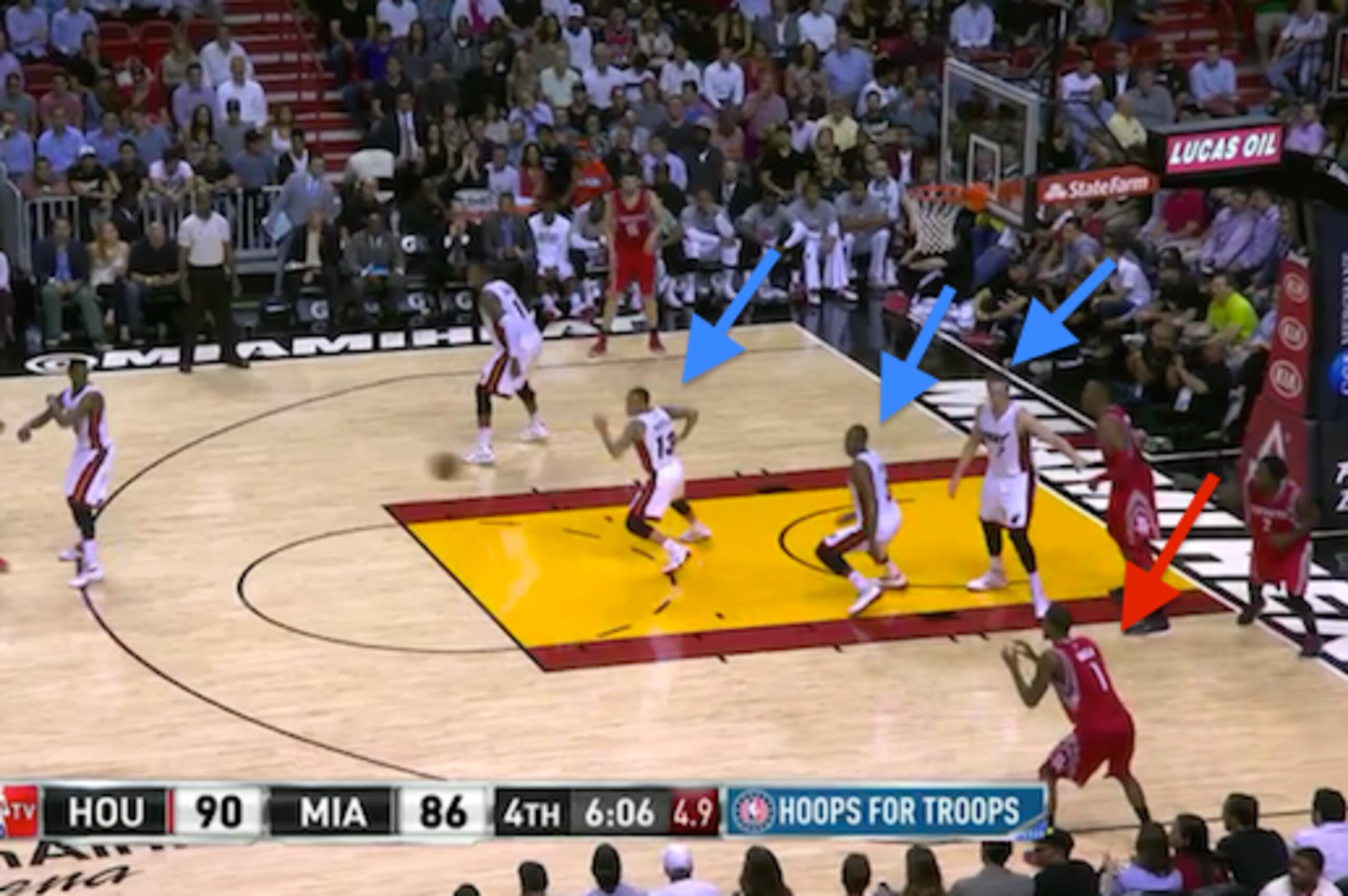
Exhibit A:

Exhibit B:
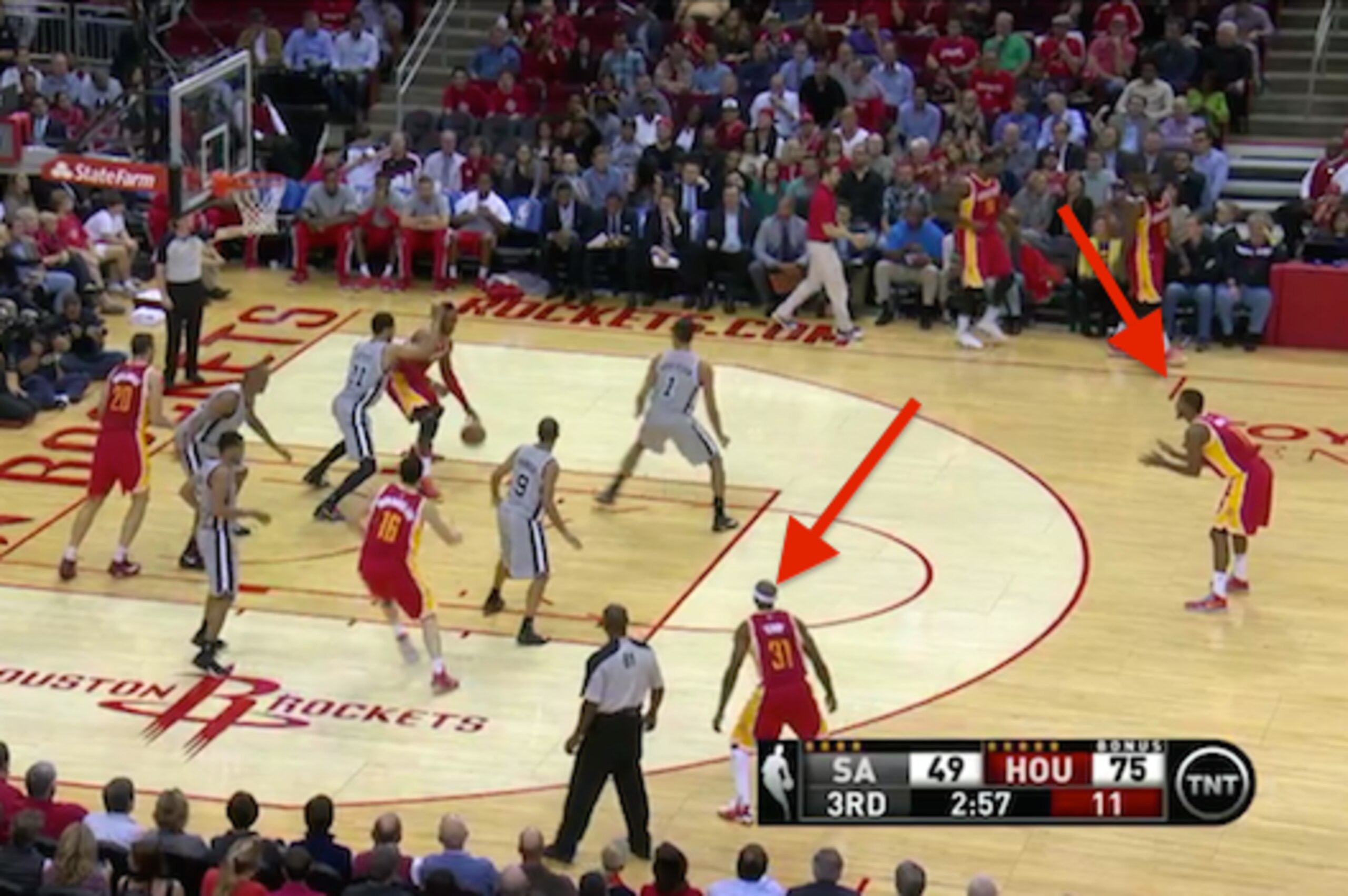
Opposing defenses are swarming Howard, leaving Houston's shooters wide open—even by the time they're catching passes and preparing to shoot.
Ahem:
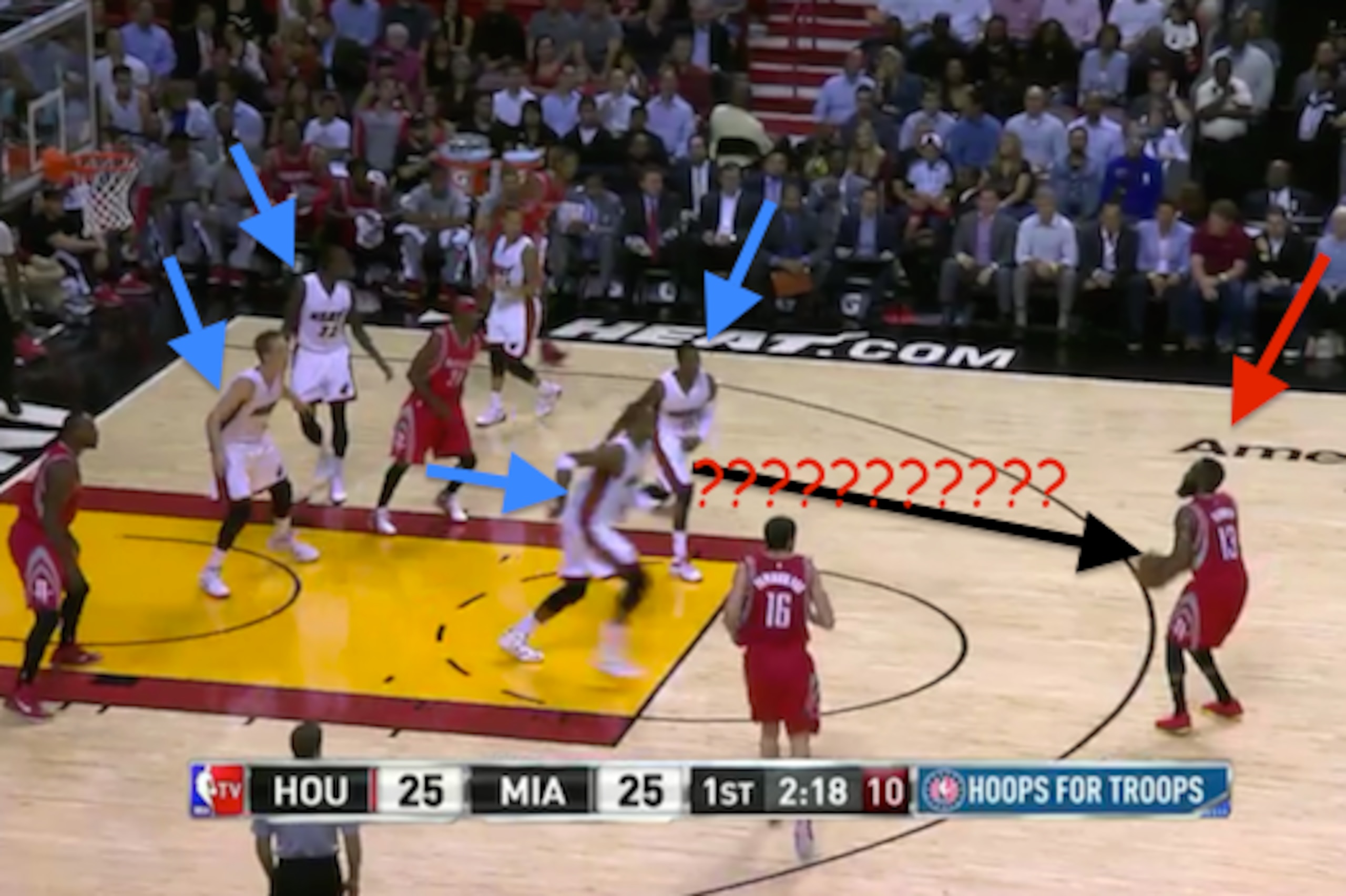
Ahem, again:
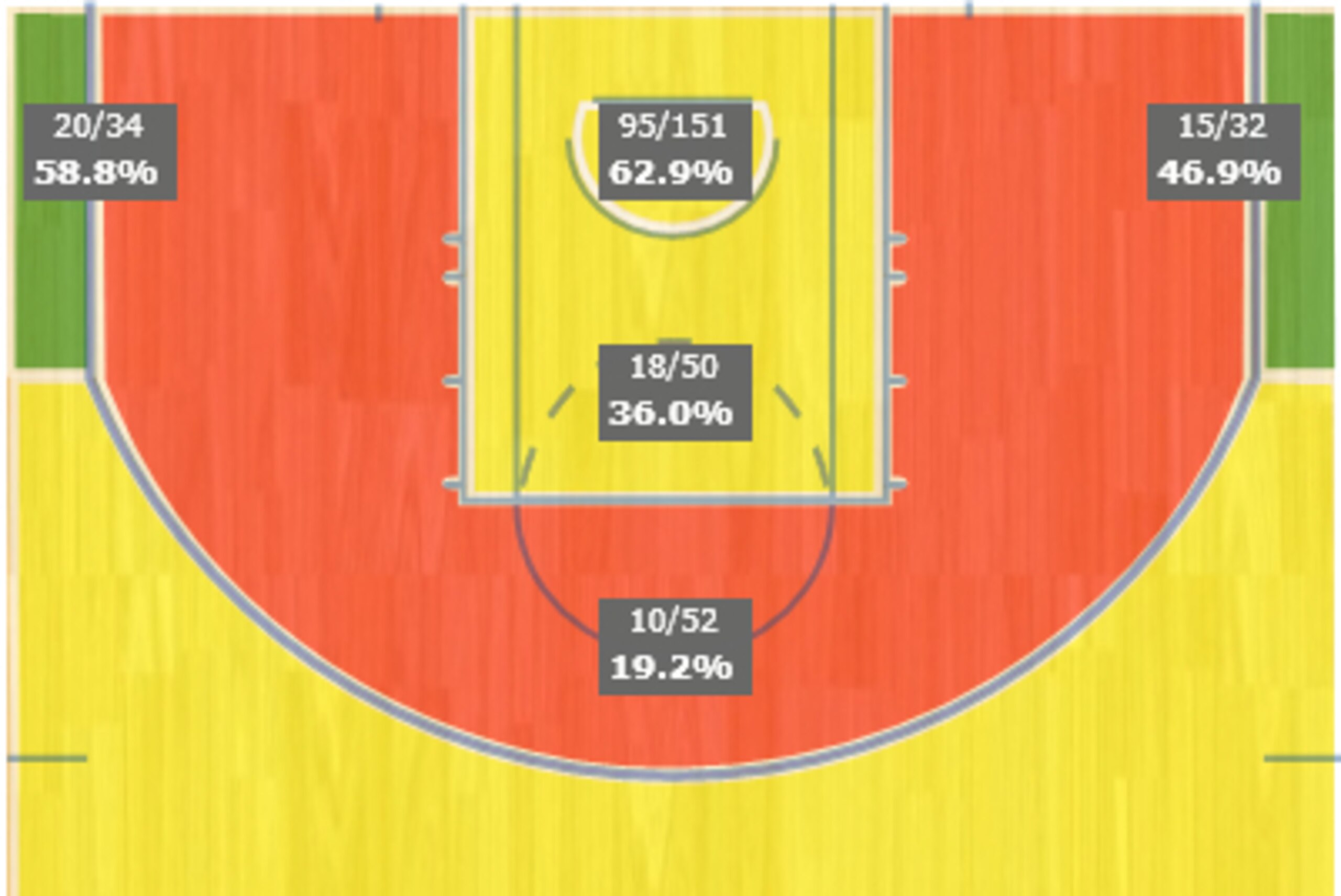
Most of the Rockets' attempts are coming within the paint and restricted area or from beyond the arc. Focusing more energy on defending the perimeter will force them to take mid-range jumpers, the least efficient shot in basketball.
Following their win over the Spurs, the Rockets ranked dead last in mid-range attempts (8.7), which is nearly four attempts fewer than the next closest team (Philadelphia 76ers). Incidentally, they also rank last in mid-range efficiency (19.2 percent). Goading them into more of those shots should have a negative impact on their three-point opportunities.
It will also help limit their ball movement. They finished 20th in passes per game last season; they already rank in the top 11 this year. They've done a better job swinging the ball around the arc off drive-and-kicks, ensuring Harden doesn't need to force the action as much. Covering the outside bases curbs those passes, paving the way for more mid-range and low-percentage shot attempts.
Doing that should, at the very least, hinder the Rockets' currently sweltering offensive attack.
Fight Shooting with Dunking and Layup-ing
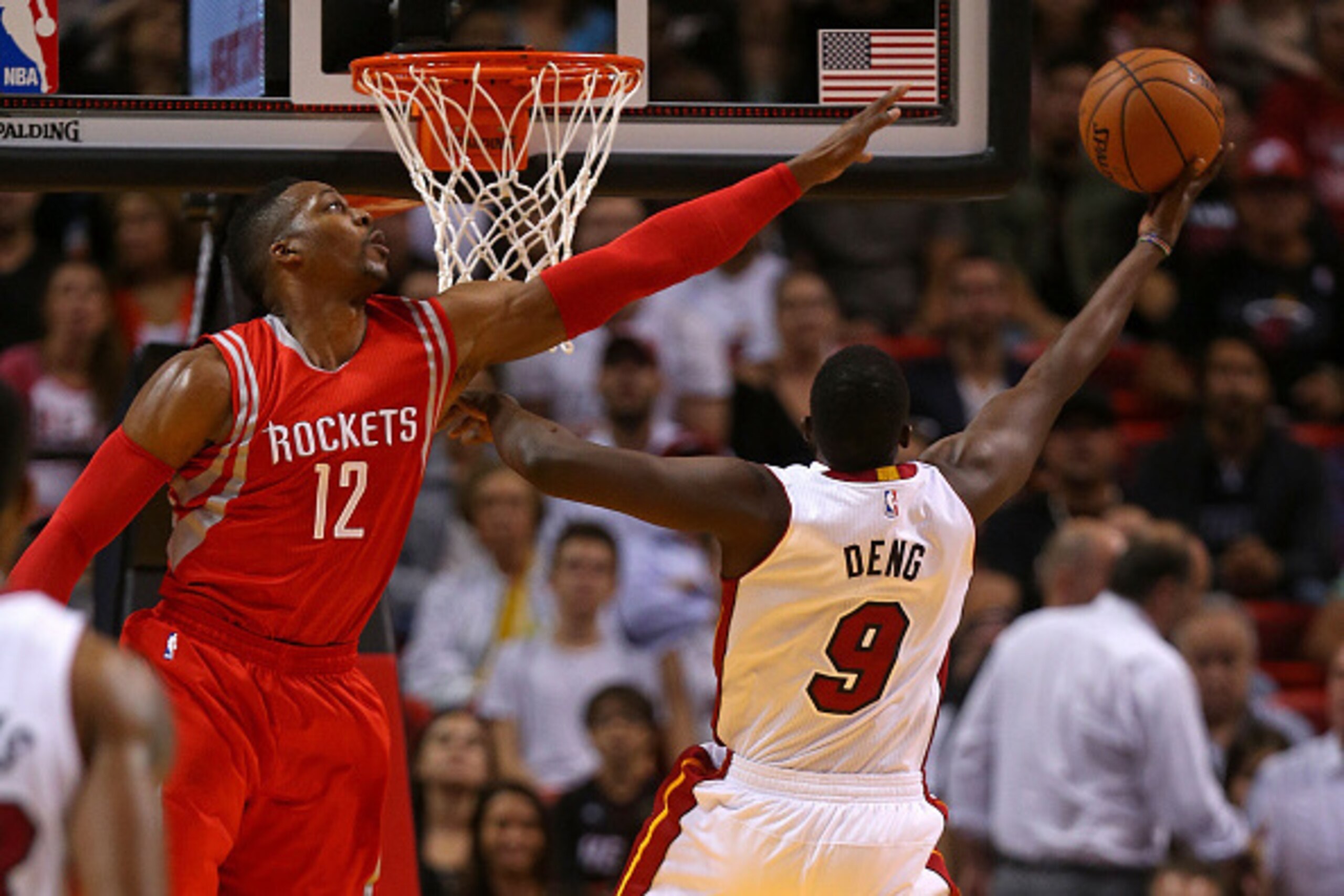
Guarding against three-pointers has aided the Rockets' early-season ascension. (Dear team, You're welcome. Sincerely, Trevor Ariza.)
Offenses are only converting 26 percent of their long balls against the boys in red, giving Houston the league's best three-point defense.
Avoiding shots from behind the rainbow entirely in response is not an option. Doing so would be foolish (see: New York's offense). Something must be done to open up those looks instead.
Like attacking the rim.
Howard has done a magnificent job intimidating opponents while policing the iron. Players aren't inclined to attack the rim when he's on the floor because he's so darn huge. More than 63.5 percent of opposing offenses' shots have actually come outside the restricted area while he's on the floor, as shown below:
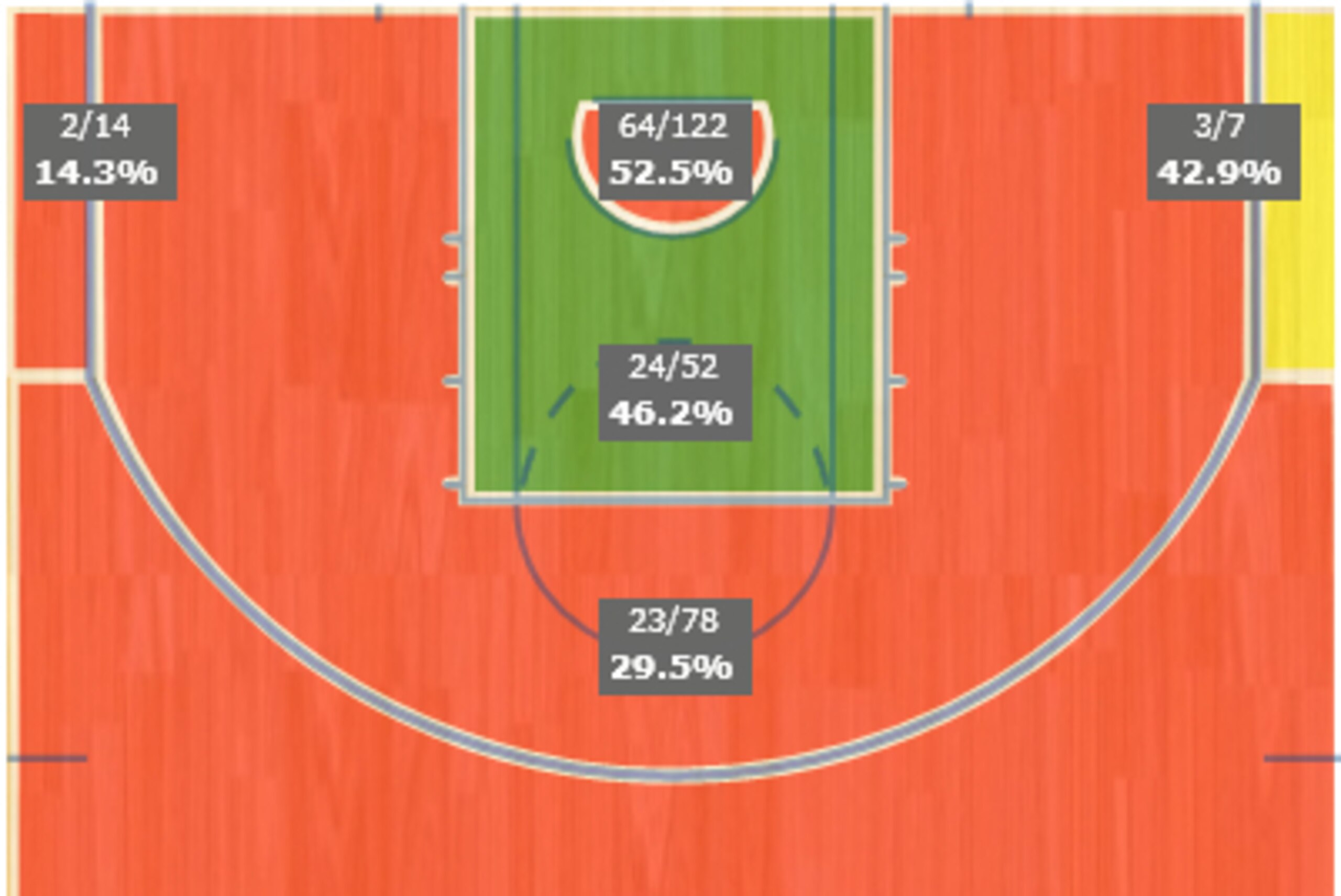
Here's the rub: The Rockets haven't been an elite rim-protecting team thus far. They rank in the middle (13th) of opponent field-goal percentage around the basket, and while Howard himself is holding shot-takers to 43.6 percent conversion rates at the rim, he's facing just four point-blank attempts a night.
Renowned rim protectors are facing plenty more elsewhere.
Roy Hibbert is contesting 10.6 per game; Anthony Davis faces 8.0; Larry Sanders sees 7.4; Nerlens Noel is defending against 6.4; Andrew Bogut and DeAndre Jordan chase after 9.0; Tim Duncan is battling against 15; and Serge Ibaka fields 7.6.
Credit the Rockets' perimeter defense with cutting off dribble penetration and rotating well off screens. Ariza and Beverley are working wonders on the outside, covering up for Harden's, um, still-developing defense better than Chandler Parsons and Jeremy Lin ever could.
But teams still need to try. Right now, they're not. They're swinging the ball around the perimeter, east and west, making life easy on Howard and the Rockets.
Teams should be pushing the bill, attacking the paint, collapsing Houston's defense, creating open and semi-open attempts for shooters. Howard is their only genuine rim protector. That's not a reason to limit offensive variance.
It's cause to press harder.
Wait, and Hope It Pays Off
At the risk of belittling what the Rockets are doing, we have to go here.
Six displays of dominance are nothing over the course of an 82-game season. It's far too soon to start coining the Rockets championship favorites. More time needs to pass, bigger simple sizes need to be seen, tougher opponents need to be dethroned.
Houston has enjoyed the sixth-easiest schedule to date. They've faced only two top-10 offenses. Four of its opponents also failed to win 30 games last season. All four—Utah Jazz, Los Angeles Lakers, Boston Celtics, Sixers—project as sub-30 win factions once again.
No clear bench contributor has emerged either. The minutes distribution has been weird and the starters currently represent 85 of the team's 104.3 points a night. And despite an uptick in ball movement, they've had a hard time generating assists.
Playing an understaffed Spurs team further skews the scope through which the Rockets are viewed. Manu Ginobili and Duncan had the night off. Rookie Kyle Anderson eclipsed 30 minutes. The Spurs team they beat wasn't actually the Spurs.
To wit: The Rockets have yet to face a true contender. Their 17-point spanking of the Miami Heat was impressive, but no one should be mistaking that squad for a legitimate title-chaser.
Better opponents will threaten their hot streak as the season wears on. Things will change at some point, as CBS Sports' Ken Berger argued ahead of their win over San Antonio:
"Despite the early returns, the Rockets don't figure to be in the same class as the Warriors, Clippers, Spurs or even Mavs when it comes time to set the playoff seeds. Among their victims so far are the dregs of each conference, the Lakers and Sixers. Next on the schedule are the Spurs and Warriors. Things can, and usually do, change quickly.
Once Oklahoma City gets Durant and Westbrook back sometime in December, the pecking order figures to be reset again. But it also appears to have been folly to presume that the season itself would be as disastrous for the Rockets as their offseason was.
"
Hot streaks go cold. Offenses falter, defenses collapse. That doesn't mean the Rockets will fall out of the playoff picture or cede control of the West altogether. It just means the Rockets of November aren't a wholly accurate glimpse into the Rockets of January, February, March or April.
Inevitably, they will cool off. The strong play may continue, and Howard and Harden could still dominate. But this brand of superhuman basketball won't last.
For now, then, opposing teams can only react and adapt to what they know and wait for time to work its usual dark magic—all while hoping these now-scorching Rockets prove to be typical title contenders rather than indomitable world-slayers.
*Stats courtesy of Basketball-Reference and NBA.com unless otherwise cited.
.jpg?w=2560 "Every Trade's Best Trade Asset 🔁")
.jpg?w=2560 "Insiders: Cowboys Overpaid for Porter")
.jpg?w=2560 "Top NFL Trade Targets")