


Ed Davis' time with the Los Angeles Lakers shouldn't be anything like his stint with the Memphis Grizzlies or even the Toronto Raptors.
They actually need him.
Inconsistent playing time has dogged Davis his entire career. If it wasn't for his quirky beginnings, he wouldn't even be in Los Angeles right now, playing for peanuts and pride.

His role was unclear while with the Raptors. Frontcourt minutes were hard to come by with the Grizzlies. The last four years have yielded more confusion than answers as Davis became something of a per-36-minute phenom who couldn't secure a stable spot in the rotation.
Nothing of the sort stands to complicate Davis' tenure—however brief—with the Lakers. Playing time will have to be earned within a rotation that includes Carlos Boozer, Julius Randle and Jordan Hill, but Davis has on-court chops that fill gaping voids.
Marginalizing him—or burying him on the bench altogether—shouldn't be an option.
Real, Live Defense
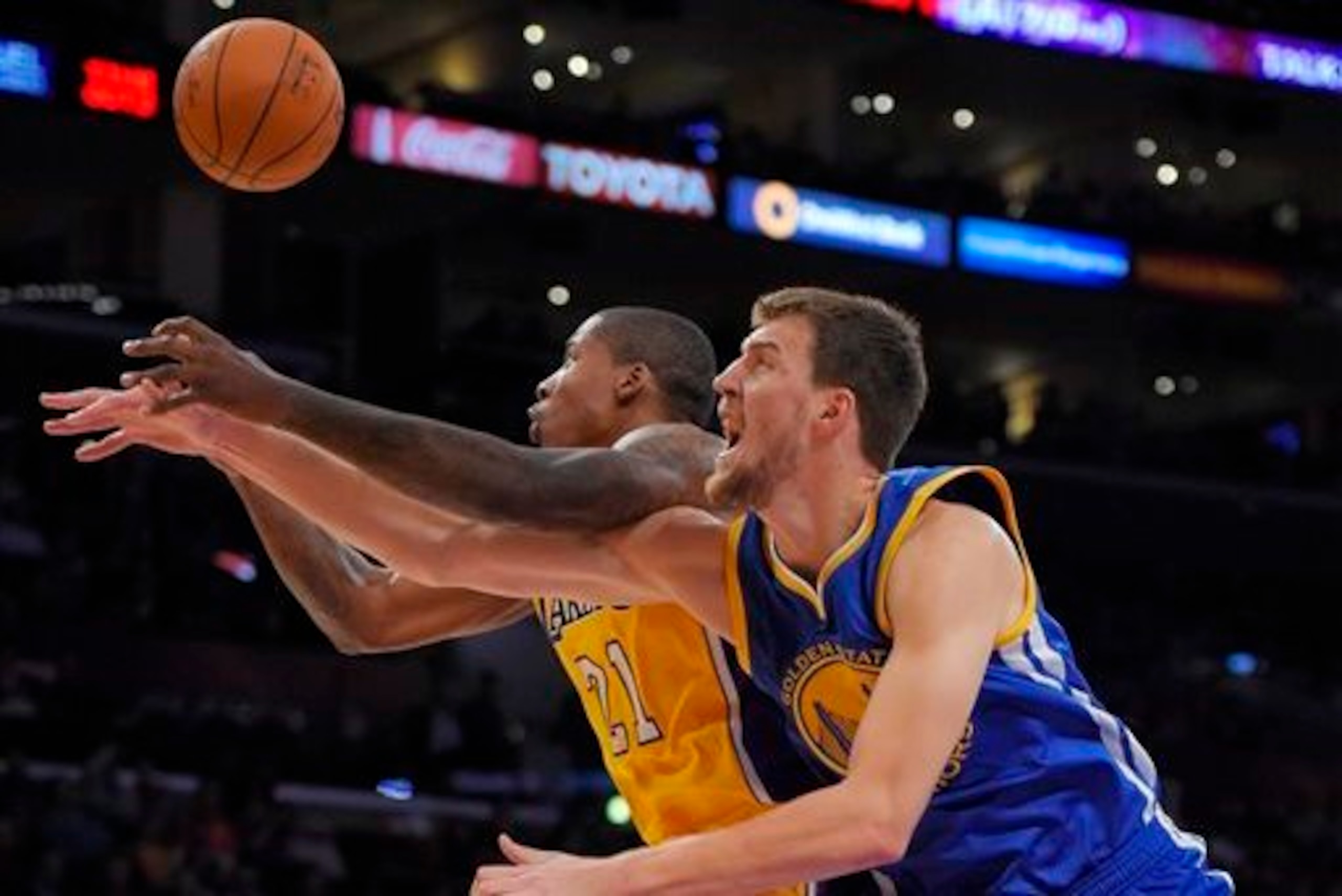
As currently constructed, the Lakers aren't built to defend.
Nevermind that the defensively obsessed Byron Scott won't ever say die. The Lakers ranked 28th in defensive efficiency last season, and the talent they've since added and retained doesn't promise improvement, much to Scott's displeasure.
"[We need to be] better on the defensive end," he said, per the Los Angeles Times' Eric Pincus. "That's the whole emphasis for this whole preseason, is just each game get better on that end of the floor, not make as many mistakes, do a better job of covering pick-and-roll. It's just the little things that we need to continue to clean up."
Improving—surviving, really—on the defensive end demands a number of different things happen. Though the Lakers are at a point where it's difficult to get any worse, they'll need to depend heavily on certain individuals to keep their defense from regressing further.
On the perimeter that means running Wesley Johnson ragged and hoping Xavier Henry gets healthy soon.
Down low that means they find someone who can contest shots.
Rim protection was an issue for them last year. They finished 18th in point-blank prevention, allowing opponents to hit 53.2 percent of their shots at the iron.
Not one of this year's primary frontcourt components can be considered an elite rim protector. Hill is athletic, but his focus is narrow. He's not going to slide over off rotations and deter dribble penetration or hassle slashers; Randle isn't an above-rim player, nor is he known for his defense; and Boozer is a sieve who is about as qualified to protect the rim as a career sheepherder is to conduct a Craniectomy.
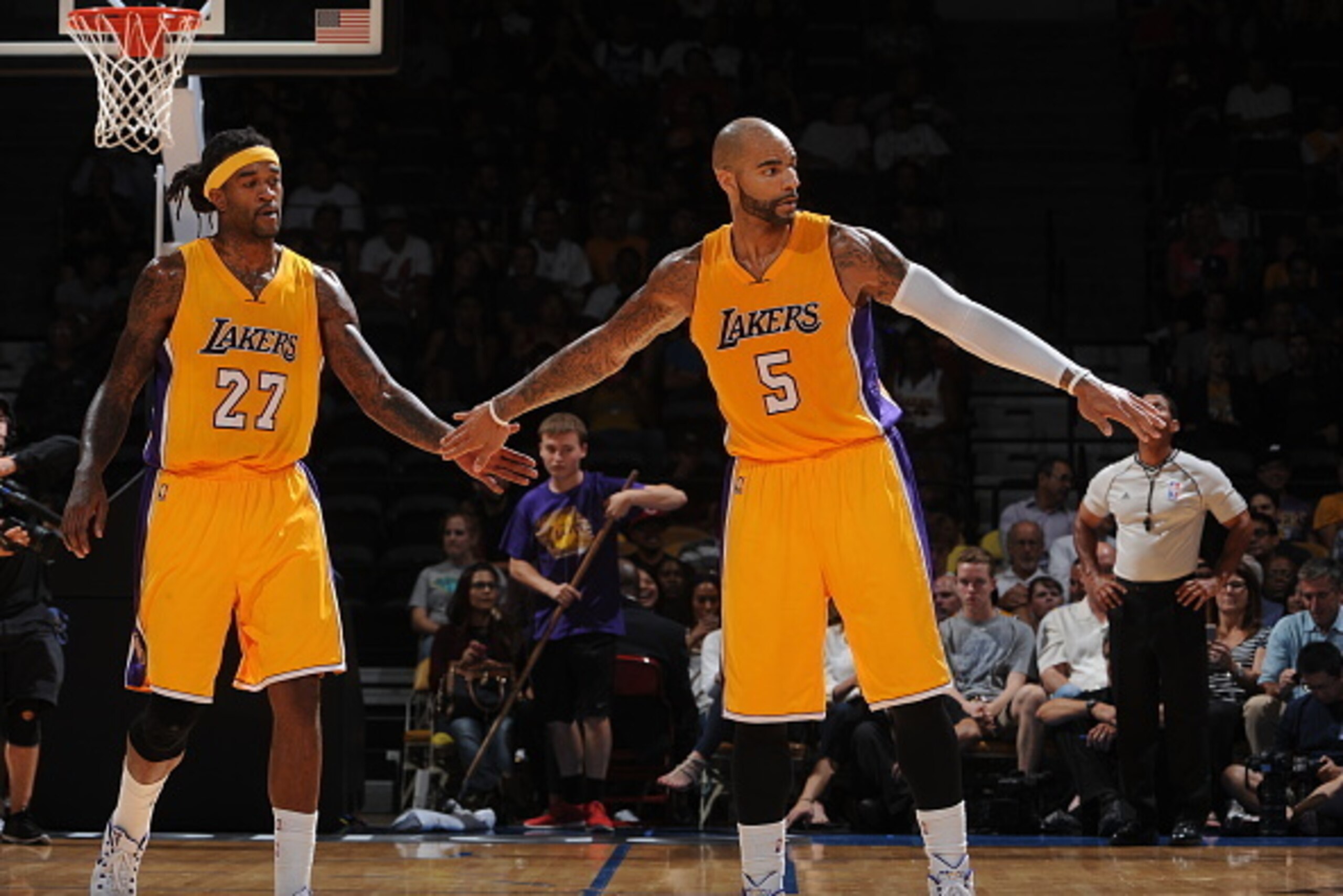
Luckily for the Lakers, they have Davis. He's quick and explosive, and while he isn't a defensive linchpin, he's someone who can exist within top-flight systems or help plug habitually and collectively running faucets.
Opposing big men combined to register a 14.3 player efficiency rating against him last season, noticeably below the league average of 15, per 82games.com. He also ranked 14th in opponent field-goal percentage among the 228 players who faced at least two shots around the basket and appeared in 25 or more games, according NBA.com. Hill finished 100th in that same category, while Boozer ended up placing 179th.
If the Lakers are going to protect the basket at all next season, they're going to need Davis—who's averaging 1.6 blocks per 36 minutes for his career—swatting shots at the rim. He is their best chance at finding an interior defensive anchor. The other alternatives are underwhelming, disastrous or Boozer.
Valuable Connections

Second-unit performance figures to be an issue for the Lakers, if only because the bench mob is, by default, going to be a huge part of their success or failure.
Who Scott starts at this point is almost irrelevant. Kobe Bryant figures to be on a minutes cap, Carlos Boozer is 32, Steve Nash remembers discovering fire and Hill has never averaged more than 20.8 minutes per game.
Assuming Scott wasn't lying while talking shop with the Los Angeles Daily News' Mark Medina, that represents 80 percent of the Lakers' starting lineup. Johnson will likely round that group out, and he's only logged more than 25 minutes a night once in the last three years.
Ergo, the Lakers will have to be creative and generous with their minutes distribution across the board.
Good thing Jeremy Lin and Davis are ready to drop the offensive hammer.
Of the many things the Lakers have seen go wrong during the preseason, the chemistry between Lin and Davis isn't among them. The two have forged synergistic ties, looking particularly dangerous as pick-and-roll partners.
This comes as no surprise, given Lin's claim to fame came within Mike D'Antoni's pick-and-roll packed offense that included a then-super athletic Amar'e Stoudemire. Davis is Stoudemire incarnate in this scenario, only his post-up game and jumper need work, and he'll play defense for more than two seconds at a time.
“Those probably will be two of the first guys off the bench,” Scott said of Lin and Davis, per Lakers.com. “With the way Ed played last night, (he) definitely played well. And Jeremy didn’t shoot the ball well—and we know he’s capable of making shots—but he did a good job of orchestrating the offense and making great passes.”
Sustaining this connection is paramount given how the Lakers offense will be structured. Bryant is already trading rim assaults for more turnaround, mid-range fadeaways, and Scott wants the team attempting between 10 and 15 three-pointers a night, per Pincus.
Ignorant though that sounds, Scott doesn't have a choice. Bleacher Report's Grant Hughes explains why:
"Scott's ideas are outdated, and they're going to exacerbate the skill deficit L.A. will be up against in almost every game this year.
When you have less talent than the opponent, you should be looking for edges, gimmicks and statistical efficiencies to exploit. It's the only way to compete.
But here's the problem: The roster Scott will coach this year isn't equipped to do any of those things. There is no magic fix-it-all style for this personnel group. Shooting 30 threes a game would be better than 30 long twos, but the Lakers will still struggle to score at an above-average rate if they fire off that many triples.
"
Pick-and-rolls—which Scott has always loved to run—will be key to the Lakers' livelihood if they're not going to space the floor and jack threes. They'll still need to hit jumpers, but curbing the number of deep balls makes getting open looks at the rim necessary.

Davis put in 58.7 percent of his shots inside eight feet of the basket last year. He also hit 42 percent of his attempts between eight and 16 feet. The potential for him to be a pick-and-pop threat is there. He can thrive alongside Lin or Nash. Anyone who's able and willing to find cutters he can complement.
And with the way the Lakers offense is shaping up—and given their inability to lean on defensive fortitude—they need that explosive slasher who can finish at the rim while hitting the occasional jump shot.
Five years ago, that may have been more Boozer. It's never been Hill.
It could be Davis.
Supersized Role

Coming up with reasons for Davis to play is easy. The list goes on and on, and anything we come up with forces us toward one conclusion: Davis deserves a chance.
"If Davis is a stopgap, that’s fine. That’s all he’s costing," NBC Sports' Dan Feldman wrote at the time of Davis' signing. "But he might develop into more—and that’s why the Lakers come out ahead on this deal."
Long-term potential is one of the huge gains Davis brought with him. The Lakers aren't flush with young, able-bodied building blocks. He is a potential cornerstone. And if he's not, he's still someone who can produce.
Remember, Davis is averaging 11.9 points, 10.2 rebounds and 1.6 blocks on 54.2 percent shooting per 36 minutes since entering the league in 2010. Only six other players—minimum 200 appearances—have matched his benchmarks during these last four years: Marcin Gortat, JaVale McGee, DeAndre Jordan, Kenneth Faried, Tyson Chandler and Dwight Howard.
(Clears throat.)
Wow.
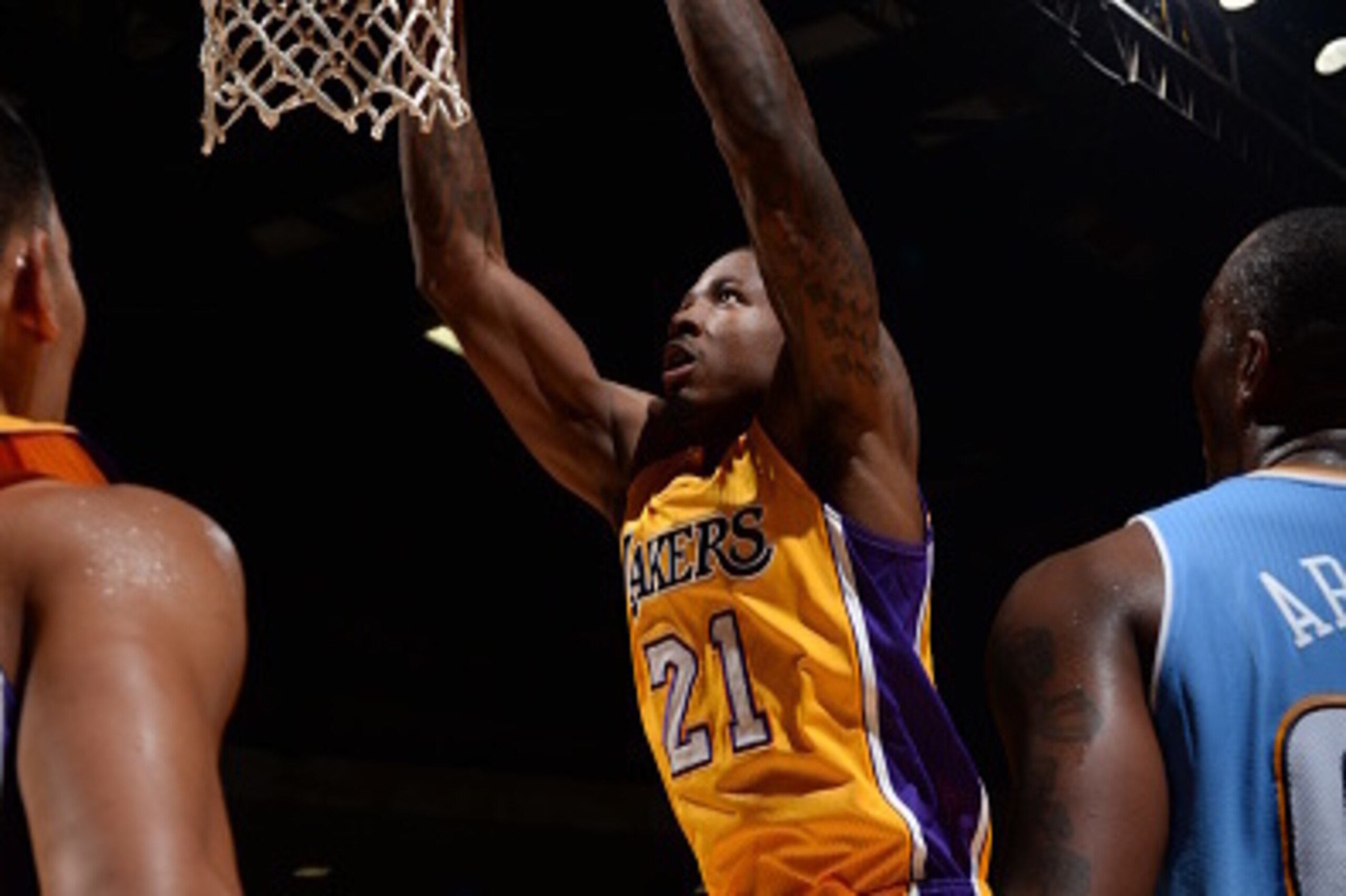
Despite limited playing time and topsy-turvy circumstances, Davis has managed to produce wherever he goes. There's no reason to believe his stay in Los Angeles will be any different; he's already putting up numbers.
Through two preseason games, he's logged 28 minutes. And in those 28 minutes, he's scored 18 points, grabbed eight rebounds and blocked four shots. That's the equivalent of 23.1 points, 10.3 rebounds and 5.1 blocks per 36 minutes.
Oh, and that's all come on 81.8 percent shooting.
Yes, it's only preseason. And yes, playing well in short bursts helps pad per-36-minute touchstones. But the Lakers aren't in position to ignore or in any way cage this type of potential.
“It’s more of a fresh start,” Davis said of playing in Los Angeles, per Medina. “It’s about getting an opportunity and being in the right situation. I’ll do whatever I can to help a team win.”
Wins will be difficult to come by as the Lakers try to withstand a Western Conference gauntlet inundated with teams more talented and healthier than themselves. This upcoming season will be rife with hardships. Finding a prominent place for Davis will be easy.
Few of their players can make a positive impact on both sides of the floor. Davis is one of those few.
Whatever role they give him needs to be gargantuan.
He's earned a fresh start and the supersized role it should come with.
*Stats courtesy of Basketball-Reference and NBA.com unless otherwise cited.

.jpg?w=2560 "NFL House in Paris Closes for Protests")
.jpg?w=2560 "Trevon Diggs Cut by Seahawks")


