Seattle Seahawks vs. Washington Redskins: Breaking Down Washington's Game Plan
A visit from the defending Super Bowl champions is likely the last thing the Washington Redskins want to see while they're still smarting from a 1-3 start. But the Seahawks haven't quite looked as all-conquering as last season's vintage.
There's hope for Washington provided the play-calling is aggressive on both sides of the ball. This approach may seem simplistic, but it's vital against a Seahawks teams that thrives when forcing opponents to play passive football.
Here's a closer look at how Washington can instead beat the Seahawks to the punch.
TOP NEWS
.jpg?w=2560 "NFL Paris Football")
NFL House in Paris Closes for Protests
.jpg?w=2560 "Seahawks Chiefs Football")
Trevon Diggs Cut by Seahawks
.jpg?w=2560 "Colts Football")
Jonathan Taylor Landing Spots
Blitz Russell Wilson
Steamroller running back Marshawn Lynch is the workhorse who makes the Seahawks tick. However, dual-threat quarterback Russell Wilson is the X-factor who turns this team from a solid one to a dominant force.
Redskins defensive boss Jim Haslett has to shut Wilson down. That should mean applying plenty of pressure off the edges.
When the Arizona Cardinals won 17-10 in Seattle in Week 16 of the 2013 season, their defense did exactly that.
Here's one great example of how the Cardinals attacked. The play involved the Cardinals sending three blitzers at Wilson. The Cards rush a linebacker through the middle and blitz two defensive backs off the edge:

At the same time, linebacker Karlos Dansby and safety Yeremiah Bell bail out and drop into coverage. Dansby covers the underneath middle, while Bell rotates to take the deep middle.
As the play develops, the covering defenders set themselves. The Cardinals also have rush end John Abraham peel off into the slot on the backside (red circle):
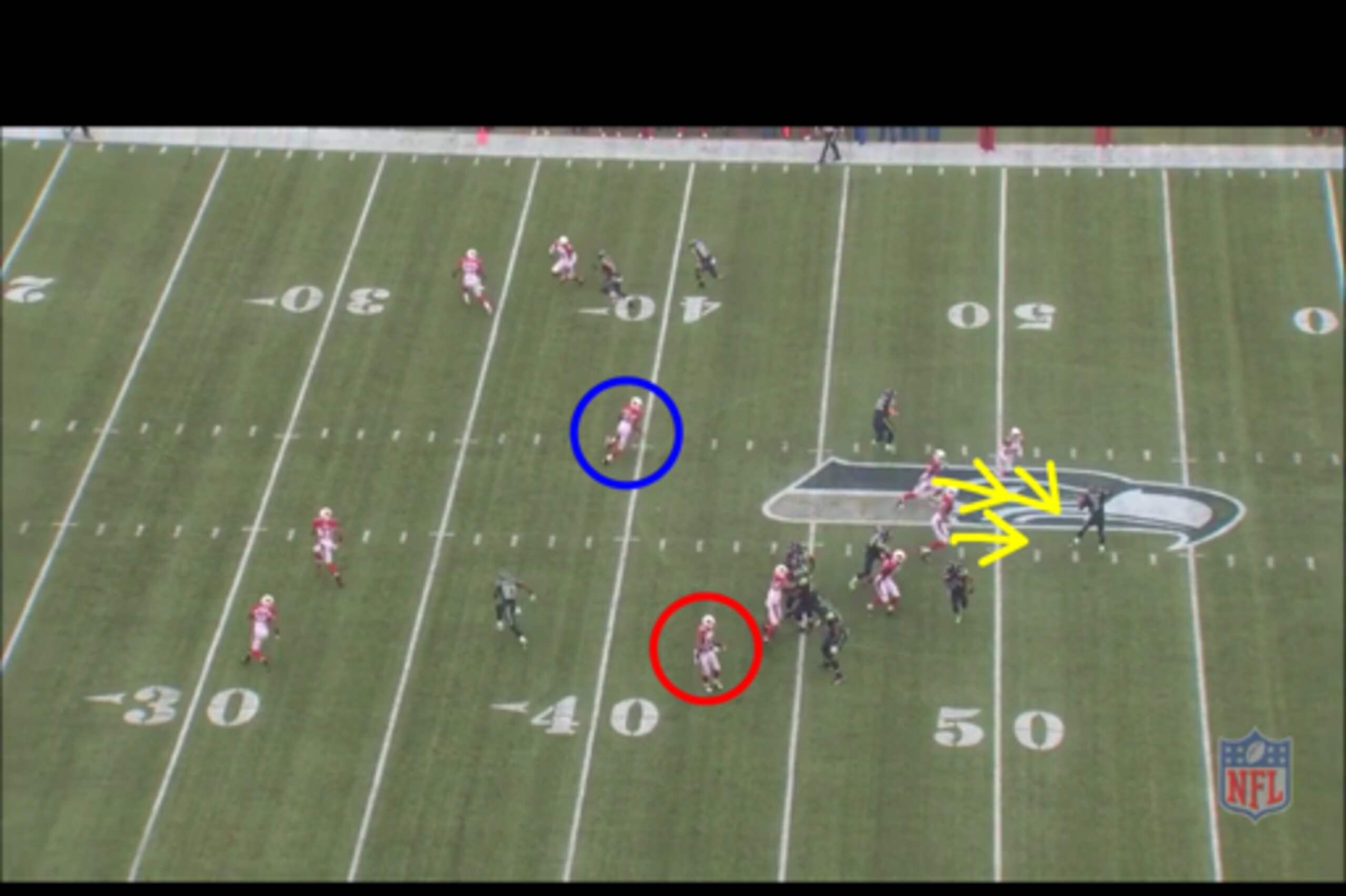
His presence keeps both edges defended. This prevents Wilson from rolling across the formation to elude the blitz. It also takes away some of the fakes and back-side screens the Seahawks love to run.
All three blitzers close in on Wilson, taking away his throwing lane:

In trademark Wilson style, he still attempts to manufacture a play by flipping the ball over the rush to his tight end. However, the pass falls incomplete:

Even if it doesn't, Dansby is there to make a quick stop short of the first down.
The beauty of this play is how it attacks Wilson's natural escape lane on his favored side. He loves to run around the edges, particularly off the right tackle.
That's where 2012's third-round bargain escapes for some of his longest runs and biggest throws off the scramble.
By blitzing the edges, Washington can simultaneously keep Wilson in the pocket and force him into quick throws underneath.
Contain Marshawn Lynch
Obviously, getting into blitzing situations can only happen if the Redskins stop Lynch. That certainly won't be easy.
Haslett needs to trust slanted fronts with one-gap alignments that allow D-linemen to gain quick penetration. That's the only way to stop the zone-stretch scheme Seattle runs.
Fortunately, it's a system Haslett's unit sees everyday in practice, since it's identical to the one that's made Alfred Morris a star in D.C. But even with that inside knowledge, Haslett needs big performances along his injury-hit front.
In particular, he'll need quick-twitch tackle Jason Hatcher to split gaps and slow Lynch down in the backfield. If that happens, Washington can focus on pressuring Wilson.

Lynch has to be a focus on early downs, but limiting Wilson's penchant for the big play will be the real key to an upset win.
However, as aggressive as the defense will need to be, head coach Jay Gruden's offense must be no less daring against Seattle's fearsome unit.
Attack the Seahawks' Coverage Schemes with Route Combinations and Crossing Patterns
Seattle's coverage is an odd mix. It is a simple structure that usually packs zones inside while relying on man coverage on the edges. Gruden should take note of how other teams have begun finding ways to exploit this mix.
The Denver Broncos routinely attacked Seattle's coverage structures with route combinations and deep crossing patterns in Week 3.
One example sees quarterback Peyton Manning connect with tight end Jacob Tamme on a 26-yard scoring pass that sent that game into overtime.
Tamme begins the play as the inside receiver in the slot, but he quickly works his way behind the pattern of outside receiver Demaryius Thomas, who runs a deep inside post:

The plan is to target free safety Earl Thomas. The Broncos want to bait Thomas into jumping the inside route.
They know Thomas will rotate down as part of Seattle's familiar Cover 3 shell (three deep, four under):
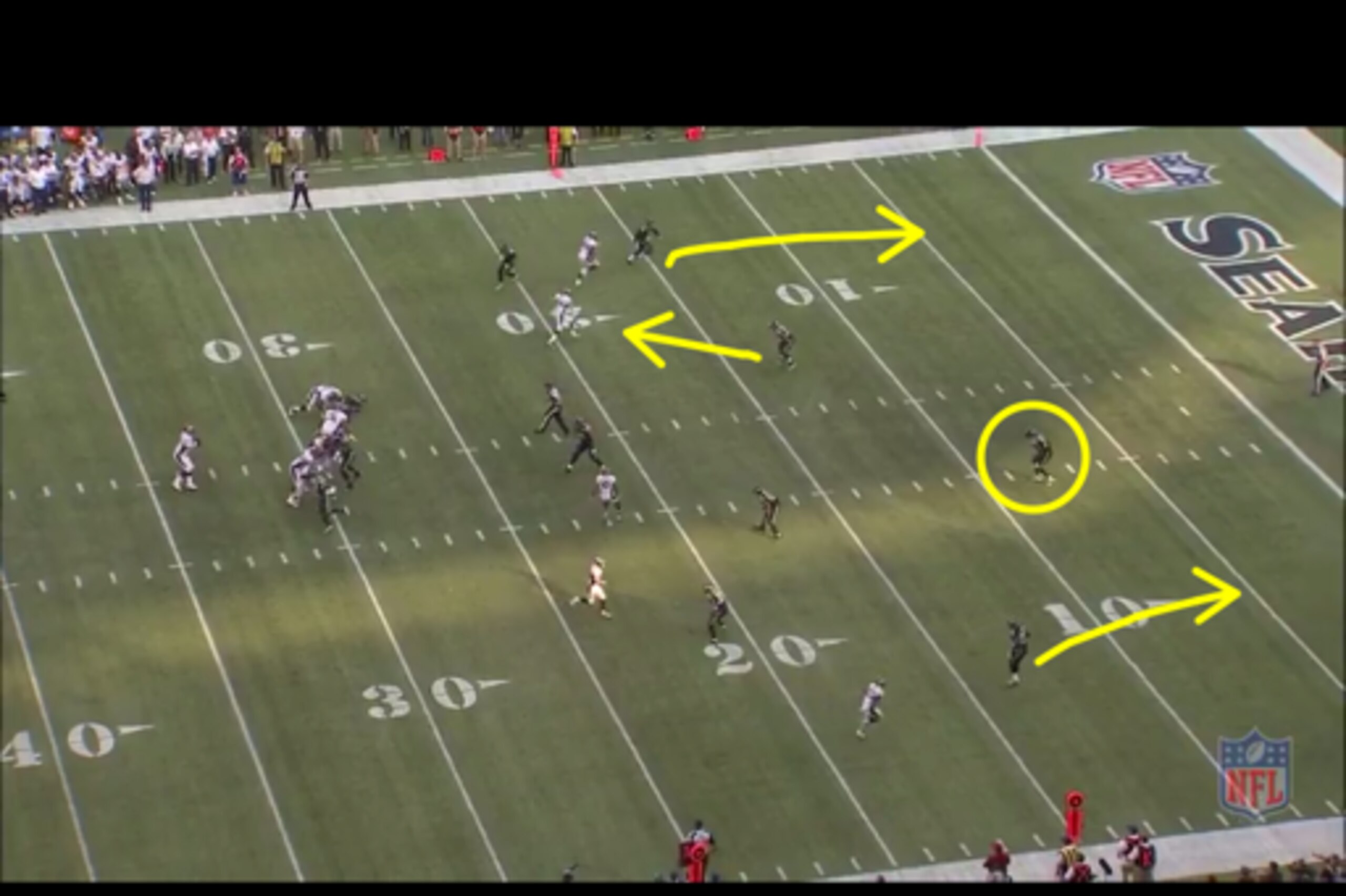
Because the Seahawks love to clog the middle passing lanes, Thomas naturally goes for the inside route:

That leaves Tamme to exploit the single coverage on the outside:

A big-bodied, athletic "move" tight end is often a mismatch one-on-one. It proves to be the case here, as Tamme hauls in the pass for an alarmingly simple score:

These plays have been giving the Seahawks fits this season. They challenge their reliance on familiar coverage structures.
Those structures usually involve letting Thomas play as a roving catch-all. However, smart route concepts and a decisive quarterback can always challenge this approach.
Whichever route Thomas went for on this play, he would've left his defense exposed. But because Seattle relies on single, press coverage on the outside, it's easy to assume the defense will always roll its coverage to the middle of the field first.
Washington can exploit this tendency if Gruden allows his talented group of receivers to run combination routes to attack the Seahawks deep. It's pointless playing safe with underneath throws against the Seahawks.
Their whole defensive philosophy is designed to make offenses do exactly that. Instead, Gruden has to let Kirk Cousins take some chances.
The coach will also be mindful of how much the Seahawks have struggled to corral tight ends so far this season. Tamme's score was one more example of how "Joker-style" tight ends have gotten behind Seattle's coverage.

Todd Dybas of The Washington Times has detailed how teams have been using tight ends to exploit players such as massive safety Kam Chancellor:
"The San Diego Chargers went after him, and the Seahawks‘ linebackers, in a 30-21 Week 2 win against the Seattle. Tight end Antonio Gates finished with seven catches for 96 yards and three touchdowns. Gates scored twice from eight yards out and once from 21 yards.
Linebackers Bobby Wagner and Malcolm Smith tried to jam Gates — a typical tactic for the Seahawks‘ defense — but he was strong enough to push through. Chancellor showed up late during two of the touchdowns.
A clever shift allowed San Diego to isolate Gates against Chancellor for the second score. The Seahawks‘ cornerbacks play sides, meaning Sherman remains on the defensive left and Byron Maxwell the right. To clear a side for Gates, San Diego bunched its receivers to the left of the snap, dragging Sherman to the other side of the field. Gates was split off the right tackle. That left Chancellor alone against him. He lost.
"
Gruden certainly has the players and concepts to add to Seattle's struggles with covering tight ends. He just needs those players healthy.
That means getting positive reports on Jordan Reed and Niles Paul. Both have the move skills to trouble the Seahawks.
Reed remains an outside candidate to play, according to CSN Washington reporter Tarik El-Bashir:
However, even if Reed is still missing, Gruden might be able to turn to Paul. The converted wide receiver has been one of this season's few success stories, catching 21 passes for 313 yards and a touchdown.
Paul's availability remains in some doubt following the concussion he sustained against the New York Giants in Week 4. The player himself is confident he'll be cleared to face the Seahawks, per Zac Boyer of The Washington Times:
"Niles Paul said Tuesday he has passed every stage of the league’s concussion protocol and expects to be able to play for the Washington Redskins when they face Seattle on Monday. ...
"I feel good," he said. "Obviously, it was a process. I had a concussion. I was out. But it’s a process that you’ve got to go through."
"
If Paul is healthy, it will be a major boost to a scheme that has to be geared to attack the Seahawks and not allow their punishing defensive backs and smothering coverage to dictate the game.
Seizing the initiative is vital against a bully like the Seahawks. Washington has to make Wilson, Lynch, Thomas, Chancellor and company uncomfortable.
That's the only route to scoring a potentially season-defining upset.
All statistics via NFL.com.
.jpg?w=2560)