Portland Trail Blazers Ready to Contend in Crowded Western Conference
The 2013-14 NBA season contained many surprises, but the Portland Trail Blazers were chief among them.
This was supposed to be a middling squad filled with some high-upside players, but instead, everything came together swimmingly. Though the team's blazing start led to an inevitable cooling-off period later in the year, the Blazers still finished with a 54-28 record, strong enough to earn them the No. 4 spot in the brutally tough Western Conference.
And they weren't content just making the playoffs, instead downing the star-studded Houston Rockets when Damian Lillard drained an ice-cold three-pointer to advance past the first round. The San Antonio Spurs outed them before the conference finals, but it was an impressive season nonetheless.
TOP NEWS

Power Ranking Every NBA Team's Starting Lineup 🔢
Worst NBA Predictions 🫣
Jokic says booing fans not welcome in Denver
Now, Rip City is primed to get even better.
Surging Stars
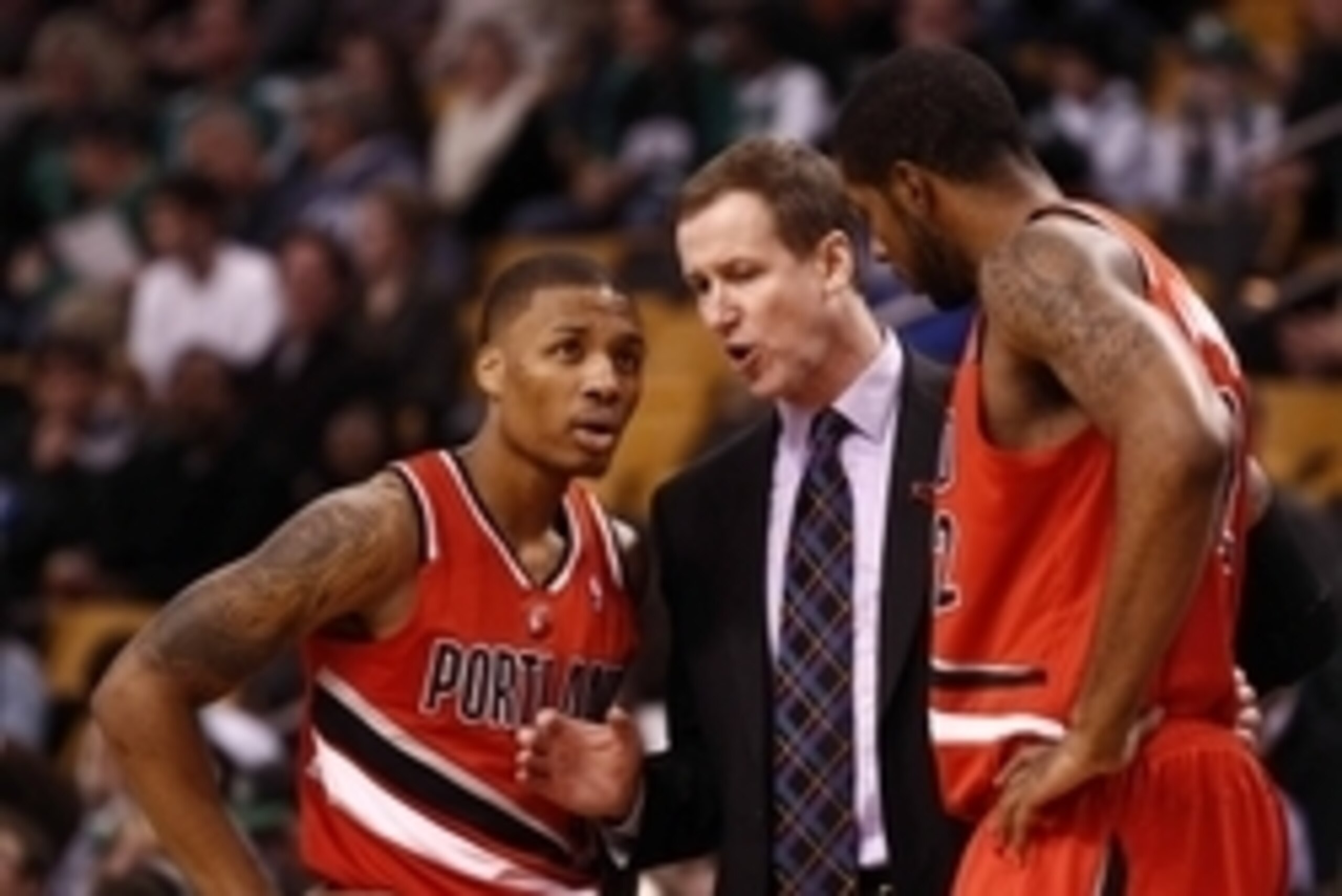
As good as Lillard and LaMarcus Aldridge already are—and I recently ranked them as the No. 16 and No. 13 players in the league heading into training camp, respectively—they both have plenty of room for growth.
That's pretty obvious when you look at the dynamic point guard, who's only entering his third NBA season out of Weber State. He may already be 24 years old, due to a long and successful collegiate career, but he's still gaining traction in the Association, particularly on the defensive end of the court.
Up to this point, Lillard has been left massively confused whenever he's greeted with a screen. It takes him too long to decide whether he should fight over the top of the pick-setting defender or jump under it before closing out on his assignment, and that sometimes causes him to run directly into the opposing player, who essentially acts like a brick wall.
You can see him allowing Andrew Bogut to function as an immovable object here:
And things aren't much better when he's working off the ball, either:
According to Synergy Sports (subscription required), the 1-guard gave up 0.88 points per possession during the 2013-14 season, a mark topped by 189 players throughout the Association. He was particularly weak when working in isolation and—you guessed it—when guarding pick-and-roll ball-handlers.
During that latter situation, he hemorrhaged 0.87 points per possession, which was the No. 181 mark in the league. Additionally, players knew this was a weakness and constantly attacked him in that manner, allowing pick-and-roll ball-handlers to account for a massive 49.6 percent of his defensive possessions.
Lillard is already dynamite on offense—functioning as one of the most impressive scorers in the NBA, despite his youth—but he's not holding his weight on the less glamorous end, which holds back his overall production. If he can become even an adequate defender for Rip City, this team would get significantly more dangerous.
Thing is, there's time for him to do exactly that.
Because he was responsible for so much of the offense at Weber State, he was never asked to carry too much defensive weight. That was true early in his NBA career as well, but now, the mentality needs to change. Portland is more competitive, more quickly than most expected, and shoring up the defense is the obvious next step in his development.
Though physical tools are required, defense is largely about effort and the overall mental game, whether it's recognizing and reacting to plays or just committing yourself to preventing points. Lillard has the quickness, both with his feet and his hands, to be at least marginally successful; now he has to play smarter.
"I think Damian has the potential to be a dominant defender and I think he wants that because he's a smart basketball player and he wants to get better every year," Gary Payton, who was pretty decent at defense during his playing days, told CSNNW.com's Chris Haynes back in June, focusing heavily on Lillard's defensive mindset. "I think he's going to go in and see the way he's not stopping guards that he should be stopping."
This isn't some slow-footed guard we're talking about but rather a player with the potential to become a two-way standout.
And speaking of standouts, how about Aldridge?
As good as this deserving All-Star was during the 2013-14 campaign, averaging 23.2 points and 11.1 rebounds per game, both of which are career highs, he can get that much better. Not only will he gain comfort serving as a central figure in the defensive system, but he's also capable of continuing to improve offensively.
While there's no doubt Aldridge is an impressive scorer, he's not exactly efficient. His game is predicated upon the least efficient shot in basketball, and he has trouble drawing contact and getting free points at the charity stripe. On top of that, he relies on assists for a large percentage of his makes, especially when compared to most players who line up at his position.
If he improves in any one area, he'll be even deadlier than before.
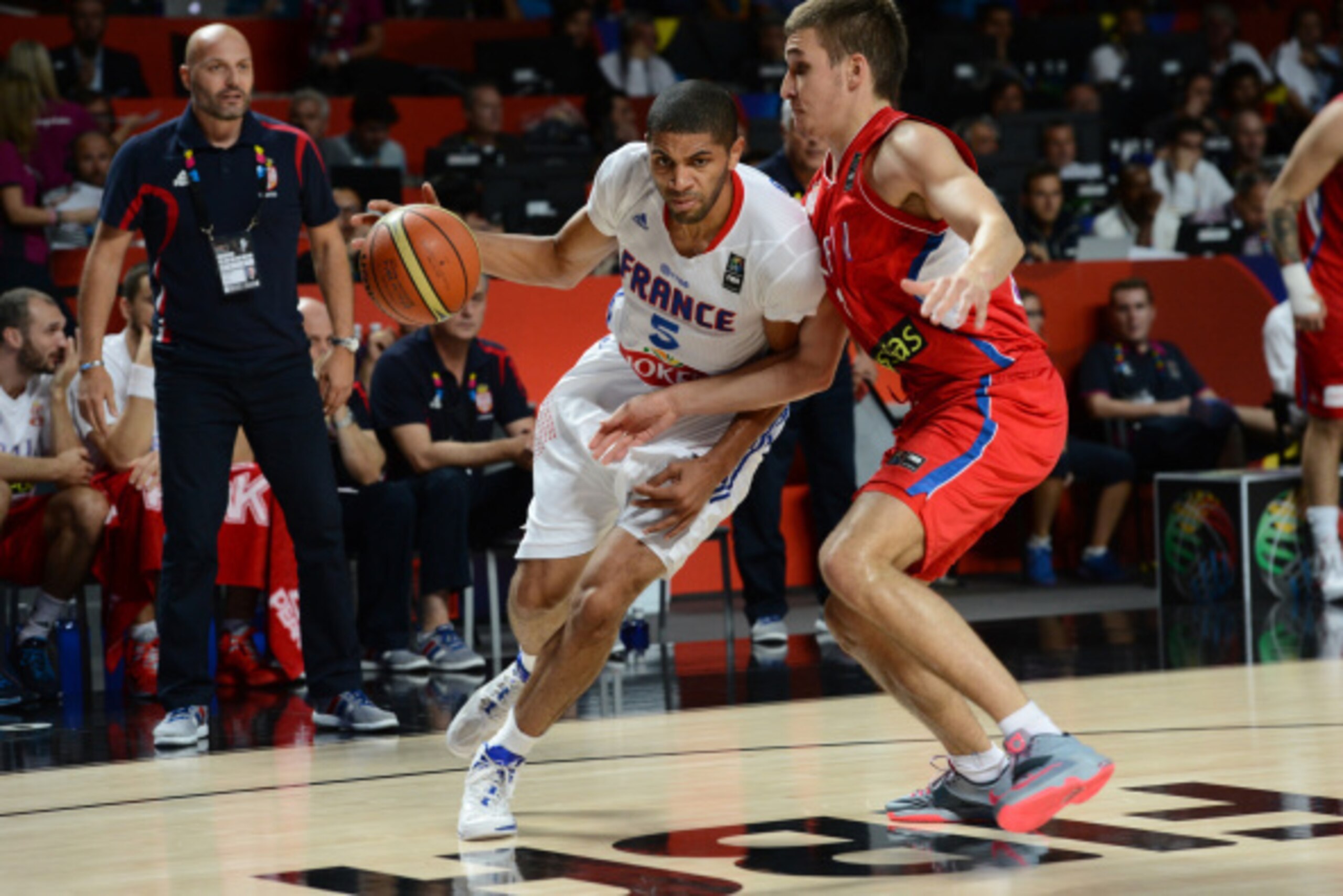
And, of course, this is saying nothing of Nicolas Batum, fresh off an incredible effort for France at the 2014 FIBA Basketball World Cup. The forward will turn 26 fairly early on in the 2014-15 season, so it's not as though he's done making improvements to his game while maintaining the athleticism he'll enjoy throughout these prime years.
The same can be said of the remaining starters. Wesley Matthews will be 28 at the start of the regular-season festivities, and Robin Lopez is a spry 26 years old, still figuring out how to excel as a Rip City starter.
This five-man unit was already quite impressive in 2013-14. There's no real risk of decline (injuries notwithstanding), and even if every single player stagnates, it will still be a strong bunch of versatile and complementary players.
But it can be much better, especially as everyone continues to gain comfort with Terry Stotts' teachings.
Burgeoning Bench
The well-publicized issue for the Blazers was the overall ineffectiveness of the bench last season.
It was such a poor group of players, especially with injuries plaguing it, that Stotts couldn't rely on it whatsoever. Fortunately, the starters all remained healthy for the vast majority of the year, save Aldridge going down for a brief spell toward the end of the regular season. If there had been any more injury woes, there's no telling how much the bench would have dragged this team down.
But it was about more than limited playing time for the second unit.
In the NBA, there's typically a strong correlation between volume and efficiency. As players—and groups of players—spend more time on the court, it's harder to maintain levels of efficiency. As they play less, it's easier for them to look better in those short spurts.
However, the low-volume Portland bench, which played fewer minutes than any other NBA team's non-starters, still didn't fare particularly well in offensive efficiency. In fact, it finished dead last, losing out to the Indiana Pacers and the rest of the league thanks to its putrid efforts. Defensively, things weren't much better, as HoopsStats.com shows that the Trail Blazers bench finished No. 27 in defensive efficiency.

"While Blazers head coach Terry Stotts was coming to terms with just how few of his reserves seemed at all playable in this series, [Gregg] Popovich was drawing a 10-point, seven-rebound performance from Aron Baynes—a bottom-of-the-barrel center who logged all of six minutes in the first round," wrote Sports Illustrated's Rob Mahoney about the overmatched nature of this Portland bunch during the postseason.
If that changes, the ceiling is drastically raised for this squad.
And so far, it appears as though that should be the case.
Early in the offseason, Lillard texted a list of free-agency targets he'd like to see Portland chase to Haynes: "Yeah…Mo Williams" and "Channing Frye, Vince Carter, Spencer Hawes, Trevor Ariza."
The Blazers didn't get any of those players, but they did add size by signing Chris Kaman and a steady backup point guard in Steve Blake. That's assuming this is the Los Angeles Lakers version of Blake, who was a comparable player to Mo Williams, and not the ineffective Golden State Warriors version.
They aren't glamorous additions, but they didn't need to fall into that classification. After all, the starters are still going to do the heavy lifting for this squad, and you can't overlook the expected improvement of the young players, primarily that of C.J. McCollum, Meyers Leonard and Thomas Robinson.
"I have no doubt the options on Lillard and McCollum will be exercised," wrote The Oregonian's Joe Freeman in late September. "Those are no-brainers. But I suspect the front office is still weighing decisions on Leonard, whose option is valued at roughly $3 million, and Robinson, whose option is a hefty $4.7 million."
Not only are these guys—Leonard and Robinson—attempting to improve, but they're now fighting for their salaries, entering into contract years with a lot to prove. The former has been quite disappointing since entering the league as a raw prospect, but his athleticism at the center spot still offers hope for the future.
Likewise, Robinson has underwhelmed since leaving behind his collegiate career at Kansas, but he looked much better toward the end of his sophomore season. Over his last 21 games, starting directly after he was re-activated and inserted back into the rotation, the power forward averaged 5.8 points, 5.1 rebounds and 0.7 assists per game while shooting 54.3 percent from the field.
His per-36-minute numbers over that stretch? Averages of 14.5 points, 12.8 boards and 1.8 assists, which is obviously some solid production from a backup big man.
If he can carry that over into the 2014-15 season, there will be far less pressure on Aldridge and Lopez in the starting lineup. The same is true with McCollum and the starting backcourt members, as the combo guard should be a much different player than he was during his rookie season.
It's already tough enough for a first-year player to make the transition to the sport's highest level. It's harder still when fighting through an injury at the beginning of that season, one that puts you directly behind the eight ball from day one.
McCollum didn't debut until Jan. 8, and that made it quite tough for him to catch up to speed.
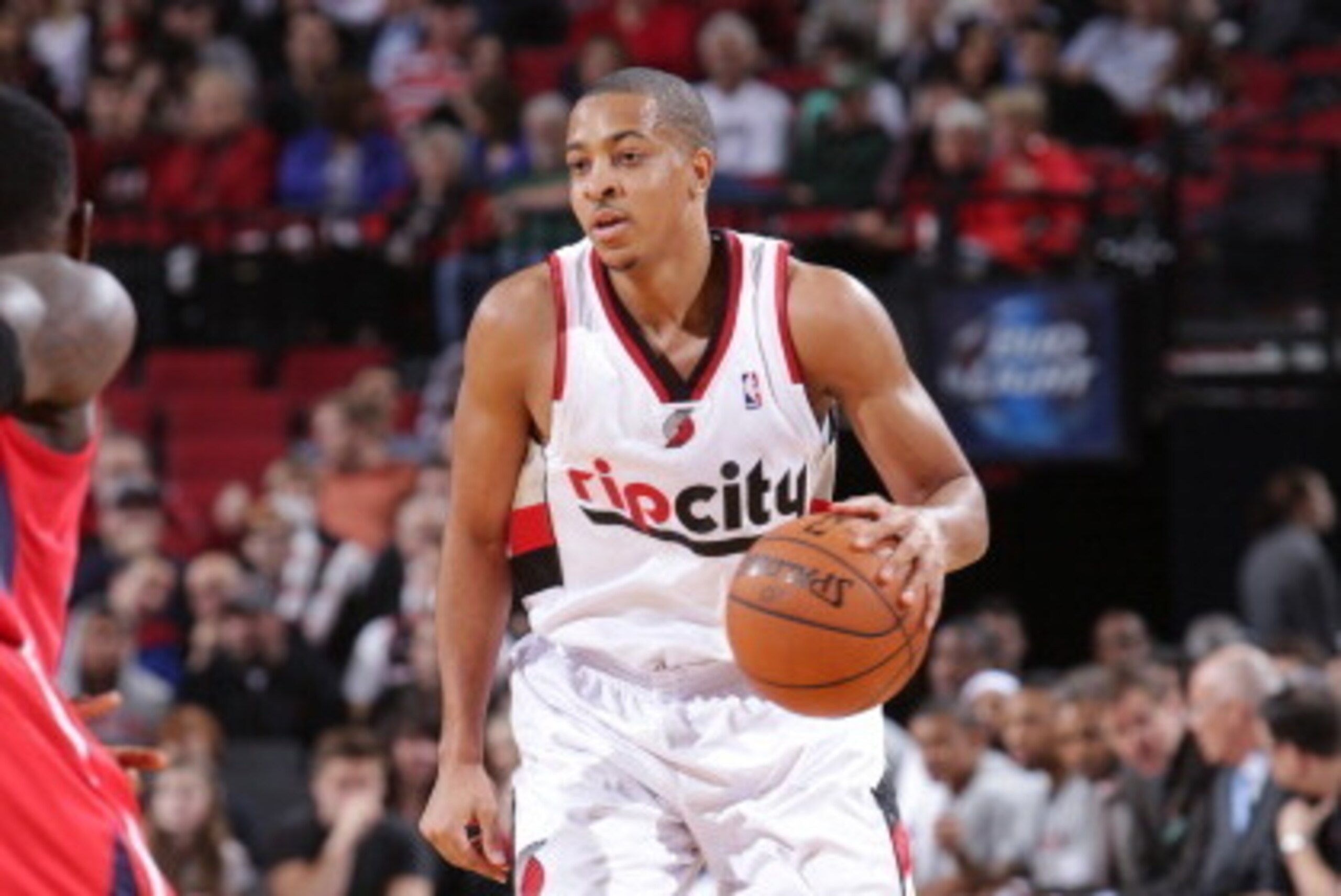
"Instead of thinking of reasons why your coach should be playing you, honestly assess reasons as to why he isn't," the Lehigh product penned for Basketball Insiders while giving advice to the next class of rookies. "The next step is to go work on those things and improve the specific areas you come up with, so there is a change in your play. For me, it was simple. I made a list of what I needed to improve on."
Even if there's just moderate improvement, McCollum will be working with the team throughout training camp and preseason action. He'll be ready to go at the beginning of the season, barring any unforeseen injury problems that could pop up between now and then.
Remember, this is a young bench, but it's also one that added two solid veteran pieces in Kaman and Blake. Among that, the lofty starting point and the potential improvement in the starting lineup, particularly when it comes to Lillard, the Blazers are in position to assert themselves as strong contenders in the Western Conference.
Is the West ridiculously tough? Yes, but so too is Rip City.
.jpg?w=2560 "Mahomes Told Teammate to Leave Meeting")


.jpg?w=2560 "🚨 Week 8 AP Top 25 Poll")


.jpg?w=2560 "Updates from EVERY NFL Game 🏈")