

Building the Ideal Rotation for the Oklahoma City Thunder Next Season
The only certainty about the Oklahoma City Thunder's rotation next season is that Kevin Durant, Russell Westbrook and Serge Ibaka will be occupying the bulk of the minutes at their respective positions.
Beyond that, there are a number of questions that still need to be answered.
Should Steven Adams or Kendrick Perkins get the nod at center? Who's the man at shooting guard? Is Reggie Jackson better suited to be a starter or a sixth man? How much playing time should the young guys get?
There are a lot of tough decisions for Thunder head coach Scott Brooks to make. Fortunately for him, his friends at Bleacher Report have taken the time to help him out with his potential roster quandaries.
After analyzing the roster, I've built the ideal rotation for the Oklahoma City Thunder this upcoming season. The starting five has been hammered out. Roles have been assigned, and all 48 minutes per position have been allocated.
It's like being an NBA head coach, except without the pressure of possibly being fired if things go awry.
Starting Point Guard: Russell Westbrook
1 of 7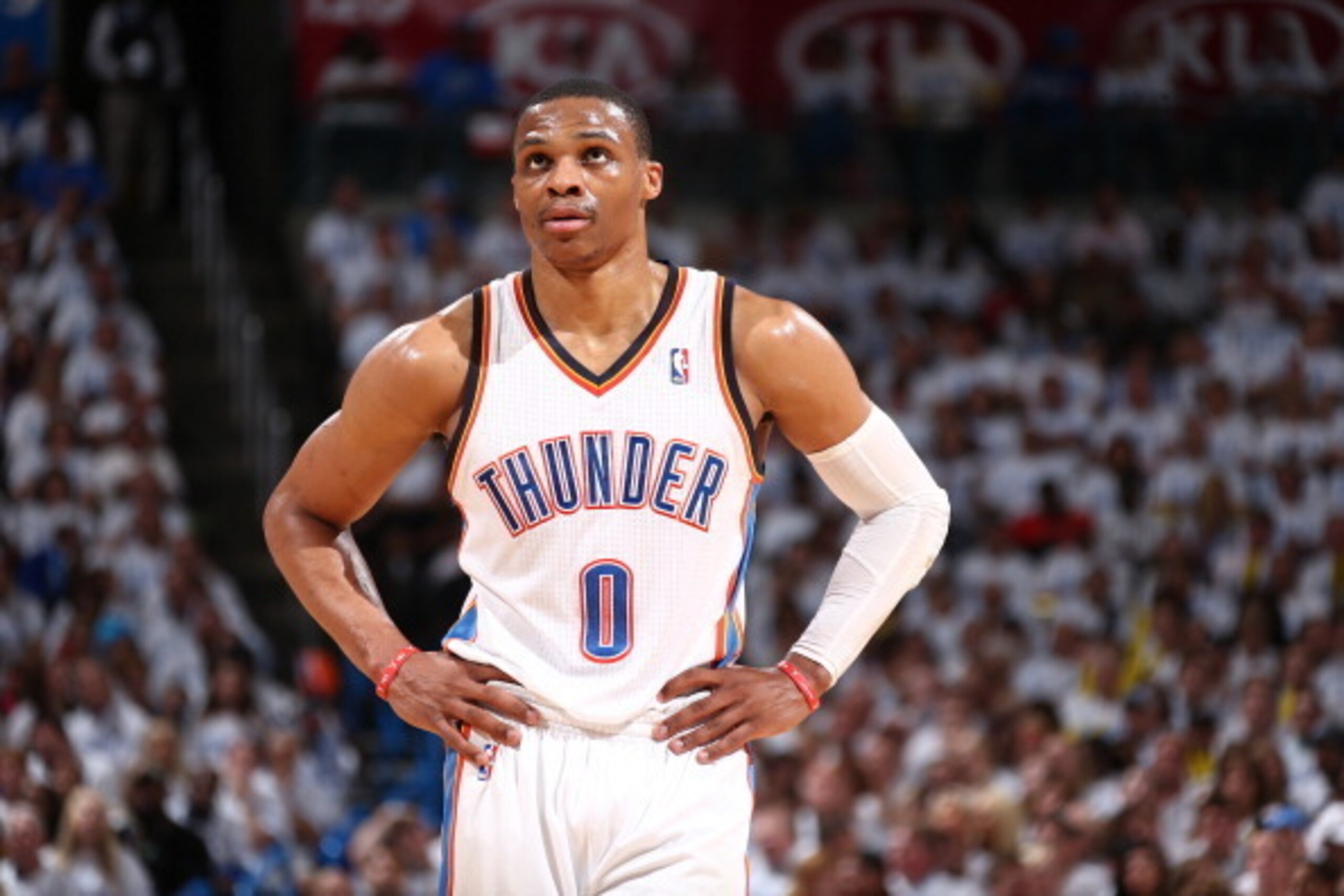
Allotted Playing Time For Next Season: 35 minutes per game
This one was a no-brainer. Russell Westbrook is one of the 10 best players in the NBA and a vital part to the best one-two punch in the league. The only hard decision here was how many minutes to give to an explosive point guard who has had trouble staying healthy in recent years.
Westbrook has logged around 35 minutes per game for most of his career. The exceptions were his rookie year (when he played 32.5 minutes per game) and last season (when he played a career-low 30.7 minutes a night while recovering from knee surgery).
Despite Scott Brooks' desire to become "a better passing team" this season, as he told The Oklahoman's Berry Tramel, Westbrook's role will remain the same. He will be asked to use his immense offensive skills to take some of the scoring load off reigning MVP Kevin Durant.
Westbrook averaged 21.8 points per game in the regular season and 26.7 points a night in the playoffs. Despite his scoring acumen, he can get others involved as well, averaging 6.9 assists per game during his six-year career.
After dealing with a third knee operation last season, the key for Westbrook will be staying healthy. If that means scaling back some of his minutes to keep him fresh for the playoff run, so be it. Championships aren't won in October anyway.
Starting Shooting Guard: Jeremy Lamb
2 of 7
Allotted Playing Time For Next Season: 25 minutes per game
The Thunder can go in a number of directions at shooting guard. If they want to keep a perimeter defender in the lineup after losing Thabo Sefolosha to the Atlanta Hawks, they could opt for Andre Roberson. They could go small with Reggie Jackson or space the floor with veteran shooter Anthony Morrow.
Recently, I wrote that third-year man Jeremy Lamb should be the team's starter at the 2. While he hasn't quite lived up to his potential yet, the 22-year-old made some strides last season. He more than doubled his scoring output from 3.1 points per game as a rookie to 8.5 points as a sophomore.
He improved his accuracy from behind the arc, shooting 35.6 percent from three (as opposed to 30 percent in his first season). While a reasonable case can be made for any of the team's other options, Lamb's upside is worth giving him a serious look as Russell Westbrook's backcourt tag team partner.
The 25 minutes per game is a shade under what Sefolosha was logging last season (26), but still an increase from the 19.7 minutes Lamb was on the floor last season. It also leaves a chunk of playing time for guys like Jackson, Roberson and Morrow to do their things.
Lamb has had his struggles in his first two seasons in the NBA, but perhaps this vote of confidence will give him the motivation he needs to succeed. With his improved outside shot and the ability to create for himself, his presence in the lineup gives the Thunder another versatile weapon.
Starting Small Forward: Kevin Durant
3 of 7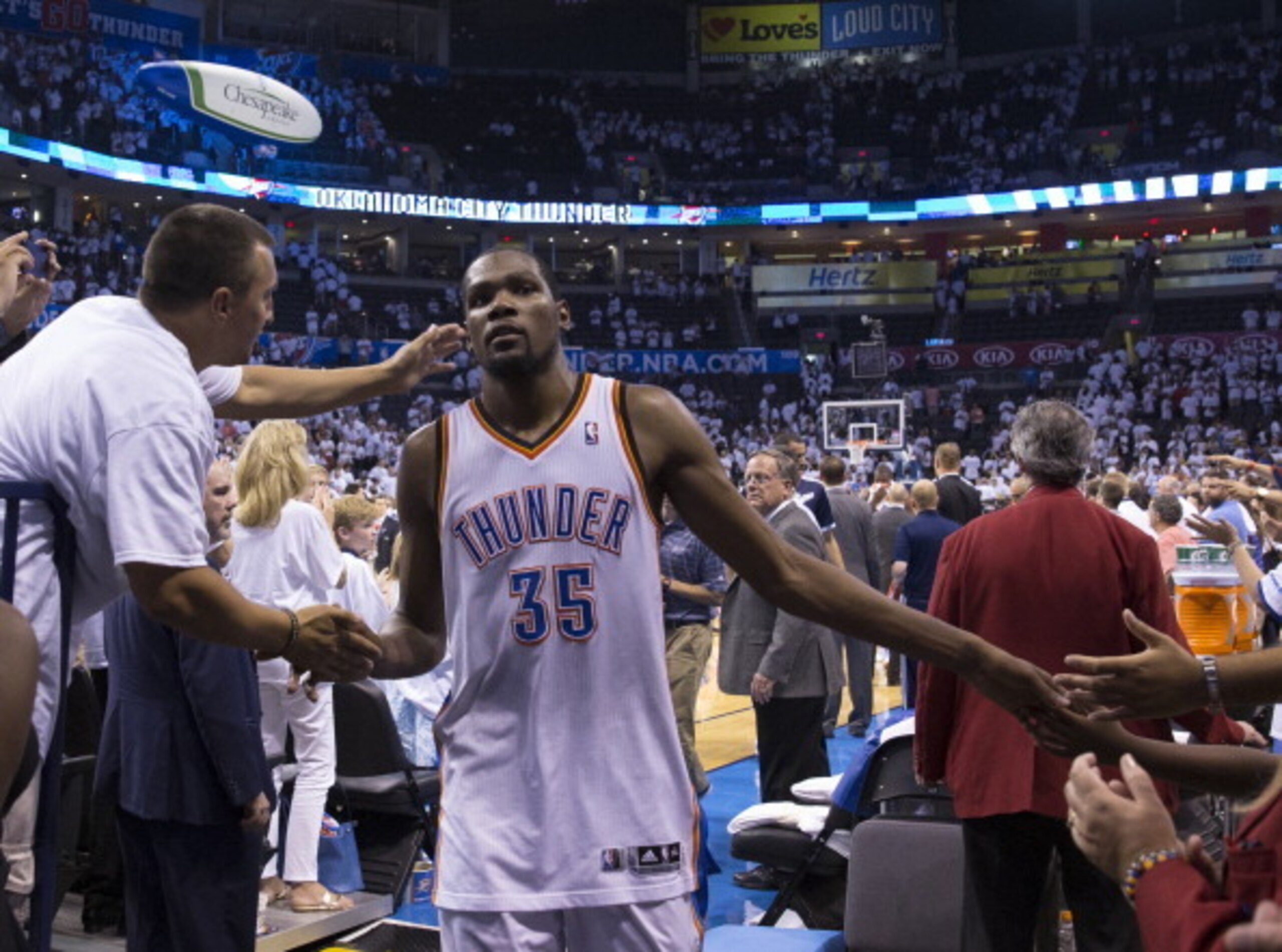
Allotted Playing Time For Next Season: 38 minutes per game
If the Thunder wanted to be selfish, they could play Kevin Durant for the entire 48 minutes every night and see what kind of gaudy offensive numbers he could put up. With KD's well-being in mind and a championship in their sights, the smart move is to give him the 38 minutes a game he's averaged throughout his career.
By now, the book on Durant is well-read. He's the game's best offensive weapon and one of the greatest pure scorers in recent memory. He combines his wiry 6'9" frame with his impressive athleticism and his sniper-like accuracy from long range (39.1 percent from three last season) to create the focal point of the Thunder's attack.
Still, with Durant bowing out of Team USA this summer due to fatigue, the Thunder will take a closer look at their superstar's workload this season and beyond, according to Darnell Mayberry of The Oklahoman.
"As we go forward there’s no question that’s something we want to look at and understand,” Thunder general manager Sam Presti said about Durant’s minutes at the end of the season. “Not only for the long term, but to also make sure we are getting the most out of the minutes that are played during one particular game or another. ... I can’t tell you what comes of it.”
Durant will be just 26 years old on Sept. 29 but, as Mayberry points out, he's logged nearly 21,000 total minutes (regular season and playoffs) in just seven seasons. If the Thunder are going to compete for a title this season or any season, they'll need to keep a close watch on when their star forward needs an occasional breather.


Starting Power Forward: Serge Ibaka
4 of 7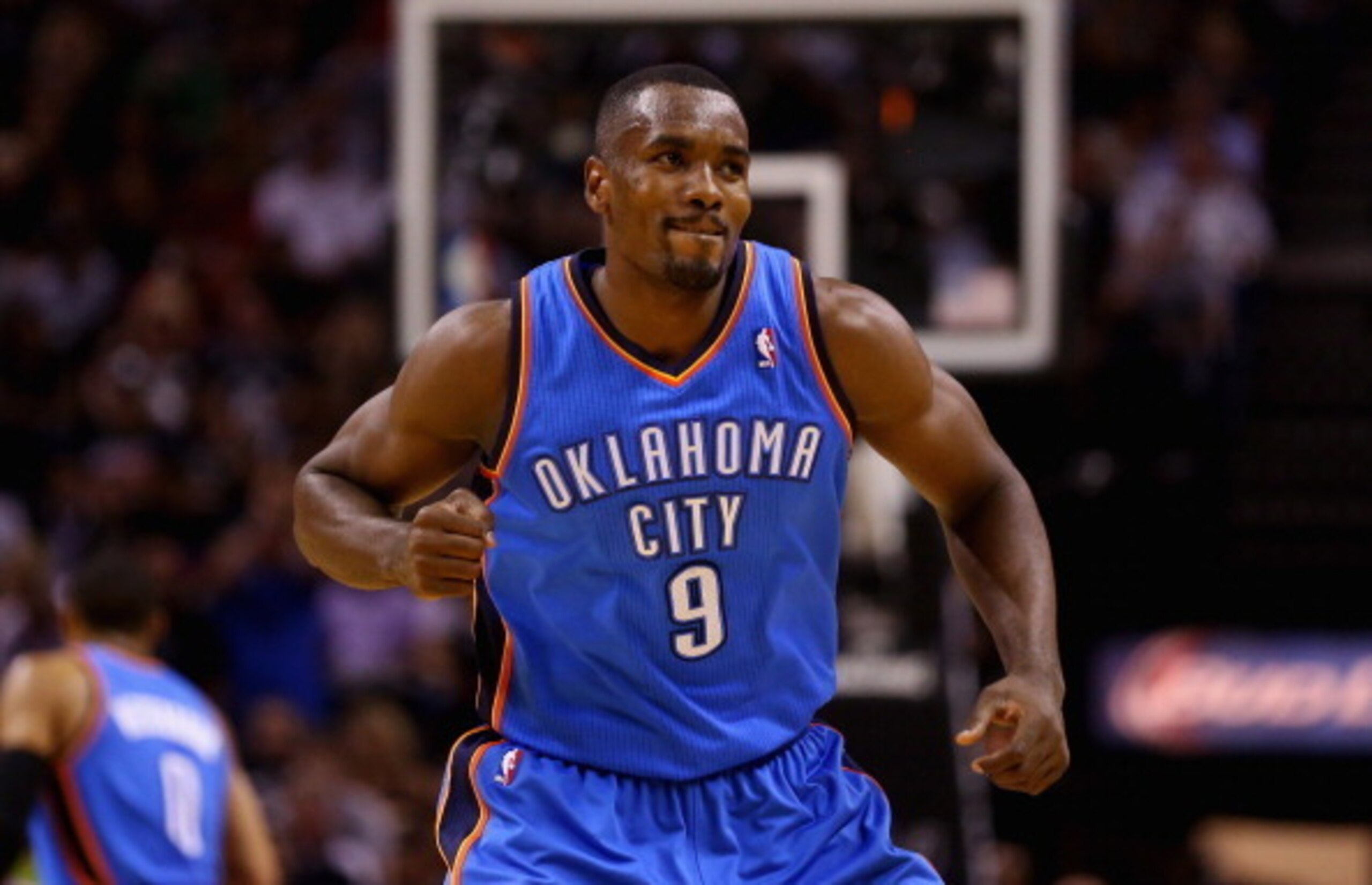
Allotted Minutes For Next Season: 31 minutes per game
Serge Ibaka doesn't get nearly enough credit for being one of the game's best two-way big men. Last season, Ibaka averaged a career-high 15.1 points per game. He also pulled down 8.8 rebounds (another career-high) and blocked 2.7 shots per contest.
Ibaka even displayed the knack for draining an occasional three, converting 38.3 percent of his 60 attempts from behind the arc last season. Despite his improved shooting touch, Ibaka still does the brunt of his offensive work in the paint. In just five seasons, he has emerged as the Thunder's best scoring threat in the post.
However, as with Durant and Westbrook, health is likely to be a concern for the team's de facto third option. Ibaka suffered a calf injury during last year's playoffs that could have sidelined him for the entire postseason. He returned for the conference finals showdown with the San Antonio Spurs but wasn't the same player.
During the summer, Ibaka played for the Spanish team during the FIBA World Cup. He suffered a hamstring injury but still managed to come back a few days later to take on France. Spain was eventually eliminated, and Ibaka now has a couple months to get himself ready for the regular season.
Still, Ibaka should have probably spent the entire offseason resting his sore calf and getting himself prepared for the NBA grind instead of chasing a World Cup title. While neither injury is expected to sideline him for the regular season, it's still something worth watching.
The Thunder have enough young big men to help lighten the load on Ibaka early on. Guys like Perry Jones, Mitch McGary and Nick Collison can step in to help keep Ibaka fresh. Playing non-stop competitive basketball for almost an entire year is bound to take its toll, and the Thunder would be wise to do what it can to keep their star forward upright for when it matters most.
Starting Center: Steven Adams
5 of 7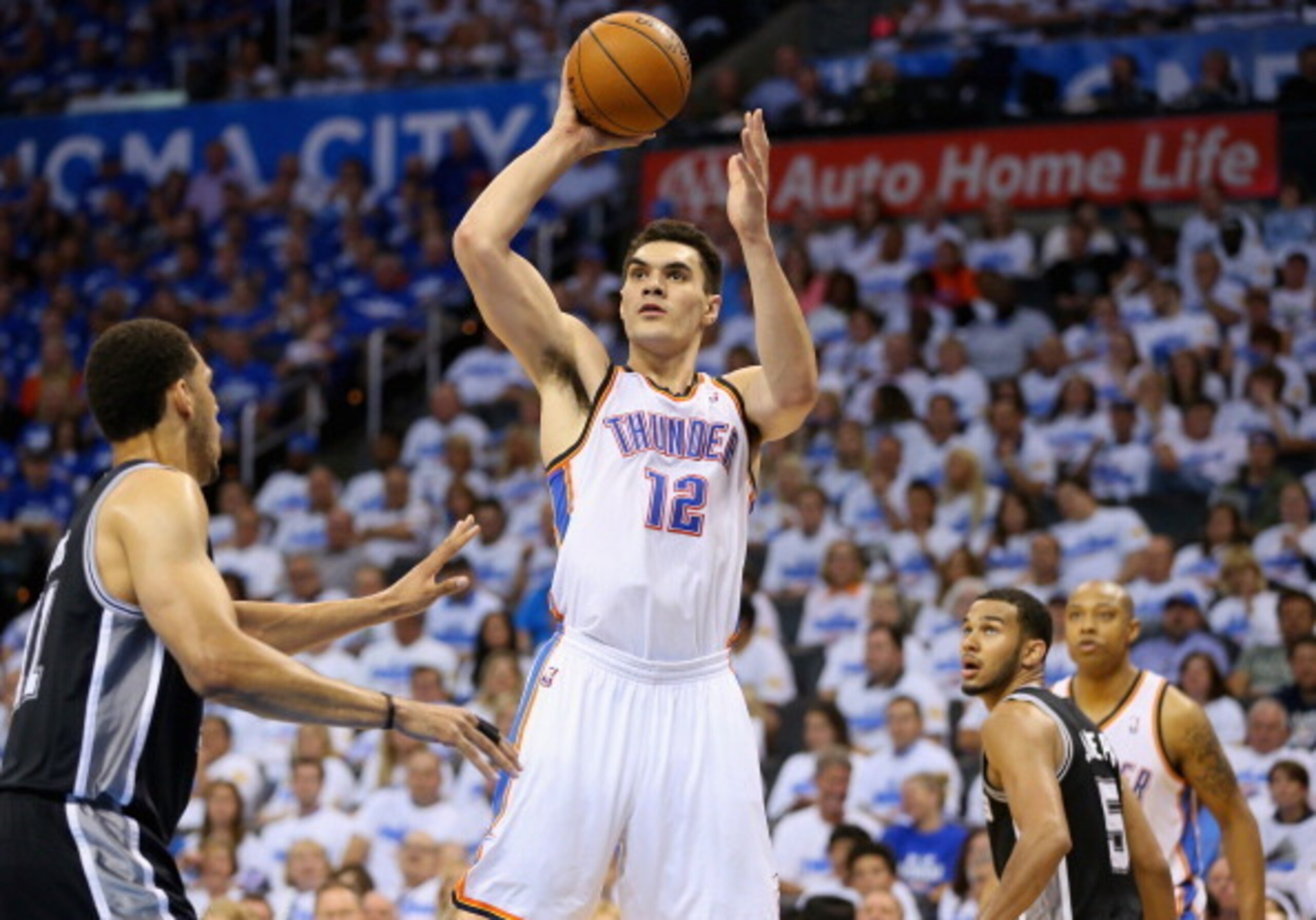
Allotted Playing Time For Next Season: 26 minutes per game
At this point, there isn't a reasonable argument one can make to put declining veteran Kendrick Perkins in the starting lineup over second-year man Steven Adams. While the 21-year-old Adams is still raw, he flashed enough of his potential as a rookie to warrant getting an extended look as the team's starting center.
At the very least, Adams can be a factor defensively and on the boards. He's 7'0" with a 7'5" wingspan and showed his ability as a rim protector in last season's playoffs, averaging 1.3 blocks per game. He also has the toughness and strength to not be bullied around inside.
Offensively, Adams still has a way to go, but that's the least of Oklahoma City's concerns. With so many offensive weapons on the roster, they only need the big man from New Zealand to give them something more than what Perkins has offered up the past few years.
Given what we've seen out of Perk recently, that shouldn't be difficult.
The 26 minutes per game is a nice jump from the 14.8 minutes per game Adams averaged in the regular season as well as the 18.4 minutes he logged in the playoffs. It also gives the Thunder the option of giving their veterans a decent amount of playing time if Adams experiences any growing pains.
By inserting Adams in the lineup, the Thunder should move at a faster pace, as they won't have Perkins slowing them down anymore. As he gets more experience under his belt, Adams should develop into a fine young center.
Key Bench Roles
6 of 7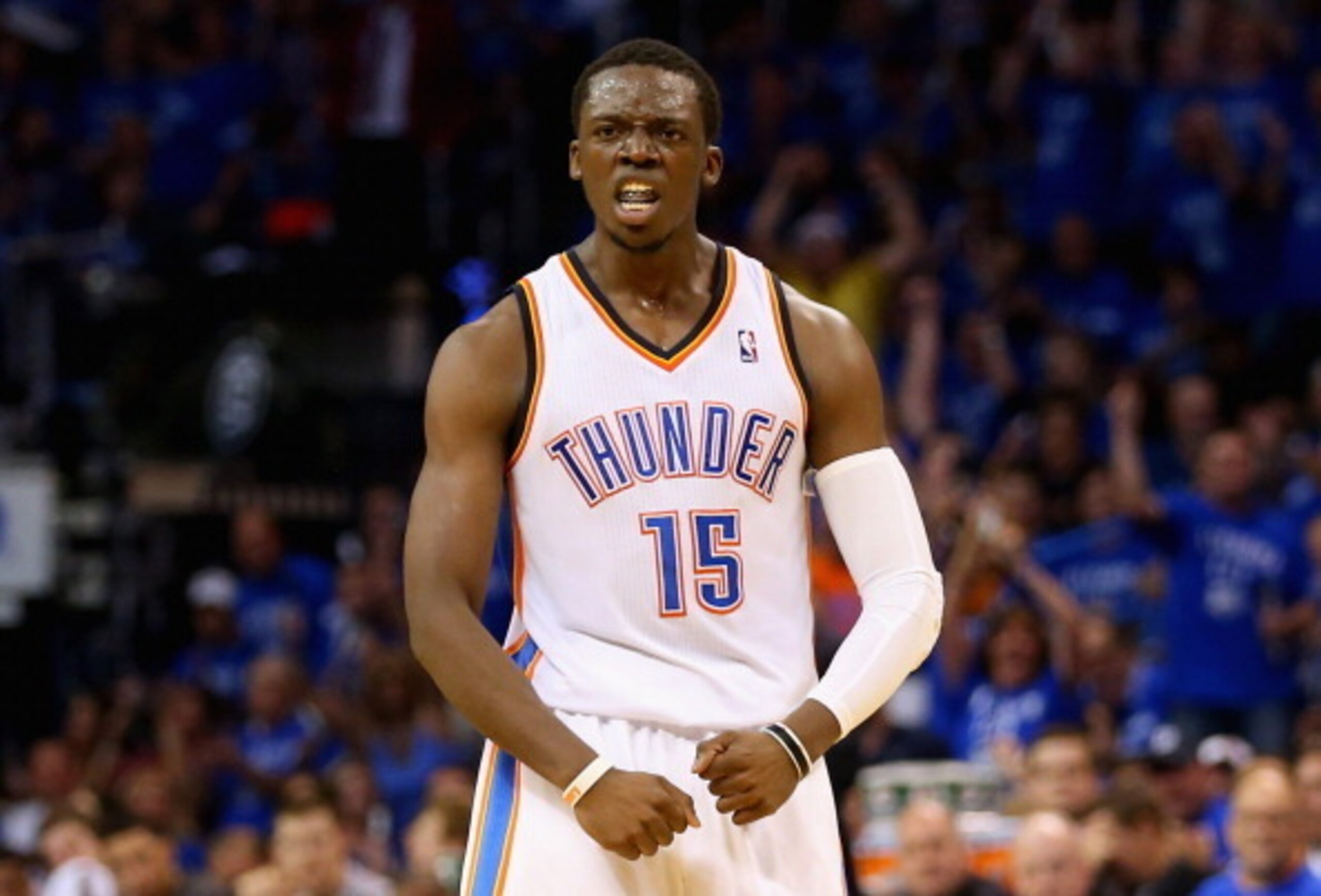
Sixth Man: G Reggie Jackson (23 minutes per game)
With Russell Westbrook and Jeremy Lamb taking up 60 of the combined 96 minutes available in the backcourt, that leaves 36 minutes for the other guards to get some run. As the team's best offensive weapon on the second unit, Reggie Jackson will likely occupy those remaining minutes.
Typically, the league's best sixth men average somewhere around 28-30 minutes per game. For example, last year's Sixth Man of the Year, Jamal Crawford of the Los Angeles Clippers, played 30.1 minutes a game.
However, with so many other guards on the Thunder's bench, Jackson will have to "settle" for around 23 minutes a night. That's a combination of the 13 minutes left for a backup point guard and a portion of the 23 minutes not being used by Lamb.
With Jackson motivated by a forthcoming new contract, he should make the most of his playing time. He's performed well as a key reserve and a spot starter in years past. The case can even be made that he deserves to start alongside Westbrook this season.
Still, with very few proven options on the bench, Jackson would be better served leading the second unit's attack as a playmaking combo guard.
First Big Off The Bench: PF Nick Collison (14 minutes per game)
With Serge Ibaka dealing with an injury-riddled summer and Steven Adams' inexperience, the Thunder could use a seasoned veteran to be their first big man off the bench. While he hasn't been productive for a few years now, Nick Collison still plays with a ton of energy and can provide a little something in the paint.
There are 39 minutes to be had behind Ibaka and Adams. Collison is capable of playing power forward or center, which gives the Thunder a little versatility with which to tinker. The 14 minutes per game is a drop from the 16.7 minutes Collison played last season, but that's to be expected for a guy who will turn 34 in October and has plenty of young guys vying for his spot.
Defensive Stopper: G/F Andre Roberson (12 minutes per game)
In years past, head coach Scott Brooks has used Thabo Sefolosha as his starting shooting guard to give the rotation a defensive presence to go along with their dynamic offensive weapons. Brooks could keep that tradition going by placing Andre Roberson in the starting lineup, but it's hard to justify playing him over guys with more upside like Lamb and Jackson.
Twelve minutes a night is a bump up from the 10 minutes Roberson played last season. If he proves to be a more reliable offensive weapon (1.9 points per game, 15.4 percent from three last year) or if the team has a greater need for a perimeter defender, those minutes could increase.
As of right now, the smarter move would be to give the bulk of the playing time to the more proven options and let Roberson develop. At 6'7", he has the size to guard 2s and 3s in a smaller lineup. That means he can have the bulk of the backup minutes behind Kevin Durant as well as a little bit of time in OKC's crowded backcourt.
The Rest of the Bench
7 of 7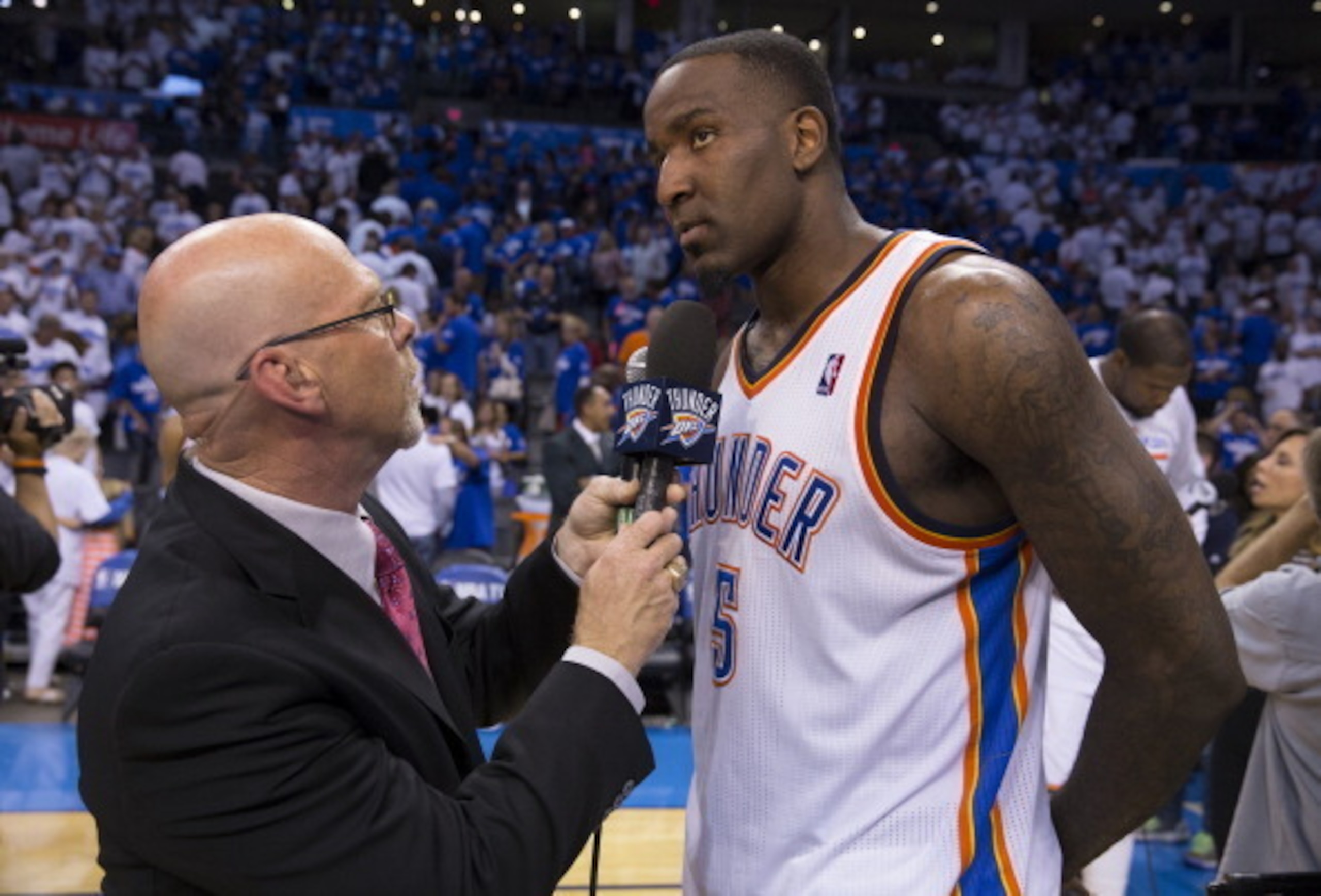
C Kendrick Perkins (13 minutes per game)
Other than his ability to defend in the post, there isn't much of a reason for the Thunder to give Kendrick Perkins significant playing time. He doesn't do much, if anything, offensively. He averaged 3.4 points in 19.5 minutes last season.
His play on the boards has declined as well. He grabbed just 4.9 rebounds per contest. That's a pretty putrid number for a 29-year-old starting center. With Steven Adams and rookie Mitch McGary still developing, Perkins' role is as a buffer until those two get more experience.
Scott Brooks' loyalty to Perkins in recent years has been one of the main reasons for criticism of the Thunder head coach. With the team likely to utilize more proven options in their pursuit of a title, we'll probably see one more lumbering year from the diminished veteran.
SG Anthony Morrow (10 minutes per game)
Much like his situation last year with the New Orleans Pelicans, Anthony Morrow finds himself fighting for playing time in a crowded backcourt. Despite a solid bounce-back year (8.4 points, 45.1 percent from three), Morrow will have to fend off Reggie Jackson, Jeremy Lamb and Andre Roberson for playing time.
As the best shooter of the foursome, he's going to get a decent opportunity to show off his deep stroke. Morrow logged 18.8 minutes per game with the Pelicans last year, most of which came after the team's backcourt was depleted by injury.
The allotted 10 minutes per game may seem a bit small, but it's hard to see where a one-dimensional player will carve out a decent chunk of playing time with so many solid guards on the roster. The Thunder will likely use Morrow to space the floor in specific situations.
F Perry Jones III (8 minutes per game)
Perry Jones' lack of production in the first two seasons of his career is less about talent and more about a lack of opportunity. He's an athletic forward with the shooting touch (36 percent from three last year) to play the 3 and the size (6'11", 235 pounds) to play the 4 as well.
The problem is both of those positions are commandeered by Kevin Durant and Serge Ibaka, two of the best in the game. That makes playing time hard to come by. That will likely be the case this season with guys like Mitch McGary, Nick Collison and Kendrick Perkins all vying for backup playing time.
Still, expect Jones to be in the mix at both forward spots. The eight minutes per game is a drop from the 12.3 he played last year, but that could change once the frontcourt picture gets a little clearer.
F/C Mitch McGary (4 minutes per game)
McGary's rookie season will be more like an apprenticeship. With veterans Collison and Perkins still on the roster, it will be tough for McGary to make his mark. However, both Collison and Perkins are free agents next summer and are long shots to return.
That means McGary can flash his potential in mop-up duty and the D-League while he waits for more time to open up. Given McGary's troubles with his back, that might not be a bad idea for his first year. When healthy, the Michigan man is a bruiser inside and can be a decent source of points and rebounds.
Lastly, point guard Sebastian Telfair might find his way into the rotation. However, with so many other guards and Telfair's inability to play anything beyond the point, he'll need an injury to get anything more than a handful of minutes this season.

.jpg?w=2560 "2 NFL Officials Suspended")
.jpg?w=2560 "Injury-stricken Seahawks signing veteran RB")

.jpg?w=2560 "Mahomes' Wife Trolls Kubiak 💀")